25 May 2026
- 0 Comments
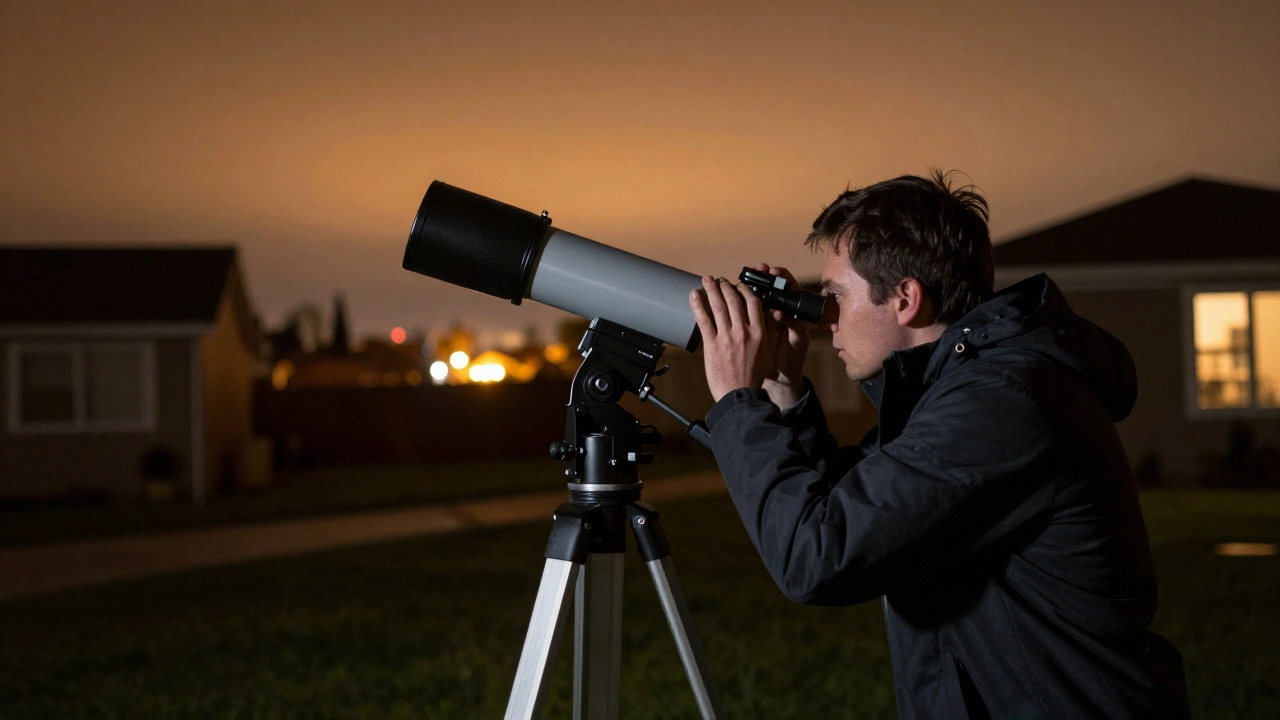
You stand in your backyard, eyes adjusting to the dark. You point your telescope at a patch of sky that looks empty to the naked eye. You know there’s something there-a galaxy, a nebula, a cluster-but what you see depends on two things fighting against each other: how big your telescope is and how bright your sky is.
This is the core tension in amateur astronomy. A massive telescope aperture is the diameter of the primary lens or mirror that collects light can pull faint details out of the darkness, but if you’re sitting under the orange glow of city streetlights, that extra glass might just be collecting more noise. On the flip side, a small scope can deliver stunning views if you’re far enough from civilization. Understanding this tradeoff isn’t just about gear lust; it’s about setting realistic expectations so you don’t end up frustrated when M31 doesn’t look like the Hubble photos.
The Light Bucket: Why Aperture Matters
Think of your telescope as a light bucket. The wider the bucket (the larger the aperture), the more raindrops (photons) you catch. In deep-sky observing, we are dealing with objects that are incredibly dim per square arcsecond. A galaxy millions of light-years away spreads its light over a large area. To see it, you need to gather enough photons to trigger the rod cells in your retina.
An 8-inch Newtonian reflector is a popular type of telescope using a concave mirror and flat diagonal mirror gathers four times more light than a 4-inch refractor. That sounds like a huge win, right? It is, but only if the signal you’re catching is stronger than the background noise. If your sky background is bright due to light pollution, that extra aperture is also gathering more of that unwanted glow. This reduces contrast. Suddenly, that fuzzy smudge of Andromeda looks bigger, but not necessarily sharper or more detailed. It just becomes a brighter, lower-contrast blob.
Here is the rule of thumb: Aperture reveals detail and surface brightness *only* up to the limit of your sky quality. Beyond that, you are just making the background brighter along with the object.
The Bortle Scale: Measuring Your Sky’s Noise
To understand what you can actually see, you need to know where you sit on the Bortle Dark-Sky Scale is a nine-point numeric scale that measures the night sky brightness. Created by John Bortle, this scale ranges from Class 1 (pristine natural darkness) to Class 9 (inner-city sky). Most suburban observers live between Class 5 and Class 7.
| Class | Sky Description | Zenith Limiting Magnitude | Visible Milky Way? |
|---|---|---|---|
| 1 | Pristine Natural Darkness | 7.6-8.0 | Yes, casts shadows |
| 4 | Rural/Suburban Transition | 6.3-6.5 | Faintly visible near zenith |
| 6 | Suburban Sky | 5.7-6.0 | No, only zodiacal light |
| 8 | Urban/Suburban Transition | 4.5-5.0 | No |
If you are on a Class 6 sky, which is common for many people living outside major metro centers, the Milky Way is essentially gone. The zodiacal light (that faint cone of sunlight scattered by dust) is invisible. This means your "noise floor" is high. Your eyes have to work harder to distinguish an object from the sky background. This is where the aperture tradeoff gets tricky. A 10-inch Dobsonian will show you more galaxies than a 4-inch refractor, but the difference won’t be as dramatic as it would be on a Class 2 sky.
Target Selection: Matching Objects to Your Site
The biggest mistake new observers make is trying to see everything everywhere. They read about the Ring Nebula (M57) or the Orion Nebula (M42) and assume they should look similar from their driveway. They don’t. You need to curate your target list based on your specific combination of aperture and Bortle class.
For High-Light-Pollution Sites (Bortle 7-9): Focus on compact, high-surface-brightness objects. These are objects that pack their light into a small area.
- Planetary Nebulae: M57 (Ring Nebula), M27 (Dumbbell Nebula), and NGC 6826 (Link Nebula). These often appear as sharp, star-like disks even in smaller scopes because their central regions are bright.
- Globular Clusters: M13 (Hercules Cluster), M3, and M5. While their outer stars fade quickly in light pollution, the dense cores remain visible and impressive. A 6-inch scope can resolve thousands of stars in M13 even from a suburb.
- Bright Open Clusters: The Pleiades (M45), Beehive Cluster (M44), and Double Cluster in Perseus. These are large but contain very bright individual stars that punch through the skyglow.
For Moderate-Light-Pollution Sites (Bortle 4-6): You can start adding extended, low-surface-brightness objects to your list.
- Large Galaxies: M31 (Andromeda) and M33 (Triangulum Galaxy). From a Class 6 sky, M31 looks like a large, diffuse cloud. M33 is much harder and may require averted vision techniques.
- Emission Nebulae: M42 (Orion) and M41. These are bright enough to show structure. You might see hints of color if you use an OIII or UHC filter, which blocks the sodium vapor light from streetlamps.
- Dwarf Galaxies: The Large and Small Magellanic Clouds are visible from southern latitudes even in moderate light pollution, appearing as fuzzy patches.
For Dark-Sky Sites (Bortle 1-3): Now you can chase the faint stuff. This is where large apertures truly shine.
- Faint Galaxies: The Virgo Cluster galaxies (M87, M86, M49). These are numerous and vary in brightness. With a 10-inch+ scope, you can trace spiral arms in some cases.
- Dark Nebulae: The Horsehead Nebula (IC 434) and the Coal Sack. These are visible by contrast against the bright emission nebula behind them. They disappear completely in light-polluted skies.
- Galaxy Groups: The Pinwheel Galaxy (M101) shows intricate spiral structure. The Whirlpool Galaxy (M51) and its companion NGC 5195 become distinct entities rather than a single blur.
The Filter Advantage: Cheating the Tradeoff
If you feel stuck between wanting a larger aperture and being stuck in a light-polluted area, filters are your best friend. Narrowband filters, such as UHC (Ultra High Contrast) or OIII (Oxygen III), work by blocking specific wavelengths of light emitted by mercury and sodium streetlights while allowing the light from emission nebulae to pass through.
Using a UHC filter on a Class 7 sky can effectively drop your perceived sky brightness to a Class 5 or 6 level for emission nebulae. This means you can get better views of M42 or the Lagoon Nebula (M8) with a modest 4-inch refractor than you might with an unfiltered 8-inch scope. However, filters do nothing for galaxies, which emit broadband light across the spectrum. For galaxies, you really do need either darker skies or more aperture.
Practical Strategy: The "Sweetspot" Approach
Don’t try to fight physics. Instead, find your sweetspot. If you live in a suburban area (Bortle 6), buying a 16-inch Dobsonian might seem like the ultimate upgrade. But consider this: a 16-inch scope is heavy, hard to transport, and takes a long time to cool down. Is it worth the hassle if your sky background limits your view of faint galaxies anyway?
Often, a mid-sized scope (6-8 inches) paired with good filters and a well-curated target list provides a better experience. You spend less time wrestling with gear and more time looking at objects that are actually visible. Save the mega-aperture for when you drive three hours to a dark site. On those trips, that 16-inch scope will reveal galaxies that were previously invisible, because the sky background noise is finally low enough to let the aperture do its job.
Start by identifying your Bortle class. There are apps like Light Pollution Map or Dark Site Finder that can give you a rough estimate. Then, pick five targets that match your class and aperture. Stick to them for a month. Learn their shapes, their colors, and how they change with different eyepieces. Once you’ve mastered those, expand your list. This approach keeps astronomy fun and rewarding, rather than a frustrating quest for perfection.
What is the best telescope aperture for suburban viewing?
For most suburban areas (Bortle 5-7), a telescope with an aperture between 6 and 8 inches offers the best balance. Smaller scopes lack the light-gathering power to resolve globular clusters well, while larger scopes become cumbersome and offer diminishing returns due to skyglow reducing contrast. An 8-inch Dobsonian is often considered the "sweet spot" for value and performance in these conditions.
Can I see galaxies from a city center?
It is extremely difficult to see galaxies from a city center (Bortle 8-9). The only exception is the Andromeda Galaxy (M31), which is large and bright enough to appear as a faint, diffuse smudge even in urban skies. Other galaxies, like Triangulum (M33) or the Pinwheel (M101), typically vanish completely due to the high background sky brightness washing out their low surface brightness.
Do light pollution filters help with all deep-sky objects?
No, light pollution filters primarily help with emission nebulae, such as the Orion Nebula or the Lagoon Nebula. They block artificial light wavelengths while passing the specific wavelengths emitted by ionized gas in these nebulae. They do not significantly improve views of galaxies, globular clusters, or open clusters, which emit broad-spectrum light similar to stars.
How does aperture affect surface brightness?
Telescope aperture increases the total amount of light collected from an object, but it does not increase the surface brightness of extended objects like nebulae or galaxies compared to the naked eye. In fact, higher magnification spreads that light over a larger area in your eye, making the object appear dimmer per unit area. Larger apertures allow you to use higher magnifications without losing too much brightness, revealing finer structural details that smaller scopes cannot resolve.
What is the difference between visual observing and astrophotography regarding light pollution?
Visual observing is limited by the human eye's inability to integrate light over time. You see what hits your retina in real-time. Astrophotography allows cameras to stack hundreds or thousands of images, integrating light over hours. This means photographers can capture faint details in light-polluted skies that are impossible to see visually, provided they use narrowband filters and post-processing techniques to subtract the skyglow gradient.