31 May 2026
- 0 Comments
Have you ever bought an eyepiece promising a massive true field of view, only to look through the telescope and realize the sky looks just as narrow as your old gear? You aren't imagining things. The marketing numbers on the box often tell a different story than what your eye actually sees. The disconnect usually comes down to one specific piece of glass inside the eyepiece: the field stop.
To get accurate results, you need to move beyond the rough estimates provided by simple formulas. We are going to break down the exact math behind converting Apparent Field of View (AFOV) to True Field of View (TFOV). By understanding the physical limits of your equipment, you can calculate exactly how much sky fits in your eyepiece before you even point the telescope at the stars.
The Anatomy of the View: What Is a Field Stop?
Before we touch a calculator, we need to understand the hardware. Inside every astronomical eyepiece, there is a hard physical limit to how wide the image can be. This is the Field Stopa metal ring or edge inside the eyepiece that defines the maximum diameter of the visible image circle. Think of it like the rim of a bucket. No matter how much water you pour in, it won't hold more than the bucket's width allows.
In optical terms, the field stop determines the maximum apparent field of view for a given focal length. If you try to design an eyepiece with a wider angle than the field stop allows, the edges will go black-a phenomenon known as vignetting. Most manufacturers measure the inner diameter of this ring in millimeters. This number is the golden key to accurate TFOV calculations. Without it, you are guessing.
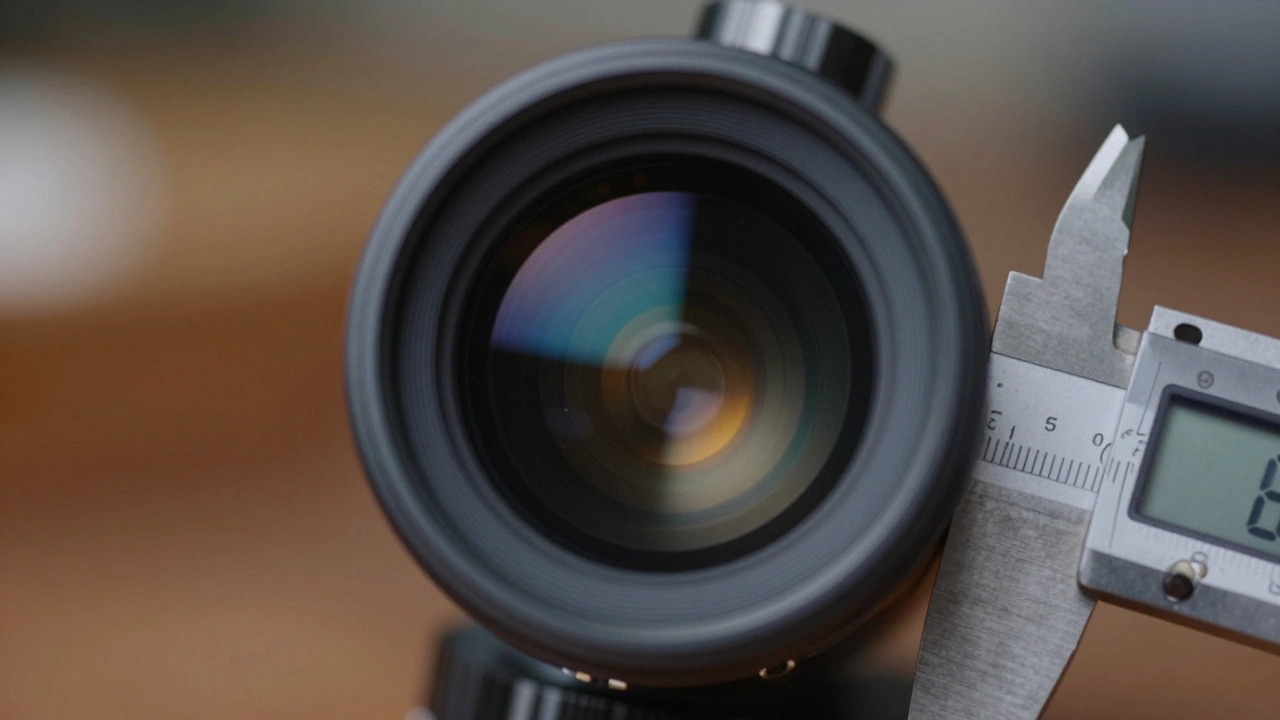
You can find the field stop size in two ways. First, check the manufacturer's specifications. High-end brands like Tele Vue, Explore Scientific, and Baader often publish these values because serious astronomers demand precision. Second, if the data isn't listed, you can measure it yourself. Remove the eyepiece from the telescope and look straight into the front lens. Use calipers to measure the dark ring you see in the center. That measurement, in millimeters, is your field stop diameter.
The Two Formulas: Why One Fails and One Succeeds
There are two common ways people calculate the True Field of View. One is a quick approximation, and the other is the precise method based on physics. Knowing when to use which saves you from frustration.
The first method is the Magnification FormulaA calculation derived from dividing the apparent field of view by the telescope's magnification. It looks like this:
- Calculate Magnification: Telescope Focal Length / Eyepiece Focal Length = Magnification
- Calculate TFOV: Apparent Field of View (AFOV) / Magnification = True Field of View
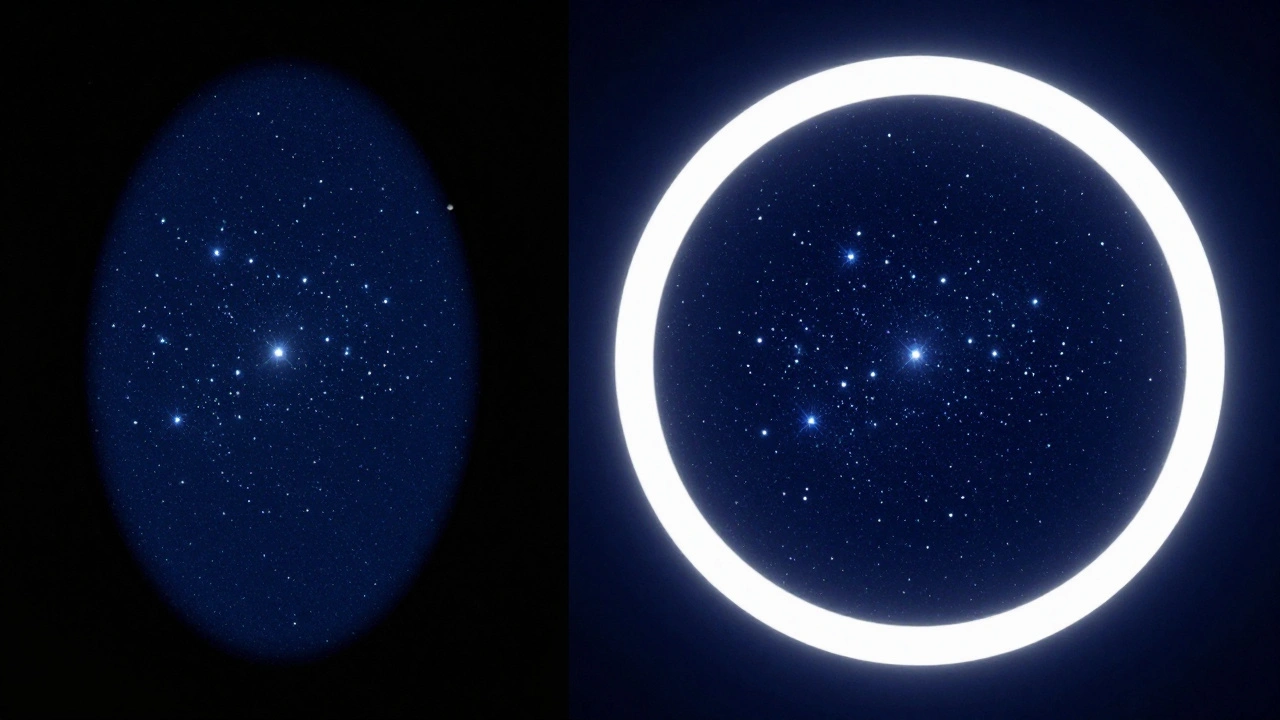
This works reasonably well for standard eyepieces with an AFOV of around 50 degrees. However, it starts to fail dramatically as the AFOV increases. Why? Because trigonometry doesn't work linearly at wide angles. As the field gets wider, the "edge" of the view stretches further than the simple division suggests. For an eyepiece with a 100-degree AFOV, this formula can underestimate the true field by up to 10-15%. That’s a significant difference when you are trying to frame a large nebula.
The second method is the Field Stop FormulaThe most accurate way to calculate true field of view using the physical diameter of the eyepiece's field stop. This is the gold standard. It bypasses the marketing claims about AFOV entirely and relies on the physical geometry of the light cone.
The formula is:
TFOV = (Field Stop Diameter in mm / Telescope Focal Length in mm) * 57.3
Where does 57.3 come from? It is the conversion factor from radians to degrees (specifically, 180 divided by Pi). This formula assumes the telescope projects a flat image onto the field stop, which is accurate enough for almost all amateur setups. It is immune to the distortions that plague the magnification formula at wide angles.
Step-by-Step Calculation Guide
Let’s put this into practice with a real-world scenario. Imagine you have a popular Newtonian reflector with a focal length of 1200mm. You want to know the true field of view for two different eyepieces: a classic Plossl and a modern wide-field Nagler-style optic.
Scenario A: The Classic Plossl
- Eyepiece Focal Length: 25mm
- Stated AFOV: 52 degrees
- Measured Field Stop: 20mm (typical for this class)
Using the Field Stop Formula:
(20 / 1200) * 57.3 = 0.955 degrees.
Now, let’s check the Magnification Formula for comparison:
Magnification = 1200 / 25 = 48x.
TFOV = 52 / 48 = 1.08 degrees.
See the difference? The magnification formula overestimates the field here because the AFOV is slightly wider than the traditional 50-degree baseline. But wait, in some contexts, the error goes the other way depending on the specific lens design aberrations. The field stop method gives you the hard physical limit. In this case, the discrepancy highlights why relying on stated AFOV can be risky if the lens design has slight variations.
Scenario B: The Ultra-Wide Angle
- Eyepiece Focal Length: 14mm
- Stated AFOV: 100 degrees
- Measured Field Stop: 27mm
Using the Field Stop Formula:
(27 / 1200) * 57.3 = 1.29 degrees.
Using the Magnification Formula:
Magnification = 1200 / 14 = 85.7x.
TFOV = 100 / 85.7 = 1.16 degrees.
Here, the magnification formula underestimates the field. The wide-angle optics stretch the image, making the actual view wider than the simple division predicts. If you were planning to fit the Pleiades star cluster (which spans about 1.1 degrees) in your view, the magnification formula might make you think it’s too tight, while the field stop formula confirms it will fit comfortably.
Comparison of Calculation Methods
| Feature | Field Stop Formula | Magnification Formula |
|---|---|---|
| Accuracy | High (Physical limit) | Low to Medium (Approximation) |
| Data Required | Field Stop Diameter (mm), Scope FL | AFOV (degrees), Scope FL, EP FL |
| Wide-Angle Performance | Excellent (>80° AFOV) | Poor (Errors increase with width) |
| Vignetting Impact | Accounts for physical cutoff | Ignores mechanical vignetting |
| Best Use Case | Precise framing, astrophotography alignment | Quick mental estimates for narrow fields |
Hidden Variables: Vignetting and Barlow Lenses
Even with perfect math, reality can interfere. The biggest culprit is vignetting. This happens when the light cone from the telescope is blocked before it reaches the field stop. This is common in fast telescopes (low f-ratio, like f/4 or f/5) paired with long-eye-relief eyepieces. The barrel of the eyepiece or the internal baffles of the focuser might clip the outer edges of the light beam.
If your telescope is fast, the calculated TFOV might be larger than what you actually see. The edges will appear darkened or black. To fix this, you may need to use a Barlow lens. A 2x Barlow lens doubles the effective focal length of your telescope. This narrows the light cone, reducing vignetting, but it also halves your True Field of View.
When adding a Barlow, simply multiply your telescope's focal length by the Barlow factor before plugging it into the Field Stop Formula. For example, if your scope is 1200mm and you add a 2x Barlow, your new effective focal length is 2400mm. Recalculate the TFOV using this new number. This ensures your expectations match the narrower, sharper view you will get.
Practical Application: Framing Deep Sky Objects
Why does this math matter? Because deep-sky objects have fixed sizes. The Orion Nebula is roughly 1 degree across. The Andromeda Galaxy is about 3 degrees long. If you calculate your TFOV incorrectly, you might choose an eyepiece that cuts off the wings of a galaxy or leaves too much empty space around a star cluster.
Pro tip: Always aim for a TFOV that is 10-20% larger than the object you want to frame. This gives you room to maneuver and account for slight misalignments in your finder scope. If the Orion Nebula is 1 degree, look for an eyepiece setup that yields a TFOV of at least 1.2 degrees. Using the field stop formula, you can quickly test different eyepieces against your telescope's specs to find the perfect match without spending hours trial-and-error at the eyepiece.
Frequently Asked Questions
How do I find the field stop diameter if the manufacturer didn't list it?
You can measure it physically using digital calipers. Look into the front lens of the eyepiece and measure the inner diameter of the dark ring you see in the center. Alternatively, you can estimate it by multiplying the eyepiece focal length by the tangent of half the apparent field of view, though direct measurement is far more accurate.
Why is my calculated TFOV different from what I see through the telescope?
Discrepancies are usually caused by vignetting, especially in fast telescopes (low f-ratio). Mechanical obstructions like the focuser drawtube or eyepiece barrel can block the outer edges of the light cone, effectively shrinking the usable field. Another cause is incorrect AFOV assumptions if you used the magnification formula instead of the field stop formula.
Does the 57.3 constant change for different telescopes?
No, 57.3 is a mathematical constant derived from converting radians to degrees (180/Pi). It applies to all telescopes and eyepieces regardless of type. It represents the number of degrees in one radian of arc.
Can I use the magnification formula for wide-field eyepieces?
It is not recommended. The magnification formula (AFOV / Mag) becomes increasingly inaccurate as the apparent field of view exceeds 60 degrees. For eyepieces with 80-degree, 100-degree, or 110-degree AFOVs, the error can be significant. Always use the field stop formula for wide-field optics to ensure accuracy.
How does a Barlow lens affect True Field of View calculations?
A Barlow lens increases the effective focal length of your telescope. If you use a 2x Barlow, double your telescope's focal length in the calculation. Since TFOV is inversely proportional to focal length, doubling the focal length will halve the True Field of View. Remember to update the focal length variable in the formula before calculating.
What is the difference between Apparent Field of View and True Field of View?
Apparent Field of View (AFOV) is the angular width of the view as seen through the eyepiece alone, independent of the telescope. True Field of View (TFOV) is the actual angular width of the sky visible when the eyepiece is attached to the telescope. TFOV depends on both the eyepiece and the telescope's focal length.