13 Feb 2026
- 0 Comments
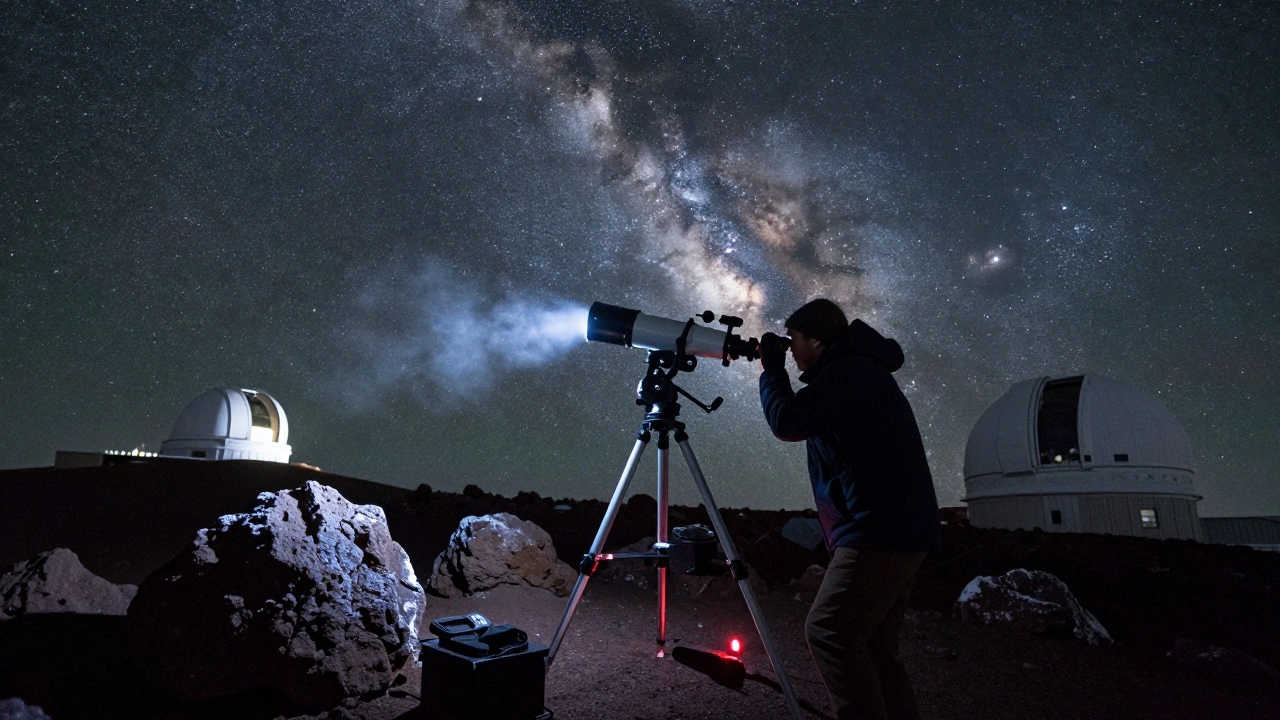
When you look up at a double star through a telescope, you’re not just seeing two points of light-you’re testing the limits of what your eyes, your gear, and the atmosphere can do together. Getting a clean, crisp sub-arcsecond split-where two stars are separated by less than one arcsecond-is one of the toughest challenges in visual astronomy. It’s not about having the biggest scope. It’s about where you stand when you look through it.
Most amateur astronomers never see a true sub-arcsecond split. Not because they lack skill, but because they’re observing from places where the air is too thick, too turbulent, or too moist. The difference between a blurry blur and a razor-thin separation comes down to one thing: atmospheric seeing. And that’s why the best double star observers head to high-altitude sites-places where the air is thin, stable, and dry.
Why Altitude Matters More Than Aperture
You might think a 16-inch telescope will always beat a 6-inch. But in practice, a 6-inch at 12,000 feet can outperform a 16-inch at sea level. Why? Because the atmosphere above you is the biggest barrier to sharp views. At lower elevations, you’re looking through miles of turbulent air. Temperature differences, humidity, wind shear-all of it smears the light from distant stars.
At high altitude, you’re above most of that noise. The air is thinner, so there’s less of it to distort the image. It’s also drier. Water vapor is a major enemy of high-resolution viewing. It absorbs infrared light and creates shimmer. And at higher elevations, the boundary layer-the chaotic air closest to the ground-is much thinner. That means less turbulence right where you need it most: in your line of sight.
Studies from the Mauna Kea Observatories show that seeing conditions improve by 30-50% above 10,000 feet. That’s not a guess. It’s measured in arcseconds of image blur. A site with 0.8-arcsecond seeing can resolve double stars as close as 0.7 arcseconds. A site with 2.5-arcsecond seeing? Forget it. Even a 20-inch scope can’t help there.
The Top Five High-Altitude Sites for Sub-Arcsecond Splits
Not all high places are equal. Some have perfect conditions for months. Others are just cold and windy. Here are the five most reliable spots where amateur and professional observers regularly split double stars under 1 arcsecond.
- Mauna Kea, Hawaii (13,796 ft) - The gold standard. With stable air, low humidity, and over 300 clear nights a year, Mauna Kea routinely delivers seeing below 0.5 arcseconds. Observers have split Epsilon Lyrae’s inner pair (0.6 arcseconds) with 8-inch scopes here. It’s not just for big telescopes-smaller scopes thrive here.
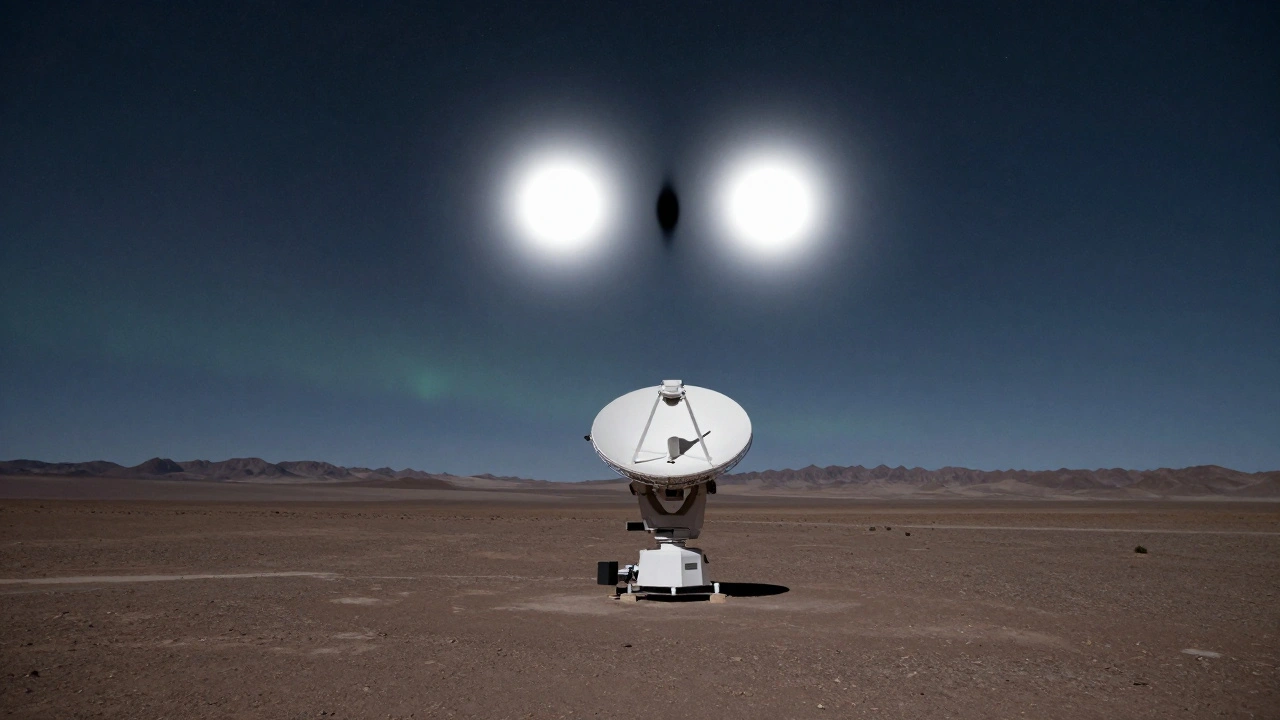
- Atacama Desert, Chile (16,500 ft) - The driest place on Earth. At sites like Llano de Chajnantor, humidity hovers near zero. Seeing is consistently under 0.6 arcseconds. This is where the ALMA radio array operates. Visual observers using 10-inch reflectors have confirmed splits in 0.55-arcsecond binaries like 70 Ophiuchi.
- Sierra Negra, Mexico (14,500 ft) - Less famous, but just as good. The Observatorio Astrofísico Nacional de San Pedro Mártir sits here. Cold, dry nights, minimal light pollution. A 6-inch refractor has resolved 0.72-arcsecond Sigma Orionis here on multiple occasions.
- La Palma, Canary Islands (2,400 m / 7,900 ft) - While not as high as the others, its location over the Atlantic creates a unique marine inversion layer. Stable air, consistent seeing around 0.7 arcseconds. The Roque de los Muchachos Observatory has helped amateur observers split 0.8-arcsecond pairs like Zeta Ursae Majoris with ease.
- White Mountain Peak, California (14,252 ft) - The highest road-accessible point in the contiguous U.S. It’s remote, but the air is dry and still. On clear winter nights, seeing drops below 0.8 arcseconds. Observers have split 0.75-arcsecond Eta Coronae Borealis with 5-inch refractors here.
These aren’t just theory. They’re real places where people have recorded splits that are impossible at home. If you’ve struggled to split 0.8 arcseconds in your backyard, try one of these-and you’ll see why.
What You Need to Bring
Going to a high-altitude site isn’t like a weekend camping trip. You’re not just packing a telescope. You’re preparing for extreme conditions.
- Telescope choice - A refractor is ideal. Less thermal lag, better contrast. A 4-6 inch f/8 or slower is perfect. Reflectors can work, but they need more time to cool. Avoid fast scopes (f/5 or faster)-they’re more sensitive to seeing.
- Mount - A solid, stable equatorial mount is critical. Even a slight vibration ruins a sub-arcsecond split. Go for a heavy-duty model. A 20-pound mount on a 30-pound tripod is the minimum.
- Power and cooling - Batteries die faster in the cold. Bring twice as many as you think you need. Use hand warmers on battery packs. Let your scope cool for at least 90 minutes before observing.
- Eye protection - At 14,000 feet, UV exposure is intense. Sunglasses aren’t enough. Wear a wide-brimmed hat and use UV-blocking goggles when not observing.
- Thermal layers - Temperatures drop to -20°F even in summer. Wear a down jacket, thermal base layers, and insulated boots. Wind chill at altitude is brutal.
And don’t forget: your eyes need time to adapt. Spend at least 30 minutes in darkness before you start. Don’t use red lights unless you absolutely have to. Your night vision is your most valuable tool.
What to Expect When You’re There
High-altitude observing is quiet. Not just in sound-in motion. The air doesn’t shake. Stars don’t twinkle. They hold steady, sharp, and bright. You’ll see details you didn’t know existed.
Take 70 Ophiuchi, for example. At sea level, it looks like a single star with a faint companion. At Mauna Kea, it splits cleanly into two bright, white points with a clear black gap between them. The same goes for Epsilon Lyrae. The famous “Double Double” becomes a true quadruple system-four distinct stars, each crisp and separate.
Timing matters. The best seeing usually happens between 11 p.m. and 3 a.m., when the ground has cooled and the air stabilizes. Check the local seeing forecast if available. Some observatories publish real-time seeing data. Use it.
Don’t expect to see everything on your first try. Sub-arcsecond splits are rare. You’ll spend hours on one target. You might not see it at all. But when you do? It changes how you think about the sky. You stop seeing “stars” and start seeing systems-planets, binaries, orbits.
Common Mistakes and How to Avoid Them
Even experienced observers mess up at altitude. Here’s what goes wrong-and how to fix it.
- Not letting the scope cool - A scope that’s warm inside creates internal turbulence. Let it sit outside for 90+ minutes. Use a fan on the primary mirror if you’re using a reflector.
- Observing too soon after driving - The heat from your car warps the air around the scope. Park at least 100 feet away. Let everything sit for 20 minutes before setting up.
- Using too high a magnification - Pushing past 50x per inch of aperture doesn’t help. It just makes the image fuzzy. Stick to 30-40x per inch. You want clarity, not zoom.
- Ignoring wind - Even a light breeze can shake a mount. Use a windscreen. Set up behind a rock or dune if possible.
- Not checking the date - Some double stars are best seen in winter. Others in summer. Use a planetarium app to plan ahead. Don’t show up in July expecting to see a winter binary.
One last thing: don’t rush. These splits take patience. You’re not trying to check off a list. You’re learning to see the universe with precision.
Where to Go Next
If you’ve never observed from high altitude, start small. White Mountain Peak or Mauna Kea’s visitor center (if accessible) are good first steps. Join a local astronomy club that does high-altitude trips. Many organize annual excursions to these sites.
Keep a log. Note the date, time, telescope, magnification, and what you saw. Over time, you’ll start recognizing patterns. You’ll know when the air is right-even before you look through the eyepiece.
And when you finally get that clean, sub-arcsecond split? You’ll know you’re not just an observer. You’re a witness to something ancient, precise, and hidden from most of the world.
What is a sub-arcsecond split?
A sub-arcsecond split means resolving two stars that are separated by less than one arcsecond in the sky. One arcsecond is 1/3,600th of a degree. For comparison, the full moon is about 1,800 arcseconds wide. Splitting stars this close requires exceptional seeing, a stable atmosphere, and a well-cooled telescope.
Can I split sub-arcsecond doubles with a small telescope?
Yes-but only under perfect conditions. A 4-inch refractor at 13,000 feet with seeing under 0.7 arcseconds can split doubles as close as 0.6 arcseconds. At sea level, even a 12-inch scope might fail. Altitude and stability matter more than aperture size.
Why is Mauna Kea so good for double star observing?
Mauna Kea sits above 40% of Earth’s atmosphere, has extremely low humidity, and benefits from a stable temperature inversion layer. The air is calm, dry, and clear over 300 nights a year. Seeing conditions often drop below 0.5 arcseconds, making it one of the best places on Earth for high-resolution visual astronomy.
What double stars are best to target for sub-arcsecond splits?
Some of the best targets include Epsilon Lyrae (0.6 arcseconds), 70 Ophiuchi (0.55 arcseconds), Sigma Orionis (0.72 arcseconds), and Eta Coronae Borealis (0.75 arcseconds). These are bright, well-separated, and have been confirmed as resolvable at high-altitude sites. Avoid very faint pairs-they’ll be lost even in good seeing.
Do I need a computerized mount to split sub-arcsecond doubles?
No. A solid, stable manual mount works fine. What matters is that the mount doesn’t vibrate. Computerized mounts can help with tracking, but if they’re lightweight or poorly balanced, they’ll introduce more motion than help. A heavy, well-set-up equatorial mount-even manual-is often better than a flimsy GoTo.