1 Mar 2026
- 0 Comments
When you step outside on a clear night to look at the stars, the last thing you want is for your telescope’s view to be washed out by stray light. Even in rural areas, a single streetlamp, a neighbor’s porch light, or the glow from your own phone screen can ruin the contrast you need to see faint galaxies, dim nebulae, or subtle planetary details. The solution isn’t always moving farther from town-it’s controlling the light that reaches your eyes and optics. That’s where hoods, shrouds, and observing huts come in.
Why Contrast Matters More Than Magnification
Most beginners think more magnification means better views. It doesn’t. What actually makes a difference is contrast-the difference between the darkness of space and the brightness of the object you’re looking at. A dim galaxy might be 100 times brighter than the background sky, but if your sky is glowing from light pollution, that 100-to-1 ratio drops to 10-to-1. Suddenly, the galaxy disappears.Think of it like trying to see a dim candle in a room lit by a 100-watt bulb. No matter how good your eyes are, the candle is gone. The same happens with deep-sky objects under light-polluted skies. Glare control doesn’t make things brighter-it makes the background darker, which makes the object pop.
Telescope Hoods: Simple, Cheap, Effective
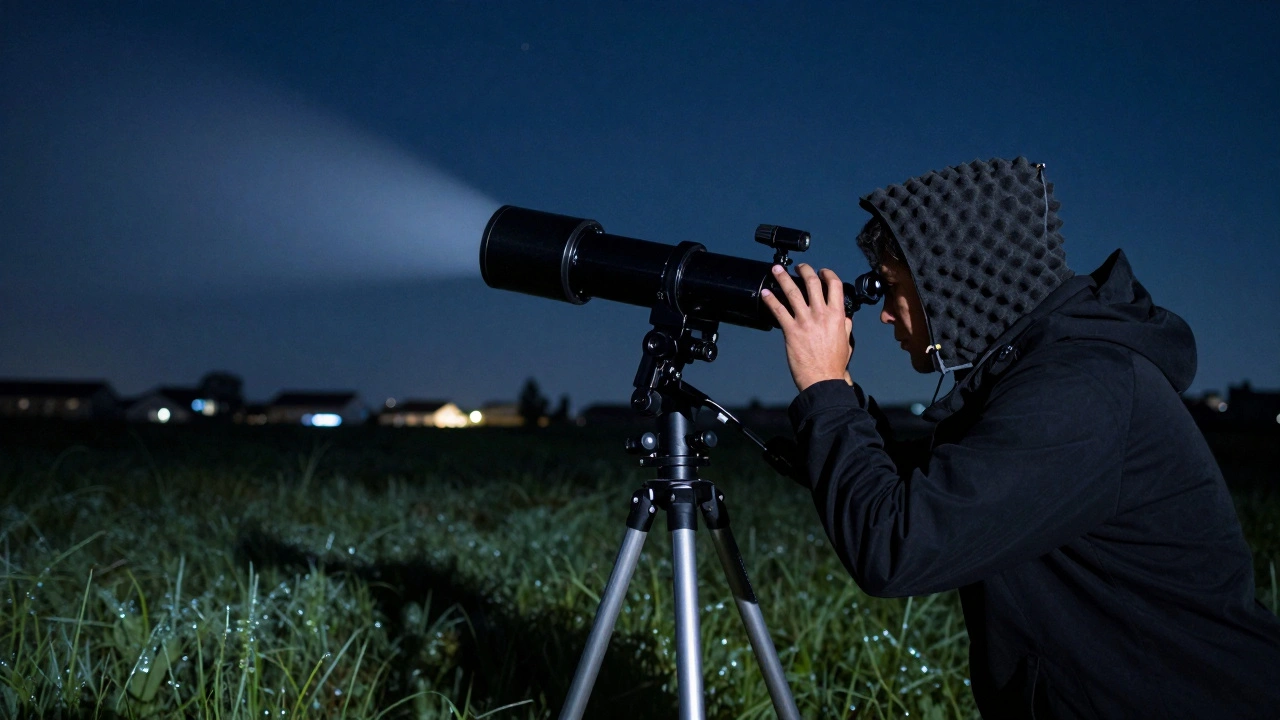
A telescope hood is just a tube or collar that extends over the front of your scope. It blocks light coming in from the sides. You can buy them, but most amateur astronomers make their own from black foam board, felt, or even rolled-up black cardboard.For a refractor, a hood that extends 6 to 10 inches beyond the lens can cut stray light by up to 70%. For a Newtonian reflector, a hood that wraps around the tube and extends past the secondary mirror helps block light from hitting the mirror at odd angles. Even a 2-inch extension can make a noticeable difference in planetary viewing or when hunting faint nebulae like the Horsehead or California Nebula.
Don’t overdo it. A hood that’s too long can cause vignetting (darkening at the edges of the view) or make it hard to reach the focuser. Test it by looking through your scope with and without the hood during twilight. If the sky background looks noticeably darker around the edges of the field, you’ve done it right.
Shrouds: The Next Level of Light Blocking
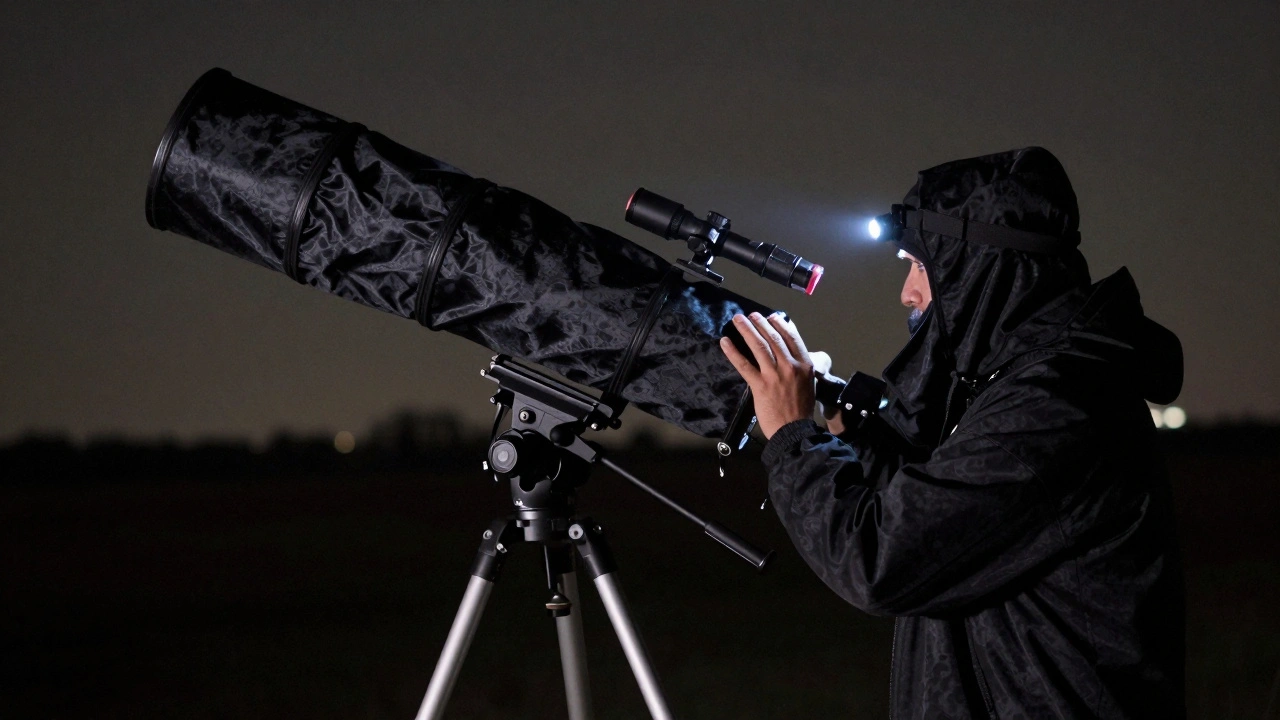
A shroud is like a hood, but it’s flexible, full-coverage, and wraps around the entire telescope tube. You’ll often see them on astrophotography rigs, but they’re just as useful for visual observers.Shrouds are made from thick black fabric-usually blackout material or velour-that absorbs light instead of reflecting it. They’re designed to block light from above, below, and the sides. A good shroud covers the tube, the finder scope, and sometimes even the eyepiece holder.
One of the biggest advantages? It stops your own body’s shadow from falling on the telescope. If you lean in to look through the eyepiece, your head can cast a shadow on the optics, creating uneven illumination. A shroud keeps your body outside the light path entirely.
Some shrouds come with zippers or Velcro so you can access the focuser without removing the whole thing. Others have a small opening for the eyepiece, letting you slip your head through while keeping everything else covered. They’re not cheap-expect to pay $50-$150-but for serious observers, the difference in contrast is dramatic.
Observing Huts: The Ultimate Glare Solution
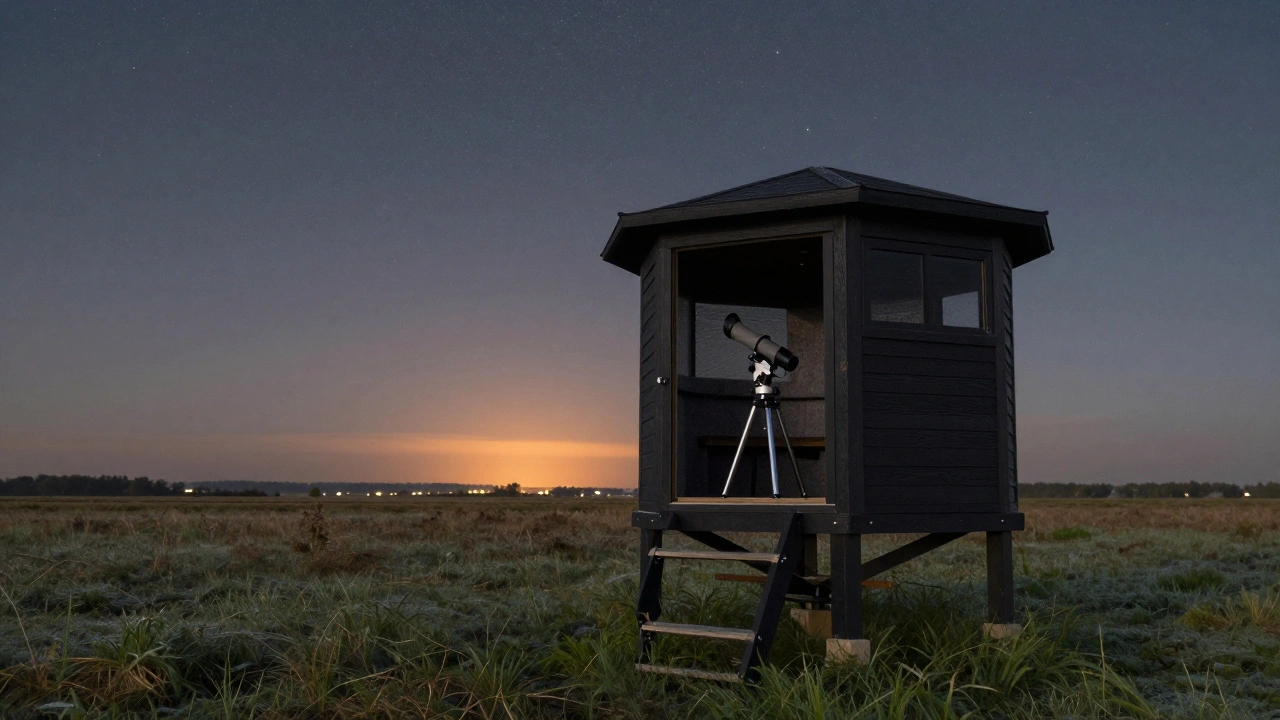
If you’re serious about dark skies, an observing hut is the gold standard. It’s not a shed-it’s a small, rotating enclosure built around your telescope. Think of it like a mini observatory, but without the dome. You can build one yourself for under $300 using pressure-treated wood, black paint, and a sliding or rotating roof.Here’s how it works: You mount your telescope on a pier or tripod inside the hut. The walls are tall enough to block all nearby light sources-streetlamps, house windows, even the glow from your car parked nearby. The roof opens partially or fully, letting you point anywhere in the sky. When you’re done, you close it up, and the whole thing becomes a light-blocking box.
One observer in rural Oregon told me he used to struggle to see M33, the Triangulum Galaxy. After building a 6-foot-wide hut with black felt-lined walls, he saw it clearly for the first time. Not because the sky got darker-but because his own equipment stopped reflecting ambient light.
Observing huts also protect your gear from dew, wind, and dust. In places like the Pacific Northwest, where dew forms fast, that’s a huge bonus. A well-built hut can extend your observing season by weeks.
How to Choose What’s Right for You
You don’t need all three. But you should pick the one that matches your setup and observing habits.- Use a hood if you have a small refractor or Newtonian and just want a quick, low-cost fix.
- Use a shroud if you have a larger scope, do astrophotography, or want to eliminate reflections from your own body.
- Build or buy a hut if you have a permanent setup, observe often, and live where light pollution is stubborn-even in the countryside.
Many people start with a hood, then add a shroud, and later build a hut. It’s not a one-time purchase-it’s a progression. Each step adds another layer of control over stray light.
What Not to Do
Avoid these common mistakes:- Don’t use white or reflective materials inside hoods or shrouds. Even a slight sheen can bounce light back into your optics.
- Don’t leave your phone screen on while observing. Even a dim screen can ruin your night vision. Use a red-light app or a red headlamp with a diffuser.
- Don’t assume dark skies = no glare. A neighbor’s LED security light, a distant billboard, or even the moon’s scattered glow can interfere.
- Don’t ignore your finder scope. It’s a small window for stray light-and it’s often the first thing to ruin contrast.
The Real Test: Compare Before and After
The best way to know if your glare control is working is to test it. Pick a faint object-say, the Pinwheel Galaxy (M101) or the Veil Nebula. Observe it without any hood or shroud. Note how much detail you see. Then, add your hood or shroud. Observe again. Did the structure become more defined? Did the background look darker? Did you suddenly see filaments or spiral arms you missed before?If the answer is yes, you’ve just upgraded your telescope without spending a dime on a new lens or sensor. Glare control is the cheapest, most effective upgrade you can make.
Final Thought: It’s Not About Darkness. It’s About Control.
You can’t control light pollution. But you can control what happens between your eyes and the sky. Hoods, shrouds, and huts don’t eliminate light-they redirect it, block it, and absorb it. They turn your telescope from a passive receiver into an active tool for contrast.When you see a galaxy that you’ve only read about, and you realize it’s because you finally blocked the right light-you’ll know why this matters more than any expensive new eyepiece.