10 Mar 2026
- 0 Comments
Most people start with a beginner telescope because they’re affordable, easy to set up, and get you looking at the Moon, Jupiter, and Saturn right away. But after a few months of stargazing, you might find yourself staring at the same few objects, wondering if there’s more. Maybe your views are blurry. Maybe you want to see deep-sky objects like the Orion Nebula or Andromeda Galaxy. Or maybe your mount wobbles every time you touch it. That’s when the question comes up: when should you upgrade your telescope, and what should you buy next?
When You Know It’s Time to Upgrade
You don’t upgrade just because you can. You upgrade when your current gear is holding you back. Here are the clear signs it’s time:
- Your views are consistently fuzzy, even when the air is steady. This usually means your optics are low quality or your aperture is too small.
- You can’t keep objects in view for more than 30 seconds. A shaky or slow mount makes tracking planets or stars frustrating.
- You’re trying to see faint objects like galaxies or nebulae-and they’re just invisible. Beginner scopes often have apertures under 70mm, which just don’t gather enough light.
- You’ve tried all the eyepieces that came with it and still feel like you’re missing out. Better eyepieces can help, but only up to a point.
- You’ve been using it for 6-12 months and are genuinely excited to see more. Passion matters more than time.
If you’re checking two or more of these, you’re ready. Don’t wait until you’re annoyed. Wait until you’re curious.
What You Really Need: Aperture, Mount, and Eyepieces
When upgrading, most beginners make the same mistake: they focus on magnification. They think bigger zoom = better views. That’s not true. What actually matters is:
- Aperture (the diameter of the main lens or mirror) - this determines how much light your telescope collects. More light = clearer, brighter views of faint objects.
- Mount - a stable, smooth-moving mount makes all the difference. A shaky mount ruins everything, no matter how good the optics are.
- Eyepieces - good ones can triple your viewing experience without buying a new telescope.
Most beginner telescopes come with 60-70mm aperture and a cheap altazimuth mount. Upgrading means stepping up to at least 80-100mm aperture and a sturdy equatorial or motorized mount.
Best Next Steps: Three Realistic Upgrade Paths
There’s no one-size-fits-all upgrade. Your best next telescope depends on what you want to see and how much you’re willing to spend. Here are three practical paths:
Path 1: The Deep-Sky Upgrade - 80mm to 100mm Refractor
If you’re hooked on nebulae, star clusters, and galaxies, go for an 80mm to 100mm apochromatic refractor. These use high-quality lenses that give sharp, color-corrected views. Brands like Sky-Watcher, Orion, and William Optics make excellent models under $800.
Pair it with a solid equatorial mount like the Sky-Watcher EQ5 or Celestron CG-4. These tracks stars smoothly, so you can watch Jupiter for 10 minutes without chasing it. You’ll see details in the Orion Nebula you didn’t know existed.
Best for: People who love color, contrast, and deep-sky objects. Great for astrophotography later.
Path 2: The Planetary & Lunar Upgrade - 114mm to 130mm Reflector
If you’re obsessed with the Moon’s craters or Jupiter’s cloud bands, a 114mm to 130mm Newtonian reflector is your best bet. These give you more light-gathering power at a lower price. A 130mm reflector costs about the same as a 100mm refractor but gives you noticeably brighter views.
Look for models with a dual-speed focuser and a sturdy altazimuth mount. The Orion SkyQuest XT6 or Celestron PowerSeeker 127EQ are solid choices. You’ll see the Cassini Division in Saturn’s rings clearly for the first time.
Best for: People who want high-contrast planetary views and don’t mind a slightly bulkier scope.
Path 3: The Smart Upgrade - GoTo Dobsonian
If you’re tired of hunting for objects manually, consider a GoTo Dobsonian. These are reflectors with computerized tracking. You point it at the sky, type in “M31,” and it finds the Andromeda Galaxy for you.
Models like the Sky-Watcher AZ-GTi 8” or the Zhumell Z8 are game-changers. You get 8 inches of aperture (203mm) - more than double what most beginners start with - and automatic tracking. It’s like upgrading from a bicycle to an electric scooter.
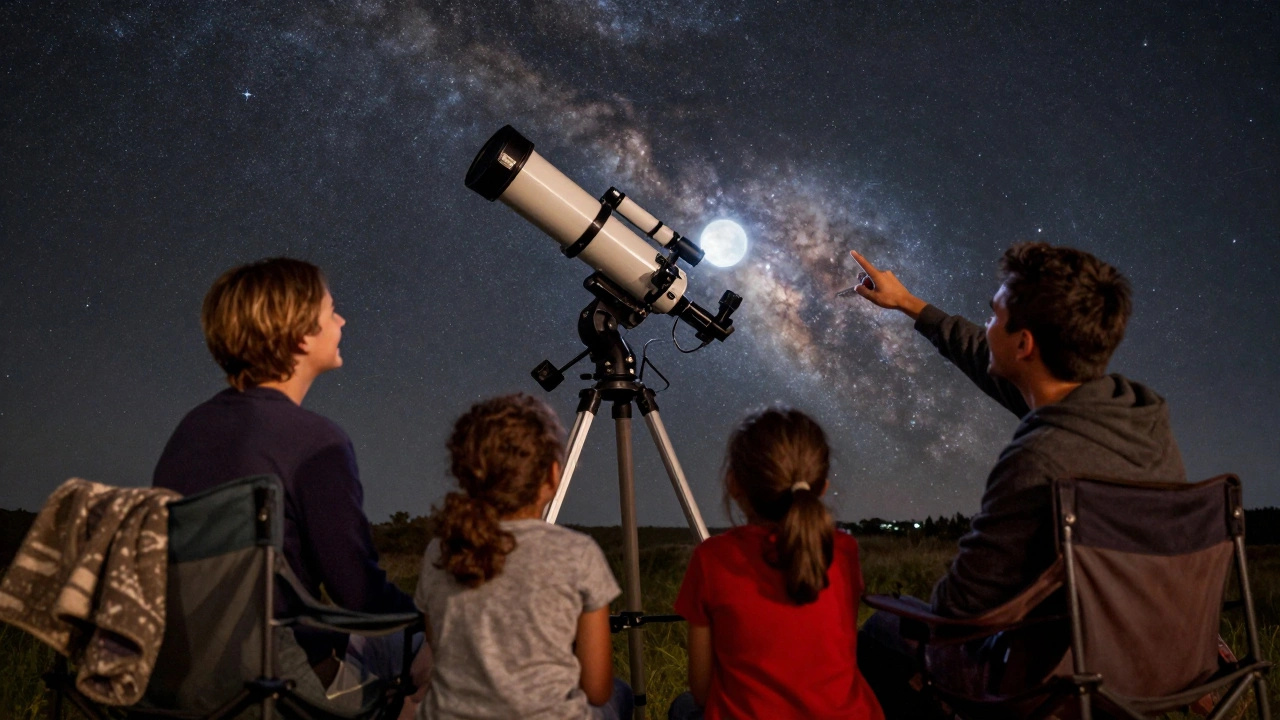
Best for: People who want simplicity, power, and ease of use. Perfect if you’re observing with friends or family.
What to Skip
There are a lot of traps when upgrading. Avoid these:
- Telescopes sold in department stores - they’re often overpriced, underperforming, and come with terrible mounts. Stick to astronomy retailers.
- High-magnification eyepieces - 2mm or 4mm eyepieces are useless. They show a dark, shaky image. Stick to 10mm-25mm.
- “Beginner kits” with 10+ eyepieces - most are junk. Buy one or two good ones instead.
- Buying a telescope without a mount - if the mount wobbles, the telescope is useless.
Don’t Forget Accessories
Upgrading your telescope doesn’t mean you need to replace everything. Some accessories make a bigger difference than new optics:
- 2” eyepieces - they give wider fields and better views than 1.25” ones.
- A good Barlow lens - a 2x Barlow doubles your eyepiece collection without buying new ones.
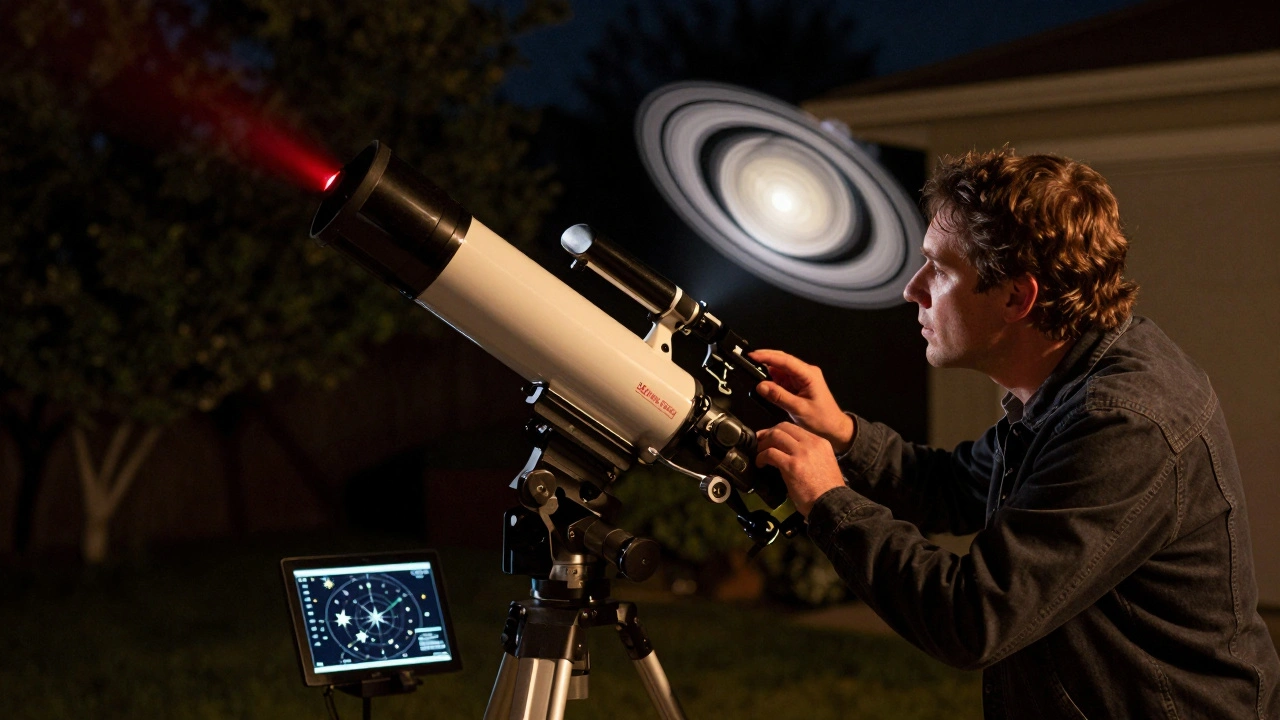
- A red flashlight - preserves your night vision. Essential.
- A star chart app - SkySafari or Stellarium are free and accurate.
- A dew shield - prevents moisture from fogging your lens on cool nights.
You can spend $100 on these and get more improvement than buying a $500 scope with junk accessories.
Where to Buy and How to Test
Buy from astronomy-specific retailers like Adorama, Agena AstroProducts, or Orion Telescopes. Avoid Amazon unless you’re buying accessories - their telescope selection is hit-or-miss.
Before buying, try to see the telescope in person. Attend a local astronomy club meeting. Portland has several - the Oregon Astronomical Society meets monthly at the Portland Observatory. Bring your current scope and compare views. Ask to look through the model you’re considering. If you can’t see it in person, read detailed reviews from experienced users on CloudyNights.com.
What You’ll See After the Upgrade
After upgrading, you’ll notice things you never saw before:
- The spiral arms of the Pinwheel Galaxy (M101) - not just a smudge, but a structure.
- The color of Betelgeuse - a deep orange, not a white dot.
- The faintest stars in the Pleiades cluster - dozens more than you ever noticed.
- Shadows on the Moon’s mountains - you’ll see depth, not just texture.
It’s not about power. It’s about clarity. About seeing the universe the way it really looks - not the way your first telescope let you imagine it.
Final Thought: Upgrade When You’re Ready, Not When You’re Pressured
You don’t need to upgrade next month. You don’t need to buy the most expensive scope on the market. You just need to move forward when your current gear stops satisfying your curiosity.
Some people upgrade after three months. Others wait two years. Both are fine. The best telescope is the one you use regularly. Don’t chase specs. Chase wonder.
How do I know if my current telescope is too small?
If your telescope has an aperture smaller than 70mm, it’s likely limiting your views. You won’t see much detail on planets, and deep-sky objects like nebulae and galaxies will appear as faint, blurry smudges. A 70mm scope is the minimum for decent views, but 80mm or more opens up the universe.
Should I upgrade the mount or the telescope first?
Always upgrade the mount first if it’s shaky. A $200 telescope on a $50 mount gives worse views than a $150 telescope on a $200 mount. Stability matters more than aperture. If your mount wobbles when you touch it, that’s your biggest problem.
Is a GoTo telescope worth it for a beginner upgrade?
Yes - if you’re frustrated by hunting for objects manually. GoTo systems like the Sky-Watcher AZ-GTi or Zhumell Z8 make finding galaxies and nebulae effortless. They’re especially great for observing with others or if you’re short on time. But if you enjoy the hunt, a manual scope teaches you the sky better.
Can I improve my current telescope without buying a new one?
Yes. Replace the eyepieces with one or two high-quality ones (like a 25mm wide-field and a 10mm Plössl). Add a Barlow lens, a dew shield, and a red flashlight. These cost less than $100 and can make your current scope feel like a new one.
What’s the best budget for my next telescope?
Plan for $500-$1,000. That range gets you a significant upgrade: 80mm-130mm aperture, a solid mount, and decent optics. Below $500, you’re often just trading one cheap scope for another. Above $1,000, you’re entering advanced territory - wait until you’re sure you want to go there.