5 May 2026
- 0 Comments
Staring at a starfield on your monitor, you notice the stars look like soft blobs rather than sharp points. You might wonder if your telescope is out of focus or if your camera sensor is just not good enough. Often, the issue isn't hardware failure but a mismatch in **plate scale**. This mathematical relationship determines how much sky fits into each pixel of your camera sensor. If you get this calculation wrong, your images will either be blurry due to undersampling or unnecessarily large and unwieldy due to oversampling.
Understanding plate scale is one of the most critical skills for any serious astrophotographer. It bridges the gap between optical physics and digital imaging. By calculating arcseconds per pixel, you can predict exactly how your equipment will perform before you even set up outside. This guide breaks down the formula, explains why it matters for image quality, and shows you how to use it to select the right gear for your targets.
Quick Summary
- Plate scale defines the angular size of the sky represented by one pixel on your camera sensor.
- The standard formula is: Plate Scale (arcsec/pixel) = 206.265 × Pixel Size (mm) / Focal Length (mm).
- Arcseconds per pixel determine whether your images are resolved (sharp), undersampled (blocky), or oversampled (noisy/large files).
- For deep-sky objects, aim for a plate scale between 1.0 and 2.0 arcseconds per pixel under average seeing conditions.
- Planetary imaging requires much finer sampling, often below 0.1 arcseconds per pixel, usually achieved with high magnification and video processing.
The Core Formula: Calculating Arcseconds per Pixel
To find your plate scale, you need two specific numbers from your equipment specifications: the focal length of your optical system and the physical size of your camera's pixels. The focal length is measured in millimeters (mm). If you are using a telescope with a Barlow lens or a reducer, you must calculate the effective focal length first. For example, a 1000mm telescope with a 2x Barlow lens has an effective focal length of 2000mm.
The pixel size is also measured in micrometers (µm) or millimeters (mm). Most modern astronomical cameras list their pixel pitch in microns. A common value for many CMOS sensors is 3.76 µm. Since the formula requires consistent units, you must convert microns to millimeters by dividing by 1000. So, 3.76 µm becomes 0.00376 mm.
The constant 206.265 comes from the conversion between radians and arcseconds. There are approximately 206,265 arcseconds in one radian. When you multiply this constant by the ratio of your pixel size to your focal length, you get the angular coverage of a single pixel.
The Formula:
Plate Scale (arcseconds/pixel) = 206.265 × (Pixel Size in mm / Focal Length in mm)
Let's walk through a real-world example. Imagine you have a ZWO ASI2600MC a popular monochrome astrocamera with 3.76-micron pixels. You mount it on a Celestial Sphere Raptor 150 an apochromatic refractor with a 1050mm focal length.
- Convert pixel size: 3.76 µm / 1000 = 0.00376 mm.
- Divide by focal length: 0.00376 / 1050 = 0.00000358.
- Multiply by 206.265: 0.00000358 × 206.265 ≈ 0.74 arcseconds per pixel.
In this setup, each pixel covers 0.74 arcseconds of the sky. This is a very fine resolution, suitable for capturing small planetary nebulae or tight star clusters without losing detail.
Why Plate Scale Matters: Sampling Theory
You might ask why we care about this number. The answer lies in Nyquist-Shannon sampling theorem a principle stating that to accurately reconstruct a signal, you must sample it at least twice per cycle. In astrophotography, the "signal" is the Point Spread Function (PSF) of a star. The PSF is the blur circle created by atmospheric turbulence, known as seeing.
If your plate scale is too coarse (large arcseconds per pixel), you are undersampling. The star's light falls into only one or two pixels. The resulting image looks blocky or pixelated, lacking smooth gradients. You lose resolution because the camera cannot capture the fine structure of the star.
If your plate scale is too fine (small arcseconds per pixel), you are oversampling. The star's light is spread across many pixels. While this sounds beneficial, it actually increases noise relative to the signal and creates massive file sizes. More importantly, it does not improve resolution beyond what the atmosphere allows. If your seeing is 2.0 arcseconds, having a plate scale of 0.2 arcseconds/pixel gives you no extra detail; it just makes the data heavier.
The ideal scenario is to match your plate scale to your local seeing conditions. This ensures you capture all available detail without wasting storage space or introducing unnecessary noise.
Matching Plate Scale to Seeing Conditions
Atmospheric seeing the blurring effect caused by turbulence in Earth's atmosphere varies significantly depending on location, altitude, and weather stability. Professional observatories in places like Mauna Kea or the Atacama Desert often achieve seeing better than 0.5 arcseconds. However, most amateur astronomers deal with seeing between 2.0 and 4.0 arcseconds.
A general rule of thumb is to aim for a plate scale that is half to one-third of your typical seeing diameter. This satisfies the Nyquist criterion while providing some margin for error.
| Target Type | Typical Seeing Requirement | Ideal Plate Scale (arcsec/pixel) | Common Equipment Setup |
|---|---|---|---|
| Large Nebulae (M42, Orion) | Poor to Average (3-5") | 1.5 - 2.5 | Short focal length refractors or Newtonians (f/4-f/6) |
| Globular Clusters & Galaxies | Average (2-3") | 1.0 - 1.5 | Medium focal length SCTs or Refractors (f/8-f/10) |
| Small Planetary Nebulae | Good (1-2") | 0.5 - 1.0 | Long focal length apochromats (f/10-f/12) |
| Planets (Jupiter, Mars) | Excellent (<1") | 0.05 - 0.1 | High power eyepieces + Barlows + Video Cameras |
Notice the drastic difference for planetary imaging. Because planets are tiny angular disks, you need extremely high magnification to resolve surface features. A plate scale of 0.05 arcseconds/pixel means you need a focal length of over 4000mm with a 3.76-micron sensor. This is why planetary imagers often use dedicated video cameras with smaller sensors and higher frame rates, combined with significant magnification.
Field of View and Total Image Coverage
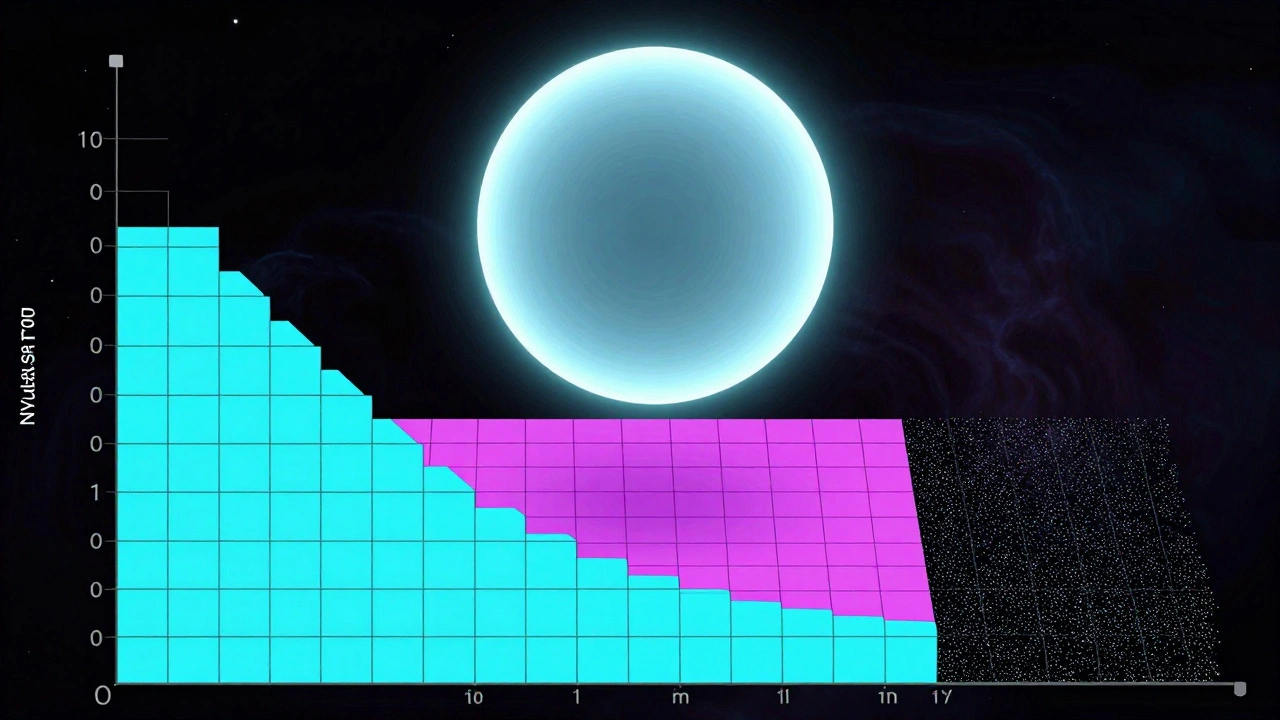
While plate scale tells you the resolution, it also helps you calculate the total Field of View (FOV) the portion of the sky visible through your telescope. Knowing your FOV is crucial for framing your target. You don't want to point your telescope and realize the galaxy is cut off on the edge.
To find the FOV in degrees, multiply the plate scale by the number of pixels along the axis (width or height) and divide by 3600 (since there are 3600 arcseconds in a degree).
FOV (degrees) = (Plate Scale × Number of Pixels) / 3600
Using our previous example: 0.74 arcsec/pixel × 4952 pixels (width of ASI2600MC) / 3600 ≈ 1.01 degrees wide. This tells you that your image will cover roughly one degree of sky. For comparison, the full Moon is about 0.5 degrees in diameter. So, this setup would fit the Moon comfortably with room to spare.
If you are targeting a large object like the Andromeda Galaxy (M31), which spans about 3 degrees, you would need a shorter focal length or a camera with a larger sensor to capture it in a single frame. Alternatively, you could take multiple exposures and stitch them together, a technique known as mosaicking.
Practical Adjustments: Barlows and Reducers
Sometimes your current setup doesn't yield the ideal plate scale. Maybe your stars are too bloated (oversampled) or too small (undersampled). You can adjust your effective focal length using optical accessories.
Barlow lenses optical devices that increase the effective focal length of a telescope are used to decrease the plate scale (make each pixel cover less sky). A 2x Barlow doubles the focal length, halving the plate scale. If your original plate scale was 2.0 arcsec/pixel, adding a 2x Barlow brings it to 1.0 arcsec/pixel. This is useful when you want more detail on smaller targets without changing telescopes.
Focal reducers optical devices that decrease the effective focal length of a telescope do the opposite. They shorten the focal length, increasing the plate scale. This widens the field of view and makes each pixel cover more sky. This is helpful for wide-field Milky Way shots where you want to capture vast areas of nebulosity quickly.
When using these accessories, remember to recalculate your plate scale. The physical pixel size remains the same, but the effective focal length changes. Always verify your new focal length with the manufacturer's specifications, as cheap Barlows may not provide exactly 2x magnification.
Troubleshooting Common Plate Scale Issues
Even with perfect calculations, real-world results can vary. Here are common issues and how to address them.
- Stars look square: This indicates severe undersampling. Your plate scale is too large. Add a Barlow lens or switch to a longer focal length telescope.
- Images are noisy and large: You might be oversampling. If your seeing is poor, reducing your focal length with a reducer can help gather more light per pixel and reduce noise.
- Focus drift: While not directly a plate scale issue, poor focus affects the perceived resolution. Ensure your focuser is stable and cooled properly.
- Optical aberrations: Even with a perfect plate scale, spherical aberration or coma can blur stars. Check your optics' collimation and consider using a coma corrector for fast Newtonian reflectors.
Another factor is Diffraction limit the theoretical maximum resolution of an optical system based on its aperture. The diffraction limit in arcseconds is calculated as 116 / Aperture (mm). For a 150mm telescope, the diffraction limit is 116 / 150 ≈ 0.77 arcseconds. If your plate scale is finer than this (e.g., 0.2 arcsec/pixel), you are resolving details that the telescope itself cannot physically deliver due to wave optics. In such cases, increasing aperture is the only way to gain true resolution, not just sampling density.
Conclusion: Finding Your Sweet Spot
Calculating plate scale is not just academic exercise; it is a practical tool for optimizing your astrophotography workflow. By understanding the relationship between pixel size, focal length, and atmospheric seeing, you can make informed decisions about gear purchases and accessory usage. Start by measuring your local seeing conditions over several nights. Then, calculate the plate scale that best matches those conditions. Finally, adjust your setup using Barlows or reducers to hit that target. With practice, you will consistently produce sharper, more detailed images that truly showcase the beauty of the night sky.
What is a good plate scale for deep sky astrophotography?
A good plate scale for deep sky objects typically ranges from 1.0 to 2.0 arcseconds per pixel. This range balances resolution with signal-to-noise ratio under average seeing conditions of 2-3 arcseconds. For larger nebulae, you might go up to 2.5 arcseconds/pixel to widen the field of view.
How do I measure my local seeing?
You can estimate seeing by observing bright stars near the zenith. If the star twinkles rapidly and appears to jump around, seeing is poor (>3"). If the star remains steady and compact, seeing is good (<1.5"). Software like SharpCap or NINA can also analyze live video feeds to give a precise Full Width at Half Maximum (FWHM) measurement in arcseconds.
Does pixel binning affect plate scale?
Yes, pixel binning effectively increases the pixel size. If you bin 2x2, your effective pixel size quadruples in area, doubling the linear dimension. This doubles your plate scale (arcseconds per pixel), making it coarser. Binning is useful for faint, extended objects where speed and sensitivity are prioritized over resolution.
Can I change my plate scale after taking the image?
No, plate scale is determined by the optics and sensor at the time of exposure. Post-processing techniques like sharpening or deconvolution can enhance contrast and clarity, but they cannot recover resolution lost due to undersampling or create detail that wasn't captured due to oversampling limitations.
What is the difference between plate scale and pixel scale?
These terms are often used interchangeably. Both refer to the angular size of the sky covered by a single pixel, usually expressed in arcseconds per pixel. Some professionals distinguish "plate scale" as the theoretical optical property and "pixel scale" as the measured performance including atmospheric effects, but for practical purposes, they mean the same thing.