20 Mar 2026
- 0 Comments
Every year, around the same time, people look up and see streaks of light cutting across the night sky-meteors. These aren’t falling stars. They’re tiny bits of space dust, often no bigger than a grain of sand, burning up as they slam into Earth’s atmosphere at tens of thousands of miles per hour. But not all meteor showers are the same. Some years, you might see dozens in an hour. Other years, barely a handful. Why? One of the biggest reasons lies in something most observers never notice: radiant drift.
What Is the Radiant, Really?
The radiant is the point in the sky from which meteors appear to originate. It’s an optical illusion, like driving through rain and seeing the drops seem to come from a single spot ahead of you. For the Perseids in August, that spot is near the constellation Perseus. For the Geminids in December, it’s near Gemini. But here’s the catch: that point doesn’t stay still.
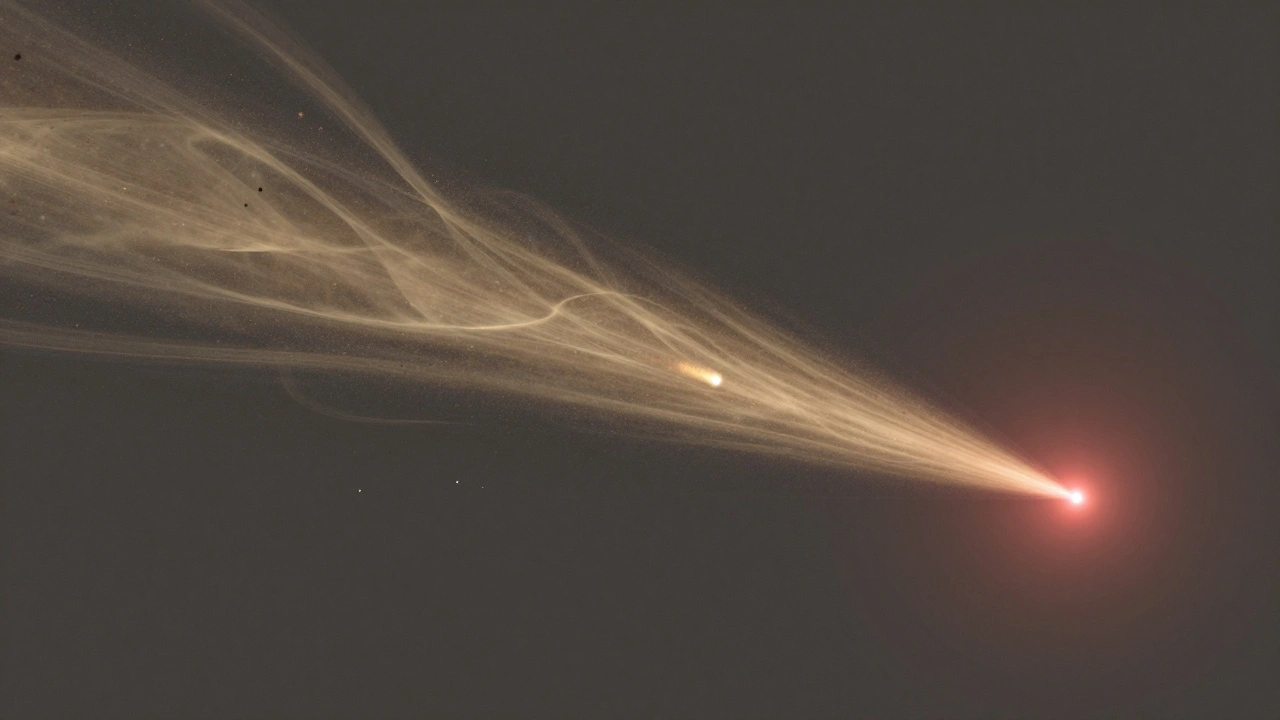
Each meteor shower comes from debris left behind by a comet or asteroid. As Earth passes through that debris stream, the particles hit our atmosphere from slightly different angles every night. That’s because the debris stream isn’t a solid sheet-it’s a wide, twisted ribbon of dust, stretched out over decades or centuries. And as Earth cuts through it, the part we hit shifts a little each night. That shift changes the radiant’s position, and that shift directly affects how many meteors you’ll see.
Why Radiant Drift Changes Your View
Imagine you’re standing under a leaky roof. If the drip is directly above you, you get soaked. But if the leak moves even a few inches to the side, the water hits the floor farther away, and you stay dry. It’s the same with meteors.
When the radiant is high in the sky-near your zenith-you’re facing the full stream of particles head-on. That’s when you get the most meteors per hour. But as the radiant drifts lower, especially toward the horizon, you’re only catching the edge of the stream. Meteors become fewer, fainter, and harder to see. Some nights, you might see 50 meteors. The next night, with the radiant 10 degrees lower, you might only see 15-even if the debris density hasn’t changed at all.
Studies from the International Meteor Organization show that radiant drift can cause meteor counts to vary by 30-60% over just three nights during peak shower periods. For example, during the 2024 Leonids, observers in the Northern Hemisphere recorded 82 meteors per hour on the night of November 17 when the radiant was at 72° altitude. Two nights later, on November 19, the radiant had dropped to 58°, and counts fell to 41 per hour. No cloud cover. No moonlight. Just radiant drift.
How the Radiant Moves Each Night
The radiant doesn’t drift randomly. It follows a predictable path across the sky, shaped by Earth’s orbit and the debris stream’s geometry. On average, the radiant moves about 0.5 to 1.5 degrees per night. That might sound tiny, but in the sky, that’s the width of two full moons side by side.
The direction of drift depends on the shower. For showers like the Perseids and Leonids, the radiant shifts slowly eastward over several nights. For others, like the Orionids, it moves slightly southward. The exact path is calculated using orbital models based on the parent body’s motion and the age of the debris stream. Older streams-like the Taurids, which come from Comet Encke-have wider, more tangled debris trails. That means the radiant drifts more erratically, and counts can jump around unpredictably from night to night.
Here’s what the drift looks like for three major showers during their peak periods:
| Shower | Peak Date | Nightly Drift Direction | Typical Drift Rate | Altitude Change Over 3 Nights |
|---|---|---|---|---|
| Perseids | August 12-13 | East | 0.8° per night | 2.4° |
| Geminids | December 13-14 | South | 1.2° per night | 3.6° |
| Leonids | November 17-18 | East | 1.1° per night | 3.3° |
What This Means for You
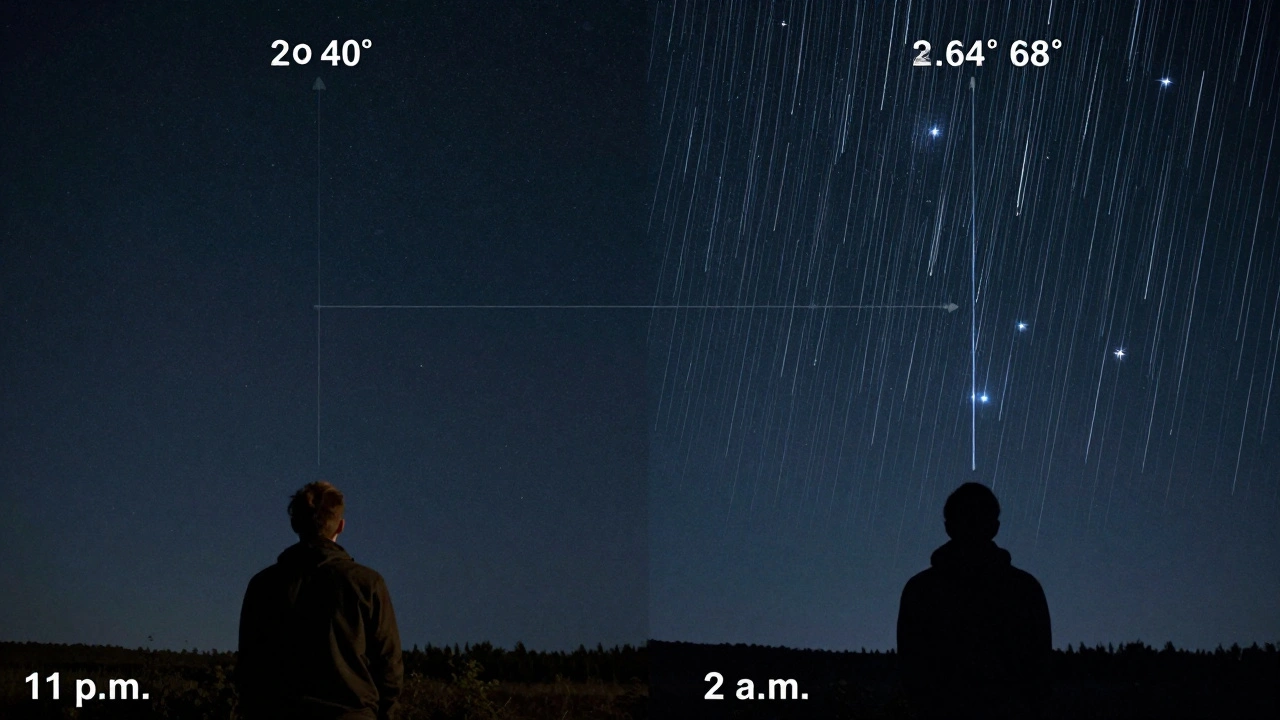
If you’re planning to watch a meteor shower, don’t just pick the peak date and call it a day. The peak date is when the Earth passes through the densest part of the debris stream-but the radiant might not be at its highest point yet. For the Geminids, the peak is usually on December 13-14, but the radiant reaches its highest point around 2 a.m. local time on the 14th. If you go out on the 13th at 11 p.m., you might see only half as many meteors as you would on the 14th at 2 a.m.
Here’s what to do:
- Check the radiant’s position for your location and date using a planetarium app like Stellarium or SkySafari. Look for the altitude (angle above the horizon).
- Wait until the radiant is at least 30° above the horizon. Below that, atmospheric absorption kills faint meteors.
- Plan your viewing for after midnight, when your location is facing into Earth’s direction of motion. That’s when you’re plowing straight into the debris stream.
- Don’t assume the best night is the official peak. Sometimes, the night after the peak has higher counts because the radiant is higher.
Tools to Track Radiant Drift
You don’t need a telescope to track radiant drift. Free tools can help you predict the best viewing times:
- Stellarium Web (stellarium-web.org): Type in the shower name, and it shows the radiant’s position hour by hour for any date.
- IMO Radiant Calculator: The International Meteor Organization offers a downloadable tool that gives exact radiant coordinates for any night during a shower’s active period.
- TimeandDate.com: Their meteor shower pages include radiant rise/set times and maximum altitude for your city.
For serious observers, some apps now include real-time drift overlays. The app Meteor Counter Pro lets you align your phone with the sky and shows where the radiant should be, even if clouds block your view.
Why Some Showers Are More Affected Than Others
Not all showers behave the same. The Geminids, for example, come from an asteroid-(3200) Phaethon-not a comet. That means the debris stream is narrower and more compact. The radiant drifts, but the density doesn’t change as much. That’s why Geminid counts are more stable night to night.
On the other hand, the Leonids are notorious for unpredictable counts. Why? Their debris stream is young and still spreading out. Every 33 years, when Earth passes through a fresh clump of debris left by Comet Tempel-Tuttle, the Leonids turn into a storm-thousands of meteors per hour. But in between, the radiant drifts through thin patches, and counts drop sharply.
Even the Perseids, one of the most reliable showers, show clear drift effects. In 2023, observers in Colorado saw 68 meteors per hour on August 12, when the radiant was at 68°. On August 14, the radiant had dropped to 61°, and counts fell to 44 per hour-even though the moon was still absent.
What You Can Do About It
Here’s the bottom line: radiant drift is real, measurable, and it matters. If you’re trying to count meteors for science, or just want to maximize your viewing experience, you can’t ignore it.
Instead of waiting for the calendar’s official peak, use this simple rule: Wait for the radiant to be highest. That usually happens between 2 a.m. and 4 a.m., local time. That’s when your side of Earth is facing directly into the stream. Combine that with a dark sky, no moon, and clear air, and you’ll see more meteors than you ever thought possible.
And if you’re curious why one night felt so much better than the next, don’t blame the weather. Blame the sky’s invisible shift-the slow, steady drift of the radiant, pulling the meteors just a little farther from your view.
Does radiant drift affect all meteor showers the same way?
No. Showers from older, more spread-out debris streams-like the Taurids or Leonids-show bigger changes in radiant position and meteor counts. Showers from compact streams, like the Geminids, are more stable. The Perseids fall in between, with moderate drift and predictable patterns.
Can I see meteors if the radiant is below the horizon?
Yes, but very few. Meteors can appear anywhere in the sky, but they’re most numerous near the radiant. If the radiant is below the horizon, you’re seeing only the tail end of the stream. You might spot a few meteors, but counts will be low-often less than 10 per hour.
Why does radiant drift happen?
Earth’s orbit intersects the debris stream at a slightly different angle each night. The debris itself is spread out along the comet’s old path, so as Earth moves forward, it hits different parts of that stream. That changes the apparent direction the meteors come from-our radiant point.
How far does the radiant move in one night?
Typically between 0.5° and 1.5° per night. That’s roughly the width of one to three full moons. Over a week, that adds up to 5-10 degrees-enough to cut meteor counts in half if you’re not watching at the right time.
Do I need special equipment to track radiant drift?
No. A smartphone with a free planetarium app like Stellarium or SkySafari is enough. Just open it, point it at the sky, and check the radiant’s altitude. No telescope, no camera, no expensive gear needed.