17 Aug 2026
- 0 Comments
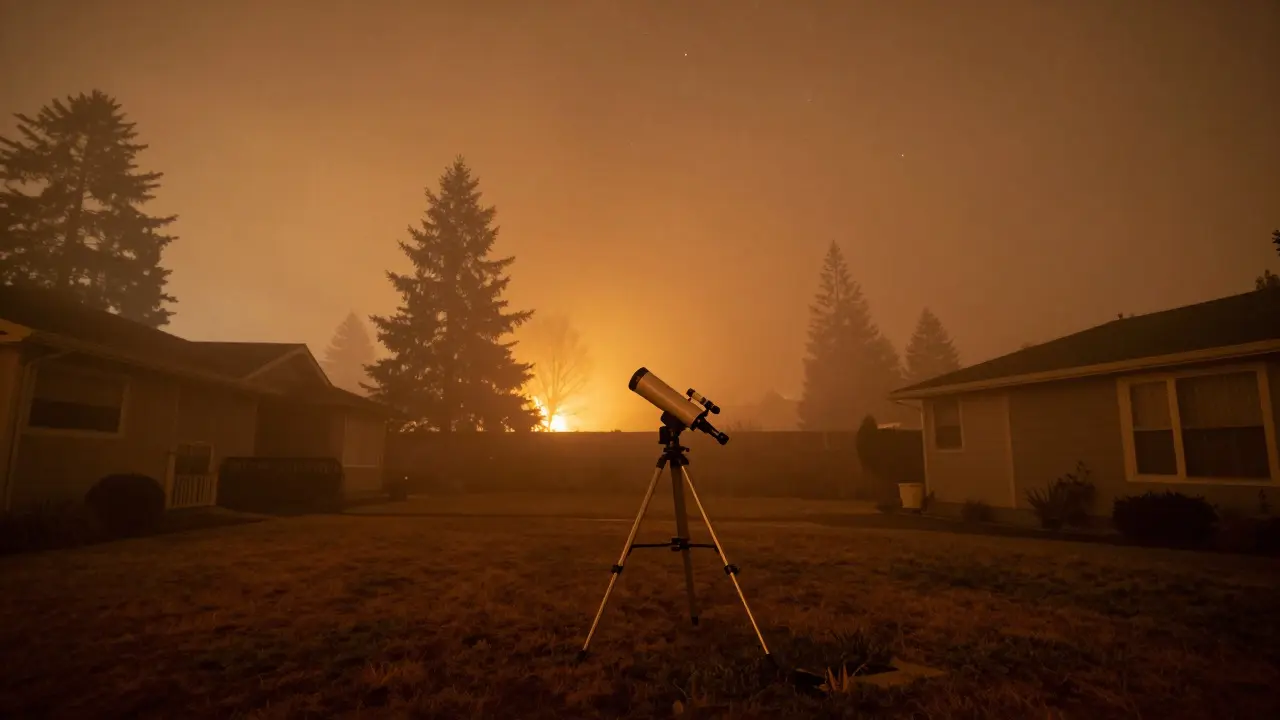
It’s 9 PM on a Tuesday in late August, and the sky above Portland looks like it’s been dipped in amber. The air smells faintly of pine resin and charred wood. You set up your telescope, eager to catch Saturn’s rings, but through the eyepiece, the planet looks washed out, fuzzy, and strangely orange. This isn’t bad seeing; it’s atmospheric extinction caused by wildfire smoke. For amateur astronomers, the difference between clear air and hazy skies can mean the gap between a crisp view of the Moon’s craters and staring at a gray blur. Understanding how aerosols interact with light is the key to deciding when to observe and what to expect.
The Physics of Hazy Skies
To understand why smoke ruins views, you have to look at what’s actually floating in the air. Aerosols are tiny solid or liquid particles suspended in the atmosphere. In clean air, these are mostly dust, sea salt, or volcanic ash. But during wildfire season, the dominant aerosols are black carbon (soot) and organic compounds from burning vegetation. These particles are microscopic-often smaller than the wavelength of visible light-but they pack a punch when it comes to scattering light.
Rayleigh scattering, which gives us blue skies, happens when light interacts with gas molecules. It scatters shorter wavelengths (blue/violet) more effectively than longer ones (red). That’s why the sky is blue. However, when you introduce larger particles like smoke, Mie scattering takes over. Unlike Rayleigh scattering, Mie scattering affects all visible wavelengths roughly equally, though it still has a slight preference for shorter wavelengths. This results in a white-to-gray haze that reduces contrast and dims starlight. If the smoke is thick enough, the scattering becomes so intense that only the longest red wavelengths penetrate, turning the sky an eerie orange or brown.
This process directly impacts visual astronomy. Stars don’t just get dimmer; their color changes. A blue-white star like Sirius might appear yellowish or even reddish in heavy smoke. More importantly, surface detail on planets disappears because the contrast between light and dark areas is washed out by the scattered light from the sky background. What you’re fighting isn’t just darkness; it’s a veil of particulate matter that acts like a dirty window pane.
Measuring the Damage: Optical Depth and Extinction
How do you know if the sky is too bad to observe? Astronomers use a metric called Aerosol Optical Depth (AOD). Think of AOD as a measure of how much light is blocked by particles before it reaches your eyes. An AOD of 0 means perfectly clear air. An AOD of 1 means half the light is absorbed or scattered. During major wildfire events, AOD values can spike to 3 or higher, meaning less than 5% of the original starlight reaches the ground.
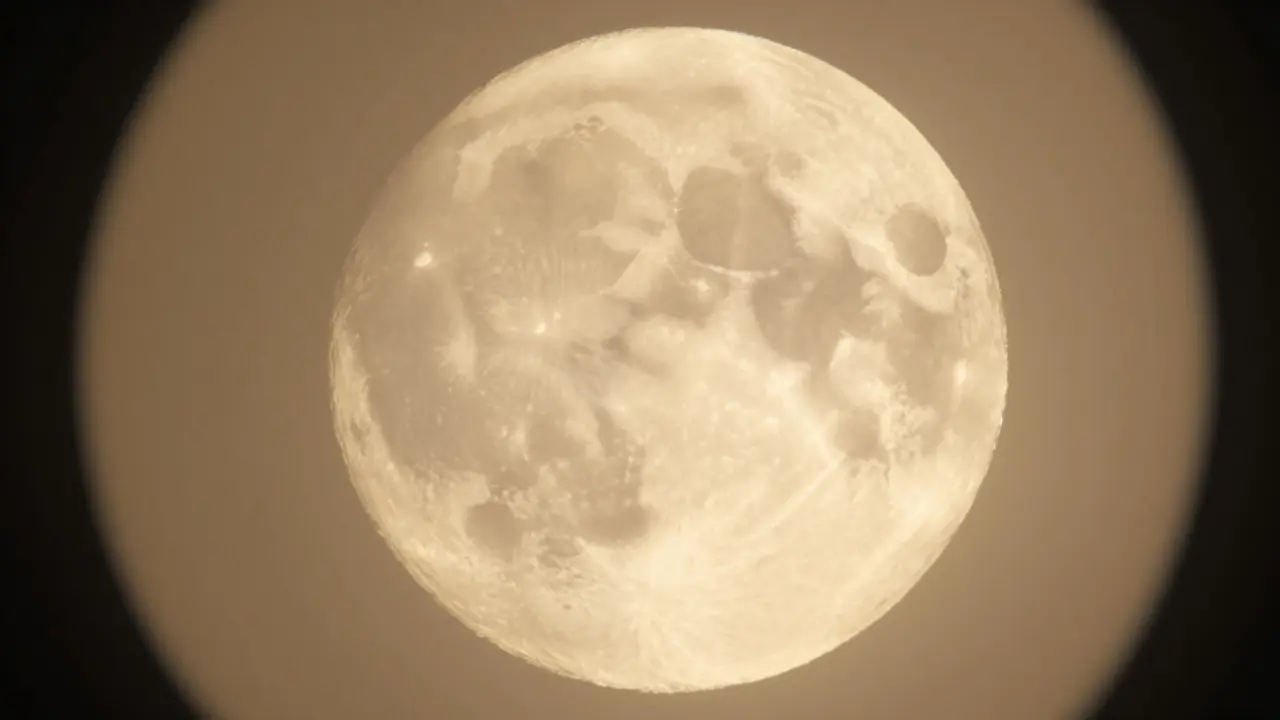
You don’t need a satellite to estimate this. You can gauge it visually using the sun or moon. On a clear day, the sun’s disk is sharp and bright. In moderate smoke, the sun looks like a pale coin. In heavy smoke, it’s barely visible, often appearing as a dull red orb. For night observers, the Moon is the best indicator. In clean air, the full Moon is blindingly bright and white. In smoky conditions, it turns orange and loses its glare, making it easier to see lunar details without squinting. Paradoxically, some lunar features become *more* visible in thin smoke because the reduced brightness lowers the dynamic range, allowing your eye to adapt better to subtle shadows. However, deep-sky objects like nebulae suffer significantly because they rely on faint, diffuse light that gets scattered away before hitting your retina.
Another practical tool is the Bortle Scale, which rates sky darkness from 1 (excellent dark site) to 9 (inner city). Smoke doesn’t change your Bortle class permanently, but it temporarily raises it. A Bortle 4 sky under heavy smoke can feel like a Bortle 7 or 8. The horizon glow intensifies, and stars below 30 degrees altitude vanish completely. If you’re in a rural area, you might still see the Milky Way core in thin smoke, but in dense plumes, even the brightest constellations fade into the background haze.
| AOD Level | Sky Appearance | Visual Impact on Planets | Deep-Sky Visibility |
|---|---|---|---|
| 0.0 - 0.1 | Clear, transparent | Crisp detail, high contrast | Faint nebulae visible |
| 0.2 - 0.5 | Slight haze, whitish | Some loss of fine detail | Bright targets OK, faint ones dimmed |
| 0.6 - 1.0 | Noticeable haze, gray/orange | Washed out, low contrast | Only brightest clusters/galaxies |
| > 1.0 | Dense smoke, opaque | Planets look like bright stars | Almost nothing visible |
Strategic Target Selection in Smoke
When the sky is polluted, you have to play to your strengths. Not all celestial objects suffer equally from aerosols. Here’s a hierarchy of what works best when the air is dirty:
- The Moon: Often the best target. As mentioned, the reduced brightness helps reveal albedo features like the Sea of Tranquility or the Apennine Mountains. Just be careful not to over-magnify, as the lower contrast makes fine details harder to resolve.
- Bright Double Stars: Pairs like Albireo (Cygnus) or Mizar/Alcor (Ursa Major) remain visible because they rely on angular separation rather than faint surface detail. The color shift in Albireo (gold and blue) might be muted, but the pair itself stays distinct.
- Bright Planets: Jupiter and Saturn are tough. Their cloud bands and rings require high contrast. In smoke, they often collapse into bright, featureless points of light. Mars is particularly poor in haze because its surface features are already subtle.
- Open Clusters: The Pleiades or Hyades can still be resolved into individual stars, but the outer, fainter members will disappear first. You’ll see the core, but lose the halo.
- Galaxies and Nebulae: These are the most affected. Andromeda Galaxy (M31) might still show its core, but the spiral arms vanish. Emission nebulae like the Orion Nebula (M42) lose their green/red hues and become faint, fuzzy patches. Avoid trying to image them visually unless the smoke is very thin.
A good rule of thumb: if you can see the North Star (Polaris) clearly against the background sky, you can probably see bright double stars and the Moon. If Polaris looks dim or indistinct, stick to the Moon or switch to binoculars for wide-field viewing, where the loss of contrast is less noticeable per square degree.
Equipment Adjustments for Hazy Conditions
Your gear needs tweaking when the atmosphere is compromised. First, consider your aperture. Larger telescopes gather more light, but they also collect more scattered light from the sky background. In very hazy conditions, a small refractor (like a 70mm or 80mm) might actually provide a clearer, higher-contrast image than a large reflector. The narrower field of view and inherent contrast of a refractor help cut through the haze.
Second, adjust your magnification. High power concentrates the limited light into a smaller area, but it also amplifies any turbulence or residual haze. Start with low to medium magnification (around 20x to 40x) to maximize the amount of light entering your eye. Only go higher if the object remains stable and detailed. If the view feels "soft" or "milky," drop the power. Sometimes, 20x is the sweet spot for preserving detail in smoky skies.
Third, manage your eye adaptation. Smoky skies are brighter than clear skies, which means your dark adaptation resets faster. Avoid looking at phone screens or white lights. Use red filters on your flashlight and keep your headlamp intensity low. Your pupils need to stay dilated to capture every photon that does make it through the aerosol layer.
Finally, consider using a neutral density filter or a colored filter. A light orange or red filter can sometimes enhance contrast by reducing the blue-green scatter from the sky. It won’t fix the problem, but it can help your eye distinguish the object from the background glow. Some observers swear by a simple piece of orange cellophane taped to the eyepiece for emergency situations.
Monitoring Conditions Before You Go Out
Don’t waste your time setting up if the sky is hopeless. Check resources before you leave the house. The US Forest Service provides real-time smoke plume maps that show where the aerosols are concentrated. If the plume is moving toward your location, wait until it passes. Satellite data from NASA’s MODIS or VIIRS sensors gives you AOD readings for specific regions. Websites like Clear Outside or Weather Underground integrate this data with local weather forecasts, giving you a combined score for observing conditions.
Pay attention to wind direction. Smoke moves with the wind. If the wind is shifting from the fire zone to your backyard, conditions will worsen. If the wind is blowing away from the fires, you might be in a temporary pocket of cleaner air. Also, check the humidity. High humidity causes water vapor to condense on smoke particles, creating a thicker, more reflective haze. Dry smoke is worse for transparency; humid smoke is worse for stability (seeing).
Local knowledge matters. In the Pacific Northwest, for example, smoke often lingers in valleys while ridges get cleaner air. If you live in a valley, consider driving to a higher elevation if the smoke is trapped below. Even a gain of 500 feet can make a significant difference in visibility.
Long-Term Implications for Astronomy
Wildfire seasons are getting longer and more intense due to climate change. This means that "polluted skies" are becoming a more frequent reality for amateur astronomers, especially in western North America, Australia, and parts of Europe. The implication is that we need to adapt our expectations and habits. We can no longer assume that a clear forecast means a clear sky. We need to incorporate aerosol monitoring into our routine planning, just like we check for clouds or temperature.
This shift also highlights the value of digital tools. Apps that overlay satellite smoke data on star charts are becoming essential. They allow you to plan your session around the cleanest windows in the sky. For astrophotographers, the impact is even greater, as long exposures amplify the effect of background noise. Many photographers now skip nights entirely if the AOD exceeds 0.3, saving time and storage space.
Ultimately, observing in polluted skies is a test of patience and strategy. It forces you to appreciate what you *can* see rather than mourning what you can’t. The Moon, bright doubles, and planetary cores remain accessible. By understanding the physics of aerosols and adjusting your equipment and targets accordingly, you can turn a frustrating night into a productive one. The sky may be hazy, but your knowledge should be crystal clear.
Can you see the Milky Way in wildfire smoke?
In thin smoke (AOD < 0.3), the core of the Milky Way might still be visible from a dark site, but it will appear dimmer and less defined. In moderate to heavy smoke (AOD > 0.5), the Milky Way usually disappears entirely because the background haze overwhelms the faint starlight. The band of the galaxy relies on millions of faint stars, which are the first to be scattered out of view by aerosols.
Does smoke affect astrophotography differently than visual observing?
Yes, significantly. Visual observing benefits from the human eye’s ability to adapt to varying light levels and contrast. Cameras, however, record everything linearly. Smoke increases the background sky brightness, which adds noise to every pixel. This reduces the signal-to-noise ratio, making faint details in galaxies and nebulae much harder to extract during post-processing. Shorter exposures are often necessary to avoid saturating the background, which limits the total integration time you can achieve.
What is the best time of day to observe during a smoke event?
Usually, later in the evening is better. Smoke tends to settle near the ground during the cooler morning hours and rises as the sun heats the atmosphere. By late evening or early morning (before sunrise), the boundary layer may mix, potentially clearing the lower atmosphere where your telescope is located. However, this varies greatly depending on local topography and wind patterns. Always check local dispersion models.
Do different types of telescopes perform better in haze?
Refractors generally perform better in hazy conditions because they offer higher contrast and less internal reflection than reflectors. The closed tube design of a refractor also prevents dust and moisture from entering the optics, which can be problematic in smoky, humid air. Large-aperture reflectors gather more light but also more skyglow, which can wash out faint details. For visual work in smoke, a mid-sized refractor (70-100mm) is often the most versatile choice.
How does wildfire smoke affect the color of stars?
Smoke scatters shorter wavelengths (blue and violet) more effectively than longer wavelengths (red and orange). This causes blue stars to appear yellowish or white, and red stars to appear deeper red. The overall effect is a warm, orange cast to the entire sky. Bright stars like Sirius or Vega may lose their distinctive blue tint, making them look similar to orange stars like Betelgeuse. This color shift can be used as a quick diagnostic for smoke thickness.