6 Sep 2026
- 0 Comments
You know that feeling when you step outside on a crisp night, look up, and realize you have no idea what you're looking at? You see a bright dot, maybe two, but the rest is just a blur of black. That’s where Star Hopping comes in. It’s not magic; it’s just using bright stars as stepping stones to find fainter ones. But here’s the catch: the sky changes every three months. What works in January will leave you staring at empty space in July. If you want to actually find things without pulling out your phone every ten seconds, you need a plan for each quarter.
The Winter Sky: Bright Lights and Big Constellations
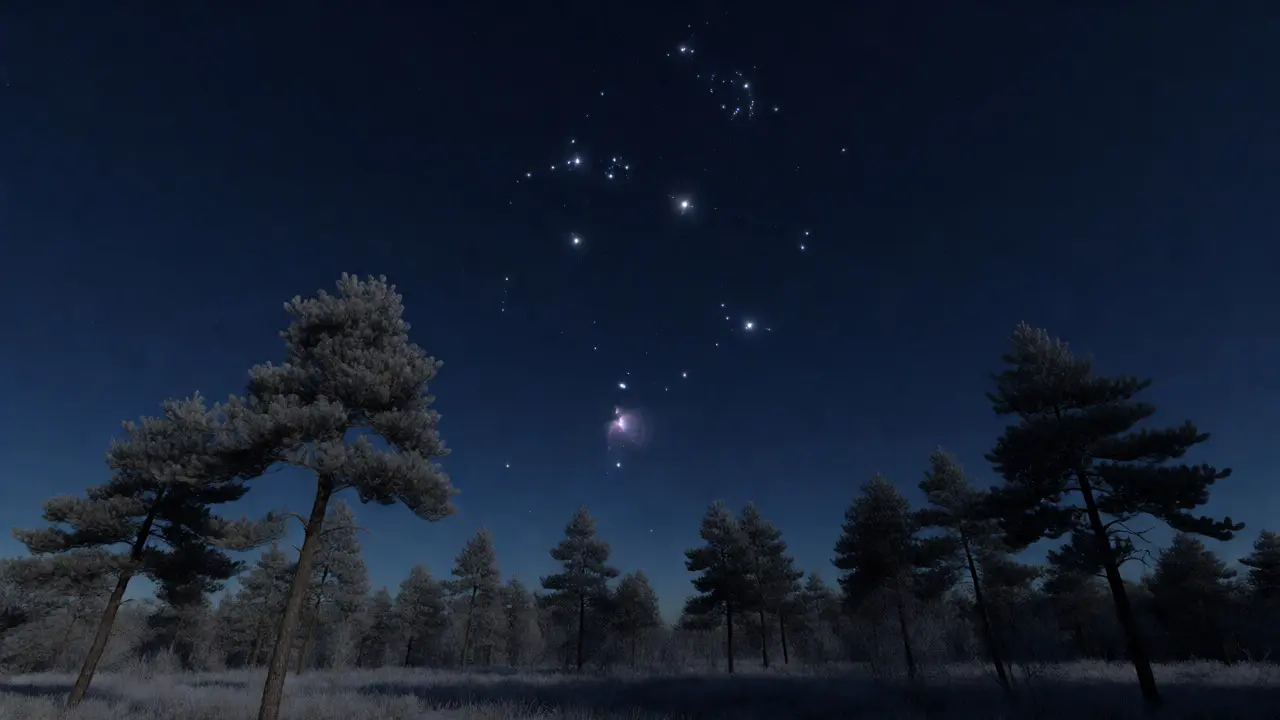
Winter is the best time to learn star hopping because the constellations are huge and unmissable. The cold air often means clearer skies, especially if you’re away from city lights. Start with Orion, the Hunter constellation known for its distinct belt of three stars. Everyone knows Orion’s Belt. It’s impossible to miss. From there, you can hop to almost anything else in the winter quadrant.
If you draw an imaginary line down through the belt, you hit Sirius, the brightest star in the night sky. But don’t stop there. Go up and left from the belt, and you’ll find Betelgeuse, a red supergiant. Now, try this: use the top-left star of the belt (Alnitak) and the top-right star of the Big Dipper’s bowl (Mizar). The midpoint between them points directly to Capella. This kind of geometric logic is the core of effective hopping. You aren't memorizing positions; you're connecting dots.
- Target: M42 (Orion Nebula)
- Start Point: Orion’s Belt
- Hop: Look below the sword hanging from the belt. Use binoculars first; it looks like a fuzzy patch.
- Pro Tip: In late December, the Pleiades cluster rises high early in the evening. They are easy naked-eye targets but stunning in small telescopes.
The Spring Sky: The Void and the Virgo Cluster
Spring is tricky. Many beginners hate it because the sky feels empty. There are fewer bright stars compared to winter or summer. But this "emptiness" is deceptive. It’s actually perfect for deep-sky hunting because there’s less glare. Your main anchor here is Ursa Major, a large circumpolar constellation containing the Big Dipper asterism.
Use the handle of the Big Dipper to arc to Arcturus. Arcturus is orange-ish and very bright. Once you’re at Arcturus, keep going in the same direction to Spica in Virgo. This curve-Arc to Arcturus, Speed to Spica-is the most famous mnemonic in amateur astronomy. Why does it matter? Because halfway between Arcturus and Spica lies the Virgo Cluster. It contains thousands of galaxies. You won’t see them all, but you can find Messier 87, a giant elliptical galaxy, by hopping from Denebola (the tail of Leo) toward Spica.
| Anchor Star | Constellation | Nearby Target | Difficulty |
|---|---|---|---|
| Arcturus | Boötes | M13 (Globular Cluster) | Easy |
| Spica | Virgo | M104 (Sombrero Galaxy) | Moderate |
| Denebola | Leo | M65/M66 (Spiral Galaxies) | Hard |
The Summer Sky: The Milky Way Highway
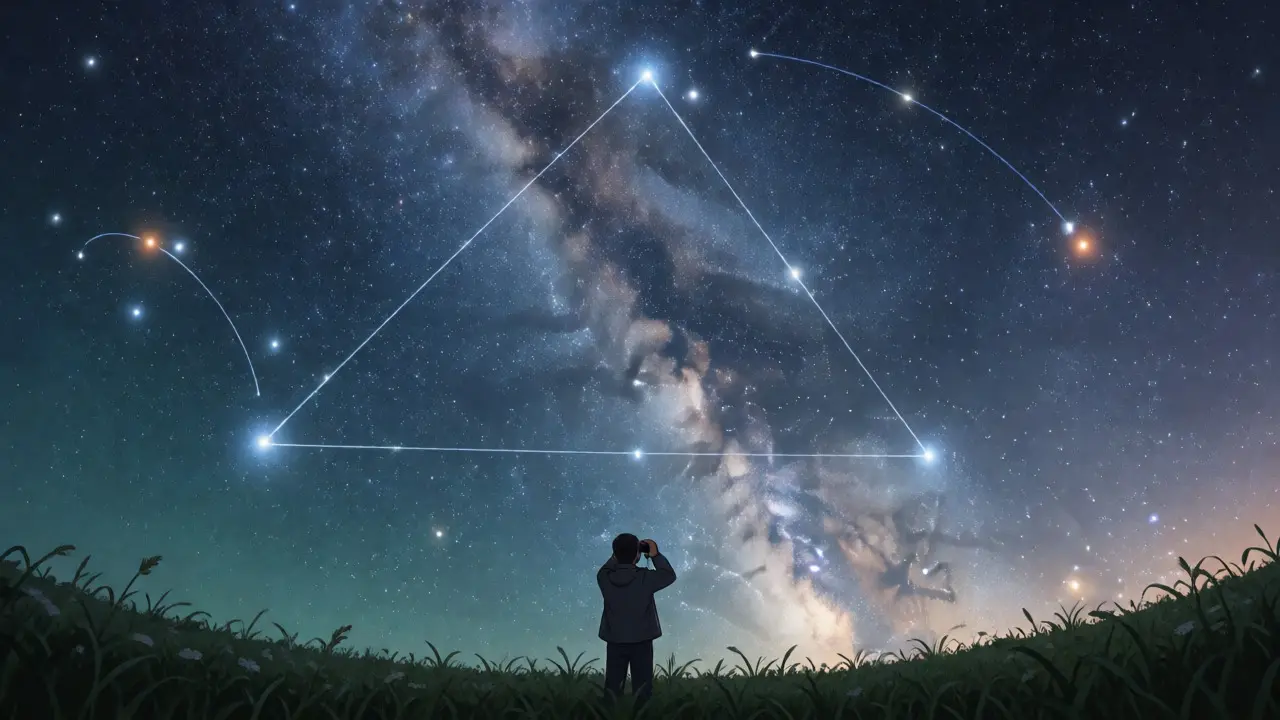
Summer nights are short, but they offer the most spectacular view of our own galaxy. The Milky Way stretches overhead, creating a dense field of stars. This makes star hopping harder because everything looks similar, but easier because you never run out of landmarks. Your primary triangle here is the Summer Triangle, an asterism formed by Vega, Deneb, and Altair.
Vega is the brightest of the three and sits near the head of Lyra. Deneb marks the tail of Cygnus, the Swan, flying along the Milky Way. Altair is in Aquila, the Eagle. These three stars form a massive right-angled triangle. Inside this triangle, you’ll find the Cygnus Rift, a dark lane where dust blocks starlight. To practice, start at Vega. Move slightly east to find Epsilon Lyrae, the "Double Double." It’s four stars grouped in pairs. Then, hop to Albireo, another double star that shows off contrasting colors-one gold, one blue. Seeing color differences is a milestone for any stargazer.
The Autumn Sky: The Great Square and Andromeda
Fall brings cooler temperatures and darker evenings earlier in the night. The dominant feature is the Great Square of Pegasus. It’s a huge box of stars that dominates the southern sky. Unlike other seasons, autumn requires precise hopping because the stars inside the square are dimmer.
Start at Alpheratz, the top-left corner of the square (which is technically also in Andromeda). Follow the chain of stars upward to Mirach. From Mirach, make a sharp turn toward Cassiopeia. About halfway, you’ll spot a fuzzy smudge: M31, the Andromeda Galaxy, the nearest major galaxy to the Milky Way. It’s visible to the naked eye under dark skies, but binoculars reveal its spiral structure. Another great target is the Double Cluster in Perseus. Find the 'W' shape of Cassiopeia. Extend the lines of the W inward until they intersect. Near that intersection, you’ll find two open clusters side-by-side. They look like glitter spilled on black velvet.
Practical Tips for Better Hopping
Knowing *what* to hop to is half the battle. Knowing *how* to do it efficiently is the other half. Most people fail because they lose their orientation. Here is how to fix that.
- Learn Your Hand Measurements: You don’t need a protractor. Hold your arm out straight. Your pinky finger covers about 1 degree. Your fist covers about 10 degrees. The span from thumb to pinky is about 20 degrees. Memorize these. When someone says "move 5 degrees west," you know exactly how far to shift your view.
- Red Light Only: White light destroys your night vision instantly. It takes 20-30 minutes to recover. Use a red flashlight to check your charts. If you don’t have one, put red tape over your phone screen.
- Start Wide: Always begin with binoculars or a low-power eyepiece (25mm or higher). High magnification narrows your field of view so much that you get lost immediately. Find the object first, then zoom in.
- Drift Method: If you can’t find a star, let it drift across the field of view. Earth rotates. Stars move from east to west. Watch which way they move. That tells you where North and South are relative to your telescope tube.
One common mistake is relying too heavily on apps. Apps are great for planning, but they disconnect you from the sky. Try to find at least one object manually before checking your phone. This builds muscle memory. After a few months, you’ll recognize patterns without thinking. You’ll see the Big Dipper and instantly know where Polaris is. You’ll see Orion and know where Sirius lives.
Seasonal Challenges and Solutions
Each season has specific annoyances. In winter, dew freezes on your lenses. Bring hand warmers to stick inside your lens caps. In summer, mosquitoes are relentless. Long sleeves and bug spray are non-negotiable. In spring, wind can shake your tripod. Wait for calm periods or weigh down your tripod legs with a bag of rocks. In fall, humidity rises quickly after sunset. Keep a microfiber cloth handy to wipe lenses frequently.
Also, consider your location. If you live in Portland, Oregon, like I do, light pollution is a real issue. You might not see the Milky Way clearly. Focus on brighter objects first. The Moon phases matter too. Avoid trying to hunt faint galaxies during a full moon. The glare washes out everything except the brightest stars. Plan your sessions around the new moon for the best results.
Do I need a telescope to start star hopping?
No. Binoculars are actually better for beginners. They offer a wider field of view, making it easier to locate objects. A pair of 7x50 or 10x50 binoculars is ideal. Once you’ve mastered finding objects with binoculars, moving to a telescope becomes much easier because you already know where to point.
How long does it take to get good at star hopping?
It varies, but most people feel comfortable within 10-15 hours of practice. Start with easy targets like the Moon or Jupiter. Then move to bright clusters like the Pleiades. Don’t rush into faint galaxies until you can reliably find stars. Consistency matters more than duration; short, frequent sessions work better than one long marathon.
What if I lose my place while hopping?
Go back to your starting point. This is called "re-anchoring." Pick a bright, unmistakable star like Polaris or Vega. Orient yourself again using cardinal directions (North, South, East, West). Often, losing your place happens because you drifted too far in one direction. Resetting prevents frustration and keeps the hobby fun.
Are there apps that help with star hopping?
Yes, apps like Stellarium or SkySafari are excellent. However, use them as training wheels. Print out paper charts for your specific latitude. Practice using the charts alone first. If you rely solely on augmented reality overlays, you won’t develop the spatial awareness needed for true independent observing.
Which season is easiest for beginners?
Winter is generally considered the easiest because the constellations are large, bright, and distinct. Orion and Taurus are hard to miss. Summer offers beautiful views but can be confusing due to the density of stars in the Milky Way. Spring and Fall require more precision due to dimmer stars and smaller constellations.