
10 Jan 2026
- 0 Comments
When you look up at the night sky, you don’t see official maps or scientific charts-you see shapes. A saucepan. A crab. A hunter with a club. These aren’t just random dots. They’re asterisms: familiar star patterns that aren’t official constellations, but are just as easy to spot and way more meaningful to most people.
What Exactly Is an Asterism?
An asterism is a group of stars that form a recognizable pattern, but it’s not one of the 88 officially recognized constellations. Think of it like this: constellations are legal boundaries drawn by astronomers. Asterisms are the shapes you and your grandma see when you’re lying on the grass, pointing at the sky. The Big Dipper is the most famous example. It’s not a constellation. It’s part of Ursa Major, the Great Bear. But no one says, "Look at Ursa Major’s handle and bowl." They say, "Look at the Big Dipper." And that’s because the dipper shape is way easier to remember, track, and use. Other common asterisms? The Summer Triangle (Vega, Deneb, Altair), the Teapot in Sagittarius, Orion’s Belt, and the Pleiades (sometimes called the Seven Sisters). These aren’t just pretty. They’re tools.Why Do Asterisms Matter?
Asterisms are the original GPS of the night sky. Before smartphones, before compasses, humans used these patterns to find direction, track seasons, and tell time. Want to find north? Look for the Big Dipper. Follow the two stars at the end of its bowl-the ones pointing away from the handle. Extend that line about five times its length, and you’ll land on Polaris, the North Star. That’s how sailors, travelers, and farmers found their way for thousands of years. The Teapot in Sagittarius? That’s not just a fun shape. It points toward the center of our galaxy. When you see it low in the southern sky during summer evenings, you’re looking toward the heart of the Milky Way. You’re not just seeing stars-you’re seeing the densest part of our galaxy, 27,000 light-years away. Asterisms are also how beginners learn the sky. Trying to memorize 88 constellations? Impossible. But the Big Dipper? You’ll remember it after one night. Once you know that, you can use it to find Polaris, then Cassiopeia, then Andromeda. It’s a ladder.Big Dipper: The Star Pattern That Changed Everything
Let’s break down the Big Dipper. It’s made of seven bright stars: Dubhe, Merak, Phecda, Megrez, Alioth, Mizar, and Alkaid. Five of them form the bowl. Two make the handle. Mizar? That’s a double star. With a good pair of binoculars, you’ll see it split into two. A third star, Alcor, orbits nearby-so close you can see both with your naked eye if you’ve got sharp vision. Ancient Arabs called them "the horse and rider." The Big Dipper moves. It circles Polaris every 24 hours. In the spring, it’s high in the sky. In fall, it’s low, almost upside down. That’s why farmers used it to know when to plant. When the dipper was upside down and hanging low, it was time to harvest. When it was upright and high, spring was coming. And here’s something cool: the stars in the Big Dipper aren’t all the same distance from us. Dubhe is 124 light-years away. Alkaid is 104. Megrez is 81. They’re not a group that formed together-they just happen to line up from our viewpoint. That’s why asterisms aren’t real physical structures. They’re illusions created by perspective.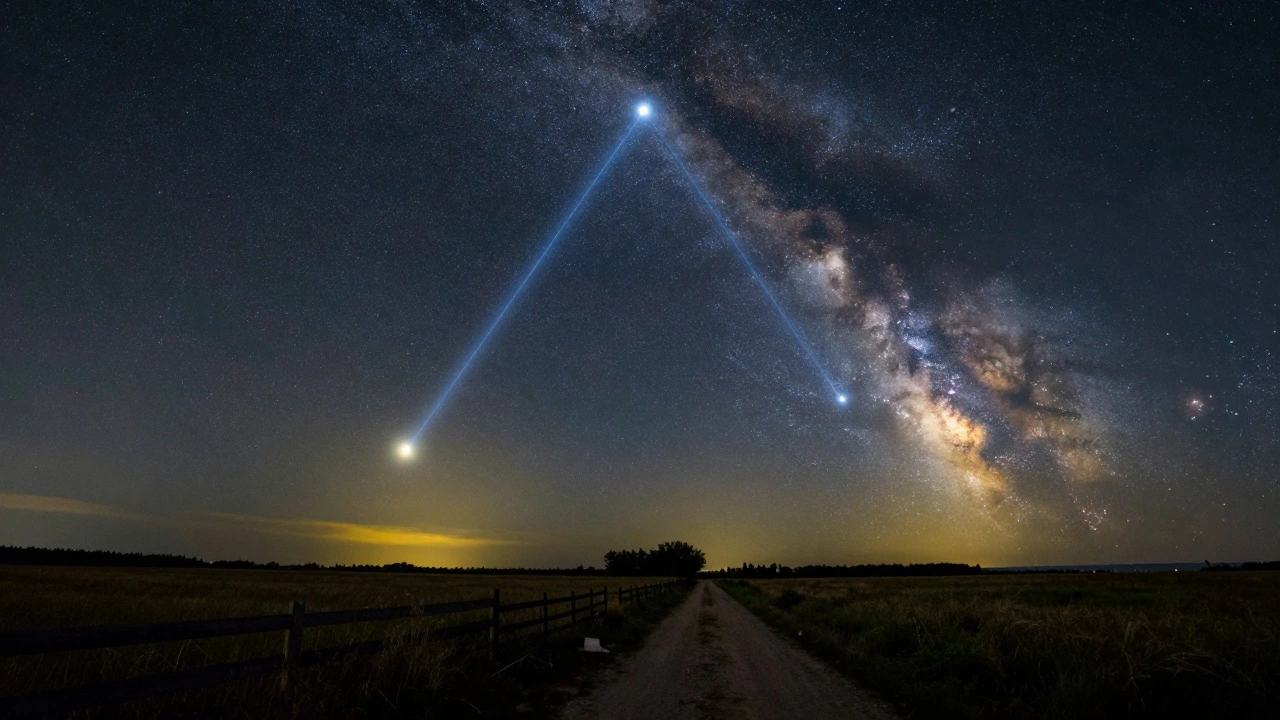
Other Must-Know Asterisms
- The Summer Triangle: Vega in Lyra, Deneb in Cygnus, Altair in Aquila. These three are among the brightest stars in the northern sky. They form a huge triangle that dominates summer nights. It’s easy to spot because each star is a different color-Vega is bluish, Deneb is white, Altair is yellowish.
- Orion’s Belt: Three stars in a straight line. Easy to see even in light-polluted cities. Follow the belt down to find Orion’s Sword, where the Orion Nebula hides. Follow it up to find the red giant Betelgeuse. This one asterism leads to half of Orion’s most famous features.
- The Pleiades: Also called M45. A tight cluster of blue stars, visible to the naked eye as a tiny, fuzzy patch. With binoculars, you’ll see at least 10-12 stars. Greek myths say they’re seven sisters, but modern astronomy counts over 1,000 stars in the group. Most are too dim to see without a telescope.
- The Teapot: Part of Sagittarius. Four stars form the body, three make the spout, and one is the handle. When Sagittarius rises in the south during summer, the Teapot points directly at the galactic center. It’s not just a shape-it’s a map.
- Cassiopeia: Looks like a W or an M, depending on the season. Five bright stars in a distinctive zigzag. It’s always near Polaris and opposite the Big Dipper. If you can find one, you can find the other.
Asterisms vs. Constellations: What’s the Difference?
Constellations are official. The International Astronomical Union drew lines in the sky in 1922 and locked them in. Each constellation has a defined area, a Latin name, and a mythological story attached. They’re for science and cataloging. Asterisms are unofficial. They’re cultural. They’re personal. They’re passed down by grandfathers telling stories under the stars. They don’t have boundaries. They’re not mapped. But they’re more useful to stargazers than any official chart. Here’s the thing: every asterism is part of a constellation. But not every constellation has a well-known asterism. Leo has a backward question mark, but most people don’t call it that. Ursa Minor has Polaris and the Little Dipper-but the Little Dipper is way harder to see than the Big Dipper. So the Big Dipper sticks. The Little Dipper? Not so much.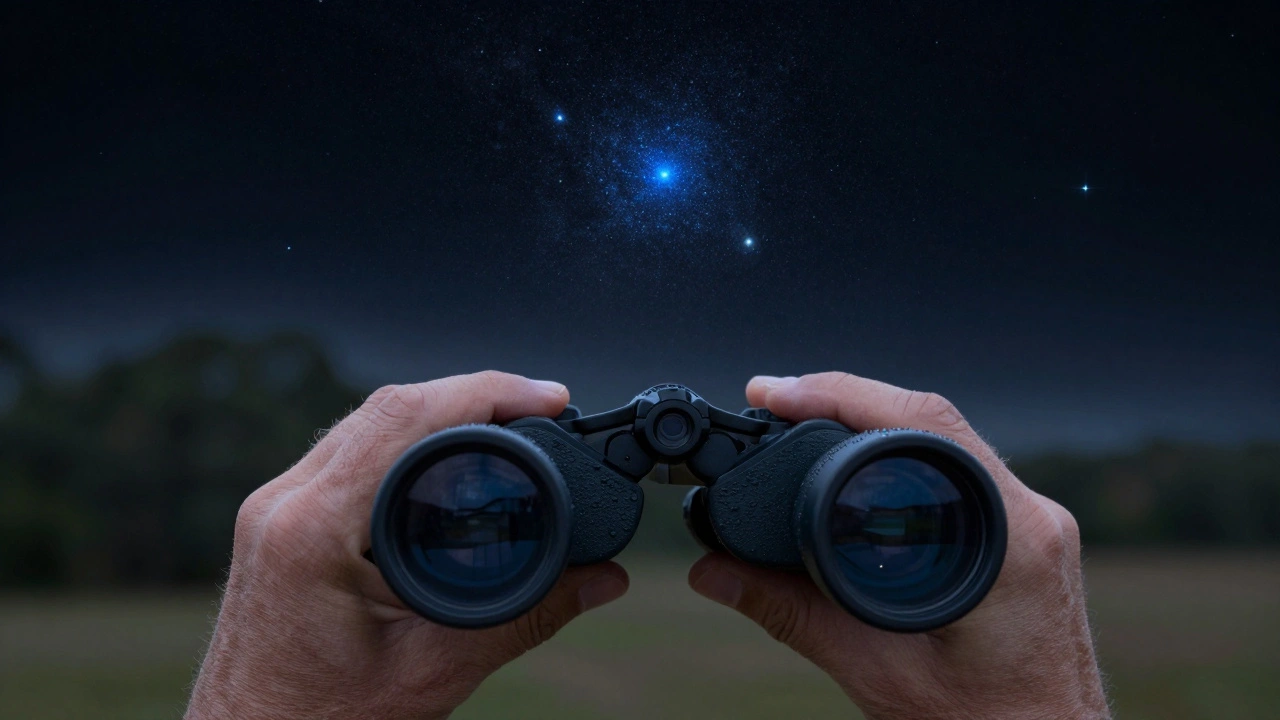
How to Find Asterisms Yourself
You don’t need a telescope. You don’t need an app. Just go outside on a clear night, let your eyes adjust for 10 minutes, and look up. Start with the Big Dipper. It’s visible almost every night of the year from the Northern Hemisphere. Once you find it:- Use it to find Polaris-the North Star.
- Look across the sky to find Cassiopeia. It’s shaped like a crooked W.
- Turn south in late summer and look for the Teapot in Sagittarius.
- Find Orion in winter. His belt is unmistakable.
- Look up in July and August for the Summer Triangle.
Why Asterisms Are Still Relevant Today
In a world of GPS, satellite maps, and AI-powered sky apps, you might think asterisms are outdated. But they’re not. They’re more alive than ever. Why? Because they connect us. When you show your kid how to find the Big Dipper, you’re not teaching astronomy. You’re teaching tradition. You’re teaching them to look up. To wonder. To remember that the sky has stories. Asterisms are also the first step into deeper astronomy. Once you know Orion’s Belt, you’ll want to find the Orion Nebula. Once you find the Pleiades, you’ll wonder why they’re so blue. Once you trace the Summer Triangle, you’ll start asking about how far away Vega really is. They’re the doorway. And they’re free.Final Thought: The Sky Belongs to Everyone
You don’t need a degree to read the sky. You don’t need expensive gear. You just need to look up-and trust what you see. The Big Dipper isn’t official. But it’s real. The Pleiades aren’t a constellation. But they’ve guided travelers for millennia. The Teapot isn’t on any scientific chart. But if you’ve ever seen it, you’ll never forget it. Asterisms remind us that science and wonder aren’t opposites. They’re partners. And sometimes, the most powerful tools we have are the ones we’ve always known.Are asterisms the same as constellations?
No. Constellations are officially recognized regions of the sky with defined boundaries, set by the International Astronomical Union. Asterisms are informal star patterns that aren’t officially recognized but are widely known and easy to spot-like the Big Dipper, which is part of the larger constellation Ursa Major.
Can you see asterisms from the Southern Hemisphere?
Yes, but some are harder to see. The Big Dipper is low or invisible from southern latitudes. However, other asterisms like the Southern Cross, the False Cross, and the Jewel Box Cluster are prominent in the southern sky. Each hemisphere has its own set of recognizable patterns based on visibility.
Why is the Big Dipper so important for navigation?
The two stars at the end of the Big Dipper’s bowl-Dubhe and Merak-are called the "Pointer Stars." If you draw a line from Merak through Dubhe and extend it about five times the distance between them, you’ll reach Polaris, the North Star. This method has been used for centuries to find true north, even without a compass.
Are asterisms made of stars that are physically close together?
Usually not. Most asterisms are optical illusions. The stars in a pattern like the Big Dipper are at wildly different distances from Earth-some are 80 light-years away, others over 120. They only appear close because we’re viewing them from one angle. They’re not gravitationally bound or part of the same cluster.
How many asterisms are there?
There’s no official count. Dozens of asterisms are widely recognized, especially among amateur astronomers. Common ones include the Big Dipper, Summer Triangle, Orion’s Belt, Pleiades, and the Teapot. Many more exist as local or cultural patterns-like the "Loch Ness Monster" in the UK or the "Dancing Girl" in parts of Asia-but they’re not universally known.