3 Mar 2026
- 0 Comments
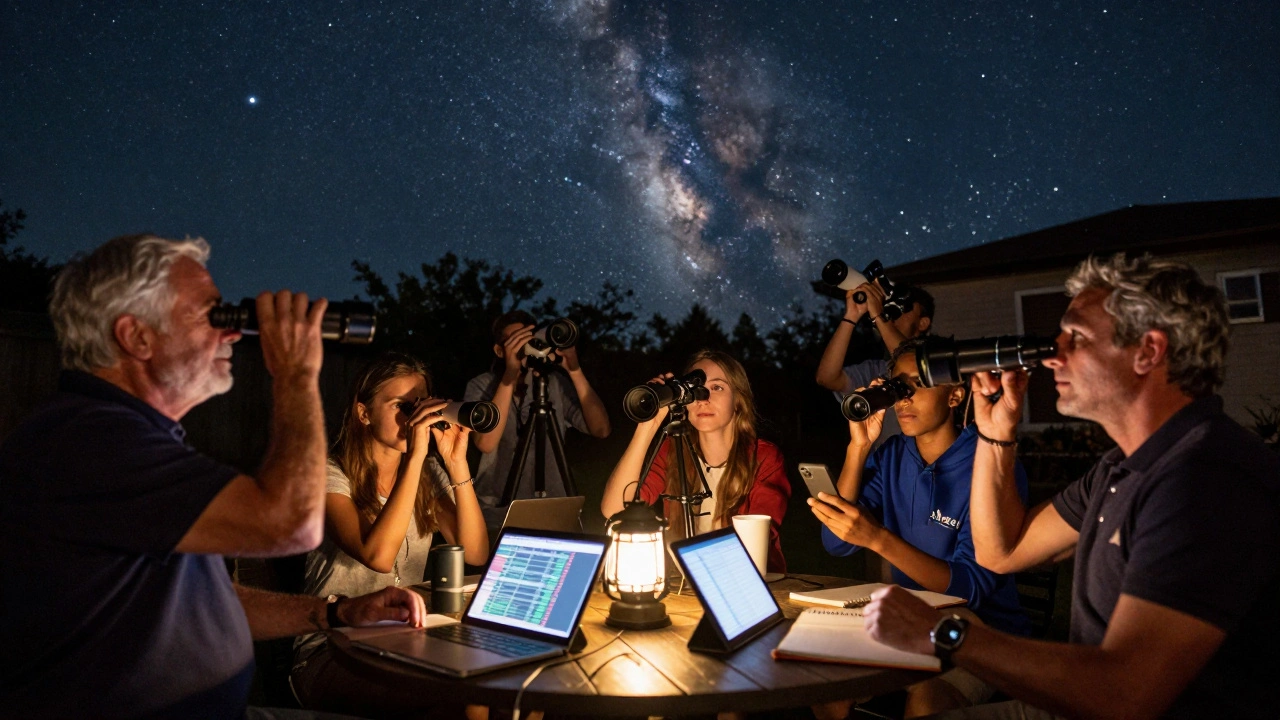
Every night, thousands of people around the world point their telescopes at the sky-not just for fun, but to help scientists uncover things no one else can see. These aren’t professional astronomers with PhDs and million-dollar observatories. They’re teachers, mechanics, retirees, and students. And they’re making discoveries that change how we understand the universe.
What Exactly Is Citizen Science in Astronomy?
Citizen science in astronomy means regular people collecting, analyzing, or reporting astronomical data that professional researchers use. It’s not about guessing star names or taking pretty photos. It’s about systematic observation, logging patterns, and spotting anomalies that computers or automated systems miss.
For decades, astronomers have relied on volunteers because the sky is too big to monitor alone. There are over 100 billion stars in our galaxy alone. Telescopes like NASA’s Kepler and TESS scan huge swaths of sky, but they generate more data than human teams can process. That’s where amateurs come in.
How Amateurs Spot Things Professionals Miss
Computers are great at finding patterns-but they’re terrible at noticing when something doesn’t fit. A star that suddenly dims for a few hours? A new comet streaking across the frame? A galaxy that looks oddly shaped? These are the kinds of things human eyes still catch better than algorithms.
Take the case of the variable stars. These are stars that change brightness over time. Some pulse every few days. Others flare unpredictably. Professional surveys can track thousands, but they can’t always classify them correctly. Volunteers on projects like the American Association of Variable Star Observers (AAVSO) have logged over 20 million observations since 1918. One amateur in Ohio spotted a star dimming by 80% over 36 hours. Follow-up studies revealed it was a rare type of binary system where one star is being slowly consumed by its companion. That discovery was published in the Astronomical Journal.
Real Discoveries, Real Impact
Amateur astronomers have contributed to major scientific milestones:
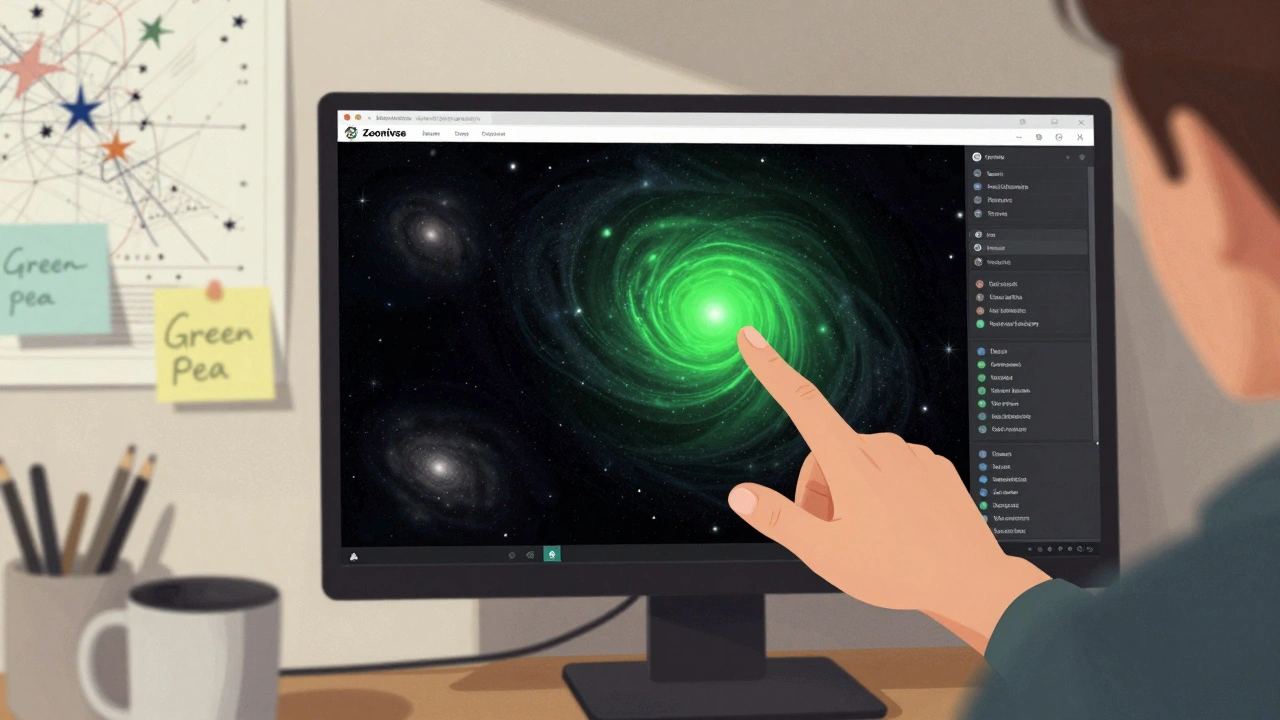
- In 2019, a group of volunteers using the Zooniverse platform discovered a new type of galaxy called “Green Peas.” These compact, star-forming galaxies were invisible to automated filters but stood out to human eyes because of their bright green color in telescope images.
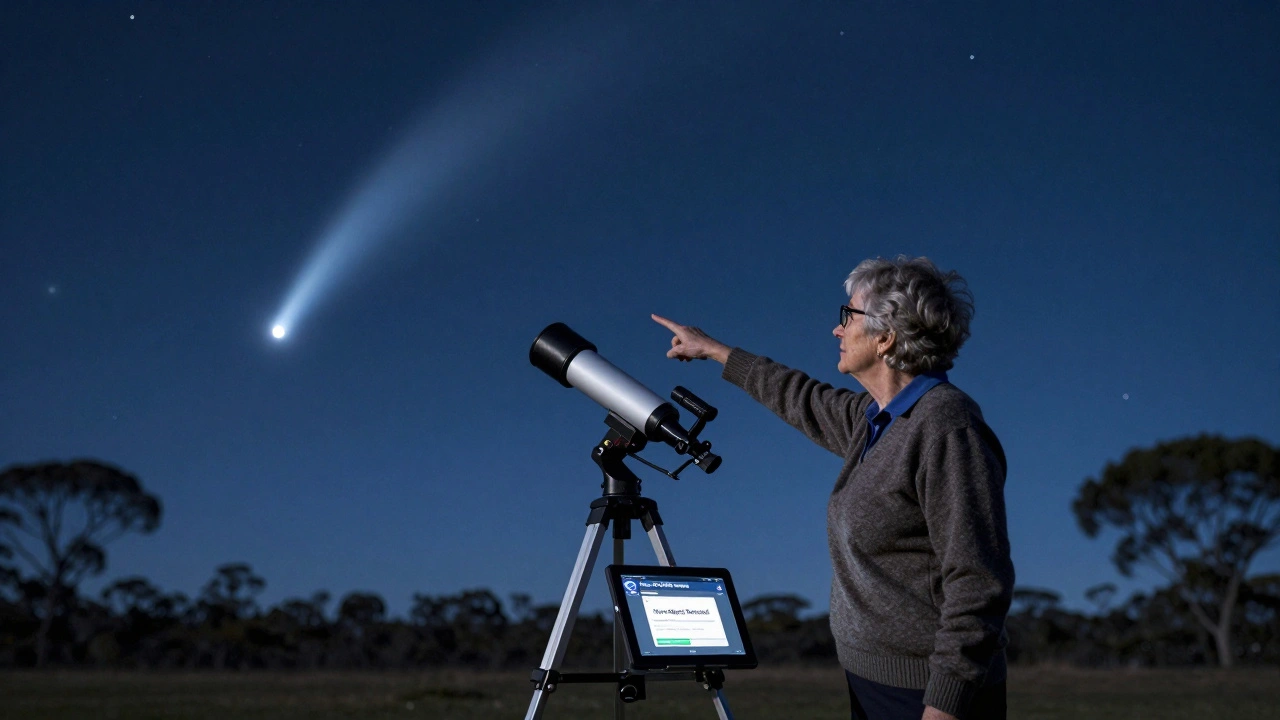
- In 2021, a retired schoolteacher in Australia noticed a new comet in images from the Pan-STARRS survey. It was later named C/2021 O3 and became one of the most studied comets of the year.
- Amateur observers helped track the path of asteroid 2022 EB5-the first asteroid ever detected before it hit Earth’s atmosphere. Its impact was confirmed by a network of amateur skywatchers who recorded its fiery entry over Greenland.
These aren’t flukes. A 2023 study in Nature Astronomy found that over 60% of new variable star discoveries between 2010 and 2022 came from citizen science projects. In asteroid tracking, amateurs contribute more than 70% of the positional data used by NASA’s Near-Earth Object program.
How You Can Get Involved
You don’t need a $10,000 telescope. You don’t even need a dark sky. Here’s how to start:
- Join a project like Zooniverse or AAVSO. Both offer free training and tools.
- Use free software like Stellarium or Cartes du Ciel to plan your observations. Many projects provide templates for logging data.
- Start simple. Try monitoring one star a week. Record its brightness, date, time, and weather. Even small, consistent data helps.
- Connect locally. Join a regional astronomy club. Many have group observing nights and data-sharing sessions.
Some volunteers use smartphone apps like SkySafari or Stellarium Mobile to take snapshots and upload them directly to databases. Others use modified DSLRs or entry-level CCD cameras. The key isn’t the gear-it’s consistency.
Why This Matters Beyond the Numbers
Citizen science isn’t just about data. It’s about changing how science works. For years, astronomy felt like a closed club. You needed a university affiliation, access to a telescope, and years of training. Now, anyone with curiosity can contribute.
Studies show that participants in citizen science projects develop stronger science literacy. A 2024 survey of 3,200 amateur astronomers found that 89% reported increased confidence in understanding scientific methods. Many go on to mentor students, start local science clubs, or even switch careers into STEM.
And the science benefits too. When amateurs report an unusual event, professionals can drop everything and point a telescope at it. That kind of rapid response is impossible with just professional teams. In 2025, a group of volunteers in Germany noticed a sudden flare from a distant quasar. Within hours, the James Webb Space Telescope was redirected to observe it. The data revealed a previously unknown magnetic field structure in the galaxy’s core.
Common Myths About Amateur Astronomy
There are a few misconceptions that keep people from getting started:
- Myth: You need expensive equipment. Reality: Many projects use data from public surveys. You can classify galaxies on your phone.
- Myth: Your data won’t be taken seriously. Reality: Amateur data is cited in peer-reviewed papers every month.
- Myth: You have to be an expert. Reality: Projects include step-by-step tutorials. You learn as you go.
The most successful volunteers aren’t the ones with the best gear-they’re the ones who show up consistently. One volunteer in Texas has been logging star brightness every night for 17 years. His data helped identify a long-term trend in a star’s behavior that led to a new theory about stellar aging.
What’s Next for Citizen Science?
The future is even more exciting. With new telescopes like the Vera C. Rubin Observatory coming online in 2026, the volume of data will explode. Scientists estimate it will generate 15 terabytes of data every night. No human team can handle that alone.
Projects are already building AI tools that flag anomalies-but they still need humans to verify them. That’s where you come in. The next breakthrough might come from someone in a small town, looking up at the sky with a backyard telescope, wondering why a certain star looks different tonight.
Do I need a telescope to do citizen science in astronomy?
No. Many projects use data from large telescopes and let volunteers classify images on a computer or phone. You can help find new galaxies, track asteroids, or spot supernovae just by looking at online images. A telescope helps if you want to make your own observations, but it’s not required to contribute.
Can kids participate in citizen science astronomy projects?
Absolutely. Projects like Zooniverse have kid-friendly interfaces and simple tasks like identifying shapes in galaxy images. Many schools use these projects in science classes. One 12-year-old in Oregon helped classify over 10,000 galaxies in six months and was listed as a co-author on a research paper.
Is citizen science data reliable?
Yes. Most projects use multiple volunteers to verify each observation. If 10 people all say a star changed brightness, scientists trust it. Statistical methods filter out errors. In fact, citizen science data often has higher accuracy than automated systems because humans are better at recognizing patterns that don’t fit.
How much time do I need to commit?
It’s flexible. You can spend five minutes a day or five hours a week. Some projects let you classify one image in under a minute. Others, like tracking variable stars, require regular nightly observations. You control the time. Even small contributions add up over time.
Will I get credit if I help make a discovery?
Yes. Many published papers list citizen scientists as co-authors. If your observation leads to a discovery, you’ll be named in the paper. Some amateurs have even had asteroids named after them. Recognition isn’t just symbolic-it’s formal and permanent.
The sky doesn’t belong to professionals. It belongs to anyone who looks up and wonders. You don’t need permission to be part of the next big discovery. Just look up, log your observations, and keep showing up. Science doesn’t just happen in labs-it happens in backyards, schoolrooms, and bedrooms all over the world.