9 Mar 2026
- 0 Comments
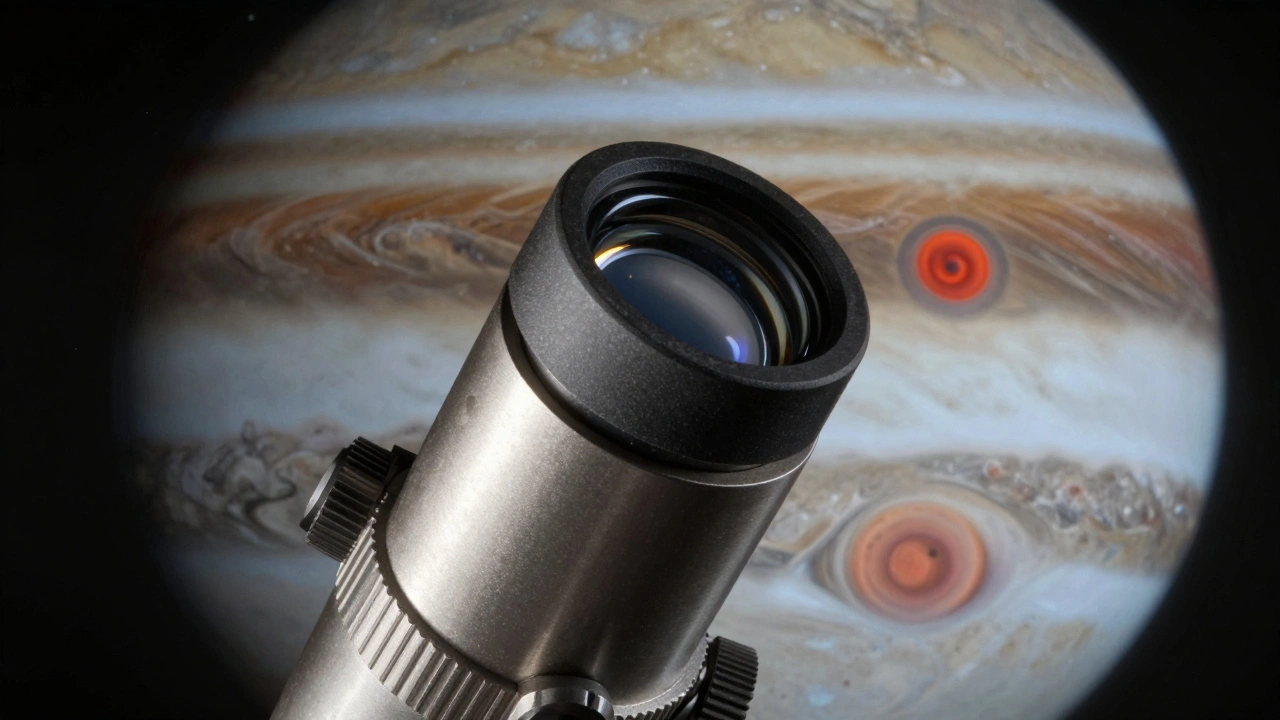
When you’re staring through your telescope at Jupiter’s cloud bands or the rings of Saturn, what you see isn’t just the light coming from space-it’s the result of every lens, prism, and coating in your eyepiece. Among all the eyepiece designs out there, the orthoscopic eyepiece stands out for one reason: it gives you the clearest, highest-contrast view of planets you can get without spending thousands on a new telescope.
What Makes an Orthoscopic Eyepiece Different?
The orthoscopic design was invented in the late 19th century by Ernst Abbe, the same optical engineer who helped Carl Zeiss build the first high-quality microscopes. It’s a simple four-element design: a single convex lens at the top, followed by a triplet cemented lens group. That’s it. No fancy aspheric elements, no complex multi-coatings. Just pure, uncluttered optics.
What makes this design special is how it handles light. Most modern wide-field eyepieces spread the light across a broad angle to give you a sweeping view of star fields. But for planets, you don’t need a wide field-you need sharpness, contrast, and detail. The orthoscopic design minimizes internal reflections and scatter, keeping stray light from washing out the fine features on Mars or the shadow of Jupiter’s moons as they cross its surface.
Because of its simplicity, the orthoscopic eyepiece doesn’t suffer from ghosting or chromatic aberration like some cheaper designs. Even in fast telescopes (f/4 or f/5), it holds its focus without needing extra accessories. That’s why serious planetary observers still swear by them-even in 2026.
Why Contrast Matters More Than Field of View
Let’s say you’re comparing an orthoscopic eyepiece with a modern 82-degree wide-angle design. The wide-field eyepiece might look more impressive at first glance-more stars, more space, more drama. But when you turn it to Jupiter, something strange happens. The cloud belts look fuzzy. The Great Red Spot doesn’t pop. The polar cap on Mars blends into the background.
That’s because wide-field eyepieces prioritize apparent field of view over contrast. They use more lens elements, more air-glass interfaces, and more coatings. Each of those adds a tiny bit of light scatter. For deep-sky objects like nebulae or galaxies, that’s fine. But for planets? You need every photon to carry detail, not noise.
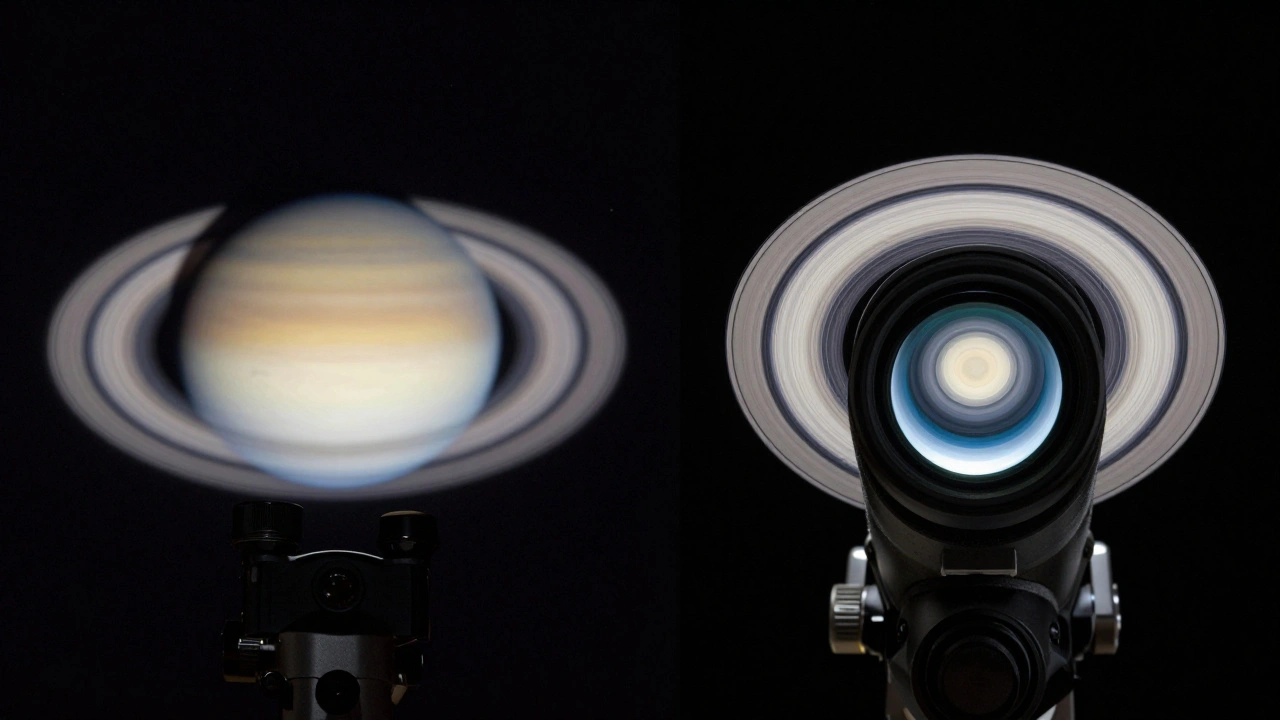
The orthoscopic design cuts that scatter. Its internal baffling and minimal lens count mean that light from the planet travels straight through with almost no bouncing around inside the eyepiece. The result? A dark background and bright, crisp features. You see the difference like this: on a clear night, you can pick out the Cassini Division in Saturn’s rings with a 6mm orthoscopic, even through a modest 6-inch refractor. Most modern eyepieces struggle to show it clearly at the same magnification.
Real-World Performance: What You Can Actually See
Here’s what observers report using orthoscopic eyepieces in real conditions:
- On Mars during opposition: You can track dust storms as they move across the surface over hours-not just guess they’re there.
- On Jupiter: The equatorial belts show texture, not just color. You see the festoons (wave-like patterns) along the edges of the belts, which many modern eyepieces blur.
- On Saturn: The Encke Division (a narrow gap within the A ring) becomes visible under steady seeing conditions, even in 80mm refractors.
- On the Moon: Crater rims are razor-sharp. You can see the fine ridges inside Tycho’s central peak without any glow or halo around them.
These aren’t theoretical claims. They’re what people with 20+ years of planetary observing have documented in forums, journals, and private logs. The orthoscopic doesn’t need a big telescope to shine. Even a 70mm refractor can reveal astonishing detail with a 5mm orthoscopic.
Limitations: What Orthoscopic Eyepieces Don’t Do
They’re not perfect. And they never claimed to be.
First, eye relief. Most orthoscopic eyepieces have very short eye relief-especially the shorter focal lengths. A 5mm orthoscopic might only give you 5mm of eye relief. That means you have to press your eye right against the lens. For people who wear glasses, this is a dealbreaker. You’ll need to remove your glasses and squint, or switch to a different design.
Second, the field of view is narrow. Around 40-45 degrees. That’s fine for planets, but if you want to see the whole Orion Nebula in one view, you’ll need something wider. Orthoscopics are planetary specialists. They’re not for wide-field sweeps.
Third, they’re mostly made in older designs. You won’t find them in every store. Brands like Tele Vue, Pentax, and Meade still make them, but they’re not mass-produced like the Plössls or Naglers. You’ll likely need to buy them secondhand or from specialty dealers.
How to Choose the Right One
If you’re serious about planetary viewing, here’s how to pick the best orthoscopic for your setup:
- Match it to your telescope’s focal ratio. Fast scopes (f/5 or faster) need a well-corrected orthoscopic. Stick with Tele Vue or Pentax models-they handle fast optics better than generic brands.
- Choose focal length based on your seeing conditions. In average skies, a 6mm or 8mm gives you 150x-200x magnification, which is ideal. In turbulent air, go longer (10mm-12mm).
- Check the barrel size. Most are 1.25-inch. If your telescope only accepts 2-inch eyepieces, you’ll need a 1.25-inch adapter.
- Buy from reputable sellers. Avoid knockoffs on eBay or Amazon. Many are labeled “orthoscopic” but are just poorly made Plossls with a fancy name.
For example, if you have an 80mm f/7.5 refractor, a 6mm orthoscopic will give you 175x magnification. That’s perfect. You’ll see the moons of Jupiter as distinct disks, not dots. You’ll see the shadow of Io crossing the cloud tops. You’ll see the polar hood on Mars shrink and grow over weeks.
Modern Alternatives: Are There Better Options?
Some say the orthoscopic is outdated. That’s not true-but there are newer designs that come close.
The Delos and ES 82° eyepieces from Tele Vue and Explore Scientific offer better eye relief and wider fields, but they cost 3-4 times as much. And while they’re excellent, they don’t always beat the orthoscopic in contrast on planets. In side-by-side tests, the orthoscopic still delivers darker backgrounds and sharper planetary edges.
The Ultrawide and Expanse lines from other brands try to mimic the orthoscopic’s performance, but they add extra glass to widen the view-and that always trades off some contrast.
Bottom line: If you want the best possible planetary view for under $100, nothing beats a genuine orthoscopic. It’s the last great analog tool in a digital age.
Who Should Use One?
Orthoscopic eyepieces aren’t for everyone. But if you fit any of these profiles, you’ll love them:
- You observe planets regularly, not just once a year.
- You’re comfortable with short eye relief and don’t wear glasses while observing.
- You have a refractor, Schmidt-Cassegrain, or a long-focus Newtonian.
- You value detail over spectacle.
- You’re building a collection of eyepieces and want one that’s proven over decades.
If you’re a beginner who just got your first telescope and want to see everything at once-skip it. Wait until you’re ready to zoom in and really study the planets. Then come back to the orthoscopic. It won’t disappoint.
Final Thoughts: The Quiet Giant of Planetary Viewing
The orthoscopic eyepiece doesn’t shout. It doesn’t have flashy branding or glowing LED rings. It doesn’t come with a warranty card that says “revolutionary.” It just works. Consistently. Reliably. For over 120 years.
In a world where every new gadget promises to change everything, the orthoscopic is a reminder that sometimes, the best solution is the simplest one. It doesn’t need AI, software correction, or smartphone integration. Just a clear night, a steady atmosphere, and your eyes.
There’s a reason planetary observers still hunt them down. Not because they’re nostalgic. But because they still deliver what no other design can: pure, unfiltered detail.
Are orthoscopic eyepieces still made today?
Yes, but not widely. Brands like Tele Vue, Pentax, and Meade still produce them, especially in 1.25-inch sizes. You’ll find them in specialty astronomy shops or on the used market. Avoid cheap copies labeled as "orthoscopic"-many are just Plossl designs with misleading names.
Can I use an orthoscopic eyepiece with a telescope that has a fast focal ratio?
Yes, but only if it’s a well-corrected model. Older or generic orthoscopics can show edge distortions in f/4 or f/5 telescopes. Stick with Tele Vue or Pentax models-they’re designed to handle fast optics without coma or astigmatism. For very fast scopes, consider a modern planetary eyepiece with a similar contrast profile.
Why do some people say orthoscopic eyepieces have poor eye relief?
Because they do. The design uses a single lens at the top, which forces your eye very close to the lens-often just 5-8mm away. This is fine for people with good eyesight, but if you wear glasses, you’ll struggle to see the full field. That’s why modern eyepieces with longer eye relief became popular.
Is an orthoscopic better than a Plossl for planetary viewing?
Generally, yes. While both are four-element designs, the orthoscopic has a better internal light path. It reduces scatter and ghosting more effectively than a standard Plossl. In direct comparison, the orthoscopic gives darker backgrounds and sharper planetary edges, especially at higher magnifications.
What’s the best focal length for planetary use with an orthoscopic?
For most amateur telescopes, 5mm to 8mm is ideal. This gives you 150x to 200x magnification, which matches the typical resolution limits of Earth’s atmosphere. Shorter than 5mm often pushes beyond usable magnification unless you have exceptional seeing. Longer than 10mm reduces detail unless you have a very large aperture.