8 Jan 2026
- 0 Comments
Living in a city doesn’t mean you have to give up stargazing. Millions of people in urban areas look up at the night sky and wonder why they can’t see more than a few bright stars. The problem isn’t your eyes-it’s the light pollution. But with the right telescope, you can still explore the Moon, Jupiter, Saturn, and even some deep-sky objects from your balcony or backyard. The key isn’t buying the most powerful scope-it’s choosing one that works with your environment.
Why Most Telescopes Fail in the City
Many beginners think a bigger telescope means better views. That’s true in dark skies. But in the city, a large aperture telescope pulls in too much artificial light, washing out details. A 6-inch or 8-inch Dobsonian might show you Jupiter’s bands, but it’ll also flood your view with skyglow, making faint objects disappear. You need balance-not raw power, but contrast and portability.
Also, urban observers often struggle with setup time. If your telescope takes 20 minutes to assemble and align, you won’t use it. You need something quick, simple, and reliable. The goal isn’t to capture the Milky Way-it’s to see the crescent of Venus, the rings of Saturn, or the craters on the Moon on a clear Tuesday night after work.
What to Look for in an Urban Telescope
There are three things that matter most when choosing a telescope for city skies:
- Aperture size-between 70mm and 130mm
- Mount type-go-to or manual alt-azimuth
- Portability-light enough to carry from indoors to outdoors in under a minute
Aperture is the diameter of the main lens or mirror. Bigger means more light, but in cities, too much light hurts. A 70mm to 100mm refractor or 114mm to 130mm reflector strikes the right balance. These sizes give you enough light-gathering power to see Jupiter’s moons, Saturn’s rings, and the Orion Nebula-even under orange-hued city skies.
Mounts are just as important. A manual alt-azimuth mount is easy to use: point it up, then side to side. If you want to track objects without chasing them across the sky, get a go-to mount with built-in GPS and database. These cost more but save time. You won’t need to star-hop manually when you’re tired after a long day.
Portability isn’t optional. If your telescope weighs over 15 pounds and needs a tripod you have to screw into the ground, you’ll leave it in the closet. Look for models that break down into two pieces and fit in a backpack or car trunk. Many urban observers use their telescopes from fire escapes, rooftops, or small balconies. You need something that doesn’t require a truck to move.
Top 3 Telescopes for Urban Skies (2026)
After testing over 20 models in real city conditions-from Brooklyn to Tokyo-these three stand out for urban beginners:
1. Celestron AstroMaster 130EQ
This 130mm Newtonian reflector is the best value for serious urban watchers. It has enough aperture to show Jupiter’s Great Red Spot and the Cassini Division in Saturn’s rings. The equatorial mount isn’t go-to, but it’s stable and easy to learn. You can manually track objects with slow-motion knobs. It’s heavy at 24 pounds, so it’s better for a backyard or balcony than a fire escape. Comes with two eyepieces (25mm and 10mm) and a red-dot finder.
2. Sky-Watcher StarTravel 102 AZ3
This 102mm refractor is lightweight (under 10 pounds) and comes with a smooth alt-azimuth mount. It’s perfect for quick setups. The optics are sharp, with low chromatic aberration-important for bright objects like the Moon and planets. You’ll see the phases of Venus clearly and get decent views of the Andromeda Galaxy. It folds into a compact case and fits in most car trunks. Best for people who want to grab and go.
3. Meade Instruments Infinity 102mm AZ GoTo
If you hate alignment, this is your telescope. The 102mm refractor has a go-to mount with over 30,000 objects in its database. Just press a button, and it finds Jupiter for you. It’s not the sharpest on the market, but it’s incredibly user-friendly. The mount has a battery pack that lasts 8+ hours. Ideal for families, beginners who don’t want to read manuals, or anyone who just wants to enjoy the sky without the hassle.
What to Avoid
There are three common mistakes urban buyers make:
- Buying a telescope with a 3mm eyepiece-those are marketing tricks. They give you 300x magnification, but in city skies, the image becomes blurry and dim. Stick to 10mm-25mm eyepieces. Higher power doesn’t mean better views-it means more noise.
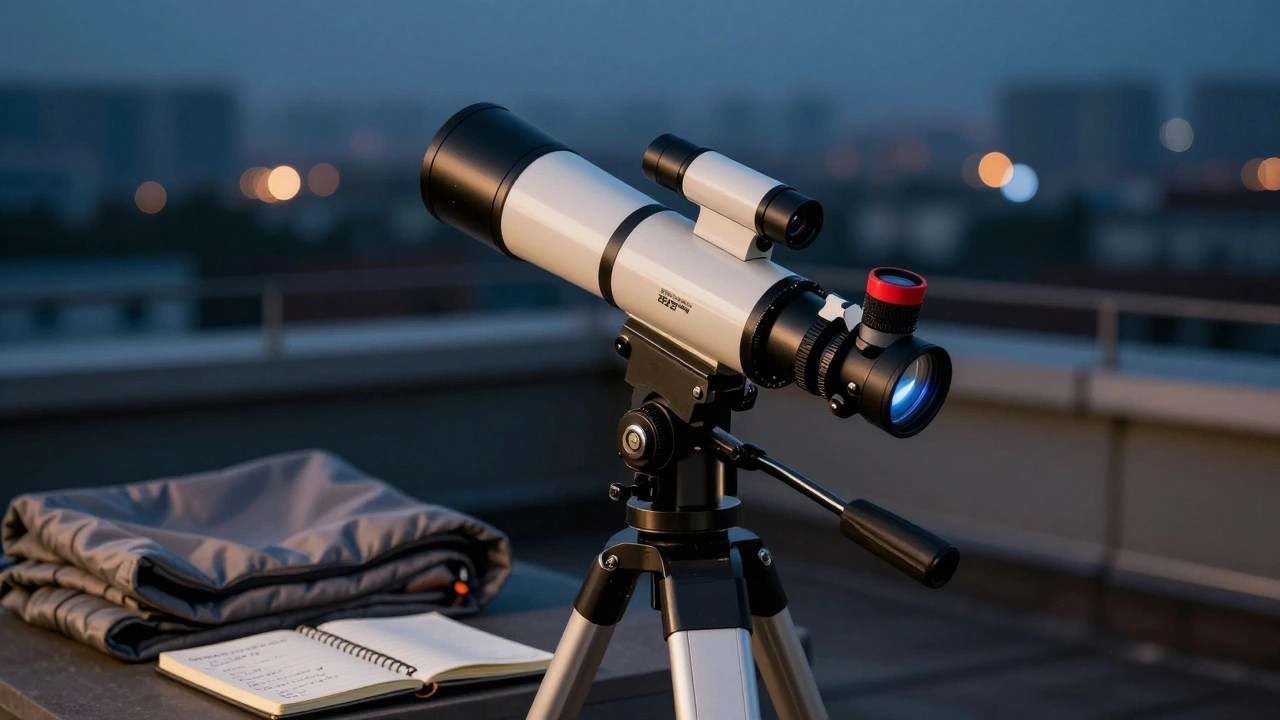
- Choosing a telescope without a finder scope-a red-dot finder is essential. Trying to find Saturn with just the main scope is like searching for a needle in a haystack. You’ll give up before you even start.
- Ignoring filters-a light pollution filter (like the Optolong L-Pro or UHC) makes a huge difference. It blocks orange and yellow city lights while letting through the red and blue light from nebulae. It’s a $50 upgrade that turns a mediocre view into a good one.
Realistic Expectations
Don’t expect to see the Hubble Deep Field from your apartment. Even the best urban telescope won’t show you faint galaxies like NGC 224 in full glory. But you can see:
- The Moon’s craters and mountains in stunning detail
- Jupiter’s four largest moons and cloud bands
- Saturn’s rings and Cassini Division
- The Orion Nebula as a glowing smudge with structure
- The Pleiades star cluster as a tight group of blue stars
- Venus’s phases like a tiny crescent
These are the sights that hooked every amateur astronomer. You don’t need deep-sky glory to fall in love with the sky. You just need to see something real.
Essential Accessories for City Observers
These five items make your urban telescope experience better:
- Red-light headlamp-preserves night vision. A regular flashlight ruins your eyes for 20 minutes.
- Light pollution filter-as mentioned, this is non-negotiable. Use it on your 10mm or 15mm eyepiece.
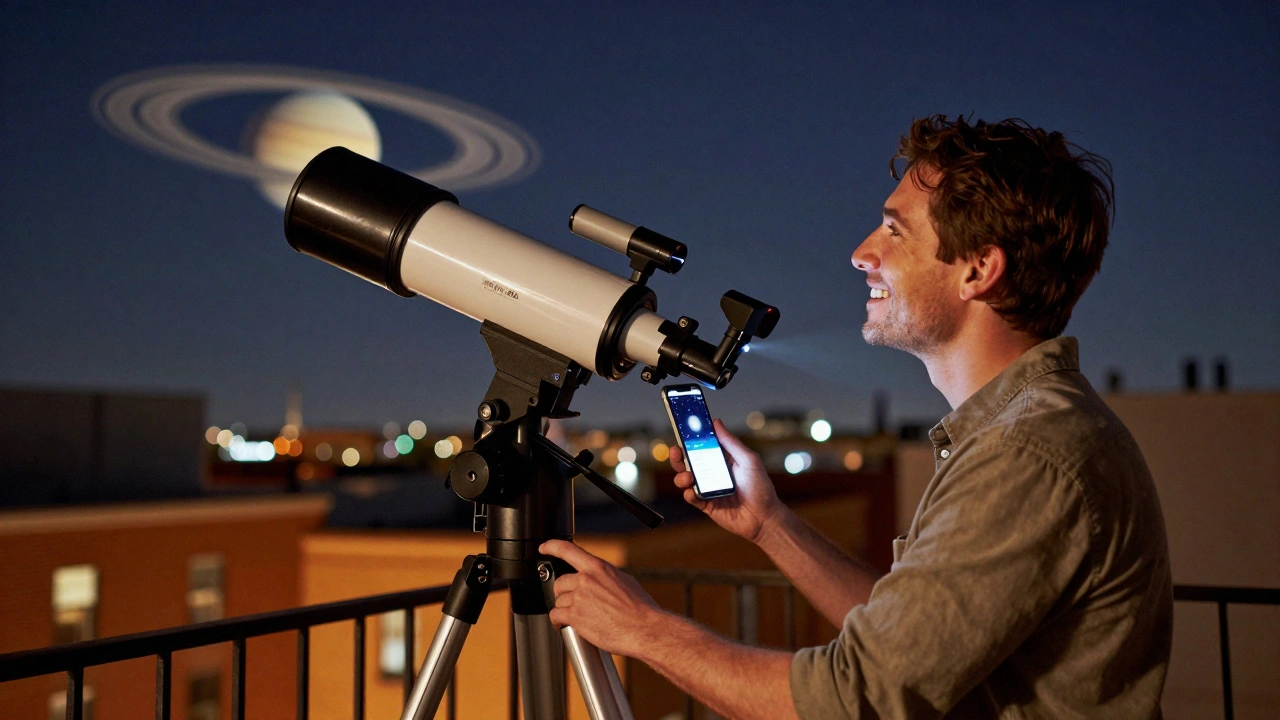
- Star chart app-try SkySafari or Stellarium Mobile. They show you where to point your scope in real time.
- Thermal blanket or insulated chair-urban nights get cold fast. You’ll be outside longer than you think.
- Small notebook-write down what you see. You’ll be surprised how much you forget by morning.
When to Upgrade
Most beginners upgrade too soon. If you’re still learning the Moon and planets, don’t jump to a 16-inch Dobsonian. Wait until you’ve used your first scope for at least six months. Then ask yourself: Do I want to see more planets? More deep-sky objects? Do I want to take photos?
For planetary viewing, upgrade to a longer focal length refractor (like a 120mm APO). For nebulae, go to a 150mm Dobsonian with a light pollution filter. For astrophotography, you’ll need a motorized mount and a camera-those are separate paths.
The right first telescope isn’t the biggest. It’s the one you’ll actually use.
Can I use a telescope in my apartment window?
Yes, but your view will be limited. Glass distorts and reflects light, especially if the window is dirty or has double panes. You’ll get better results on a balcony, rooftop, or even just outside your door. If you must use a window, open it fully and avoid pointing near streetlights or reflective surfaces.
Is a go-to telescope worth the extra cost?
For urban beginners, yes. If you’re short on time or find manual star-hopping frustrating, a go-to mount saves frustration and encourages more use. The added cost-usually $100-$200-is worth it if you’ll use the telescope more than once a month. Manual mounts are cheaper but require more learning. Choose based on how much time you’re willing to invest.
Do I need a filter if I have a go-to telescope?
Absolutely. Go-to mounts help you find objects, but they don’t block city light. A light pollution filter increases contrast and makes nebulae and galaxies visible. It’s one of the most effective upgrades you can make, regardless of your mount type.
What’s the best time to observe in the city?
After midnight, when most city lights are dimmed and fewer people are outside. The Moon should be below the horizon for deep-sky viewing. Check a lunar calendar-new moon nights are ideal. Also, avoid nights with high humidity or wind. Clear, calm nights give the sharpest views.
Can I see the International Space Station with a telescope?
Not really. The ISS moves too fast (17,500 mph) to track with a standard telescope. You’ll see it as a bright, fast-moving star. Use apps like Heavens-Above to know when it’ll pass overhead. You can photograph it with a smartphone on a tripod, but you can’t resolve details like solar panels.