28 Dec 2025
- 0 Comments
Most beginners in astrophotography hit a wall after their first few shots. You set up your camera on a tripod, take a 30-second exposure of the Milky Way, and it looks great-until you zoom in. The stars aren’t sharp. They’re streaked. That’s because Earth spins. And without tracking, your camera just captures that motion as blur. That’s where a portable star tracker comes in. It’s not a fancy mount. It’s not a $3,000 equatorial system. It’s a small, lightweight device that rotates your camera at the same rate the sky moves. And for wide-field imaging, it’s the only thing you need.
What a Star Tracker Actually Does
A star tracker is a motorized platform that holds your camera and turns it slowly to match Earth’s rotation. Think of it like a turntable for the night sky. Without it, your camera stays still while the stars drift across the frame. With it, your camera moves with them. The result? Sharper stars, longer exposures, and more detail in your Milky Way shots.
Entry-level trackers like the Sky-Watcher Star Adventurer Mini or the iOptron SkyGuider Pro are designed for this exact purpose. They’re built for wide-field imaging-think landscapes with stars, nebulae like Orion, and the Andromeda Galaxy. They don’t handle long telephoto lenses or heavy telescopes. But they work perfectly with a DSLR or mirrorless camera and a standard lens, like a 14mm or 24mm.
These trackers use a single-axis motor to follow the celestial equator. That’s enough for exposures up to 2-5 minutes. You don’t need polar alignment perfection. Just a rough setup, and you’re good to go.
Why You Don’t Need a Big Mount
Many people think astrophotography means lugging around a heavy equatorial mount, balancing a telescope, and spending hours calibrating. That’s not true for wide-field work. A full equatorial mount is overkill. It’s heavy. It’s expensive. It needs a sturdy tripod and precise polar alignment. For most people, it’s more hassle than it’s worth.
A portable star tracker weighs under 2 pounds. It fits in a backpack. You can set it up in under 5 minutes. No software. No computer. No complex alignment tools. Just point it north, level it, and let it do the work.
Compare this to a traditional equatorial mount: it needs a separate polar scope, alignment routines, counterweights, and often a laptop for guiding. That’s great for deep-sky imaging with a 6-inch telescope. But for capturing the Milky Way over a forest or a mountain ridge? A tracker is the smart choice.
How to Set Up a Star Tracker for Best Results
Setting up a star tracker isn’t complicated, but a few steps make all the difference.
- Find true north. Use a compass app, but remember: magnetic north isn’t true north. In Portland, Oregon, the difference is about 18 degrees. Use an app like Stellarium or SkySafari to find Polaris’s exact position in the sky.
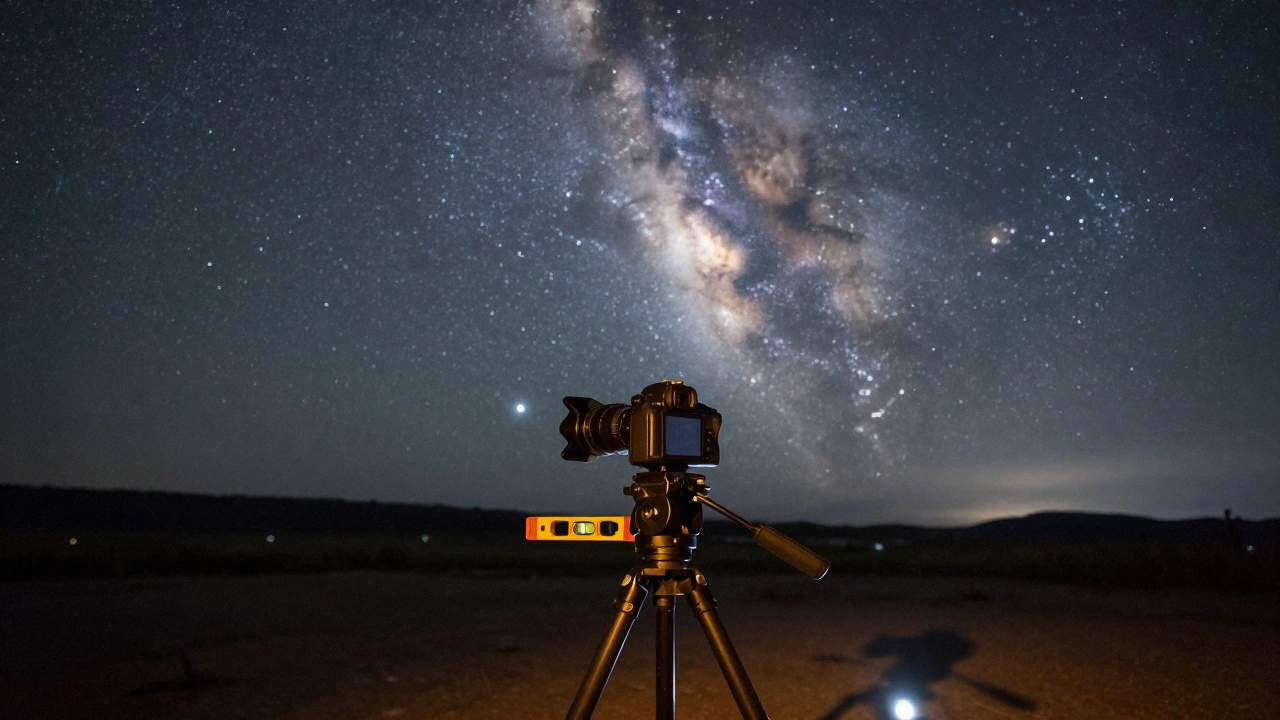
- Level the base. Most trackers come with a bubble level. Use it. Even a slight tilt causes tracking errors.
- Attach your camera. Use a quick-release plate. Make sure your lens is balanced. A heavy lens on one side will strain the motor.
- Do a rough polar alignment. Point the tracker’s polar axis toward Polaris. You don’t need to be exact. Within 3-5 degrees is fine for 2-minute exposures.
- Use a remote shutter. Even pressing the button causes vibration. Use a wired remote, intervalometer, or your phone app if your camera supports it.
- Start with 2-minute exposures. ISO 1600, f/2.8, 120 seconds. Shoot in RAW. Stack 5-10 frames in software like Sequator or DeepSkyStacker to reduce noise.
One mistake beginners make is trying to shoot too long too soon. Start with 90 seconds. See how the stars look. Then go longer. Pushing past 5 minutes without guiding will start to show drift, even on a good tracker.
Best Lenses for Star Trackers
Not all lenses work well with star trackers. Wide-angle lenses are ideal. They have a large field of view, which means you don’t need perfect tracking. Even if there’s a tiny bit of drift, it won’t ruin the shot.
Here are the top lenses for entry-level trackers:
- 14mm f/2.8 - Perfect for capturing the Milky Way core with foreground detail. Great for landscapes.
- 20mm f/1.8 - Slightly narrower, but brighter. Good for tighter compositions.
- 24mm f/1.4 - Lets you capture more detail in the Perseus Arm. Requires a bit more precision.
- 50mm f/1.8 - Not wide, but usable for short exposures. Great for shooting the Pleiades or Andromeda.
Avoid zoom lenses. They’re heavier, slower, and harder to focus. Stick to primes. They’re sharper, lighter, and faster.
What You Can Photograph
With a portable tracker, you’re not limited to just the Milky Way. You can capture:
- The Orion Nebula - A bright, colorful cloud of gas. Looks amazing at f/2.8 with 3-minute exposures.
- The Pleiades (Seven Sisters) - A tight cluster of stars. Easy to frame with a 24mm lens.
- The Andromeda Galaxy - Visible to the naked eye. A tracker lets you capture its spiral arms.
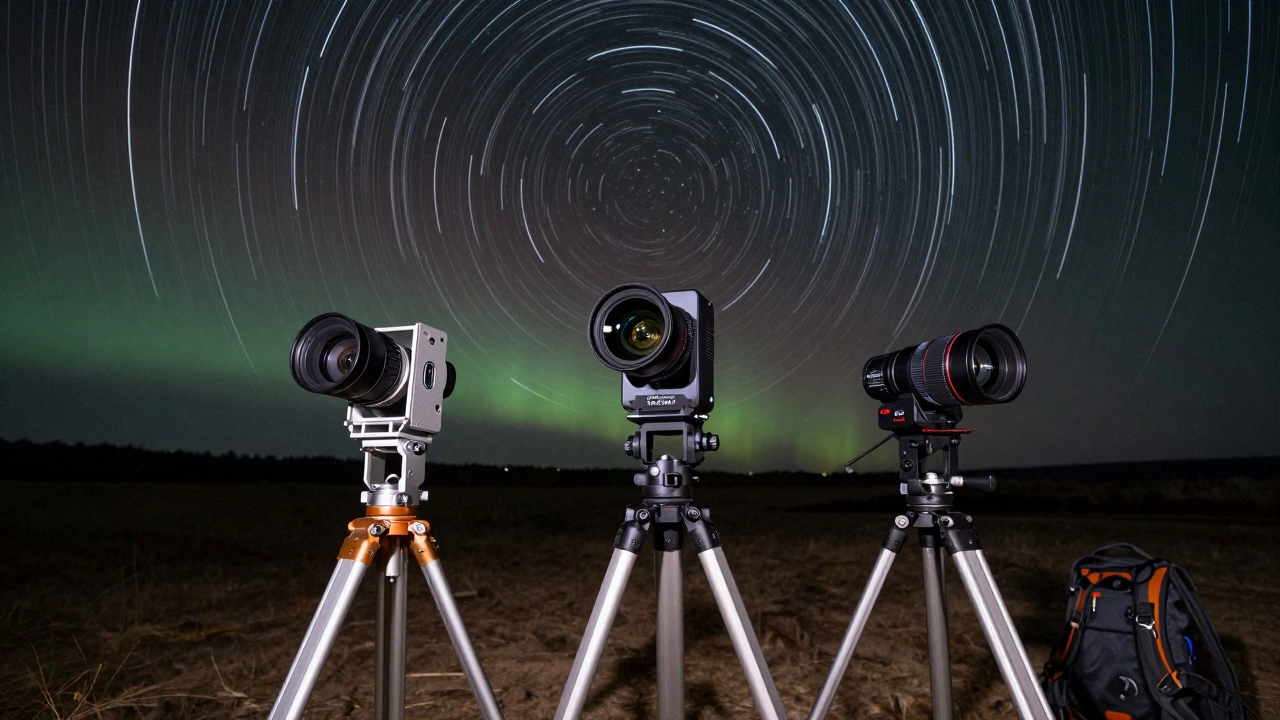
- Star trails with foreground - Combine a long exposure with a short one for a composite. The tracker lets you keep the ground sharp while the stars swirl.
One of the biggest surprises for new users? You can shoot nebulae without a telescope. The Orion Nebula, for example, is bright enough to capture with a standard camera lens. Just give it time. Five minutes. Ten minutes. You’ll start to see color.
Limitations and When to Skip It
Star trackers aren’t magic. They have limits.
They won’t work well with lenses longer than 100mm. The tracking error becomes visible. If you’re trying to photograph Jupiter or Saturn, you need a telescope and a guided mount.
They also struggle in windy conditions. Even a light breeze can shake a lightweight setup. If you’re on a mountain ridge or open field, use a heavy tripod or add weight with a camera bag.
And if you’re in a city with heavy light pollution, a tracker won’t help much. You still need dark skies. The tracker just makes the most of what you have.
Entry-Level Models to Consider
Here are three trackers that work well for beginners:
| Model | Weight | Max Payload | Tracking Accuracy | Price (USD) |
|---|---|---|---|---|
| Sky-Watcher Star Adventurer Mini | 1.1 lbs | 4.4 lbs | ±1 arcminute | $299 |
| iOptron SkyGuider Pro | 1.5 lbs | 5 lbs | ±1.5 arcminutes | $349 |
| Vixen Polarie | 1.3 lbs | 4 lbs | ±2 arcminutes | $329 |
All three are solid. The Sky-Watcher Mini is the lightest and easiest to carry. The iOptron has better electronics and a built-in polar scope. The Vixen Polarie is simple, reliable, and has been around for years.
Final Thoughts
If you want to take your astrophotography beyond 30-second exposures, a portable star tracker is the most practical upgrade you can make. It’s affordable, portable, and gives you results you can see immediately. No need to wait for a big investment. Just get one, head out on a clear night, and try a 3-minute exposure. You’ll be amazed at how much more detail you capture.
It’s not about having the best gear. It’s about using the right tool for the job. For wide-field imaging, that tool is a star tracker.
Can I use a star tracker with my smartphone?
Most smartphones can’t be mounted securely on a star tracker. The weight and balance are off, and the apps don’t support long exposures well. Some users have rigged setups with adapters, but results are inconsistent. For serious wide-field imaging, use a DSLR or mirrorless camera.
Do I need to polar align perfectly?
No. For entry-level trackers and exposures under 3 minutes, a rough alignment is enough. Point the tracker’s axis within 5 degrees of Polaris. You can use the North Star’s position in your phone’s sky map. Perfect alignment matters more for long telephoto lenses or exposures over 5 minutes.
Can I use a star tracker in the city?
Yes, but you won’t get great results. Star trackers help with sharpness, not brightness. If your sky is washed out by light pollution, even a perfect exposure will look gray. You need dark skies to see the Milky Way or nebulae. Try heading 30+ miles from city lights.
How long does the battery last?
Most trackers run on AA batteries and last 6-10 hours. That’s enough for multiple sessions. Some models support USB power, which lets you use a power bank. Bring extra batteries if you’re shooting all night.
Can I use a star tracker for video?
Not really. Star trackers are designed for still images. Their motors move too slowly for smooth video. For time-lapse videos, use a fixed tripod and shoot in intervals. For motion video of stars, you need a different approach.