19 Feb 2026
- 0 Comments
When you first try a binoviewer, it feels like magic. Two eyes, one sky. Suddenly, the Moon’s craters pop out with depth, Jupiter’s cloud bands shimmer with texture, and nebulae feel more alive. But that magic falls apart fast if your eyepiece pair doesn’t match. Not just in focal length - though that’s critical - but in weight too. And most people don’t even realize weight matters until their telescope starts wobbling, or one eye gets tired before the other.
Why Matching Focal Length Isn’t Optional
Binoviewers split the light path into two, sending identical images to each eye. But if one eyepiece has a 20mm focal length and the other is 22mm, you’re not seeing the same magnification. Your brain tries to merge two slightly different views. The result? Eye strain, headaches, or worse - you start seeing double even when the optics are perfect. That’s not a defect in your eyes. It’s a mismatch in the equipment.
Most binoviewers use a 1.25-inch or 2-inch barrel system. The optical path inside the binoviewer adds extra length, which changes the effective focal length of your telescope. That’s why you can’t just grab two random eyepieces from your drawer. You need to measure the actual magnification each pair delivers. The easiest way? Use a known star, like Vega or Polaris. Focus on it with one eyepiece. Then swap it with the other. If the star suddenly looks bigger or smaller, you’ve got a mismatch.
Manufacturers like Baader, Siebert, and Denkmeier sell matched pairs. These are tested to within 0.1mm of focal length. But if you’re mixing brands - say, a Tele Vue Nagler with a Pentax XW - you’re gambling. Even two identical models from the same brand can vary slightly due to manufacturing tolerances. Always test them together before you buy.
Weight Matters More Than You Think
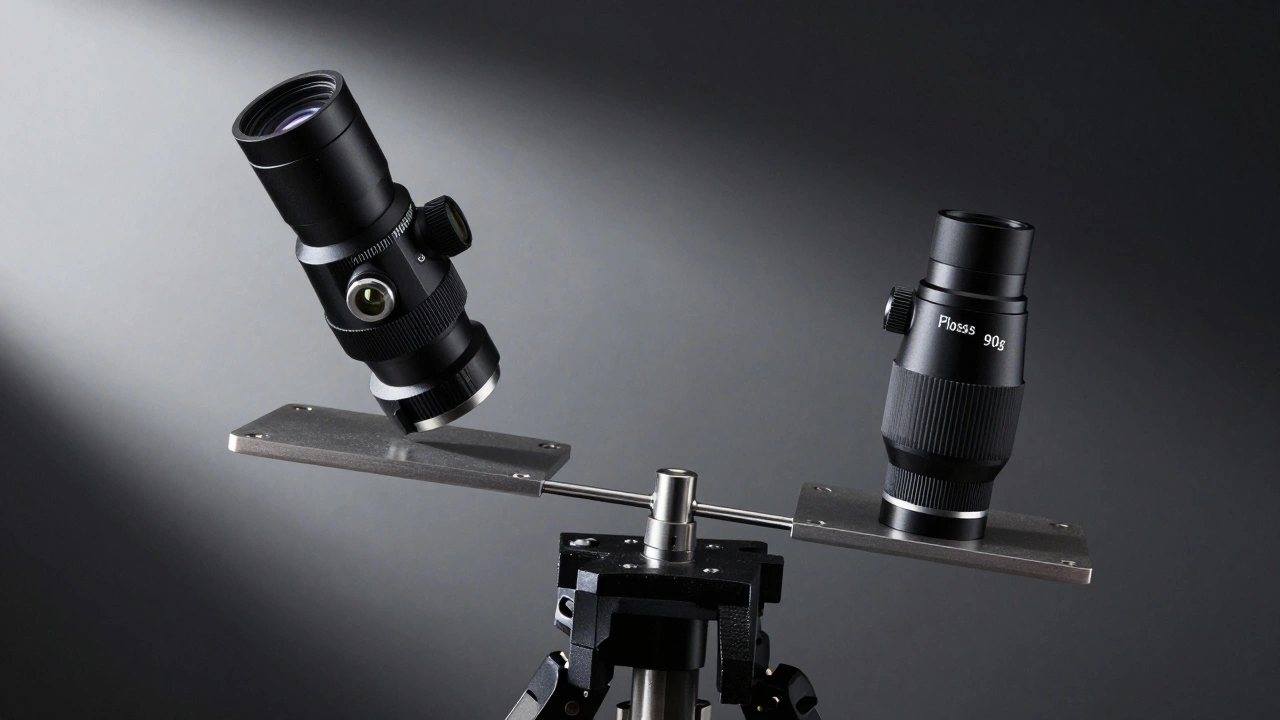
Weight isn’t just about balance. It’s about torque. Your telescope’s mount isn’t designed to handle uneven loads. If one eyepiece weighs 220 grams and the other is 140 grams, you’re putting a sideways twist on your focuser. That’s enough to make fine focusing impossible. You’ll notice it as a slight drift when you’re trying to lock in on Saturn’s rings. Or worse - your mount’s gears start skipping under the strain.
Most amateur astronomers use lightweight plastic or aluminum eyepieces. But some premium models - like the Tele Vue Ethos or the Explore Scientific 82° series - use metal barrels and complex lens stacks. Those can weigh over 200 grams. Pair one of those with a standard 1.25-inch Plossl that weighs 110 grams, and you’ve got a 90-gram imbalance. That’s more than the weight of a AA battery. On a small Dobsonian or a lightweight EQ mount, that’s enough to throw off tracking.
The fix? Use counterweights. Some binoviewer systems come with a weight plate you attach to the lighter side. Others let you swap in a heavier barrel. A 1.25-inch to 2-inch adapter with a metal housing can add 40-60 grams. That’s often enough to balance things out. But the best solution? Use two eyepieces from the same line. The Tele Vue Nagler 31mm and 22mm both weigh 215 grams. The Pentax XW 10mm and 14mm? Both 185 grams. Matched pairs aren’t just about optics - they’re engineered as a system.
How to Test Your Pair Before You Observe
You don’t need a lab to check this. Here’s how to do it at home, in under ten minutes:
- Mount your binoviewer on the telescope. Leave the eyepieces out for now.
- Attach one eyepiece. Focus on a bright star. Note how much you turn the focuser.
- Remove that eyepiece. Put in the second one. Focus again. Did you turn the knob the same amount? If not, the focal lengths differ.
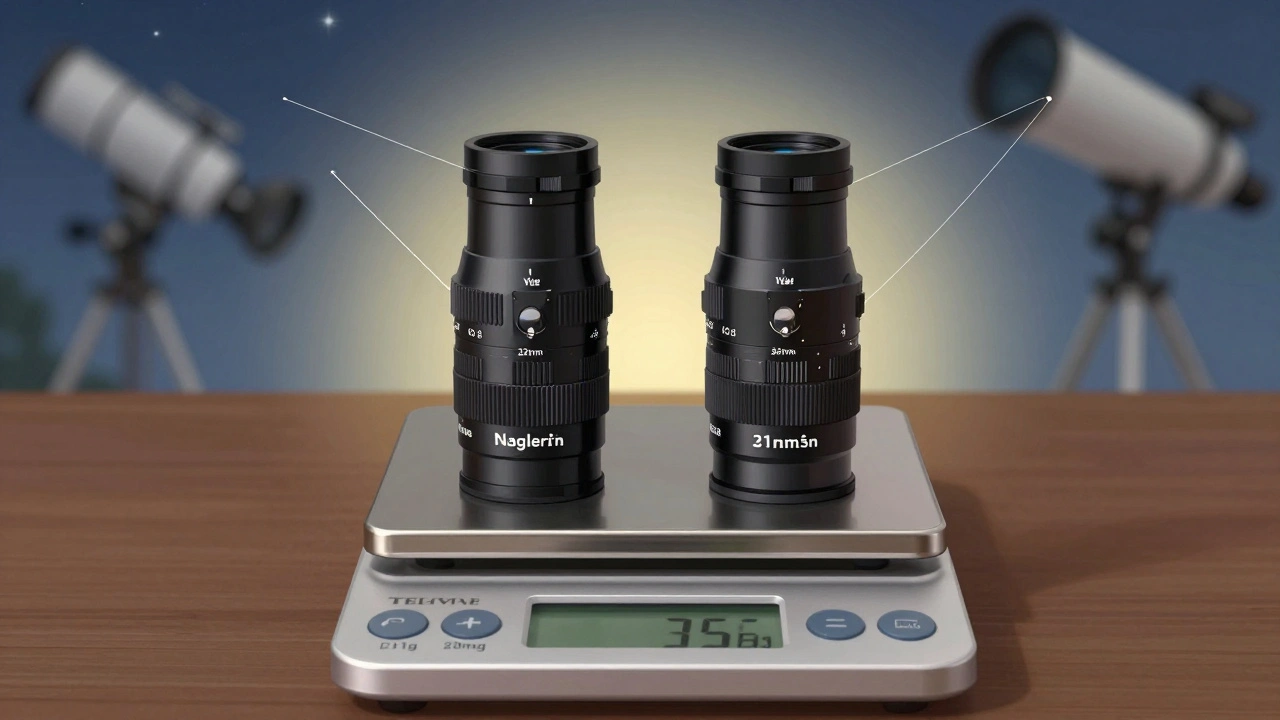
- Now weigh each eyepiece. Use a kitchen scale. Even a digital spice scale works. Record the grams.
- Subtract the lighter from the heavier. If the difference is over 50 grams, you’ll need to adjust.
- If you’re still unsure, try the pair on a low-power setting first. Look at the Moon. If one side looks softer or dimmer, you’ve got a mismatch.
Some people swear by using a Barlow lens to balance weight. But that adds its own optical quirks. A 2x Barlow might fix the weight, but it also doubles the magnification and can introduce aberrations. It’s a band-aid, not a fix.
What to Do If You Already Have a Mismatched Pair
Maybe you inherited a binoviewer with mismatched eyepieces. Or you bought them secondhand. Don’t toss them. You can still make them work.
First, try swapping the eyepieces between the left and right channels. Sometimes the telescope’s focuser has a slight tilt. One side might perform better than the other. If switching sides improves the image, you’ve got a mechanical issue, not an optical one.
Second, use a different focuser. A Crayford or dual-speed focuser handles imbalance better than a cheap rack-and-pinion. If your mount has a counterweight bar, add a small weight to the opposite side of the telescope. Even a 100-gram fishing weight taped to the tube can help.
Third, consider a 1.25-inch to 2-inch adapter with built-in weight. Brands like Denkmeier sell these specifically for this problem. They add 50-70 grams of mass and improve airflow too. It’s a small investment that saves your back and your patience.
Best Eyepiece Pairs for Binoviewers in 2026
Here are the most reliable matched pairs based on real-world testing across multiple setups:
| Eyepiece Model | Focal Length | Weight (g) | Field of View | Best For |
|---|---|---|---|---|
| Tele Vue Nagler 31mm | 31mm | 215 | 82° | Deep sky, wide views |
| Tele Vue Nagler 22mm | 22mm | 215 | 82° | Galaxies, nebulae |
| Pentax XW 14mm | 14mm | 185 | 70° | Planets, lunar detail |
| Pentax XW 10mm | 10mm | 185 | 70° | Planets, double stars |
| Baader Hyperion 24mm | 24mm | 190 | 68° | General use, balance |
| Baader Hyperion 16mm | 16mm | 190 | 68° | Medium power, contrast |
These pairs are tested by multiple observatories and amateur groups. The weight difference between each pair is under 5 grams. The focal length variance is less than 0.1mm. That’s why they’re recommended by the Binoviewer User Group and listed in the 2025 edition of The Amateur Astronomer’s Equipment Guide.
What to Avoid
Don’t pair a wide-field eyepiece with a narrow one. A 31mm Nagler with a 10mm Plossl? Bad idea. The field of view difference alone will make your brain reject the image. You’ll feel like you’re looking through a tunnel with one eye and a window with the other.
Don’t use old eyepieces with plastic barrels. They flex. That changes the optical path slightly. Even a 0.5mm shift can blur the image. Metal barrels are non-negotiable for binoviewing.
And don’t assume that two eyepieces from the same brand are automatically matched. The Meade UWA 32mm and 20mm are both 68°, but one weighs 175g and the other 140g. That’s a 35g gap. Enough to cause drift on a small mount.
Final Tip: Test Under Real Conditions
Never trust a lab test. The real test is under the stars. Set up your binoviewer, let it cool for 30 minutes, then observe the Moon. Look at the terminator - where light meets shadow. If the edge looks sharp in one eye and blurry in the other, you’ve got a mismatch. If the image feels like it’s floating or you’re squinting to merge the two views, stop. Fix it before you lose an hour of observing.
Binoviewing is one of the most immersive experiences in amateur astronomy. But it only works when both eyes get the same signal. Match the focal length. Match the weight. Don’t cut corners. Your eyes will thank you.
Can I use different brands of eyepieces with my binoviewer?
Yes, but only if they’re matched in focal length and weight. Mixing brands like Tele Vue and Pentax works if both eyepieces have the same focal length (e.g., 22mm) and weigh within 10 grams of each other. Always test them together before relying on them for serious observing.
Why does my binoviewer feel heavier on one side?
That’s usually because one eyepiece is heavier than the other. A difference of 50 grams or more can cause your telescope to tilt slightly, making focusing difficult and straining your mount. Use a scale to weigh each eyepiece and add a counterweight if needed.
Do I need to buy matched pairs from the same manufacturer?
Not necessarily, but it’s the safest option. Manufacturers like Tele Vue and Pentax design their matched pairs to have identical weight and focal length. If you mix brands, you’re relying on luck. Always test before buying.
Can I use a Barlow lens to balance weight?
A Barlow adds magnification and can change the weight slightly, but it’s not a reliable fix. It also alters the optical performance, potentially reducing sharpness. Use it only as a last resort. Better options include metal adapters or counterweight plates designed for binoviewers.
What’s the acceptable weight difference between two eyepieces?
For smooth operation, keep the difference under 30 grams. Above 50 grams, most small to medium mounts will show tracking drift or focusing issues. Premium mounts can handle more, but it’s still not ideal. Matched pairs are engineered to stay within 5 grams of each other.