25 Mar 2026
- 0 Comments
Quick Summary
- The Dobsonian telescope combines a Newtonian reflector with a simple altazimuth mount for easy handling.
- Beginners benefit from large aperture sizes at lower price points compared to refractors or SCTs.
- Manual tracking is straightforward, making it ideal for learning the night sky without relying on motors.
- Portability varies by size, with 6-inch and 8-inch models being the sweet spot for new users.
- Maintenance is minimal, primarily requiring occasional collimation and lens cleaning.
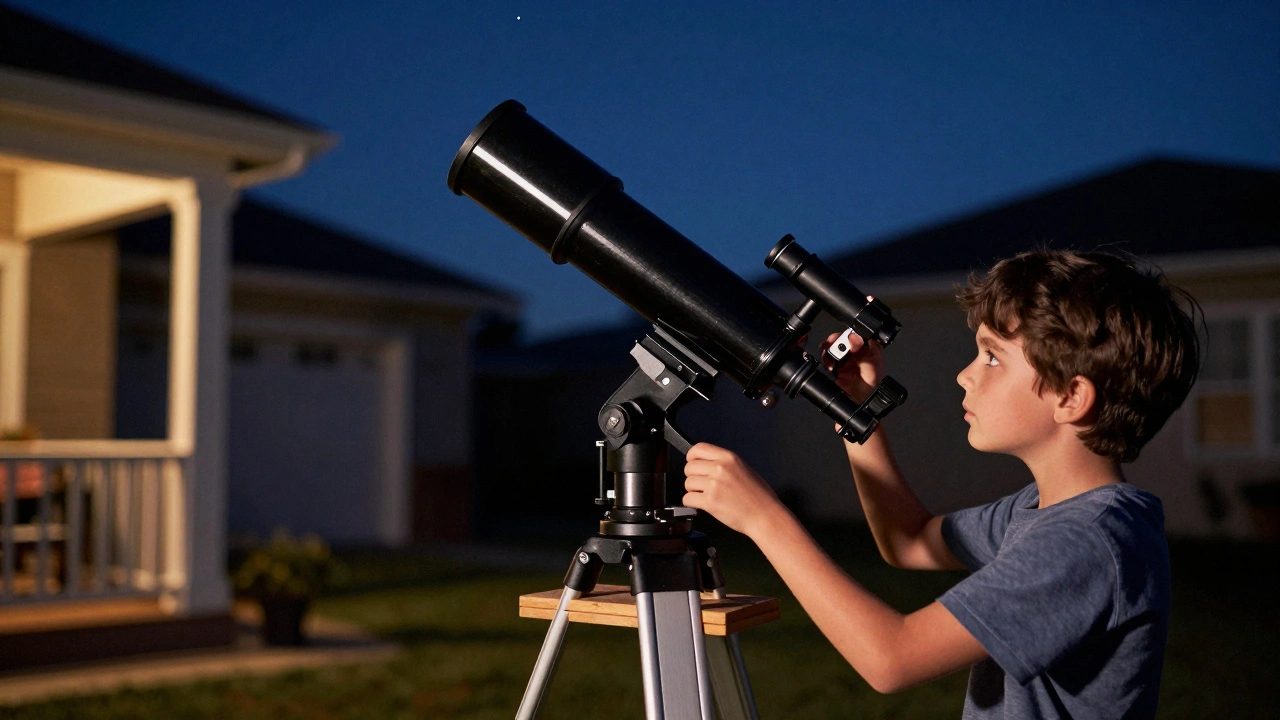
Have you ever walked into a store or browsed online, only to find yourself staring at a dozen different telescope options? It’s overwhelming. You want to see the rings of Saturn or the face of Jupiter, but the jargon stops you cold. Many people make the mistake of buying a cheap department store telescope that ends up gathering dust in the closet. You don’t need to be an engineer to start looking up, but you do need the right tool. That tool is often the Dobsonian. It strips away the complexity and puts the glass where it belongs: in your hands.
Living in a place like Portland, where the sky can be clear one night and rainy the next, you want a setup that is quick to deploy. You don’t want to spend an hour assembling a tripod when a cloud bank is rolling in. The Dobsonian design solves this. It sits on a sturdy base, rocks back and forth, and points exactly where you want. It feels more like a toy than a scientific instrument, but the views it delivers are serious.
What Exactly Is a Dobsonian Telescope?
To understand why this is the best choice, you need to know what you are actually buying. A Dobsonian is not a specific type of lens or mirror. It is a specific style of mount. The optical tube is usually a Newtonian ReflectorA type of telescope that uses a concave primary mirror to gather light and a flat secondary mirror to reflect the image to the eyepiece.. This optical design is old, dating back to Isaac Newton himself. It uses mirrors instead of lenses to focus light.
The innovation comes from the mount. Traditional telescopes use an equatorial mount that aligns with the Earth’s axis. This is great for long-exposure astrophotography, but it is heavy, complex, and requires calibration. The Dobsonian mount is an altazimuth mount. It moves up and down (altitude) and side to side (azimuth). It sits on a wooden or plastic rocker box. You push the tube, and it moves. No gears, no motors, no computer chips required.
This simplicity changes everything for a beginner. When you look through a Dobsonian, you are seeing the object in real-time. You aren’t fighting a slow motor to catch up with the stars. You are the tracker. This connection helps you learn the sky faster because you are physically moving the instrument to follow the celestial objects.
Why Aperture Matters More Than You Think
If you ask any experienced astronomer what matters most in a telescope, they will tell you one thing: aperture. Aperture is the diameter of the main mirror or lens. It is the light bucket. A larger aperture gathers more light. More light means you can see fainter objects. You can see the spiral arms of a galaxy or the glow of a nebula. A small aperture might show you a bright star, but a large aperture shows you the structure.
This is where the Dobsonian shines. For the same price, a Dobsonian gives you a much larger aperture than a refractor. A refractor uses glass lenses. Large lenses are heavy and expensive to make without defects. Mirrors are cheaper to produce in large sizes. A $400 Dobsonian might give you an 8-inch mirror. A $400 refractor might give you a 4-inch lens. That 8-inch mirror gathers four times as much light as the 4-inch lens.
Imagine trying to read a book in a dark room. A small telescope is like a candle. A Dobsonian is like a flashlight. You can see the text clearly. In the context of deep-sky objects like the Orion Nebula, that extra light makes the difference between seeing a fuzzy smudge and seeing actual color and detail. This is why beginners often regret buying small refractors. They want to see deep space, but their equipment limits them to the Moon and bright planets.
Dobsonian vs. Other Telescope Types
Before you pull out your credit card, you need to know how the Dobsonian stacks up against the competition. There are three main contenders for the beginner market: the Refractor, the Schmidt-Cassegrain (SCT), and the Dobsonian.
| Feature | Dobsonian | Refractor | SCT (Schmidt-Cassegrain) |
|---|---|---|---|
| Aperture per Dollar | Excellent | Low | Medium |
| Portability | Medium to Low | High | High |
| Setup Time | Very Fast | Fast | Medium |
| Maintenance | Occasional Collimation | Very Low | Low |
| Best For | Deep Sky Objects | Planets & Moon | Photography & Versatility |
Refractors are beautiful. They are sealed tubes that require almost no maintenance. They are great for viewing the Moon and planets because the optics are sharp. However, they are expensive for their size. If you want a 6-inch refractor, you are paying a premium. SCTs are compact. They fold the light path, making a long telescope fit into a short tube. They often come with computerized GoTo mounts. This sounds amazing, but it adds cost and complexity. If the batteries die or the alignment fails, you are stuck.
The Dobsonian wins on value. It is the workhorse of amateur astronomy. It is not the most portable option, but an 8-inch model is manageable for a car trunk. It is not the most precise for photography, but it is the best for visual observation. If your goal is to look through the eyepiece and say "wow," the Dobsonian is the king.
Choosing the Right Size and Brand
When shopping, you will see sizes ranging from 4.5 inches to 14 inches. Do not be tempted by the giant ones. A 14-inch Dobsonian is heavy, expensive, and requires a large dark sky to be useful. For a beginner, the sweet spot is between 6 and 8 inches. A 6-inch scope is light enough to carry up a flight of stairs. An 8-inch scope is the standard for a reason. It shows you almost everything visible to the human eye.
Brands matter, but not as much as build quality. OrionA popular manufacturer of telescopes and astronomy accessories known for entry-level to mid-range gear. is a common name in the hobby. Their SkyQuest series is a classic entry point. ZhumellA brand that offers portable Dobsonian telescopes with high-quality optics at competitive prices. makes excellent scopes that are often sold at big-box retailers. Sky-WatcherA major telescope manufacturer offering a wide range of optical tubes and mounts for various budgets. also produces reliable Dobsonians. Avoid the "department store" brands that sell 60mm telescopes for $50. Those are toys, not instruments. They will frustrate you and kill your interest in the hobby.
Consider your storage space. If you live in an apartment, a large tube might be hard to hide. If you live in a house, you can store it in a closet or garage. In Portland, humidity is a factor. You want a telescope that can be stored in a dry place. Mirrors can tarnish if left in damp conditions for too long.
Handling and Maintenance Tips
One fear beginners have is breaking the glass. The primary mirror in a Dobsonian is usually at the bottom of the tube. It is heavy and sits in a cell. It is not fragile like a lens. However, you should always hold the tube by the handles or the base. Never grip the mirror cell itself. Dust is the enemy. Keep the dew cap on when you are not using the scope.
There is one maintenance task you will need to learn: collimation. This is the alignment of the mirrors. Over time, bumps or transport can knock the mirrors slightly out of alignment. If your images look blurry or one side is darker, you might need to collimate. It sounds scary, but it is just turning three screws on the secondary mirror holder. You can do this with a laser collimator tool that costs about $20. It takes five minutes. Once you do it once, you will never fear it again.
Keep your eyepieces clean. Use a blower brush to remove dust. Do not wipe them with your shirt. That scratches the coating. Use a microfiber cloth designed for optics if you must wipe them. A clean view is a happy view. Also, let the telescope acclimate. If you bring a cold telescope inside, condensation will form. If you bring a warm telescope outside, the air currents inside the tube will blur the image. Give it 15 to 30 minutes to reach the outside temperature.
Learning the Sky with a Dobsonian
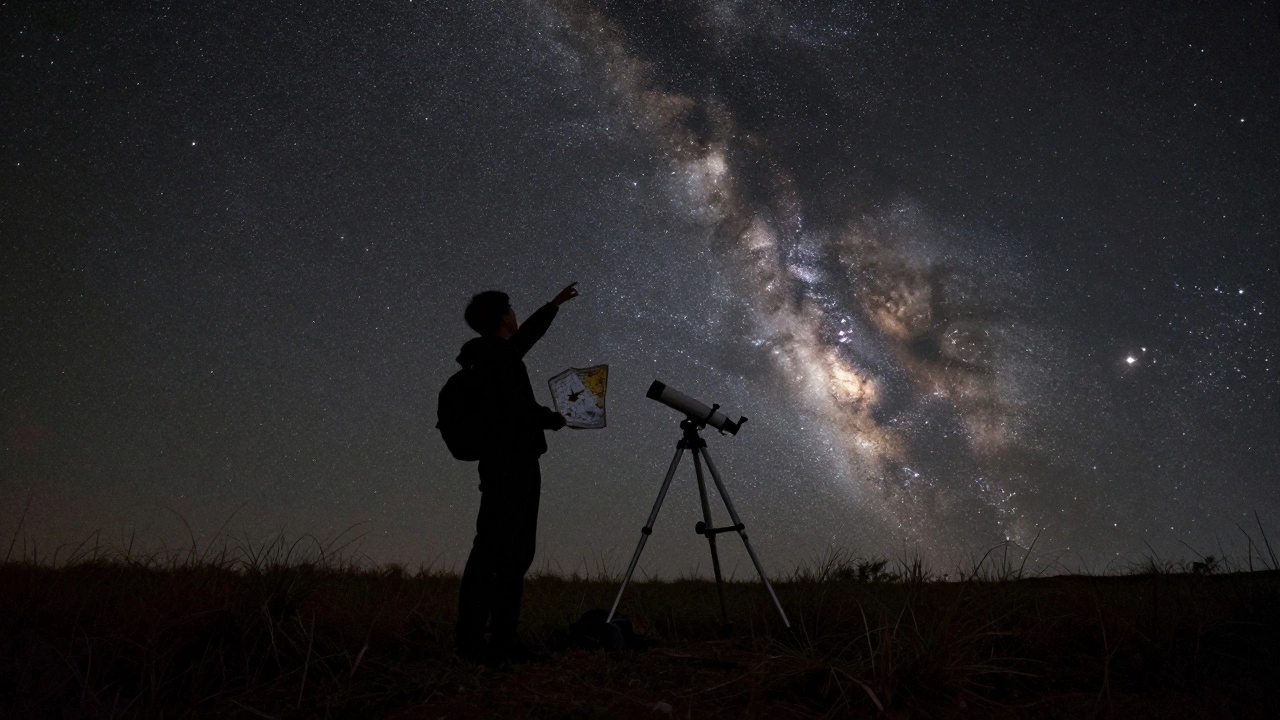
Because the Dobsonian moves manually, you are forced to learn where things are. You cannot just type in "M42" and have the scope point it out. You have to find Orion first, then find the belt, then find the nebula. This builds your star knowledge. It turns stargazing into a treasure hunt. You start recognizing constellations. You learn how the sky moves.
Start with the Moon. It is the best test object. You can see craters, mountains, and valleys. Then move to planets. Jupiter shows four moons. Saturn shows rings. These are bright and easy to find. Once you are comfortable, move to deep-sky objects. The Orion Nebula is a great target. The Andromeda Galaxy is visible to the naked eye, but a Dobsonian shows its spiral structure. The Pleiades star cluster looks like a handful of diamonds.
Don't rush. The first few nights are about setup and patience. You might get frustrated if you can't find anything. That is normal. Join a local astronomy club. In the Pacific Northwest, there are many clubs that host star parties. They bring their big scopes and let you look through them. It is the best way to learn and meet people who share your passion.
Frequently Asked Questions
Is a Dobsonian telescope good for astrophotography?
Dobsonians are primarily designed for visual observation. The altazimuth mount does not track the stars smoothly for long exposures. You can take pictures of the Moon or bright planets with a camera attached, but deep-sky photography requires an equatorial mount with tracking motors.
How much does a good beginner Dobsonian cost?
A quality 6-inch to 8-inch Dobsonian typically ranges from $300 to $600. This price usually includes the optical tube, mount, and a couple of eyepieces. Avoid spending less than $200, as you will likely get poor optics that will frustrate you.
Can I use a Dobsonian in a city with light pollution?
Yes, but you will see fewer deep-sky objects. Light pollution washes out faint galaxies and nebulae. In a city, you will still see the Moon, planets, and bright star clusters. For the best experience, travel to a darker location once in a while.
Do I need a computerized mount to find objects?
No. A Dobsonian is manual. You use a star chart or a phone app to locate objects. This manual method helps you learn the sky better than relying on a computer. It is more engaging and less prone to technical failures.
How often do I need to collimate the mirrors?
Collimation depends on how much you move the telescope. If you transport it often, check it every few months. If it stays in one place, you might only need to do it once a year. If your views look soft or uneven, check the collimation.
Is an 8-inch Dobsonian too heavy for a beginner?
An 8-inch Dobsonian weighs around 30 to 40 pounds. It is manageable for most adults. If you live in an apartment or have mobility issues, a 6-inch model is lighter and easier to carry, though it gathers slightly less light.
Starting your astronomy journey is about curiosity. You don't need the most expensive gear to see the wonders of the universe. You need a tool that works. The Dobsonian provides that reliability. It puts you in the driver's seat. It rewards patience with breathtaking views. Whether you are standing on a balcony in the city or driving out to the hills for dark skies, this telescope will serve you well for years. Grab a star chart, step outside, and look up. The universe is waiting for you.