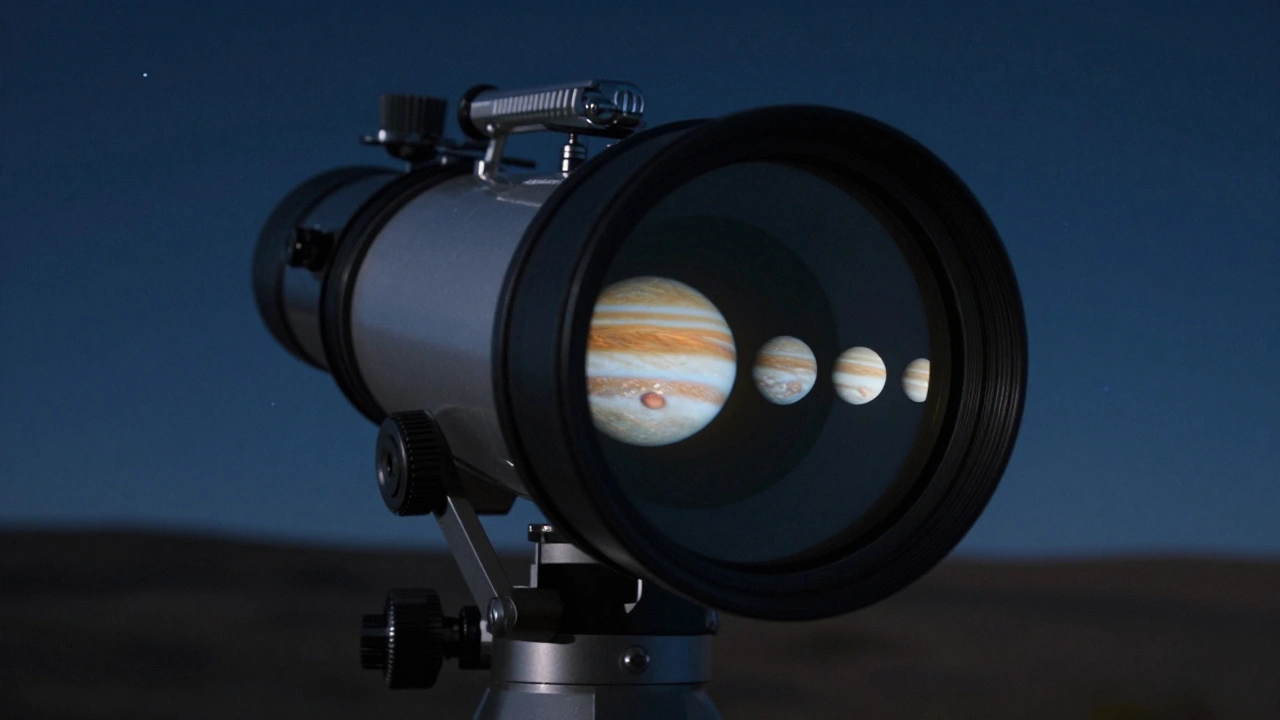
9 May 2026
- 0 Comments
Pointing a telescope at Mars is the fourth planet from the Sun, known for its reddish appearance due to iron oxide on its surface and seeing nothing but a fuzzy red dot is frustrating. You bought the gear, you waited for the clear night, and yet the view feels underwhelming. The truth is, planetary detail visibility depends less on how much money you spent and more on understanding the physics of light, atmospheric turbulence, and your eyes.
If you want to know exactly which features are observable with your specific equipment, you need to look beyond marketing specs. We aren't just looking at magnification; we are looking at resolution, contrast sensitivity, and aperture size. This guide breaks down what you can realistically see on each planet, helping you set expectations that match reality.
The Hard Limit: Resolution vs. Magnification
Most beginners fall into the trap of thinking higher magnification equals better views. It doesn't. Magnification spreads the light out, making the image dimmer and often blurrier if the atmosphere or optics can't support it. What actually determines planetary detail visibility is resolution-the ability to distinguish two close points as separate entities.
This is governed by the Rayleigh Criterion, a formula based on your telescope's aperture (diameter). Simply put, a larger aperture gathers more light and resolves finer details. A standard rule of thumb for visual observation is that you can resolve details roughly equal to 138 divided by your aperture in millimeters (in arcseconds). For example, a 100mm (4-inch) refractor has a theoretical resolution of about 1.38 arcseconds. If a feature on Jupiter is smaller than that angular size, it will blend into the background regardless of how much you zoom in.
- Aperture: The diameter of the main lens or mirror. This is your most critical spec for planets.
- Resolution: The smallest detail the scope can theoretically show, measured in arcseconds.
- Magnification: How large the image appears. Useful only up to the point where the image becomes too dim or blurry.
Don't chase "power" in eyepieces. Chase aperture. A cheap 6-inch reflector will show you more planetary detail than an expensive 4-inch refractor because it has a larger light bucket and better diffraction limits.
Jupiter: The King of Amateur Observation
Jupiter is the largest planet in our solar system, a gas giant composed mostly of hydrogen and helium with a complex atmosphere is the easiest target for spotting details. Even in small telescopes, you can see its four Galilean moons-Io, Europa, Ganymede, and Callisto-as distinct points of light lining up near the planet.
But the real prize is the cloud bands. In a 4-inch scope, you'll see the equatorial zone and the darker belts above and below it. As aperture increases to 6 inches or more, these bands break down into intricate structures. You might spot the Great Red Spot is a persistent high-pressure storm in Jupiter's southern hemisphere, larger than Earth. It looks like a faint, rusty-red oval. Seeing this requires patience and good "seeing" conditions (stable air).
| Aperture Size | Observable Details | Required Conditions |
|---|---|---|
| 3-4 inches | Main cloud belts, Galilean moons as dots | Moderate seeing |
| 5-6 inches | Fine banding, Great Red Spot (if prominent) | Good seeing |
| 8+ inches | Polar haze, subtle color variations, moon transits | Excellent seeing |
Pro tip: Watch for "shadow transits." When Io passes in front of Jupiter, its shadow appears as a tiny black dot moving across the disk. This happens regularly and is a stunning confirmation of orbital mechanics right before your eyes.
Saturn: The Jewel of the Solar System
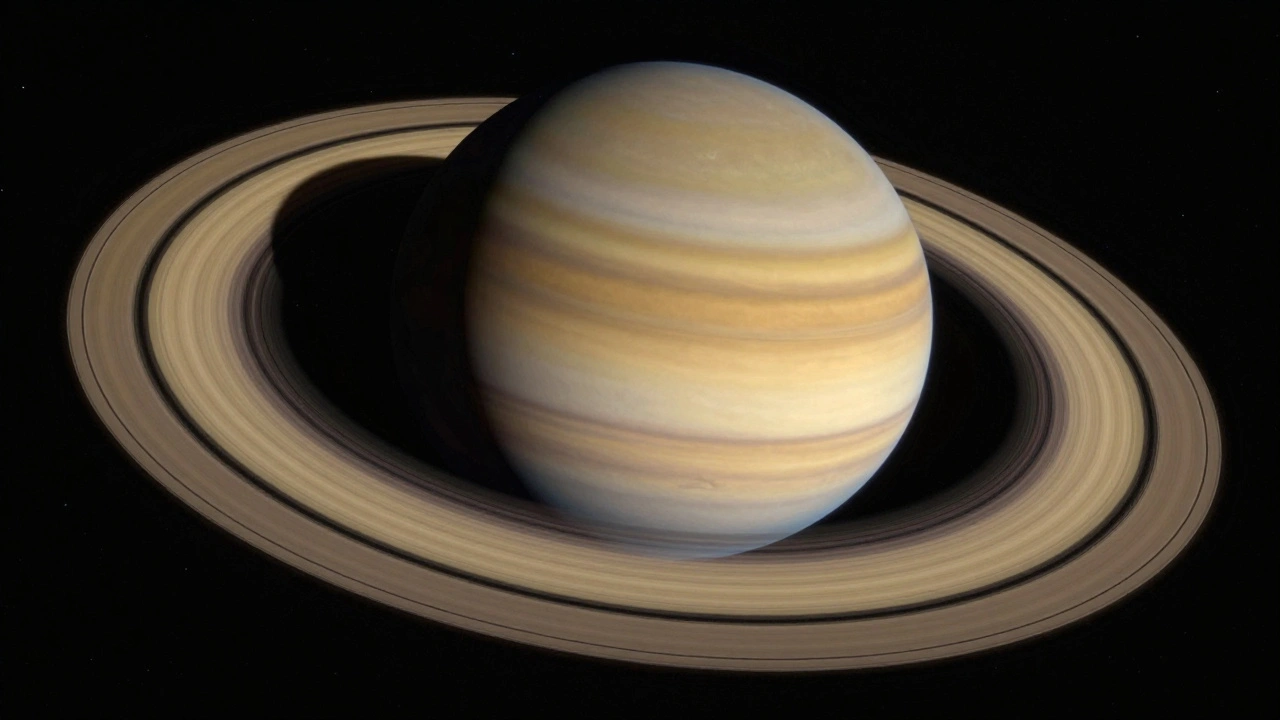
Saturn is the sixth planet from the Sun, famous for its extensive ring system made of ice and rock particles offers a different challenge. The rings are bright and high-contrast, making them easy to spot even in small scopes. However, the Cassini Division-the dark gap separating the A and B rings-is harder to resolve.
In a 4-inch telescope, you'll clearly see the rings and the planet body, but they may look merged. By 6 inches, the Cassini Division usually opens up as a thin dark line. At 8 inches or more, you might glimpse the Encke Gap within the A ring, though this is rare and requires exceptional atmospheric stability.
Another key feature is the tilt. Saturn's rings change angle over a 29-year cycle. Right now, in 2026, the rings are opening up nicely, offering a great view of their full span. If you observe during an equinox (when the rings appear edge-on), they seem to vanish, leaving just the planet and its moons floating in space-a surreal sight.
Mars: The Test of Patience
Mars is the fourth planet from the Sun, characterized by its thin atmosphere and polar ice caps is deceptive. Because it's small and far away, it rarely shows much detail unless it's at opposition (closest approach to Earth). Even then, you need a decent-sized scope.
In a 4-inch scope, Mars is just a pinkish disk. You won't see anything distinct. In a 6-inch scope, during a good opposition, you might detect the white polar ice caps. These are highly reflective and stand out against the darker terrain. Darker surface features, like Syrtis Major, require 8 inches or more and very steady air. Most amateurs spend years trying to sketch these albedo markings without success.
Be wary of "red fever." Many new observers buy scopes expecting to see craters and mountains. They don't exist at this scale. You're looking for broad, low-contrast shading changes. It’s subtle, almost like watching a watercolor painting dry.
Venus and Mercury: The Elusive Pair
Venus is the second planet from the Sun, covered in thick clouds that reflect sunlight brightly never shows surface details through optical telescopes because it’s shrouded in dense clouds. What you *can* see is its phase. Like the Moon, Venus goes through crescent, quarter, and gibbous phases. This was historically crucial proof that planets orbit the Sun, not Earth.
Mercury is even trickier. It stays close to the Sun, so you only have brief windows at dawn or dusk. Its low altitude means poor seeing conditions due to atmospheric distortion. In a 6-inch scope, you might see its phases and perhaps a hint of limb darkening (the edges appearing slightly darker than the center).
The Enemy: Atmospheric Seeing
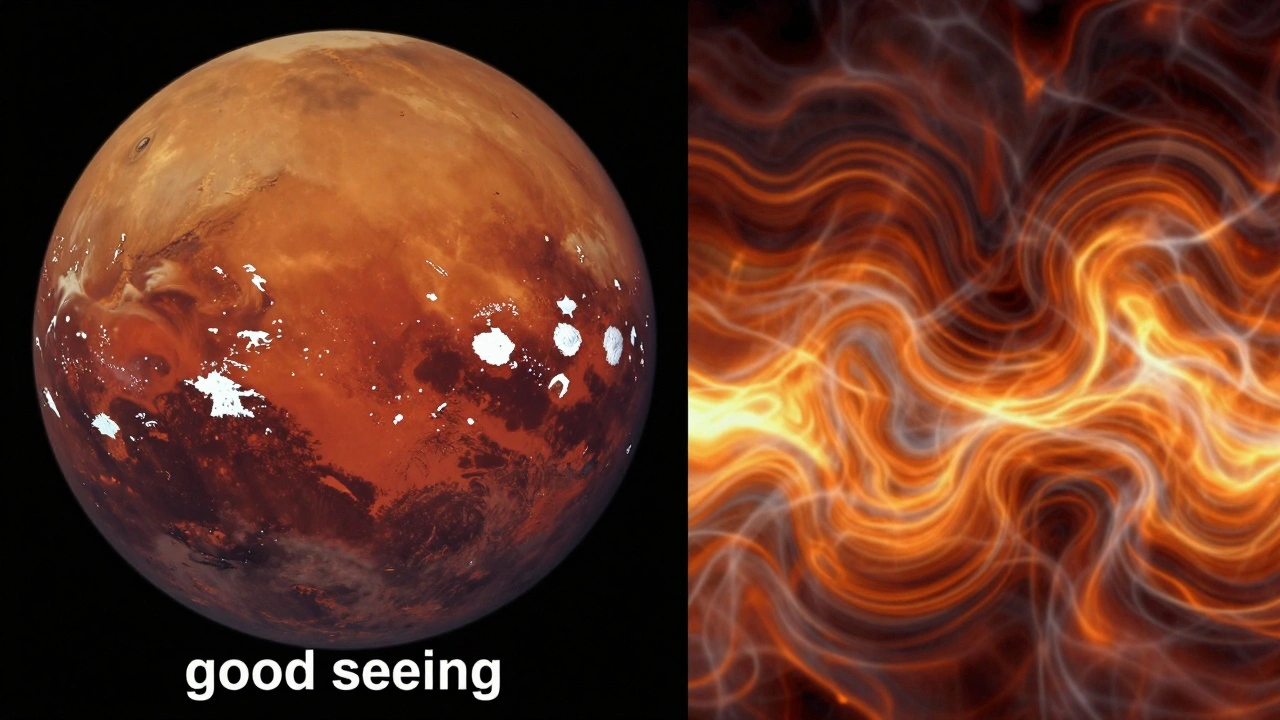
Your telescope might be perfect, but the air above you might not be. "Seeing" refers to the stability of the atmosphere. Turbulent air causes stars to twinkle and planets to boil. On bad nights, even a 10-inch scope performs worse than a 4-inch one because the larger aperture collects more distorted light.
How do you tell? Look at a star. If it dances around and changes shape rapidly, the seeing is poor. Wait for moments when the image stabilizes-these "sweet spots" last only seconds but reveal incredible detail. Observing from urban areas also introduces heat shimmer from pavement and buildings. Let your telescope cool down for at least an hour before observing to avoid internal tube currents.
Enhancing Contrast with Filters
Filters can help bring out subtle details. A #21 Light Pollution Reduction filter cuts some skyglow, while a #80A Blue filter enhances blue-hued features on Jupiter and Uranus. For Mars, a yellow (#12) or orange (#24) filter reduces eye strain and boosts contrast between the polar caps and the desert surface.
Remember, filters dim the image. Use them only when you have enough aperture and brightness. They are tools for refinement, not magic wands.
What is the best telescope for viewing planetary details?
The best telescope balances aperture, optical quality, and portability. An 8-inch Dobsonian reflector offers excellent value and resolution for planets. For convenience, a high-quality 4-5 inch refractor or Schmidt-Cassegrain is ideal. Prioritize aperture over brand name.
Why does my planet look blurry despite high magnification?
Blurry images are usually caused by poor atmospheric seeing, insufficient cooling time for the telescope, or exceeding the useful magnification limit of your aperture. Reduce magnification and wait for stable air.
Can I see craters on the Moon with any telescope?
Yes, lunar craters are easily visible even in small binoculars or 2-inch telescopes. The Moon is bright and close, making it the best target for testing your equipment's resolution before attempting planets.
Do I need a camera to see planetary details?
No, visual observation reveals more immediate detail than most beginner cameras. Astrophotography stacks hundreds of frames to enhance contrast, but your eye can perceive subtle colors and contrasts in real-time if you practice relaxed viewing.
When is the best time to observe planets?
Observe when planets are highest in the sky (near meridian transit). This minimizes the amount of atmosphere the light must pass through, reducing distortion. Avoid observing near the horizon.