17 Apr 2026
- 0 Comments
The Basics of the Celestial Sphere
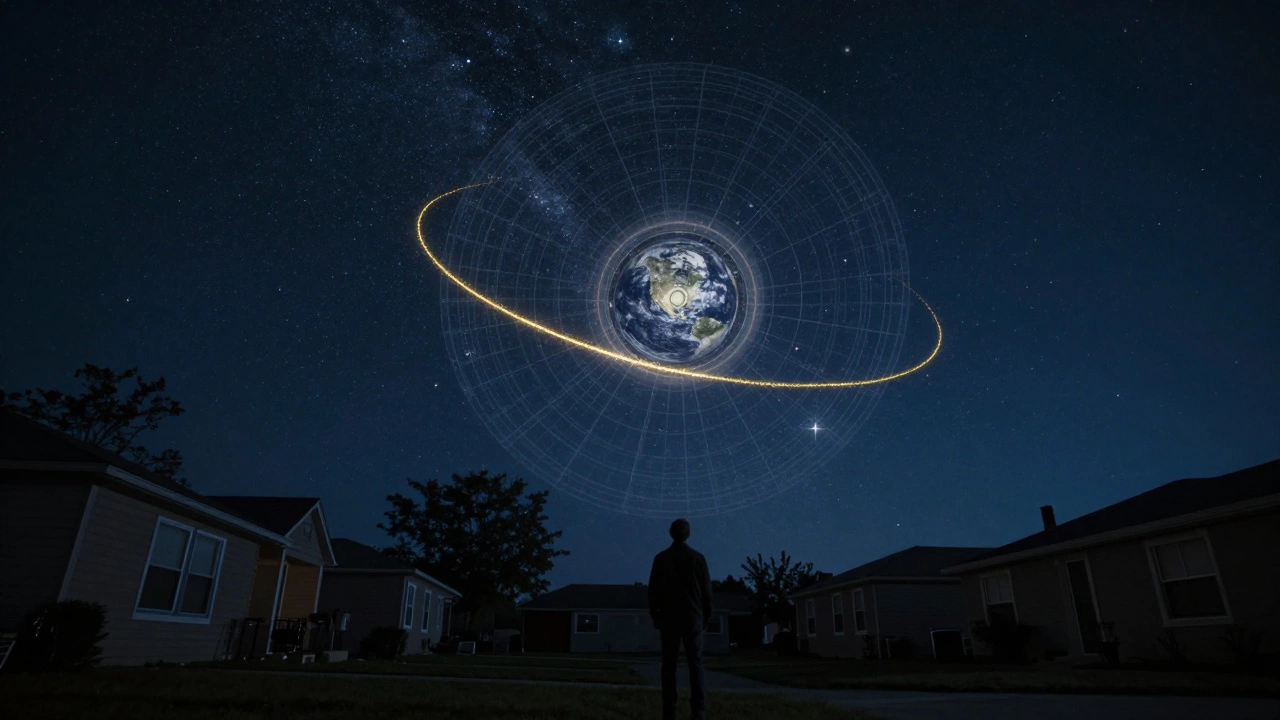
Before we tackle the lines, we need to talk about the Celestial Sphere is an imaginary globe surrounding Earth, where all stars and planets are projected as if they were stuck to the inside of a giant ball. It isn't a physical object, but it's the best way for us to describe where things are. Since we're standing on a rotating sphere, the easiest way to map the sky is to take the coordinates we use on Earth-like latitude and longitude-and project them straight up into space. This is how we create a grid that works for anyone, whether you're in Portland or Tokyo.
The Celestial Equator: Earth's Mirror
Think of the Celestial Equator as the Earth's equator, but expanded infinitely into space. If you imagine a giant line circling the Earth's waist and then push that line out until it hits the stars, you've found it. This line divides the sky into the Northern and Southern Hemispheres. It represents the projection of Earth's equator onto the celestial sphere.
Why does this matter to you? Because the celestial equator tells you how the stars will move. For someone living in the Northern Hemisphere, the celestial equator always sits to the south. If you're looking directly at it, you're looking toward the center of the cosmic map. Most of the famous constellations you see in the summer, like Cygnus or Lyra, hang out near or across this line. It's the baseline for measuring mapping the sky coordinates, specifically declination, which is basically the space version of latitude.
The Ecliptic: The Sun's Highway
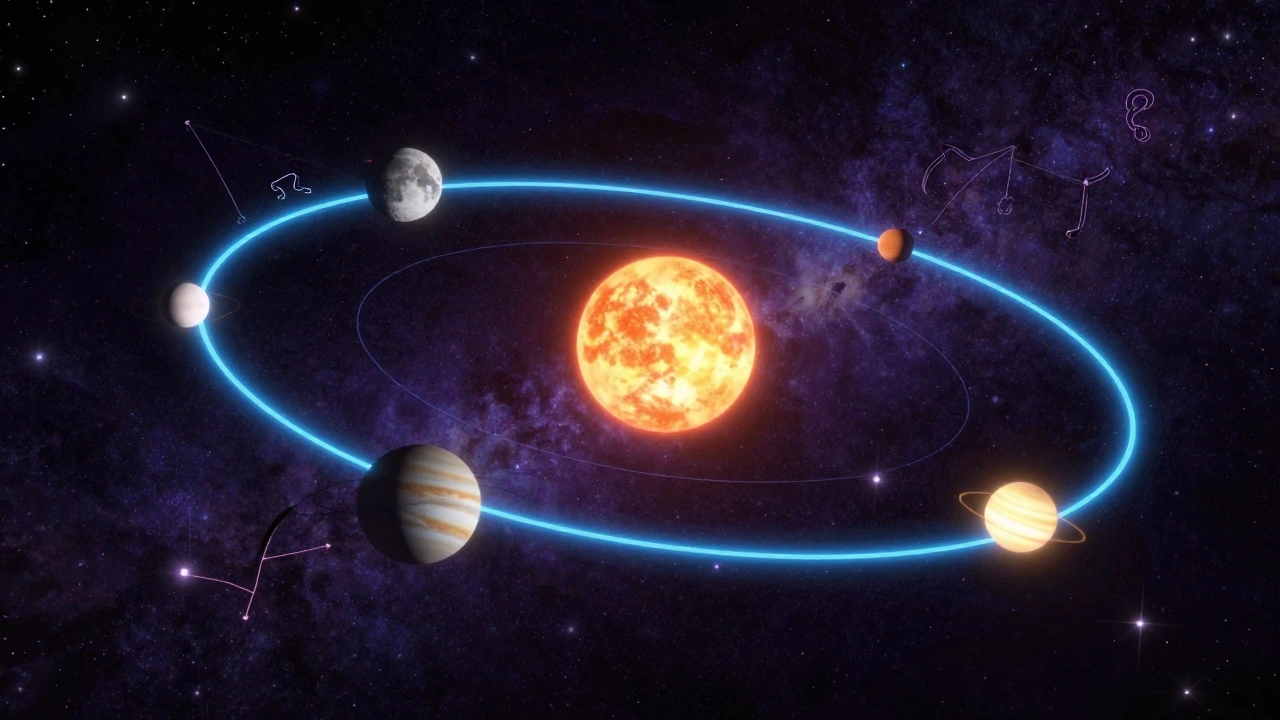
While the celestial equator is about Earth's rotation, the Ecliptic is about Earth's orbit. The ecliptic is the apparent path the Sun takes across the sky over the course of a year. If you tracked the Sun's position against the background stars every day from January to December, you'd see it draw a slightly wobbly circle around the sky. This path is the plane of Earth's orbit around the Sun.
Here is the secret: the Sun isn't the only thing on this highway. Because our solar system is relatively flat, the Moon and all the Planets also stay very close to the ecliptic. If you see a bright light in the sky and you aren't sure if it's a star or a planet, check if it's near the ecliptic. If it's sitting right on that path, there's a massive chance it's a planet like Jupiter or Mars. This is why the Zodiac constellations-like Aries, Leo, and Scorpio-are positioned along this line. They are the "roadside attractions" of the solar system's main highway.
| Feature | Celestial Equator | Ecliptic |
|---|---|---|
| Based on... | Earth's Rotation (Axis) | Earth's Orbit (Revolution) |
| What it tracks | Hemisphere divide | Sun, Moon, and Planets |
| Key Markers | Equinoxes | Zodiac constellations |
| Geometry | Aligned with Earth's equator | Tilted 23.5° relative to equator |
The 23.5 Degree Tilt: Why the Lines Don't Match
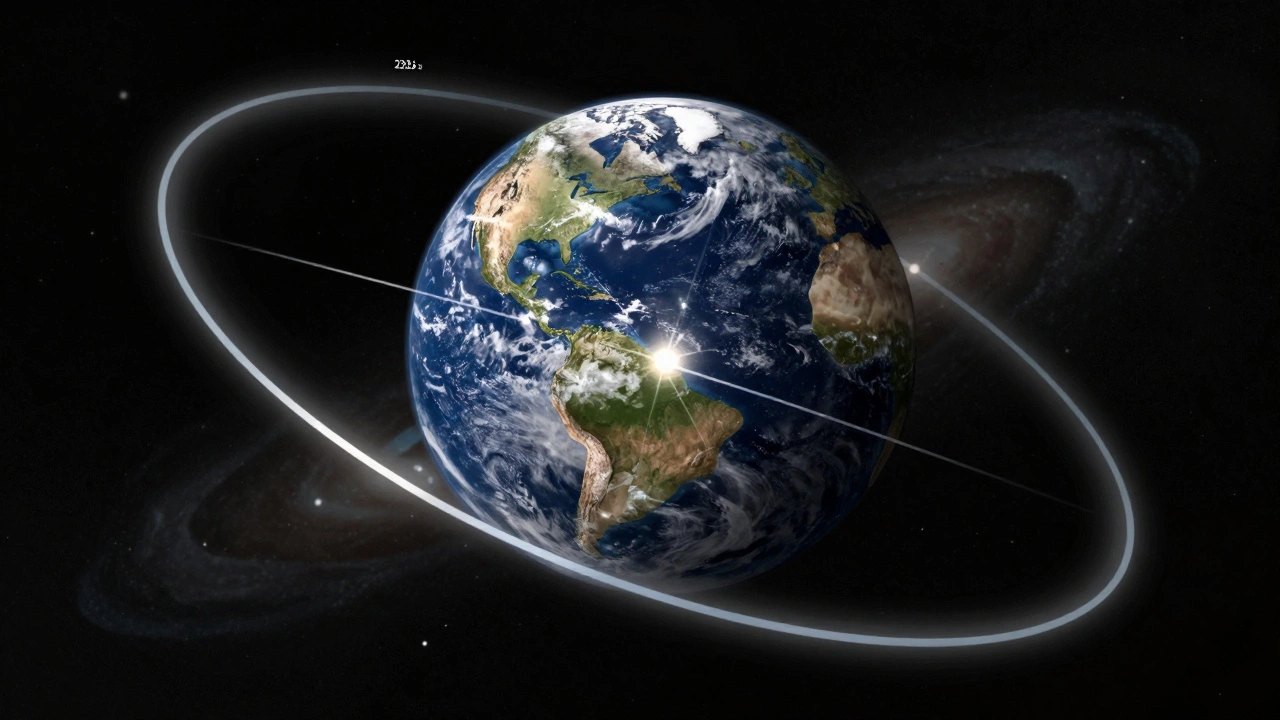
If the celestial equator and the ecliptic were the same line, we wouldn't have seasons. But Earth doesn't sit straight up and down; it's tilted. This tilt of roughly 23.5 degrees is the reason these two circles in the sky don't overlap perfectly. Instead, they intersect at two specific points. These points are the Equinoxes. When the Sun hits one of these intersection points, day and night are almost exactly equal in length. This happens every March and September.
When the Sun is at its furthest point north of the celestial equator, we hit the Summer Solstice (June). When it's furthest south, we hit the Winter Solstice (December). For a beginner, understanding this tilt helps you realize why certain constellations are only visible during specific seasons. For example, the "winter hexagon" of stars is prominent when the ecliptic is positioned such that those stars are visible during the night hours of the Northern Hemisphere's winter.
How to Find These Lines in the Night Sky
You can't see these lines with your naked eye, but you can find them using "anchor stars." Here is a practical way to map them out without needing a PhD in astrophysics:
- Find the North Star: Locate Polaris. Everything revolves around this point. The celestial equator is always exactly 90 degrees away from Polaris.
- Look for the Zodiac: Find a bright planet like Venus or Saturn. Since planets always stay near the ecliptic, the line connecting the planet to the Sun's current position is the ecliptic.
- Use a Star App: Most apps have a toggle for "Equator" and "Ecliptic." Turn them on and see how the planets hug the ecliptic while the stars are scattered everywhere else.
Once you start seeing these patterns, you'll notice that the sky isn't random. You'll see that the Milky Way, our own galaxy's disk, also cuts across these lines at a different angle, adding another layer to the 3D map of the universe.
Common Pitfalls for Beginners
One big mistake people make is thinking the ecliptic is a perfectly straight line. Because of the Moon's orbit, which is tilted about 5 degrees relative to the ecliptic, the Moon doesn't always sit exactly on the Sun's path. This is why we don't have a solar eclipse every single month. If the Moon's path and the ecliptic were identical, the Moon would block the Sun every single New Moon.
Another common point of confusion is mixing up the celestial equator with the horizon. The horizon is your personal line (it changes as you move), but the celestial equator is a universal line. No matter where you are on Earth, the celestial equator remains the same relative to the stars, even if it appears higher or lower in your local sky.
What is the difference between the celestial equator and the horizon?
The horizon is the line where the earth meets the sky from your specific perspective; it changes whenever you move. The celestial equator is an imaginary line in space that represents Earth's equator projected outward. It stays in the same place relative to the stars regardless of where you are standing.
Why do planets always stay near the ecliptic?
Planets stay near the ecliptic because the solar system formed from a spinning disk of gas and dust. As a result, almost all the planets orbit the Sun on roughly the same flat plane. Since we are viewing them from within that same plane, they appear to travel along a single narrow path in our sky.
How do the equinoxes relate to these lines?
The equinoxes occur at the two points where the ecliptic (the Sun's path) crosses the celestial equator. When the Sun reaches these intersection points, it spends exactly 12 hours above the celestial equator and 12 hours below it, leading to nearly equal day and night lengths.
Can I see the celestial equator without a telescope?
You cannot see the line itself because it is an imaginary mathematical boundary. However, you can find it by identifying stars that lie on it or by using a star chart. If you are at the Earth's equator, the celestial equator will pass directly overhead through your zenith.
Which constellations are located on the ecliptic?
The constellations located along the ecliptic are known as the Zodiac. These include Aries, Taurus, Gemini, Cancer, Leo, Virgo, Libra, Scorpio, Sagittarius, Capricorn, Aquarius, and Pisces. Because the planets travel this path, they are always found within or very close to these specific constellations.
Next Steps for Your Stargazing Journey
Now that you have the basic grid, try this: download a free app like Stellarium or SkyView. Instead of just searching for a star, turn on the coordinate grid. Look at how the planets drift along the ecliptic and how the stars in the Northern Hemisphere rotate around Polaris. Once you're comfortable with these lines, the next step is learning about right ascension and declination-the actual numbers that let you pinpoint any object in the sky with mathematical precision.