18 May 2026
- 0 Comments
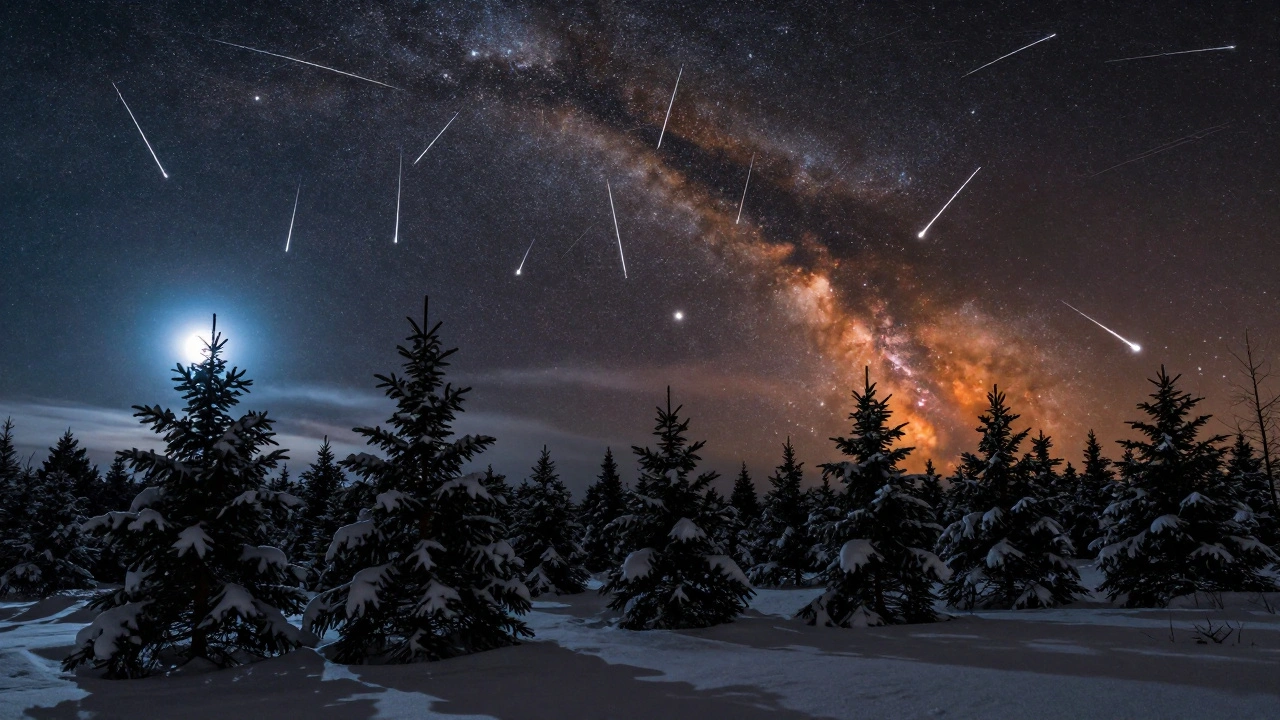
There is a specific window every year when the sky feels like it’s exploding with light. For most of us, that moment arrives in mid-December. If you have never seen a Geminid meteor shower is an annual celestial event produced by debris from the asteroid 3200 Phaethon, known for its high activity rate and bright fireballs., you are missing out on what many astronomers consider the finest display of the calendar. Unlike the Perseids in summer or the Leonids in November, the Geminids offer something unique: consistency, brightness, and speed that makes them easy to spot even if you live near a city with some light pollution.
The Geminids don’t just show up randomly. They follow a predictable schedule tied to the Earth’s orbit intersecting the path of a rocky body called 3200 Phaethon is a near-Earth asteroid discovered in 1983, which acts as the parent body for the Geminid meteor stream.. As our planet plows through this trail of dust and rock fragments, the particles burn up in our atmosphere at roughly 60 kilometers per second. That speed creates long, glowing streaks across the night sky. In 2026, this spectacle will reach its maximum intensity around December 14th, giving you a clear target to plan your evening around.
Why the Geminids Are Different From Other Showers
You might wonder why we should care about another meteor shower. After all, there are dozens throughout the year. The difference lies in the source. Most meteor showers come from comets-icy bodies that leave behind fragile trails of dust. When those particles hit the atmosphere, they often disintegrate quickly, creating faint, short-lived streaks. The Geminids, however, come from an asteroid. This means the debris is denser, tougher, and more substantial.
This density translates to two major benefits for you as an observer. First, you get more fireballs are exceptionally bright meteors, brighter than Venus, caused by larger meteoroids entering the atmosphere.. These are the big ones-the ones that make people look up and gasp. Second, the meteors tend to last longer before burning up completely. You aren’t just seeing a quick flash; you’re watching a sustained trail of light. Because the radiant point (the spot in the sky where the meteors appear to originate) is located in the constellation Gemini, the meteors often seem to shoot out from a recognizable pattern of stars, making it easier to track their paths.
When to Watch in 2026
Timing is everything when it comes to catching these lights. The Geminid season officially runs from mid-November until mid-December, but the activity ramps up significantly only in the final weeks. For 2026, here is how you should break down your viewing strategy:
- Early Activity (November 15 - December 5): Expect low rates, perhaps 5 to 10 meteors per hour. This is good practice if you want to get used to scanning the sky, but don’t expect a showstopper yet.
- Ramp-Up Phase (December 6 - December 13): The rate climbs steadily. By the week leading up to the peak, you could be seeing 30 to 40 meteors per hour under dark skies. This is a great time to test your location.
- Peak Night (December 14 - Early Morning December 15): This is the main event. Under ideal conditions, the rate hits approximately 120 to 150 meteors per hour. Note that "peak" doesn’t mean the whole night. The radiant rises later in the evening, so the best viewing happens after midnight local time.
- Post-Peak (December 16 - December 20): Activity drops off sharply but remains visible. You can still catch decent numbers if the weather was bad during the peak.
A crucial detail for planning: the Moon phase matters. In 2026, the Full Moon occurs on December 3rd. By the time the Geminids peak on the 14th, the Moon will be in its waning gibbous phase, setting earlier each night. This is actually favorable. On the night of December 14th into the early morning of the 15th, the Moon will set around 3:30 AM (depending on your longitude), leaving the latter part of the night much darker and better for spotting fainter meteors.
Finding the Right Spot
Where you stand determines what you see. Light pollution is the enemy of meteor watching. City lights wash out the dimmer meteors, leaving you to see only the brightest ones. If you live in a dense urban area, you need to drive away from the center. Aim for a spot where you can see the Milky Way. If you can’t see the band of the galaxy, you are probably too close to streetlights.
Here is a practical checklist for choosing your site:
- Dark Sky Reserves: Look for International Dark Sky Places near you. These areas have strict lighting ordinances to preserve natural darkness.
- Elevation Helps: Higher ground reduces atmospheric haze and obstruction from trees or buildings. A hilltop or a mountain overlook is ideal.
- Open Horizon: You want to see as much of the sky dome as possible. Avoid standing directly under power lines or tall structures.
- Safety First: Never go to a remote location alone if you don’t know the area. Tell someone where you are going and bring a charged phone.
If you cannot leave the city, find the darkest park you can. Even in Portland, Oregon, or similar mid-sized cities, moving ten miles outside the downtown core can double or triple the number of meteors you see.
How to Prepare Your Body and Gear
Watching meteors sounds relaxing, but it is physically demanding. You will be lying on the ground or sitting in a reclining chair for hours in potentially freezing temperatures. Preparation is key to enjoying the experience rather than suffering through it.
Start with warmth. Dress in layers. Base layers should be moisture-wicking (avoid cotton), middle layers should be insulating (fleece or wool), and outer layers should block wind. Bring a heavy blanket or a sleeping bag to lie on. Ground chill sucks heat out of your body faster than air chill does. Wear warm socks and gloves, but keep one hand free or wear thin liner gloves so you can adjust your camera or check your phone without exposing skin to the cold for long periods.
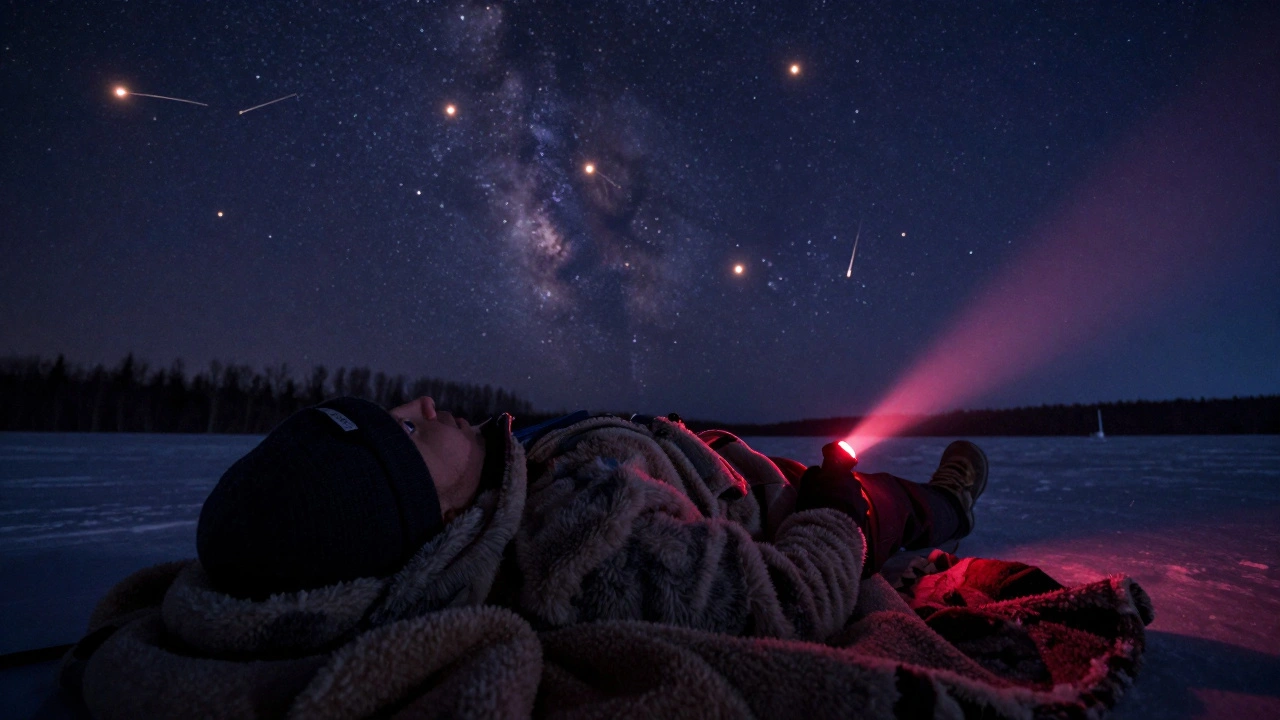
Regarding gear, you do not need a telescope. Telescopes have narrow fields of view, which limits your chances of seeing a meteor since they can appear anywhere in the sky. Binoculars are also unnecessary and might hinder your ability to relax. The best tool is your naked eye. However, bringing a red-light flashlight is smart. White light blinds your eyes and ruins your night vision for up to 30 minutes. Red light preserves your ability to see faint objects in the dark.
If you want to photograph the shower, bring a sturdy tripod, a wide-angle lens (14mm to 24mm is ideal), and a camera capable of manual settings. Set your ISO between 1600 and 3200, open your aperture as wide as possible, and use a shutter speed of 10 to 15 seconds. Focus manually on infinity, tweaking slightly back to ensure sharpness on the stars.
Understanding the Science Behind the Show
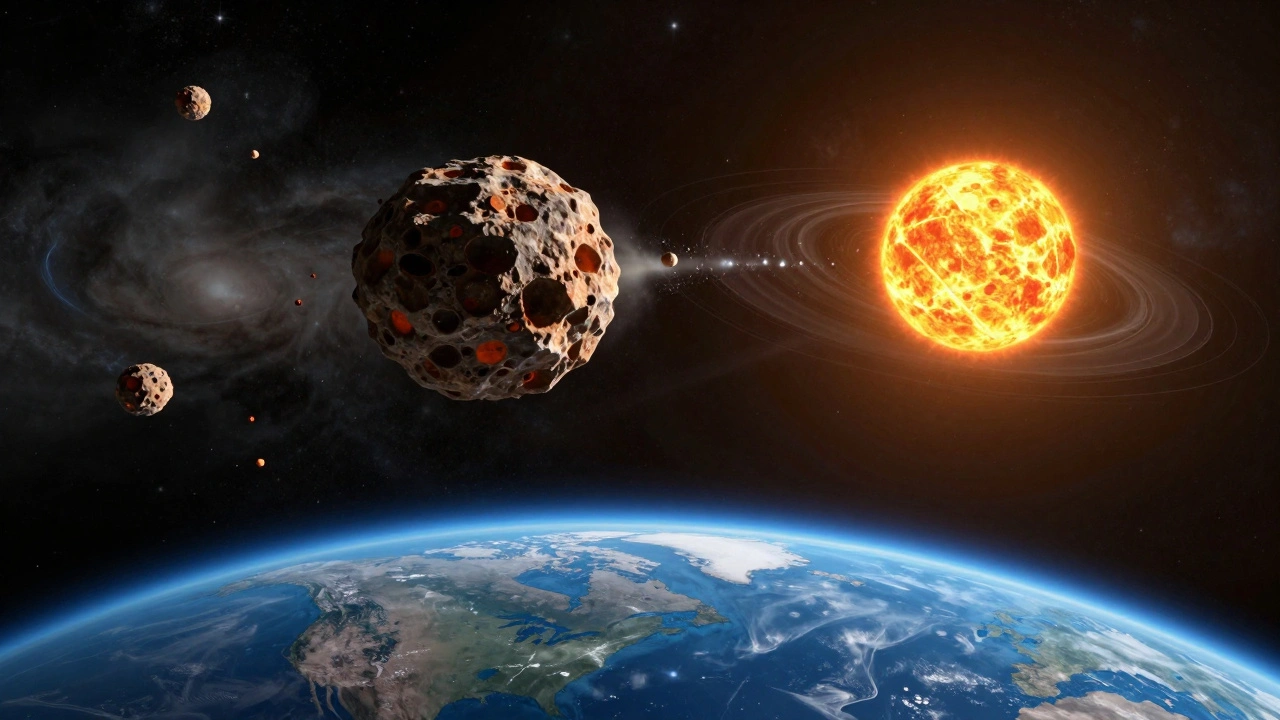
To appreciate what you are seeing, it helps to understand the mechanics. The Geminid meteor stream is a collection of debris particles left behind by the asteroid 3200 Phaethon as it orbits the Sun. is relatively young in astronomical terms. The asteroid itself has a highly elliptical orbit that brings it closer to the Sun than Mercury and takes it beyond Mars. Every time it passes perihelion (its closest point to the Sun), intense heat causes thermal stress fractures on its surface, shedding rocks and dust. Over thousands of years, this debris has spread along the orbital path.
When Earth intersects this path, gravity pulls these particles toward us. They enter the atmosphere at high speeds, compressing the air in front of them. This compression generates immense heat, causing the particle and the surrounding air to glow. This is not friction heating the rock; it is shockwave heating the air. The result is a plasma trail that we see as a meteor. The term "shooting star" is a misnomer-they are not stars, nor do they shoot; they fall and burn.
| Shower Name | Peak Date | ZHR (Ideal Conditions) | Parent Body | Speed (km/s) |
|---|---|---|---|---|
| Geminids | Dec 14 | 120-150 | Asteroid 3200 Phaethon | ~60 |
| Perseids | Aug 12 | 100 | Comet Swift-Tuttle | ~59 |
| Leonids | Nov 17 | 10-20 (outbreaks higher) | Comet Tempel-Tuttle | ~71 |
| Quadrantids | Jan 4 | 120 | Asteroid 2003 EH1 | ~41 |
As shown in the table above, the Geminids compete with the Quadrantids for the highest Zenithal Hourly Rate (ZHR). ZHR is a theoretical maximum calculated under perfect conditions: a dark sky, the radiant at the zenith (directly overhead), and no obstructions. In reality, you will rarely see 120 meteors in an hour because the radiant is rarely perfectly positioned and skies are rarely perfectly dark. But compared to the Leonids, which can be unpredictable, the Geminids are reliable year after year.
Troubleshooting Common Viewing Problems
Even with the best plans, things can go wrong. Cloud cover is the biggest risk. December is often cloudy in many temperate regions. Check detailed cloud cover forecasts, not just general weather apps. Use resources like Clear Outside or Windy.com, which provide hourly precipitation probability and cloud ceiling data. If clouds are forecasted, don’t give up entirely. Sometimes gaps open up unexpectedly. Be ready to move quickly to your pre-selected spot.
Another issue is patience. New observers often stare at the radiant point, expecting meteors to pop out of it like bubbles from a straw. This is inefficient. Meteors radiate outward from that point, meaning they can appear anywhere in the sky. Spread your gaze across the entire hemisphere. Let your eyes relax and scan peripherally. Your peripheral vision is more sensitive to motion than your central vision, helping you spot faint streaks faster.
If you are cold, stop shivering. Shivering burns energy and makes you colder. Get inside for ten minutes to warm up, then return. It is better to watch for two comfortable hours than four miserable ones. Hydration also plays a role. Cold air is dry, and dehydration affects your comfort levels. Bring a thermos with hot tea or chocolate.
Can I see the Geminid meteor shower from my backyard?
Yes, you can. While light pollution reduces the number of visible meteors, the Geminids produce enough bright fireballs to be seen from suburban and even some urban areas. The key is to face away from streetlights and allow your eyes to adjust to the darkness for at least 20 minutes. If you can see the Big Dipper clearly, you are in a decent spot.
What is the best time of night to watch the Geminids?
The best time is typically after midnight, preferably between 2:00 AM and dawn. This is because the radiant point in the constellation Gemini rises higher in the sky later in the night. The higher the radiant, the more of the sky is available for meteors to streak across. Before midnight, the radiant is low, limiting your view to a smaller section of the sky.
Do I need special equipment to see the Geminids?
No special equipment is needed. In fact, telescopes and binoculars are counterproductive because they limit your field of view. The best tool is your unaided eyes. If you want to document the event, a DSLR or mirrorless camera with a wide-angle lens and a tripod is sufficient. A red-light flashlight is recommended to preserve your night vision while moving around.
Why are the Geminids considered the best meteor shower?
They are favored for their reliability and quality. Unlike comet-derived showers, the Geminids come from an asteroid, resulting in slower, brighter, and more persistent meteors. They frequently produce fireballs and often leave persistent trains (glowing trails) behind them. Additionally, their peak occurs in December, avoiding the humidity and insects of summer showers like the Perseids.
What if it rains on the peak night?
Don't worry. The Geminid shower lasts for several days with high activity. The nights immediately before and after the peak (December 13th and 15th in 2026) still offer excellent viewing opportunities with rates only slightly lower than the peak. Always have a backup night planned.