6 May 2026
- 0 Comments
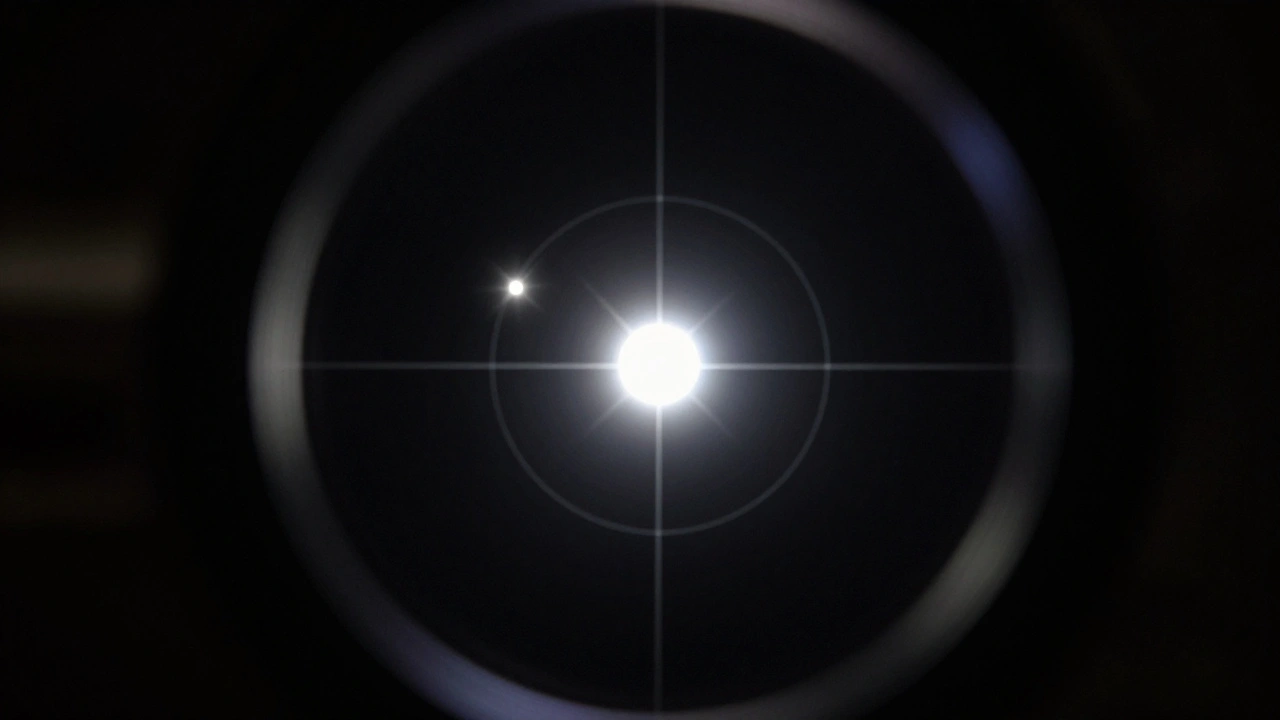
Looking through a telescope at a double star feels like finding a hidden treasure. You see two points of light dancing together, locked in a gravitational embrace that has lasted for billions of years. But seeing them is only the first step. The real magic happens when you start measuring them. When you record their position angle and separation, you stop being just an observer and become a contributor to science. Your data helps astronomers track orbital changes, calculate masses, and even spot new companions that professional telescopes might miss.
Measuring double stars isn't about complex math or expensive software. It’s about patience, good technique, and understanding how to translate what you see into numbers that matter. Whether you are using a simple reticle eyepiece or a digital camera with specialized software, the core concepts remain the same. Let’s break down exactly how to capture these measurements accurately.
Understanding the Basics of Binary Star Measurement
Before you look through the eyepiece, you need to understand what you are actually measuring. A double star system consists of a primary star (the brighter one) and a secondary star (the fainter companion). To describe where the secondary is relative to the primary, we use two specific values: separation and position angle.
Separation is the angular distance between the two stars. It is measured in arcseconds. Think of it as the length of a line connecting the centers of both stars. If a star is 10 arcseconds away, it means it appears as far apart as a dime held at arm's length would appear from your eye, roughly speaking. Smaller separations require higher magnification and better seeing conditions.
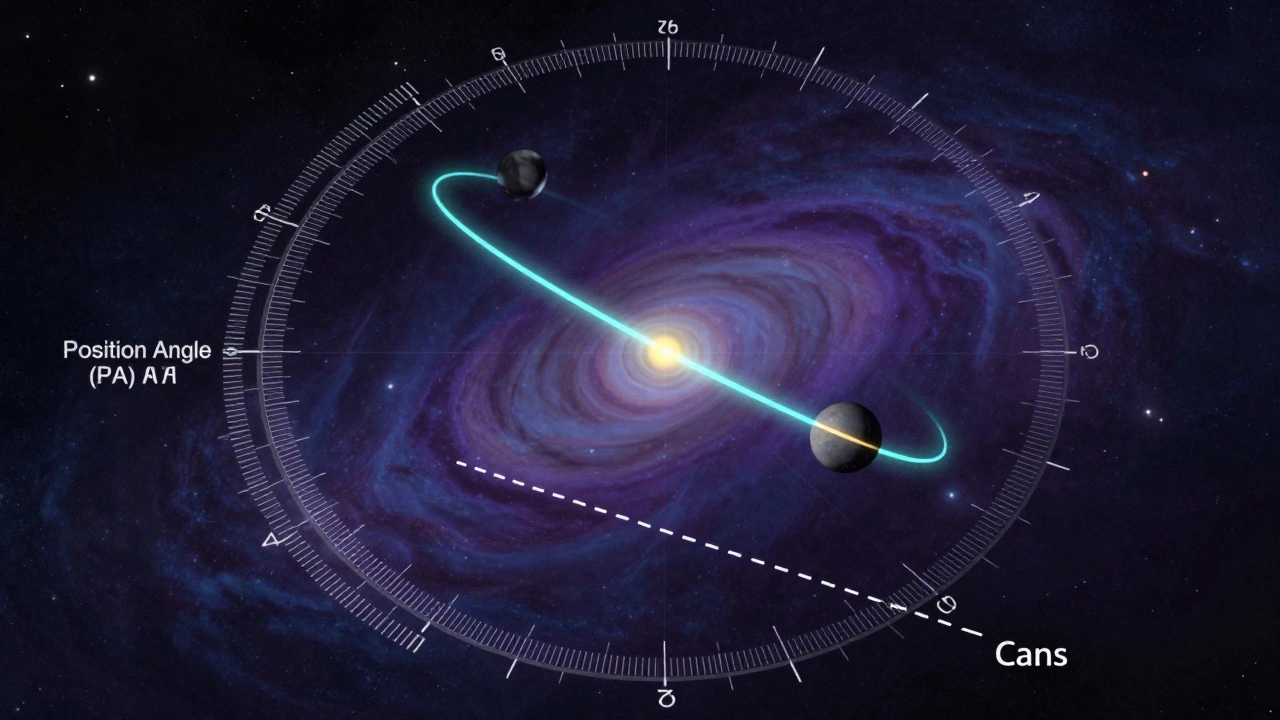
Position Angle (PA) is the direction of the secondary star from the primary, measured clockwise from North. This is the tricky part for beginners. In standard map coordinates, North is up. In the sky, if you are looking through a telescope, North might be up, down, left, or right depending on your setup. Position Angle ranges from 0° to 360°. 0° (or 360°) is due North. 90° is East. 180° is South. 270° is West.
| Term | Definition | Unit of Measure |
|---|---|---|
| Primary Star | The brighter component of the pair | Magnitude |
| Secondary Star | The fainter companion star | Magnitude |
| Sep | Angular distance between components | Arcseconds ("") |
| PA | Angle clockwise from North to Secondary | Degrees (°) |
Tools for Measuring: Reticles vs. Digital Methods
You don’t need a supercomputer to measure double stars. In fact, many professional astronomers still rely on traditional methods because they teach you to really *see* the stars. There are two main approaches: visual measurement with a micrometer and digital measurement with imaging software.
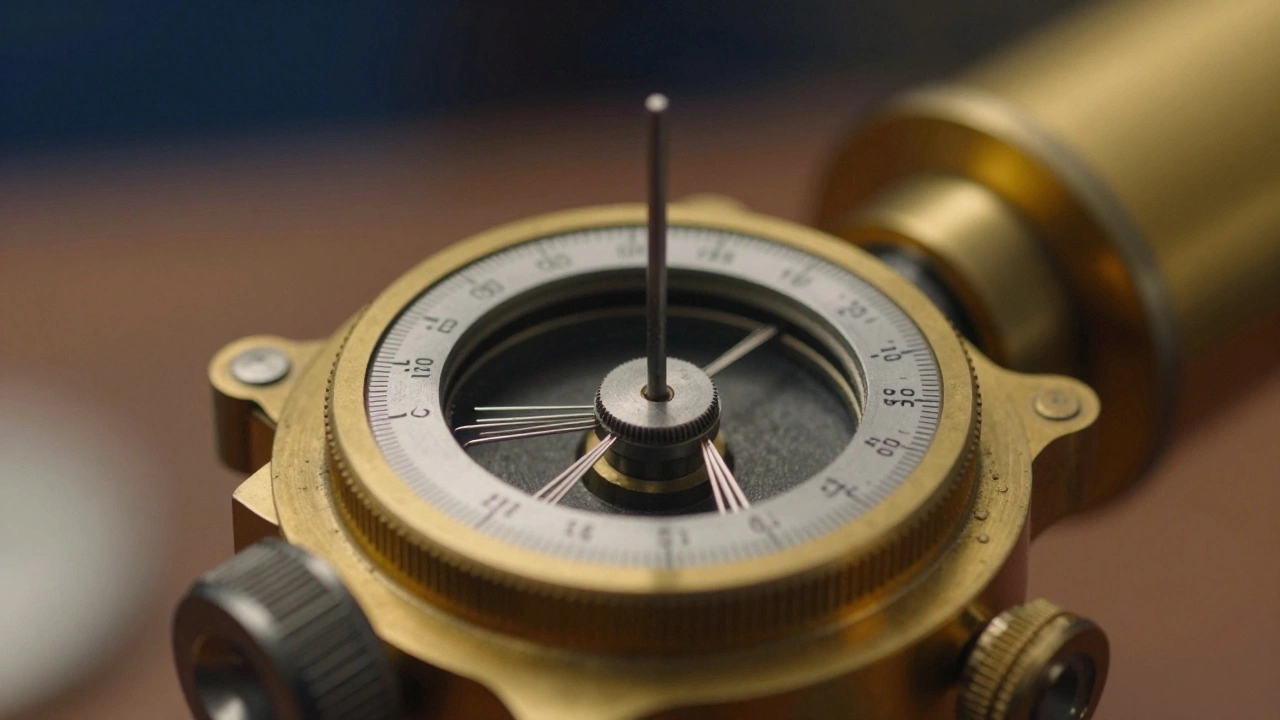
Filament Micrometer is an eyepiece containing fine wires used to measure angles and distances. This is the classic tool. It usually has two movable vertical wires and a fixed crosshair. By sliding the wires until each touches a star, you can read the separation directly off a scale. Some advanced micrometers also have a rotating ring to help determine the position angle. The beauty of a micrometer is that it forces you to focus sharply and judge contrast carefully. It works even when seeing conditions are mediocre, as long as you can resolve the pair.
On the other hand, Astrophotography Software like Astrometry.net or dedicated apps such as SharpCap allows you to take a short exposure and let the computer do the math. You snap a picture, align it with catalog data, and the software spits out the PA and separation instantly. This method is faster and less prone to human error, but it requires a camera, a stable mount, and often clearer skies than visual observing. For wide doubles, visual methods are often more satisfying. For tight pairs under 1 arcsecond, digital tools are usually necessary unless you have a very large aperture telescope.
Step-by-Step Visual Measurement Technique
If you choose the visual route, here is how to get accurate results. Preparation is key. Make sure your telescope is cooled down and focused perfectly. Use high magnification-enough to make the stars look like sharp disks, not fuzzy blobs. Diffraction spikes can interfere with measurements, so avoid using secondary mirror supports if possible, or rotate the scope to change the spike orientation.
- Center the Primary: Place the primary star exactly on the center crosshair of your micrometer or reticle. Do not move the telescope yet.
- Measure Separation: Slide the movable wire until it gently touches the edge of the primary star. Note the reading. Then slide the other wire to touch the secondary star. The difference between these readings is your raw separation. Alternatively, if your micrometer has a calibrated scale, simply count the divisions between the centers.
- Determine Position Angle: This is the hardest part visually. You need to know where North is in your field of view. One trick is to look at a known binary with a published PA and compare. Another method is to use a compass app on your phone to orient your telescope tube before observing. If your micrometer has a rotatable ring, align the zero mark with North, then rotate the ring until the reference line points to the secondary star. Read the degrees.
- Record Immediately: Write down the time, date, magnification, and your raw numbers. Don’t trust your memory. Memory fades; ink stays.
A pro tip: Take multiple measurements. Move the telescope slightly, re-center, and measure again. Average your results. This reduces random errors caused by atmospheric turbulence or shaky hands.
Handling Orientation and Mirror Flip Issues
Here is where most beginners stumble. Telescopes flip images. Refractors and Newtonian reflectors often invert the image upside down and backwards. Schmidt-Cassegrain telescopes might leave it upright but reversed left-to-right. This messes up your Position Angle reading if you aren’t careful.
To fix this, you must determine the orientation of your optical train. A simple way is to observe a well-known asterism, like the Big Dipper, and note which way the handle points. If the handle points left when it should point right, you have a mirror reversal. You can correct for this in your calculations later, or physically rotate your eyepiece to match standard orientation. Many observers prefer to keep their setup consistent and apply a correction factor to all their PA readings. For example, if your scope flips the image horizontally, you might need to subtract your measured PA from 360° and adjust accordingly. Always document your setup’s orientation so future observations are comparable.
Recording Data for Science Projects
Your measurements are more than just personal notes. They can contribute to global databases. Organizations like the International Double Star Association (IDSA) encourage amateur submissions. When you submit data, consistency is crucial. Use standard formats. Include the date in Julian Date format if possible, as it simplifies long-term analysis. List the magnitude difference between the stars, as this affects visibility. Note the "seeing" conditions-was the air steady or turbulent? Poor seeing makes precise measurements unreliable.
Why does this matter? Because some double stars orbit slowly over decades. Your measurement today, combined with someone else’s measurement ten years ago, helps define the orbit. Knowing the orbit tells us the mass of the stars. Mass is the most important property of a star-it determines its life, death, and everything in between. By measuring separation and position angle, you are helping weigh the stars.
Troubleshooting Common Errors
If your measurements seem off, check these common pitfalls. First, ensure you are measuring the centers of the stars, not their edges. Atmospheric distortion can make stars look elongated. Wait for moments of stability. Second, check your micrometer calibration. Over time, threads wear down, or scales shift. Compare your measurements against a known standard, like Alpha Cygni (Deneb), which has a well-documented separation and PA. If your numbers don’t match within a reasonable margin, recalibrate.
Another issue is confusion between optical doubles and physical binaries. Optical doubles are stars that appear close together but are unrelated, lying at different distances from Earth. Their position angles change randomly over time due to proper motion. Physical binaries orbit each other, so their PA changes smoothly. If you are tracking a pair over months and the PA jumps erratically, it might be an optical double. Consult catalogs like the Washington Double Star Catalog (WDS) to confirm if a pair is suspected to be physical before investing hours in tracking it.
What is the best telescope for measuring double stars?
There is no single "best" telescope, but larger apertures generally resolve tighter pairs. A 4-inch refractor is excellent for wider doubles and offers sharp contrast. For closer pairs under 1 arcsecond, you’ll want at least an 8-inch reflector or a 6-inch apochromatic refractor. Stability and smooth focusing mechanisms are more important than sheer size for accurate measurements.
How do I find North in my eyepiece?
Point your telescope at Polaris (the North Star). Since Polaris is almost exactly North, its position in your field of view indicates North. If Polaris is at the top of your view, North is up. If it’s on the left, North is left. Mark this orientation on a piece of paper or mentally note it before moving to your target star.
Can I measure double stars with a smartphone camera?
Yes, but with limitations. Smartphone cameras attached to telescopes can capture images that software can analyze. However, the small sensors often struggle with high magnifications and may introduce pixelation. Dedicated planetary cameras or DSLRs provide better resolution for precise astrometry. Smartphones are great for learning the process but less reliable for submitting high-precision scientific data.
What is the difference between an optical double and a physical binary?
An optical double is a chance alignment of two unrelated stars at different distances from Earth. A physical binary consists of two stars gravitationally bound and orbiting a common center of mass. Physical binaries show consistent, predictable changes in position angle over time, while optical doubles drift independently.
How often should I measure a specific double star?
For slow-moving pairs, once every few years is sufficient. For faster orbits or tight pairs, monthly or even weekly measurements can reveal significant changes. Consistency is key. Try to observe the same pair under similar conditions each time to minimize variable errors. Submitting regular data helps scientists refine orbital models.