8 May 2026
- 0 Comments
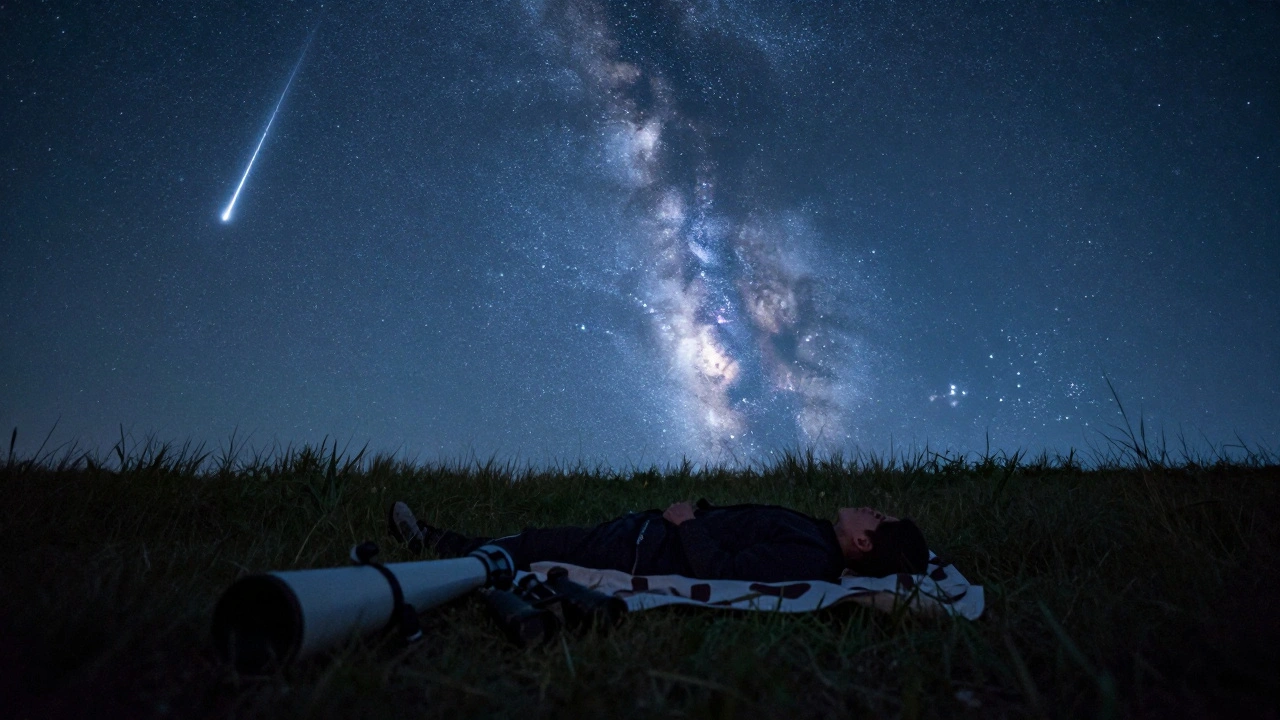
Imagine you are lying on your back in a dark field. The sky is clear, and the Perseid meteor shower is peaking tonight. You have spent weeks planning this moment. Now, you reach into your bag to grab your gear. Do you pull out a heavy, tube-shaped telescope, or do you choose the lightweight binoculars? This choice defines your entire experience. If you pick wrong, you might miss the show entirely.
Most beginners make the same mistake. They think more magnification means better views. They mount their telescope, aim at the radiant point, and wait. Nothing happens. Meanwhile, someone else is just looking up with naked eyes and sees ten shooting stars. The truth is simple: telescopes are terrible for meteors. Binoculars are okay. But your eyes are actually the best tool. Let’s break down why narrow-field optics fail here and how to use wide-field approaches correctly.
The Problem with Narrow Fields of View
To understand why telescopes struggle, you need to look at the concept of field of view (FOV). A standard astronomical telescope has a very narrow FOV. Even at low power, it often shows less than one degree of the sky. For context, the full moon is about half a degree wide. When you look through a telescope eyepiece, you are staring at a tiny postage stamp in an infinite ocean.
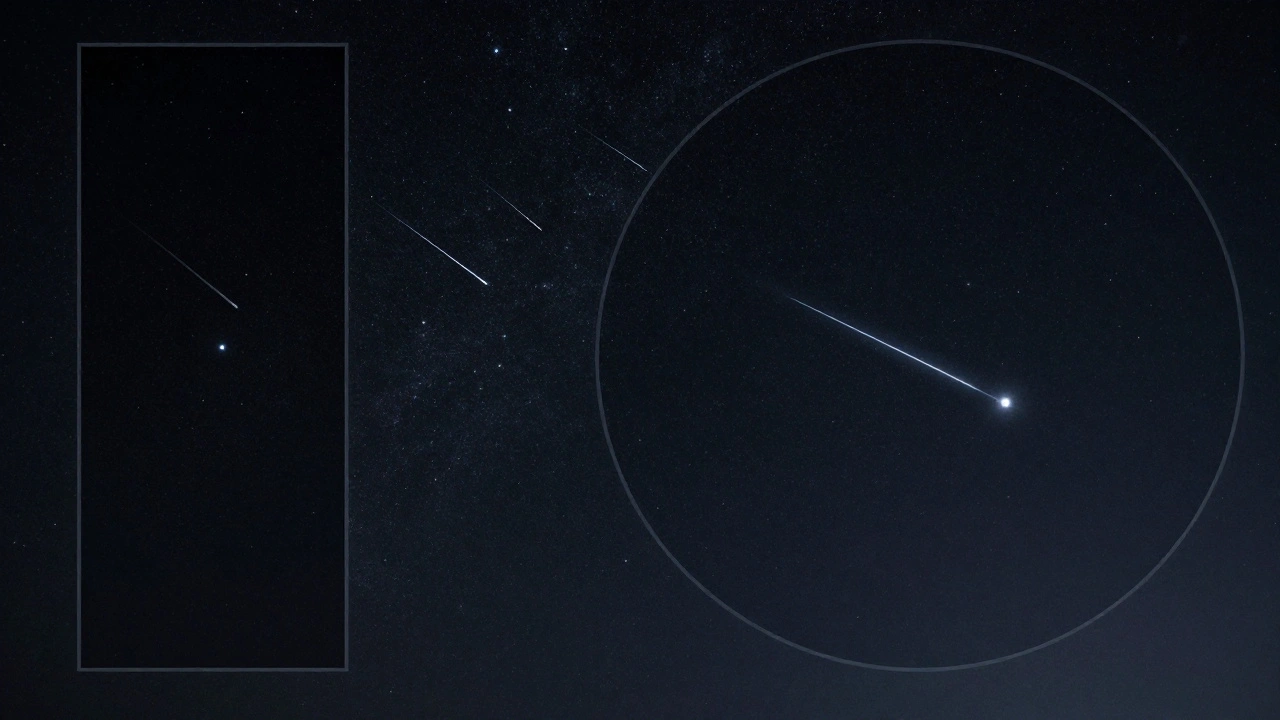
Meteors are random events. They can appear anywhere along their path. While they seem to radiate from a specific star cluster (the radiant), they streak across large sections of the sky. If you lock your telescope onto the radiant point of the Leonids, you are ignoring 99% of the sky where meteors might actually cross your view. It is like trying to catch rain by holding a straw open instead of an umbrella.
Furthermore, telescopes require precise alignment. Meteors move fast. A bright fireball might last only two seconds. By the time you hear someone shout "Look there!" and try to slew your mount to that spot, the event is over. The mechanical lag of equatorial or alt-azimuth mounts makes tracking transient events nearly impossible for visual observers.
Why Binoculars Are a Better Compromise
If you insist on using optical aid, binoculars offer a significant advantage over telescopes. A typical pair of 10x50 binoculars provides a field of view around five degrees. That is ten times wider than most telescope setups. This wider window increases your probability of catching a meteor significantly.
Beyond the wider view, binoculars provide binocular vision. Looking with both eyes creates a sense of depth and immersion that monocular viewing lacks. When a meteor streaks across the view of binoculars, it feels closer and more dramatic. The larger objective lenses (often 50mm or 60mm) also gather more light than your pupils, making fainter meteors visible as slightly brighter streaks against the background stars.
However, binoculars have their own drawbacks. They are heavier than you think. Holding them steady requires effort, and neck fatigue sets in quickly during long observation sessions. You cannot scan the horizon efficiently while holding them to your face. You end up staring at one patch of sky for too long, missing activity elsewhere. They are a step up from telescopes, but still not the ideal solution.
The Naked Eye: The Ultimate Wide-Field Instrument
Here is the counterintuitive fact: your unaided eyes are the superior instrument for meteor watching. Your natural field of view is roughly 180 degrees horizontally. You can see an entire hemisphere of the sky at once. No telescope or binocular can match this coverage. When you lie down and look up, you are monitoring the maximum possible area for incoming meteors.
Human vision also adapts to darkness better than any optical device when used correctly. After twenty minutes in total darkness, your rod cells become highly sensitive. You can detect meteors as faint as magnitude +6.5 with the naked eye. Telescopes and binoculars do not improve sensitivity enough to justify the loss of field of view. In fact, the glass elements in optics introduce slight light loss due to reflection and absorption, potentially making faint meteors harder to see compared to direct viewing.
The psychological aspect matters too. Watching with naked eyes allows you to relax. You can chat with friends, drink hot coffee, and enjoy the atmosphere. With a telescope, you are tethered to the equipment. You feel pressure to "find" something. With naked eyes, every flash is a surprise. This reduces anxiety and makes the experience more enjoyable.
Choosing the Right Gear for Different Goals
Not all observing sessions are the same. Your goal dictates your equipment. If you want to count meteors for scientific purposes, such as contributing to the International Meteor Organization, you must use naked eyes. Their guidelines strictly forbid optical aids because they skew the limiting magnitude and count rates. Using binoculars would invalidate your data.
If your goal is photography, the rules change completely. Here, you don't use binoculars or telescopes attached to cameras directly for wide-field shots. Instead, you use a camera with a wide-angle lens (14mm to 24mm). This mimics the naked-eye approach but captures the image. Telescopes are only useful for astrophotography if you are trying to capture a meteor impacting a planet or moon, which is extremely rare and requires lucky timing.
For casual enjoyment, some observers use binoculars selectively. They might use them to identify constellations before the shower peaks. Once the action starts, they put the binoculars down. This hybrid approach helps you learn the sky layout without sacrificing the wide-field advantage during the peak hours.
| Method | Field of View | Ease of Use | Best For |
|---|---|---|---|
| Naked Eye | ~180° | Very High | Counting, General Viewing, Relaxation |
| Binoculars (10x50) | ~5° | Medium | Constellation ID, Enhanced Drama |
| Telescope | <1° | Low | Avoid for Meteors |
Optimizing Your Observation Setup
Since you should primarily rely on naked eyes or binoculars, setup becomes about comfort and visibility. Location is critical. Light pollution kills meteor visibility faster than poor equipment. Drive away from city lights until the Milky Way is visible. The darker the sky, the more meteors you will see. A site with a southern exposure is usually best in the Northern Hemisphere, as it offers the widest view of the celestial sphere.
Comfort determines how long you can stay awake. Bring a reclining chair or a thick sleeping pad. Lying flat on hard ground causes back pain within thirty minutes. If your body hurts, you will stop looking up. Warmth is equally important. Temperatures drop at night. Dress in layers. Wear a hat. Cold fingers distract you from the sky.
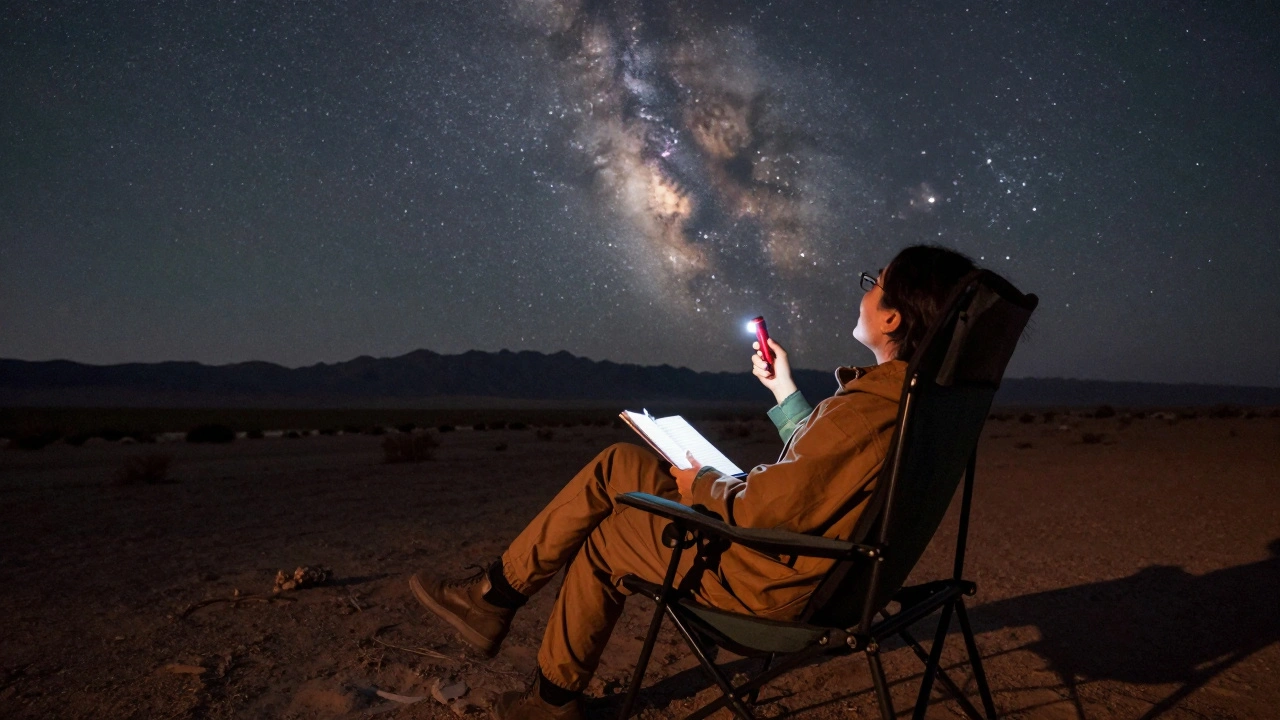
Allow your eyes to adapt. Avoid looking at phone screens or white lights. If you need light, use a red flashlight. Red light preserves your night vision, allowing your rods to remain sensitive. Turn off all unnecessary lights in your car. Wait at least twenty minutes after arriving at the site before starting your observations.
Timing and Strategy for Peak Performance
Meteor showers have predictable patterns, but individual meteors do not. The rate of meteors is measured by the Zenithal Hourly Rate (ZHR). This number tells you how many meteors a single observer would see under perfect conditions with a radiant at the zenith. However, real-world conditions vary. The radiant height affects the rate. When the radiant is low on the horizon, fewer meteors enter the observable sky volume.
Plan your session around the radiant's position. For morning showers like the Quadrantids or Lyrids, the best viewing is between 3 AM and dawn. For evening showers like the Perseids, late night to early morning works best. Don't give up if the rate seems slow. Meteor activity comes in bursts. Sometimes you will see none for ten minutes, then three in quick succession. Patience is the most important skill.
Keep a log. Write down the time, brightness, and color of each meteor. Note if it left a persistent train. This practice sharpens your attention and makes the experience more engaging. It also helps you recognize different types of meteors. Some are fast and thin; others are slow and thick. Identifying these characteristics adds a layer of expertise to your hobby.
Common Mistakes to Avoid
Many new observers ruin their experience by chasing the radiant. Remember, meteors stream away from the radiant, not towards it. If you stare directly at the radiant star cluster, you will see few meteors. Look perpendicular to the radiant for the longest trails and highest chance of detection. Scan the sky slowly, moving your gaze from horizon to horizon.
Another common error is expecting constant action. Meteor showers are not fireworks displays. They are sporadic. Even during major showers, there will be quiet periods. Accept this rhythm. Use the quiet times to rest your eyes, check the weather, or socialize. Frustration leads to quitting early. Enjoyment leads to staying until the sun rises.
Finally, don't neglect safety. Dark fields can hide holes, rocks, or wildlife. Walk carefully. Be aware of your surroundings. If you go alone, tell someone where you are going. Weather can change rapidly. Have an escape route planned. Safety ensures you return home to share your story.
Can I see meteors through a telescope?
Technically yes, but it is highly discouraged. Telescopes have a very narrow field of view, meaning you are looking at a tiny fraction of the sky. Since meteors can appear anywhere, you are statistically likely to miss almost all of them. Additionally, telescopes are hard to move quickly, so you won't be able to track fast-moving meteors effectively.
Are binoculars better than naked eyes for meteors?
Binoculars offer a wider view than telescopes and can make meteors appear slightly brighter. However, they restrict your field of view compared to naked eyes and cause neck strain. For counting meteors scientifically, naked eyes are required. For casual viewing, naked eyes are generally preferred for comfort and coverage, though binoculars can add drama to individual sightings.
What is the best time to watch meteor showers?
The best time depends on the specific shower. Generally, the hour before dawn is optimal because the Earth is facing forward into the debris stream, like a car hitting bugs on its windshield. Also, the radiant points of many major showers rise higher in the sky during pre-dawn hours, increasing the number of visible meteors.
How does light pollution affect meteor viewing?
Light pollution washes out faint meteors. In a city, you might only see the brightest fireballs. In a dark sky location, you can see dozens of fainter meteors per hour. Light pollution reduces the limiting magnitude of your vision, drastically cutting the number of visible events. Driving away from city lights is the single most effective way to improve your experience.
Should I look at the radiant point of the shower?
No, avoid staring directly at the radiant. Meteors appear to originate from the radiant, so they are shortest and least visible near it. As they travel further from the radiant, their trails lengthen and become easier to see. Aim your gaze 30 to 60 degrees away from the radiant for the best chances of spotting long, dramatic streaks.