28 Dec 2025
- 0 Comments
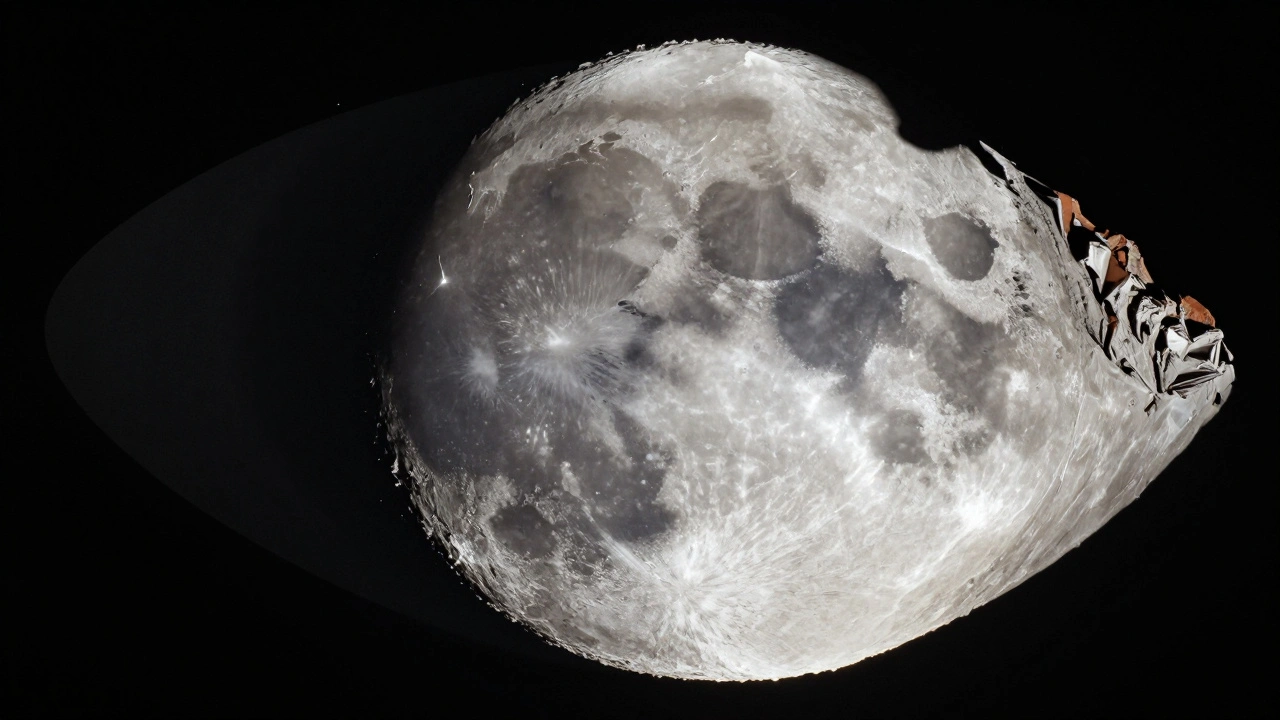
Look up at the Moon on a clear night, and you’re not just seeing a glowing disk. You’re staring at a frozen record of the solar system’s violent past. The Moon’s surface is packed with features that tell a story older than Earth itself. If you’ve ever wondered why some parts look dark and flat while others are covered in bumps and valleys, you’re not alone. Let’s break down the four biggest lunar features you can see with your own eyes: craters, maria, mountains, and rilles.
Craters: The Moon’s Scar Tissue
Craters are everywhere. They’re the Moon’s most obvious feature, and they’re not just holes in the ground-they’re impact scars. Billions of years ago, asteroids and comets slammed into the Moon’s surface at speeds over 40,000 miles per hour. Each collision blasted out rock, melted it, and threw debris into the air. When it settled, it formed the raised rims and central peaks we see today.
The Moon has no atmosphere to burn up incoming space rocks, so even small ones hit hard. That’s why its surface is so pockmarked. Some craters, like Tycho near the southern pole, have bright rays stretching across hundreds of miles. Those rays? They’re material thrown out during the impact, still fresh and reflective. Others, like the huge South Pole-Aitken Basin, are so old they’ve been worn down by time and later lava flows.
Craters aren’t all the same. Simple craters are bowl-shaped and under 15 kilometers wide. Complex craters-those bigger than that-have central peaks and terraced walls. The crater Copernicus, visible with binoculars, is a textbook example: steep walls, a flat floor, and a tall central peak. It’s about 93 kilometers wide and formed about 800 million years ago. You can see it clearly just after first quarter when the Sun is low and shadows make the details pop.
Maria: The Dark Seas That Aren’t Water
Those big, dark patches on the Moon? They’re called maria (singular: mare), Latin for "seas." Early astronomers thought they were oceans. They were wrong. There’s no water here-just solidified lava.
Between 3 and 4 billion years ago, massive asteroid impacts cracked the Moon’s crust wide open. Deep below, hot rock from the mantle oozed up through those cracks and flooded the low-lying basins. This lava cooled slowly, turning into smooth, dark basalt rock. It’s much darker and less reflective than the surrounding highlands, which is why they look so black against the bright terrain.
The largest mare is Oceanus Procellarum, the Ocean of Storms. It covers more than 4 million square kilometers-bigger than all of Europe. Mare Imbrium, the Sea of Rains, is another giant. It was formed by a single impact so huge it likely changed the Moon’s shape. You can trace its edge with the naked eye: it’s the big, dark oval on the upper left side of the Moon during a full moon.
Here’s the kicker: maria are mostly on the near side-the side we always see. Why? Scientists think the Moon’s crust was thinner on that side, making it easier for lava to break through. The far side? It’s mostly highlands and craters, with very few maria. That’s still a puzzle.
Mountains: The Moon’s Ancient Ridges
Moon mountains aren’t like Earth’s. No tectonic plates here. No erosion. These peaks were built by violence, not slow uplift.
The most dramatic lunar mountains ring the edges of the big impact basins. Think of it like this: when a giant asteroid hits, it doesn’t just make a hole-it compresses the ground all around it, pushing rock upward in a ring. Those rings become mountain ranges.
The Apennine Mountains, part of the rim of Mare Imbrium, rise over 4,500 meters high. They’re visible as a sharp, jagged line along the eastern edge of the Sea of Rains. The Alps, another range, form a smooth arc just north of Mare Imbrium. You can spot them with binoculars as a dark line cutting across a bright area.
There are also isolated peaks, like Mons Piton, standing alone in Mare Imbrium. It’s about 2,300 meters tall and casts a long shadow at sunrise. These aren’t volcanoes-they’re fragments of the original basin rim that got left behind after the lava flooded the area.
One of the most fascinating facts? The Moon’s tallest peak is not on a rim-it’s inside a crater. Mons Huygens, near the center of the Montes Apenninus, stands at nearly 5,500 meters. That’s taller than Mount Rainier.
Rilles: The Moon’s Hidden Riverbeds
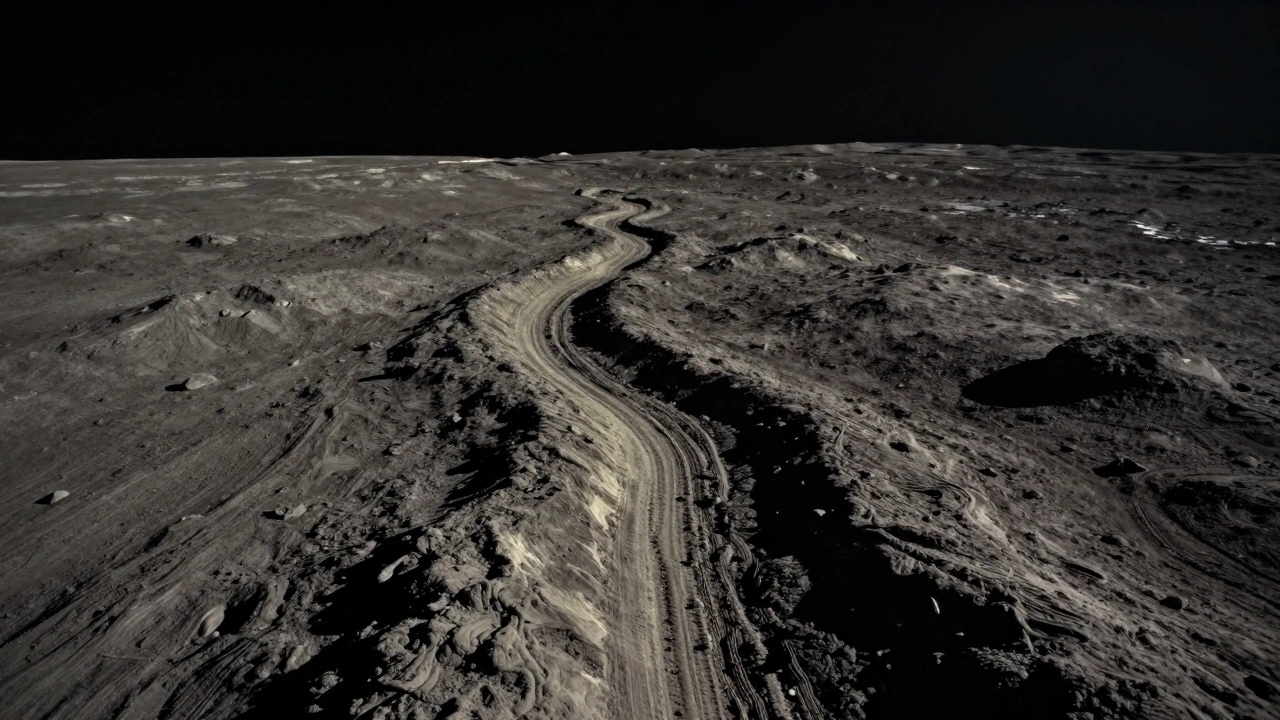
Rilles are the Moon’s quietest features, but they’re among the most mysterious. They look like long, narrow grooves carved into the surface. Some are sinuous, winding like rivers. Others are straight, slicing across the landscape like ruler lines.
Sinuous rilles, like the ones in Mare Serenitatis or the Hadley Rille near Apollo 15’s landing site, were likely formed by ancient lava flows. Imagine rivers of molten rock carving channels into the ground as they moved. When the lava drained away, it left behind hollow tunnels. These aren’t dry riverbeds-they’re lava tubes.
Straight rilles, or grabens, are different. They form when the crust stretches and cracks. Think of pulling apart a chocolate bar-it splits along clean lines. On the Moon, this happens when the crust is pulled apart by gravitational forces or the weight of nearby maria. The most famous straight rille is Rimae Sirsalis, a 1,200-kilometer-long crack cutting across the lunar highlands. It’s visible through a small telescope.
There’s even a third type: arcuate rilles, which curve gently around the edges of maria. These are thought to be collapsed sections of lava tubes that once helped drain lava out of the basin.
Observing rilles takes patience and good seeing conditions. They’re faint, and you need a telescope with at least 60mm aperture and steady skies. The best time? When the terminator-the line between day and night on the Moon-is passing over them. That’s when shadows are longest and details are sharpest.
Why These Features Matter
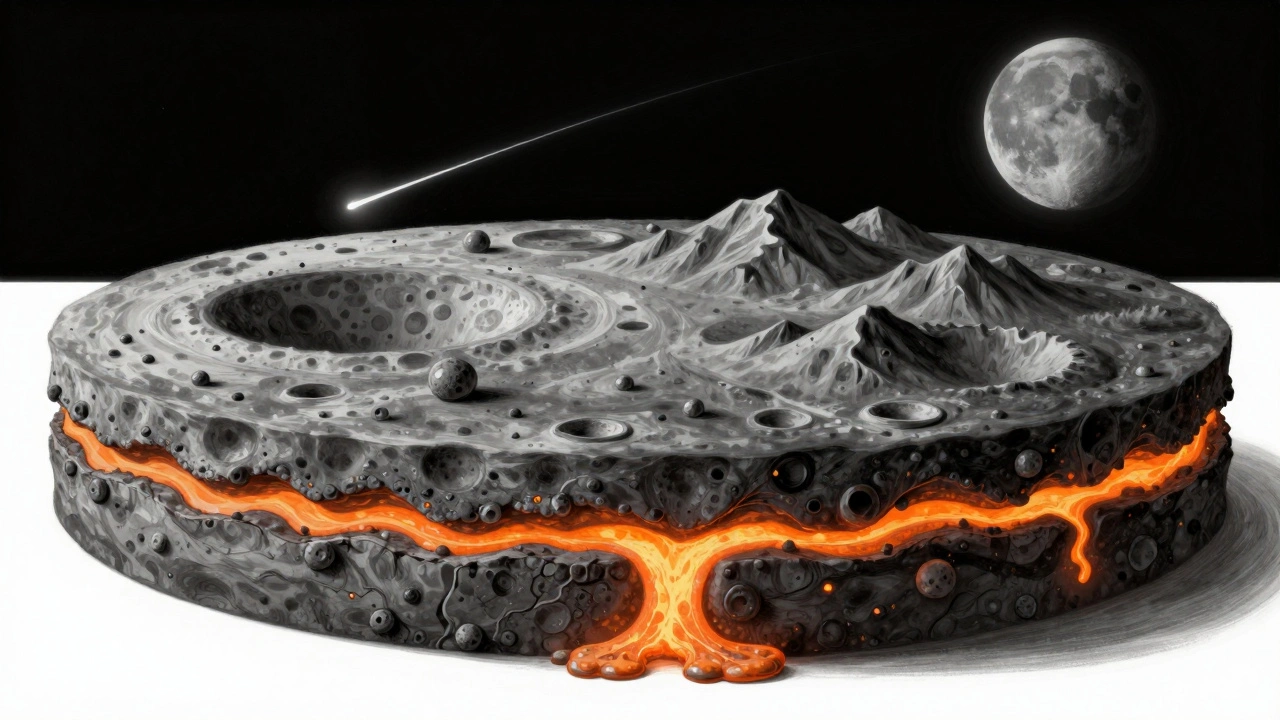
These four features aren’t just pretty shapes. They’re clues. Craters tell us about the bombardment history of the inner solar system. Maria reveal how the Moon’s interior once flowed like a molten sea. Mountains show us the scale of ancient impacts. Rilles hint at the Moon’s volcanic past and how its crust behaved under stress.
When you look at the Moon, you’re not just seeing a satellite. You’re seeing a world that was once geologically alive. It had volcanoes, lava flows, and tectonic stresses. It was hit harder than Earth ever was. And because it has no weather or erosion, all of it is still there-frozen in time.
How to Observe Them
You don’t need a fancy telescope to see these features. Start with binoculars. You’ll easily spot the maria, the bright craters like Tycho and Copernicus, and the mountain ranges along the terminator.
- Best time to observe: First and last quarter phases. The Sun is low, casting long shadows that highlight every bump and groove.
- Use a lunar map app. Apps like SkySafari or Stellarium show you what’s visible each night.
- Sketch what you see. It trains your eye to notice details you’d otherwise miss.
- Wait for steady air. Even a small telescope can show rilles if the atmosphere isn’t shaky.
Try this: On the evening of February 20, 2026, the Moon will be in its first quarter phase. Look just after sunset. You’ll see the terminator running down the center. That’s where the best details show up. Find the bright crater Tycho near the south. Look north from it-there’s a dark, smooth patch. That’s Mare Clavius. To its left, a jagged line of peaks? That’s the Apennines. And if you have a telescope, trace the thin, winding groove just below the Apennines-that’s the Hadley Rille.
What’s Next?
Once you’ve got the hang of craters, maria, mountains, and rilles, you’ll start noticing more: rays, domes, valleys, even the faint glow of earthshine on the dark side. The Moon is a living laboratory. Every night, it shows you something new. You don’t need to be an expert. Just look up, be patient, and let the ancient landscape speak.
Why does the Moon have so many craters compared to Earth?
The Moon has no atmosphere, so nothing burns up incoming asteroids or comets. Earth’s atmosphere protects us-most space rocks vaporize before they hit. Plus, Earth has weather, erosion, and plate tectonics that erase craters over time. The Moon has none of that. Its surface is a 4-billion-year-old archive of impacts, untouched and preserved.
Are the maria really seas?
No. Early astronomers named them "seas" because they looked dark and smooth, like water. We now know they’re vast plains of solidified lava. The name stuck, but there’s not a drop of water there. The maria are made of basalt, the same dark rock that forms ocean floors on Earth.
Can I see rilles with binoculars?
Most rilles are too narrow and faint for binoculars. You’ll need a telescope with at least 60mm aperture and good seeing conditions. The Hadley Rille, for example, is about 1 kilometer wide and requires 100x magnification to see clearly. But you can spot the general shape of large rilles with larger binoculars under perfect skies.
Why are maria mostly on the near side of the Moon?
The Moon’s crust is thinner on the near side, likely because of how it formed. When the Moon cooled after its creation, heat from Earth kept the near side warmer, preventing the crust from thickening as much. That made it easier for lava to burst through and flood the basins. The far side’s thicker crust blocked most lava flows, so it stayed mostly cratered.
What’s the best time of month to see lunar features?
The best time is during the first and last quarter phases. That’s when the Sun is low on the lunar horizon, casting long shadows that highlight craters, mountains, and rilles. At full moon, the Sun is directly overhead-everything is flat and washed out. Avoid full moon for detailed viewing.