2 Jan 2026
- 0 Comments
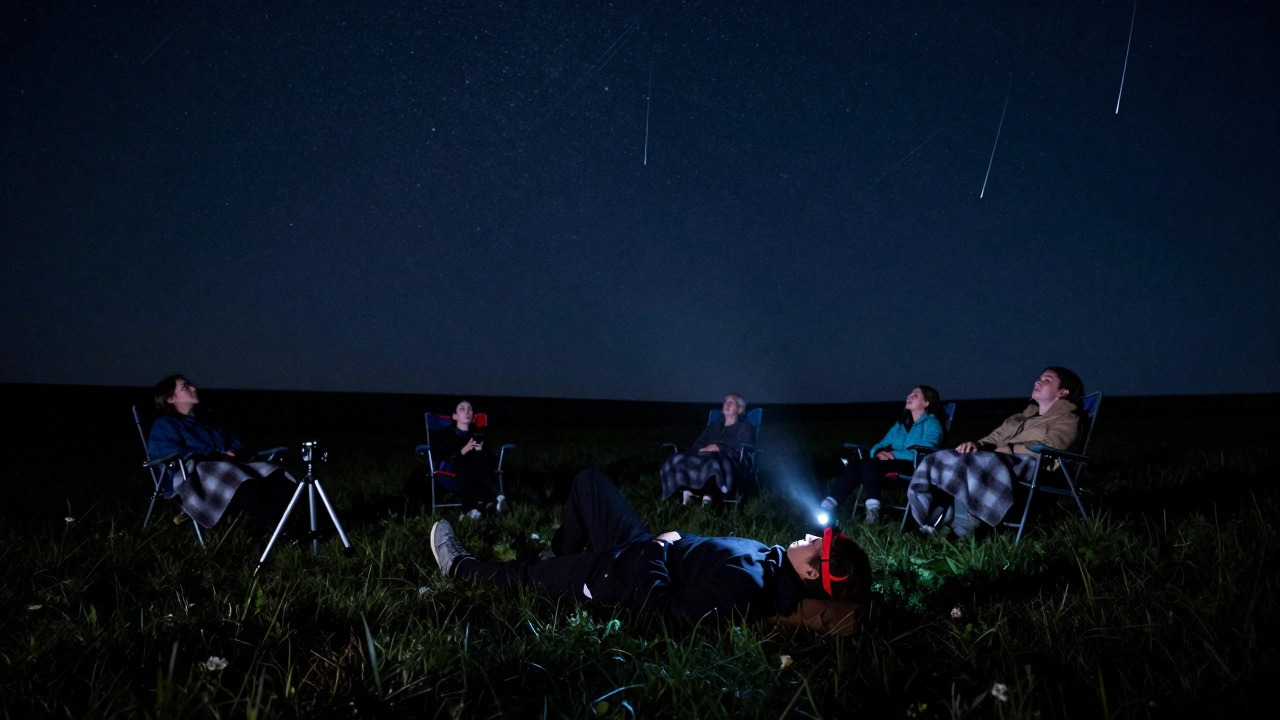
It’s August again. The Perseids are peaking, and your phone’s weather app says clear skies all night. You’ve packed your blanket, your thermos of coffee, and your fancy new tripod. You’re ready. But when you arrive at your favorite spot-quiet, dark, and just far enough from town-you notice three people already there. One’s got a white LED headlamp. Another is scrolling through their phone. And the third? They’re adjusting a tripod so big it blocks half the sky. Suddenly, your excitement turns to frustration.
Meteor showers aren’t just about seeing shooting stars. They’re about sharing the night sky. And if you don’t follow basic etiquette, you’re not just ruining your own experience-you’re ruining it for everyone else.
Why Red Lights Matter More Than You Think
Your eyes need 20 to 30 minutes to fully adjust to darkness. That’s not a guess. It’s science. Once they do, they become 10,000 times more sensitive to light than in daylight. A single white LED from a phone, a headlamp, or even a car door light can wipe out that adaptation in seconds. And it doesn’t just affect you. It affects the person next to you. And the person five feet away. And the family setting up their telescope 30 yards down the trail.
Red light is the only safe option. Not because it’s trendy. Because it’s the only color that preserves your night vision without blinding others. A dim red LED headlamp, a red flashlight, or even a red cellophane-covered flashlight from your kid’s Halloween kit? That’s your gear. You don’t need a $100 astronomy light. You just need something that doesn’t flood the sky with blue-white glare.
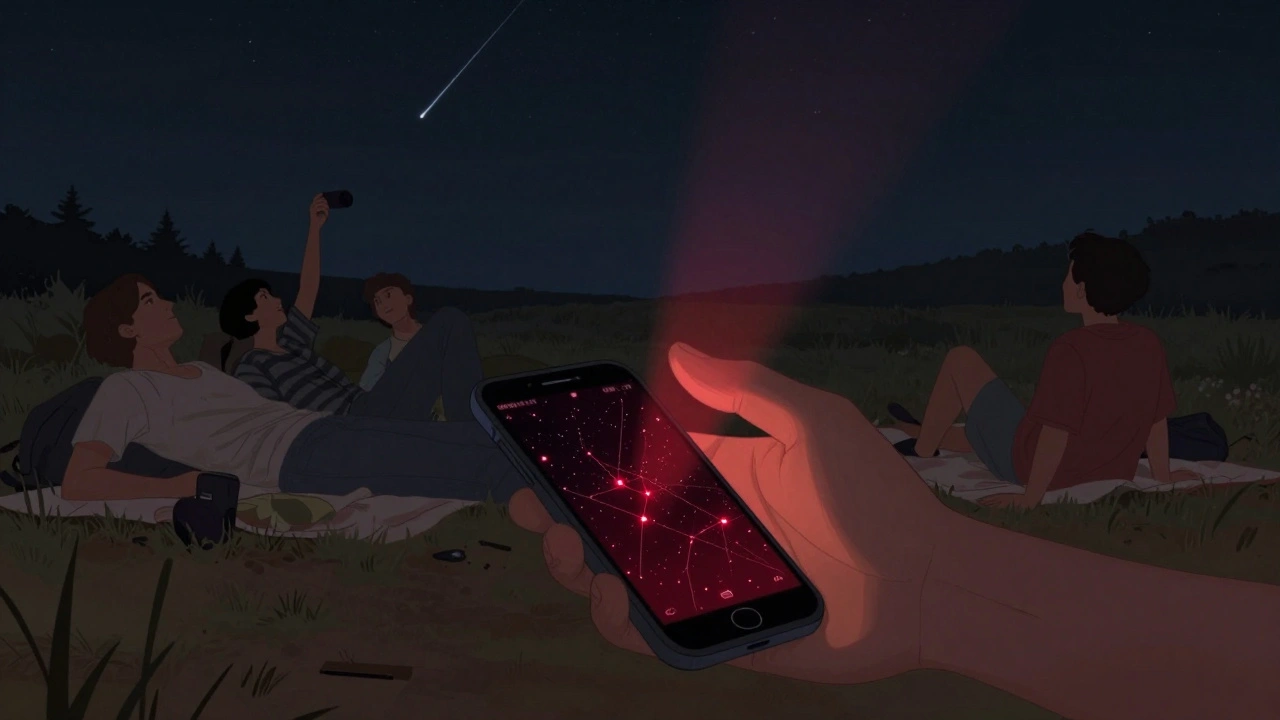
And no, putting your phone screen on “night mode” doesn’t count. Even the dimmest white light from a phone screen-especially if it’s glowing under your chin as you scroll through meteor apps-is still a problem. If you need to check the time or your viewing app, turn your back, crouch low, and shield the screen with your hand. Better yet, memorize the peak times ahead of time.
Tripod Awareness: Don’t Be the Person Who Blocks the Sky
You bought a new tripod because you want to photograph the meteors. Good. But here’s the thing: you don’t need to set it up in the middle of the best viewing zone.
Most people watch meteors by lying back and letting their eyes drift across the whole sky. A tall tripod, especially one with a camera pointed upward, doesn’t just take up space-it creates a blind spot. One person with a tripod in the wrong spot can block the view for three or four others. And if they’re fiddling with settings, adjusting focus, or using a red screen to check exposure? That’s even worse.
Here’s how to fix it:
- Set up your tripod at the edge of the viewing area, not the center.
- Keep it low. If you can, use a ground-level tripod or even just a beanbag on the grass.
- Don’t point it straight up unless you’re alone. Aim slightly off-center-toward the radiant point, but not directly overhead.
- If you’re sharing space with others, ask: “Can I set up here?” and be ready to move if someone says no.
Photographing meteors is cool. But if you’re standing in the middle of a group, blocking their view while you fiddle with ISO settings, you’re not a photographer. You’re a nuisance.
Quiet Is the New Cool
Meteors don’t make noise. But people do. Loud talking, laughter, music, phone ringtones, and even sudden gasps can ruin the mood. It’s not about being silent forever. It’s about respecting the rhythm of the night.
When you see a meteor? Whisper it. Point gently. Let others look. Don’t yell, “Oh my god, did you see that?!” unless you’re in a group that agreed to that kind of energy.
And if you brought kids? Great. But teach them before you go. Explain that the sky is quiet, and the stars are listening. Bring a small flashlight with a red cover. Tell them to stay low. If they get restless, take a walk away from the group. Don’t let them run around with a glowing phone.
Leave No Trace-Even in the Dark
You wouldn’t leave trash on a hiking trail. Don’t leave it on a meteor viewing spot either. That includes:
- Empty coffee cups
- Plastic wrappers
- Used tissues
- Styrofoam containers
- Broken tripods or lost lens caps
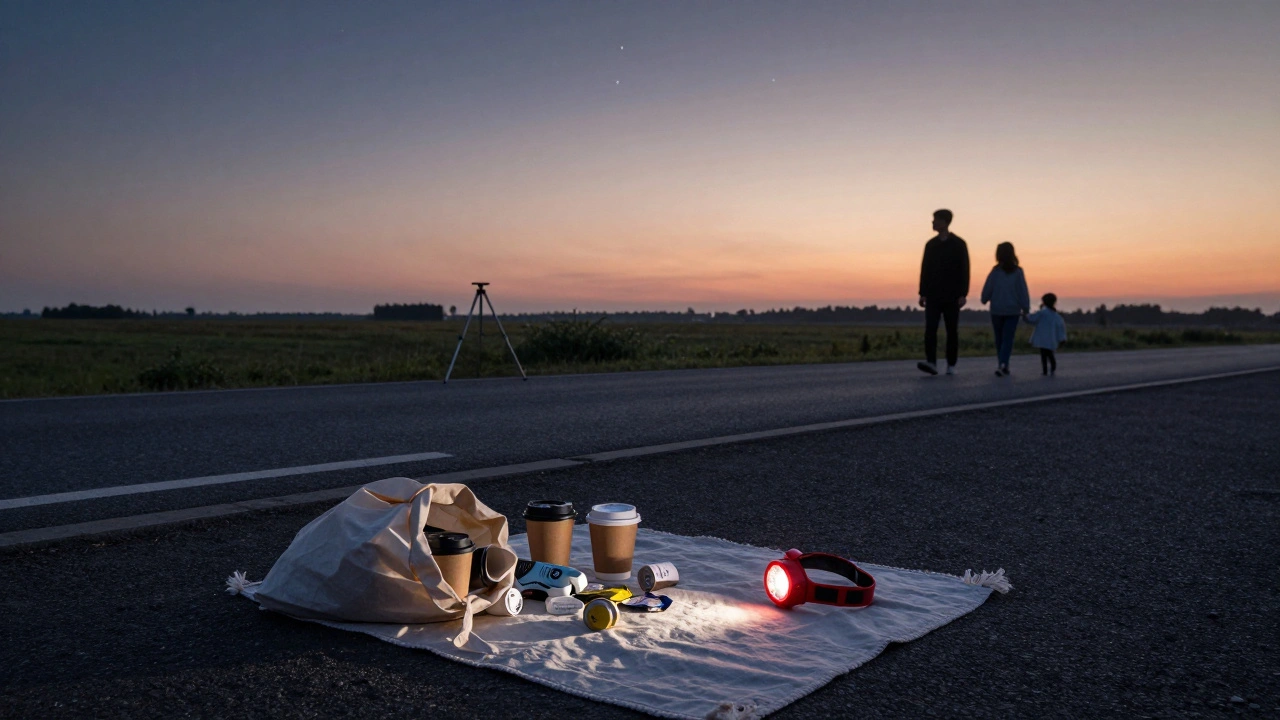
Bring a small bag. Put your trash in it. Take it with you. If you see someone else’s trash? Pick it up. You’re not a park ranger. But you are part of the community that keeps these places beautiful.
And if you’re at a public park or roadside pull-off? Don’t park in a way that blocks others. Leave room for cars. Don’t spread out blankets on the road. Don’t leave chairs or coolers overnight. People come at dawn too.
What Not to Do
Here’s a quick list of things that make meteor watchers want to scream:
- Using a white light to find your way
- Setting up a tall tripod in the middle of the group
- Playing music or podcasts out loud
- Using your phone screen as a map without shielding it
- Shining a laser pointer at the sky (yes, people do this)
- Bringing a dog that barks at every passing car
- Arriving 15 minutes before the peak and leaving 10 minutes after
Laser pointers? They’re not just rude-they’re dangerous. A laser aimed at the sky can blind pilots. Even if you’re not aiming at a plane, the beam can reflect off clouds and reach aircraft hundreds of feet above. Don’t bring one. Ever.
What to Do Instead
Here’s how to be the kind of stargazer everyone wants to see:
- Arrive 45 minutes before the peak. Let your eyes adjust. Drink your coffee. Breathe.
- Wear a red-light headlamp. Test it before you leave home.
- Use a star map app on your phone-but turn the brightness down, cover it with your hand, and use it only when necessary.
- Bring a reclining chair or a thick blanket. Don’t sit upright. Lie back. Let your neck rest.
- Watch the whole sky, not just one spot. Meteors don’t care where you look.
- Stay for at least an hour. The best meteors often come after the peak.
- Bring a friend. Talk softly. Share the wonder.
When You See a Meteor
When you see one-really see it-you’ll feel it. A flash. A trail. A silent streak across the black. You’ll want to scream. Or cry. Or just sit there, frozen.
That’s the moment. That’s why we go out. Not to get the perfect photo. Not to check off a bucket list. But to remember how small we are. And how vast the universe still is.
Respect that. Respect the quiet. Respect the dark. And respect the people around you.
Because the sky doesn’t belong to you. It belongs to everyone who looks up.
Do I need a telescope to see a meteor shower?
No. Telescopes make meteor watching worse. They limit your field of view to a tiny patch of sky. Meteors streak across hundreds of degrees. You need your whole horizon. Just use your eyes. Lie back. Look up. Let your vision wander.
Can I use my smartphone to find meteors?
Yes, but carefully. Apps like SkySafari or Stellarium can show you where the radiant is. But never use the screen in front of you. Turn the brightness to the lowest setting, cover it with your hand, and look away while you tap. Better yet, study the map before you go out.
What if I’m at a public viewing event?
Follow the rules they give you. Most organized events have designated viewing zones, red-light only policies, and quiet hours. Don’t set up your gear without asking. Don’t bring pets. Don’t use white lights. These events are for groups-respect the space and the people managing it.
Are meteor showers predictable?
Yes, to a point. Major showers like the Perseids, Geminids, and Quadrantids happen every year around the same dates. Peak times are listed by astronomy sites. But meteors themselves are random. You might see five in five minutes. Or none for 20. Patience is part of the experience.
What’s the best time to watch?
The best time is after midnight, when your side of Earth is facing the direction of Earth’s orbit. That’s when you’re plowing into the debris stream head-on. The peak hour is usually between 2 a.m. and dawn. But even an hour before or after can be great. Just be patient.