18 Mar 2026
- 0 Comments
When NASA launches the Nancy Grace Roman Space Telescope in 2027, it won’t just be staring into the cosmos blind. Before a single photon hits its detector, scientists run thousands of simulations to predict what the telescope will see - and what it won’t. Two key tools make this possible: STIPS and I-Sim. If you’ve ever wondered how astronomers prepare for a mission that won’t even launch for another year, these are the behind-the-scenes engines that make it all work.
What is STIPS?
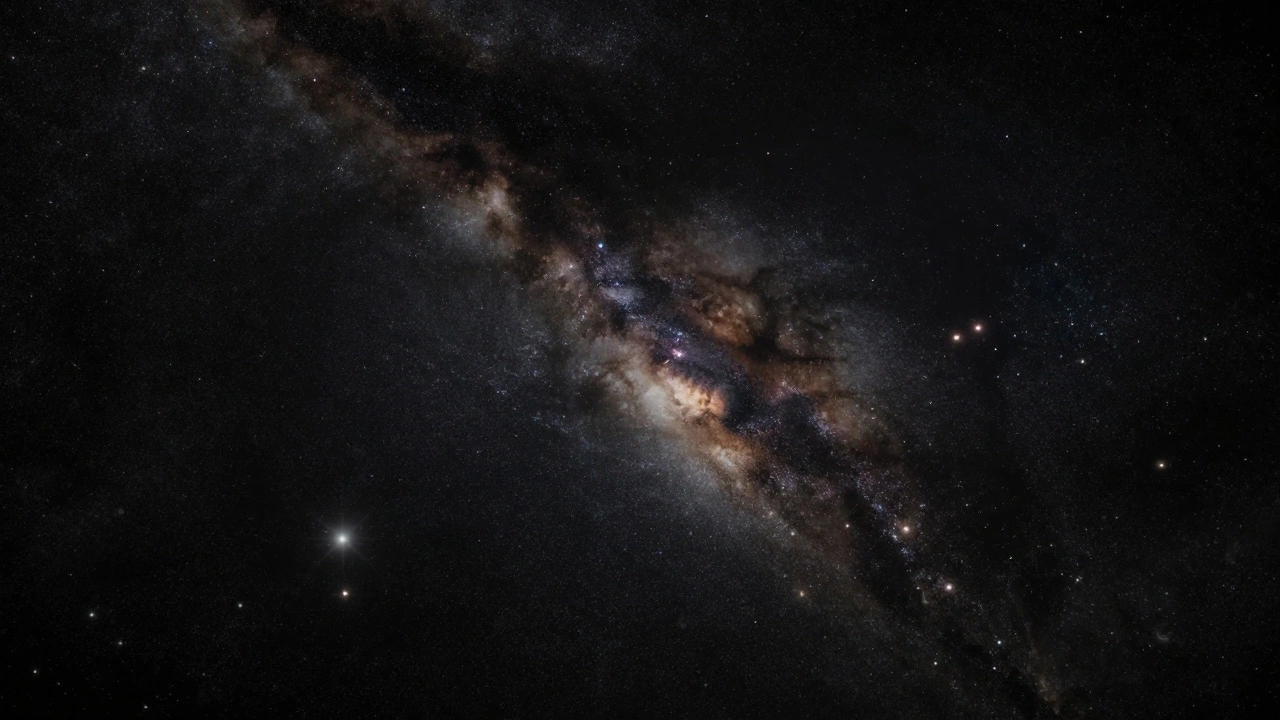
STIPS stands for Space Telescope Image Simulator. It’s not a physical device. It’s software - a detailed digital model of how the Roman Space Telescope will capture light from stars, galaxies, and exoplanets. Think of it as a video game engine for astronomy. You feed it a map of the sky - say, a patch of the Milky Way with 10,000 stars - and STIPS simulates exactly how each one will appear through Roman’s cameras, filters, and sensors.
It doesn’t just copy-paste images. It accounts for real-world noise: cosmic rays hitting the detector, electronic readout glitches, the slight blurring from atmospheric distortion (even though Roman will be in space), and how different wavelengths of light behave across its wide field of view. STIPS even simulates how the telescope’s motion affects long exposures. It’s so accurate that astronomers use its output to plan observation schedules, estimate how long they need to stare at a target to find a faint galaxy, or figure out if their science goal is even possible.
STIPS was built specifically for Roman, but it’s based on tools used for Hubble and JWST. That means it’s been tested against real data. In 2023, NASA ran STIPS simulations on real Hubble images of the Hubble Deep Field. The simulated results matched the actual observations within 2% - a level of precision that gives scientists confidence it’ll work for Roman.
What is I-Sim?
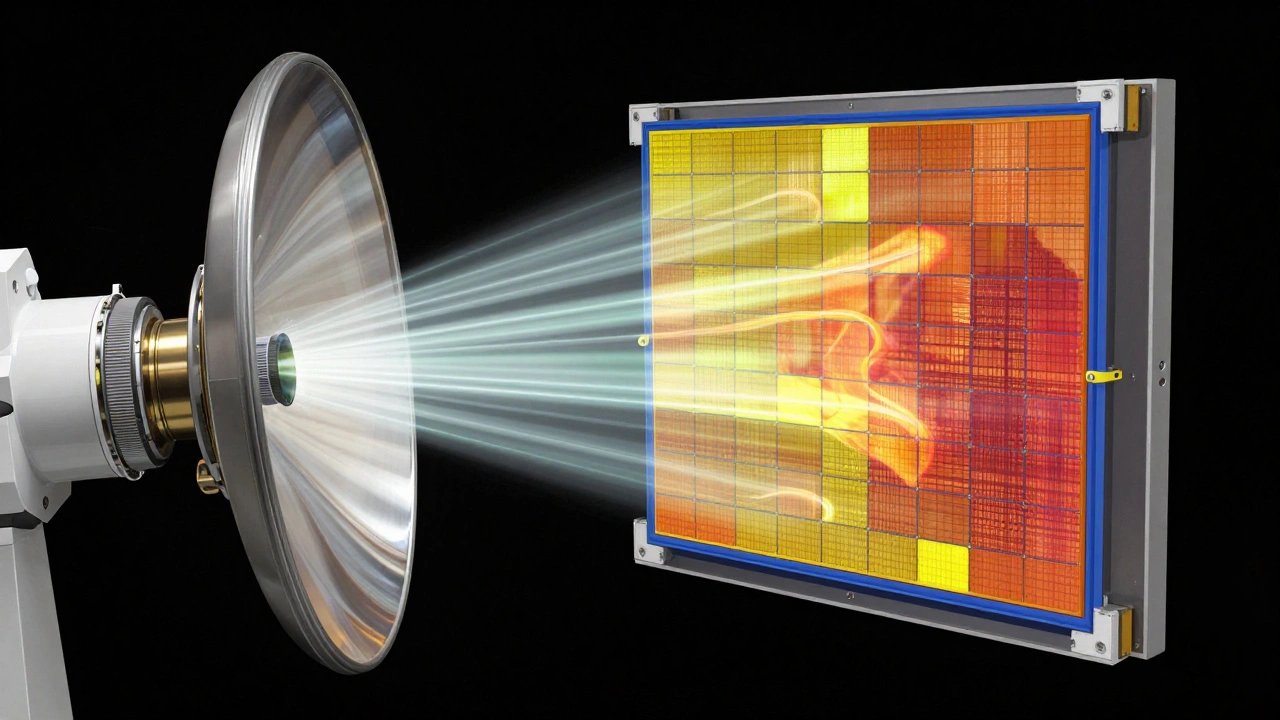
If STIPS simulates what the telescope sees, I-Sim simulates what the telescope is. I-Sim - short for Instrument Simulator - models the hardware itself. It’s like a digital twin of Roman’s entire optical system: its mirrors, lenses, detectors, filters, and electronics. While STIPS asks, “What will this star look like?” I-Sim asks, “How does this sensor respond to light?”
I-Sim breaks down the telescope into components. It models how photons travel from the primary mirror, bounce off the secondary, pass through filters, and finally land on the 18-sensor mosaic. It simulates thermal drift, electronic crosstalk between pixels, and even how dust on the optics might dim the signal. It’s not just about light - it’s about how the hardware behaves under stress, over time, and in the cold vacuum of space.
Why does this matter? Because if you don’t know how your detector responds to a dim object, you can’t trust your measurements. Imagine trying to measure the brightness of a distant exoplanet, but your sensor adds a 5% error because of heat buildup. I-Sim catches that. It’s how NASA found a subtle pixel-to-pixel variation in one of Roman’s sensors back in 2024 - a flaw that would’ve skewed dark matter surveys if uncorrected.
How STIPS and I-Sim Work Together
STIPS and I-Sim aren’t rivals. They’re a team. Here’s how:
- First, I-Sim generates a detector response model - a detailed map of how each pixel behaves under different light levels and temperatures.
- Then, STIPS uses that model to simulate sky images. It doesn’t just assume pixels are perfect. It injects the real-world quirks from I-Sim into every simulated photon.
- The result? A simulated image that includes not just starlight, but also sensor noise, readout artifacts, and optical imperfections - exactly what Roman will deliver.
This feedback loop is critical. If STIPS outputs an image that looks too clean, scientists know something’s wrong. If I-Sim says a detector is too sensitive, they tweak the calibration. Together, they create a virtual twin of Roman that’s more reliable than any ground test.
Who Uses These Tools?
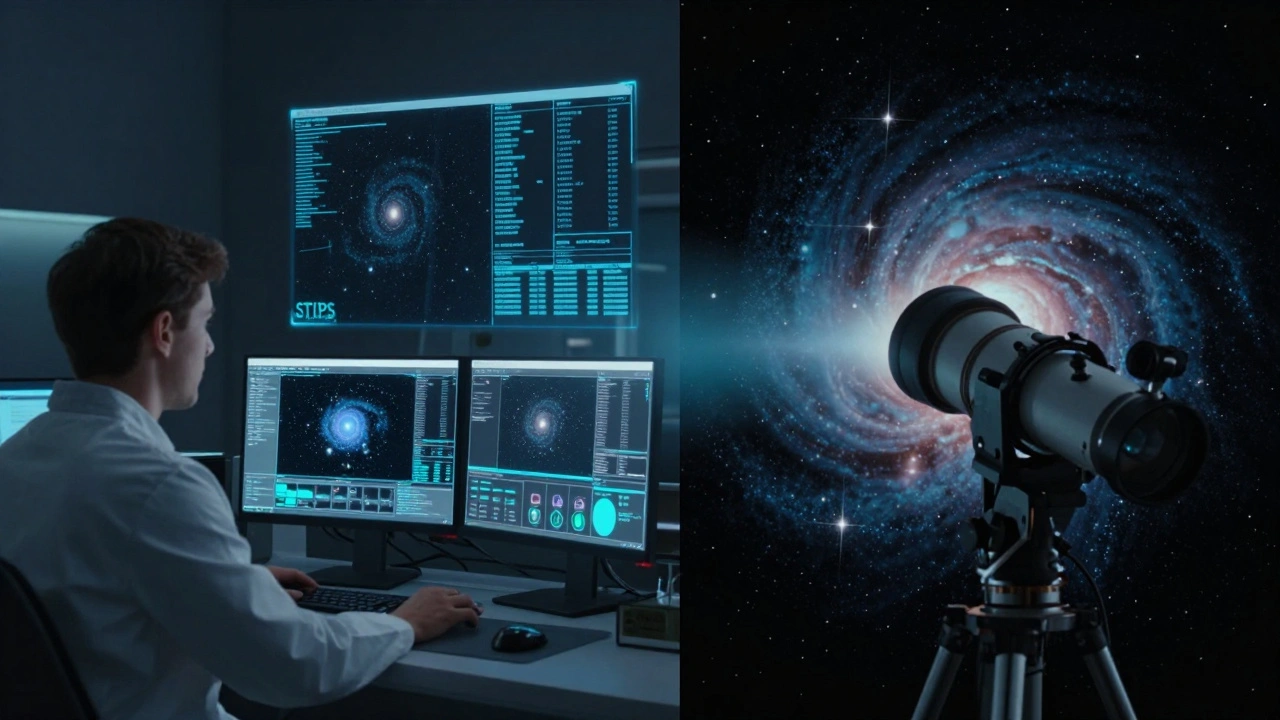
Not just NASA engineers. Hundreds of astronomers worldwide use STIPS and I-Sim to plan their research. A grad student in Chile might use STIPS to test whether their target galaxy can be detected in just 30 minutes of exposure. A team in Germany might use I-Sim to figure out how to correct for a known sensor defect before submitting their observation proposal. The Roman Science Operations Center at STScI (Space Telescope Science Institute) runs daily simulations to optimize observing strategies.
And it’s not just for science. Mission planners use these tools to schedule telescope time. Roman will observe 10,000 square degrees of sky - that’s 100 times the area Hubble ever imaged. Without simulations, they’d be flying blind. STIPS and I-Sim let them pick the best targets, avoid crowded fields, and maximize discovery potential.
Why This Matters for Future Missions
These tools aren’t just for Roman. They’re a blueprint. The James Webb Space Telescope used similar tools, but STIPS and I-Sim are the first to be designed from the ground up for a survey telescope with a 0.28 square degree field of view - wider than 100 full moons. That’s unprecedented.
Future missions like LUVOIR or HabEx will inherit this software stack. The lessons learned from simulating Roman’s wide-field imaging, its low-light sensitivity, and its data pipeline are now part of NASA’s standard toolkit. STIPS and I-Sim are becoming the new normal for space telescope planning.
Real-World Impact: What They’ve Already Revealed
Before Roman even launched, simulations have already changed how we think about dark energy. In 2025, a team using STIPS predicted that Roman could detect 50 million distant supernovae - 10 times more than current surveys. That number changed how the mission’s core science goals were written.
Another surprise came from I-Sim. Simulations showed that Roman’s infrared detectors would pick up faint heat signatures from rogue planets - planets floating in deep space with no star. That wasn’t even a planned science goal. Now, it’s a major program.
And in 2024, STIPS helped identify a blind spot in Roman’s coverage: a region near the galactic plane where star density is so high that individual objects blur together. That led to a software update that now includes a deblending algorithm in the data pipeline. All before a single mirror was polished.
What’s Next?
By late 2026, NASA will release a public version of STIPS and I-Sim. Anyone with a decent computer and Python can download them. Universities, amateur astronomers, even high school clubs will be able to simulate Roman observations. Imagine a student in Ohio running a simulation of a galaxy cluster, then comparing it to real data when Roman launches. That’s the future these tools are building.
For now, STIPS and I-Sim are quiet, powerful engines running in the background - not on rockets, but on servers. They’re the reason we’ll know what Roman sees before we ever see it ourselves. And that’s how modern astronomy works: not by waiting for the telescope to launch, but by simulating its vision before it even turns on.
Are STIPS and I-Sim available to the public?
Yes. By late 2026, NASA will release public versions of both STIPS and I-Sim as open-source Python packages. They’ll be available through the Space Telescope Science Institute’s website, with documentation and example scripts. You won’t need supercomputers - a modern laptop can run basic simulations. This is part of NASA’s push to make Roman data accessible to students, citizen scientists, and researchers outside major institutions.
Can STIPS simulate exoplanets?
Yes, but with limits. STIPS can simulate the light from exoplanets that are bright enough to be resolved - mostly young, hot Jupiters orbiting nearby stars. It can’t simulate the direct image of an Earth-sized planet in the habitable zone because those are too dim and too close to their stars for Roman’s resolution. But it can simulate the gravitational microlensing events caused by rogue exoplanets, which is one of Roman’s key science goals.
How accurate are these simulations compared to real data?
Extremely accurate. STIPS has been validated against real Hubble Deep Field data, matching observed star counts and brightness distributions within 2%. I-Sim’s detector models have been tested against lab measurements of Roman’s flight sensors, with errors under 1.5%. These are among the most validated simulation tools in astronomy history.
Do I need to know Python to use STIPS or I-Sim?
Basic familiarity helps, but not required. Public versions will include graphical interfaces for simple tasks like selecting a sky region or choosing filters. For advanced users - like researchers planning observations - Python scripts will offer full control. Tutorials and Jupyter notebook examples will be provided to guide users step-by-step.
How do STIPS and I-Sim differ from telescope simulators for amateur astronomers?
Amateur tools like Stellarium or SkySafari simulate what you’d see through a backyard telescope - they’re visual aids. STIPS and I-Sim simulate scientific data: pixel-level detector responses, noise, calibration errors, and statistical uncertainties. They’re not for stargazing - they’re for planning peer-reviewed science. One tells you where to point your scope; the other tells you whether your data will be publishable.