14 Apr 2026
- 0 Comments
Key Takeaways for Your Next Observation
- Stick to the meteor counts standard by recording the exact start and end times of your session.
- Only count meteors that clearly belong to the shower radiant, not random "sporadics."
- Track your local sky conditions, especially cloud cover and light pollution, as these drastically shift the results.
- Use the Zenithal Hourly Rate (ZHR) formula to normalize your data for others to use.
The Core Goal of Visual Reporting
When you submit data to a global clearinghouse, you aren't just saying "I saw a lot of stars falling." You are providing a data point for a massive 3D map of space debris. Most observers submit their findings to the International Meteor Organization is a global network of observers that standardizes the recording of meteor activity to provide accurate data for scientific research. Also known as IMO, it ensures that a person in Oregon and a person in Japan are measuring the same phenomenon using the same rules.
The primary challenge is that visual observation is subjective. Your eyes are the sensor, and sensors vary. One person might perceive a dim meteor that another misses. To fix this, we use standardized reporting forms that force you to record variables that affect the count, such as the limiting magnitude of your sky.
Mastering the Art of the Count
To get a count that scientists will actually accept, you need to distinguish between the shower and the background noise. Sporadic Meteors are random meteors not associated with any specific meteor shower, occurring at a steady rate throughout the year. If you count every single light in the sky, your data is polluted.
How do you tell them apart? Look at the radiant. The radiant is the point in the sky from which the shower meteors seem to originate. If a meteor's path, when traced backward, doesn't lead back to that point, it's a sporadic. It's an easy mistake to make when you're excited, but if you include sporadics in your shower count, you're artificially inflating the activity of the Meteor Shower, which is an event where the Earth passes through a trail of comet or asteroid debris, resulting in a high frequency of meteors appearing to radiate from a single point.
Here is the exact workflow for a clean count:
- Set a fixed window: Decide on a specific time block (e.g., 11:00 PM to 2:00 AM). Do not just "eye it."
- Tally only radiant meteors: Use a mechanical tally counter or a simple notepad to mark every meteor that clearly belongs to the shower.
- Note the interruptions: If a cloud bank covers half the sky for 20 minutes, mark that time. You cannot count for 60 minutes if the sky was only clear for 40.
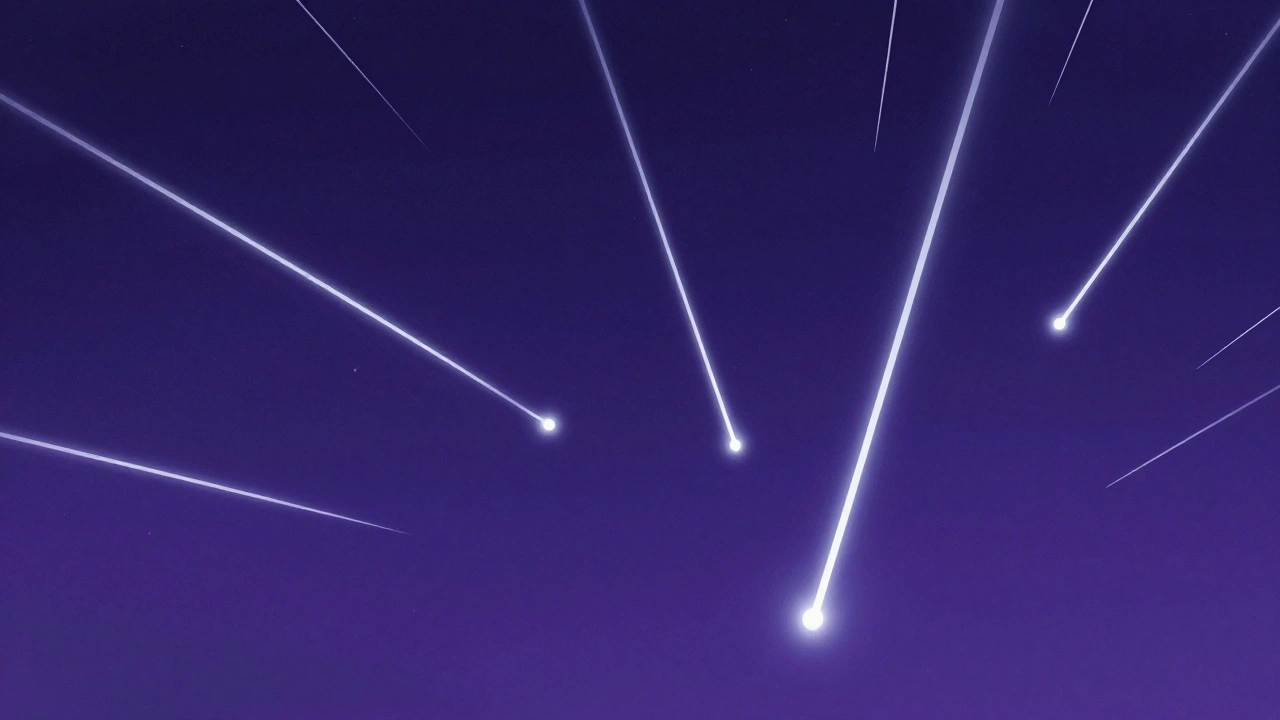
- Identify "Fireballs": Mark any exceptionally bright meteors separately. A single Fireball is a meteor that reaches a peak brightness greater than that of the brightest star in the sky, often leaving a persistent train. These are high-value targets for researchers.
Calculating the Zenithal Hourly Rate (ZHR)
A raw count is useless without context. If you saw 10 meteors per hour under a city glow, that's a huge deal. If you saw 10 per hour in the middle of the desert, it's a slow night. This is why we use Zenithal Hourly Rate is a standardized formula that estimates the number of meteors a single observer would see if the radiant were at the zenith and the sky were perfectly dark. Commonly referred to as ZHR, it's the gold standard for comparing different observation sites.
To calculate ZHR, you need three pieces of data: your actual count (N), the time spent observing (T), and the limiting magnitude of your sky (Lm). The formula looks scary, but the logic is simple: it adjusts your count based on how much of the sky you could actually see and how many dim meteors you missed because of light pollution.
| Variable | What it represents | Impact on Data |
|---|---|---|
| Limiting Magnitude | The dimmest star you can see | Lower magnitude = fewer meteors detected |
| Radiant Altitude | How high the radiant is in the sky | Lower altitude = fewer visible meteors |
| Cloud Cover | Percentage of sky blocked | Directly reduces the effective observation time |
Dealing with Light Pollution and Sky Quality
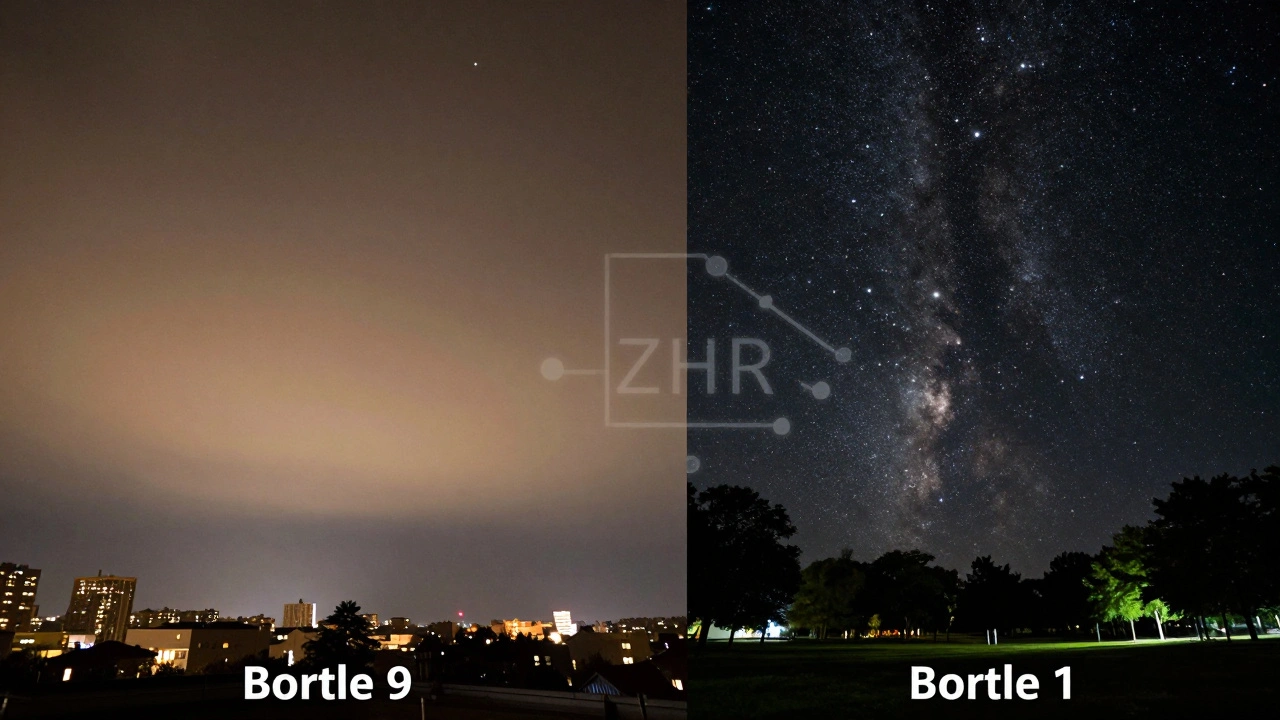
You can't ignore the environment. A sky in downtown Portland is vastly different from a sky in the High Desert. To report accurately, you must determine your limiting magnitude. A quick way to do this is to use a star chart and find the dimmest star you can barely perceive. If you can only see stars down to magnitude 4, you're missing a massive chunk of the meteor population.
This is where Bortle Scale is a nine-level scale that measures the brightness of the night sky, where Level 1 is a perfectly dark sky and Level 9 is an inner-city sky. By noting your Bortle class, you give the database managers a shortcut to understand your local interference. If you are reporting from a Bortle 7 area, the database knows your ZHR will be lower than a Bortle 2 observer's, even if you're looking at the same shower.
Submitting Your Data to Databases
Once you have your numbers, don't just email a paragraph of text. Most professional databases require a structured format. Whether you are using a web form or a CSV upload, the data should be broken down into distinct fields. This allows the Astronomical Data Analysis is the process of using mathematical models and software to find patterns in celestial observations to run scripts that aggregate thousands of observers into a single curve.
When filling out the forms, be honest about your errors. If you spent 10 minutes checking your phone or talking to a friend, subtract those 10 minutes from your total observation time. In science, an honest "unknown" or a corrected time is a thousand times more valuable than a "perfect" number that was guessed.
Common Pitfalls to Avoid
One of the biggest mistakes beginners make is counting satellites. With the rise of Satellite Constellations, which are groups of multiple satellites working together, such as Starlink, that often appear as a train of lights moving across the sky, the sky is more crowded than ever. Satellites move slower and have a steadier glow. Meteors are gone in a flash. If you aren't sure, don't count it.
Another trap is "over-counting" during the peak. When the meteors start falling fast, your brain wants to see them everywhere. You might start counting the same meteor twice if you're glancing around. The best way to avoid this is to keep your gaze in one general area of the sky rather than scanning frantically. You'll miss some, but the ones you catch will be accurate.
What is the best time of night for meteor counting?
Generally, the hours between midnight and dawn are best. This is because the Earth is rotating into the path of the debris stream, meaning you are essentially "hitting" the meteors head-on, which increases the frequency and speed of the sightings.
Do I need a telescope for visual reporting?
No. In fact, telescopes are counterproductive for meteor counts because they narrow your field of view. Visual reporting is done with the naked eye to capture the widest possible area of the sky.
How do I handle intermittent clouds?
You must use "effective time." If you observe for two hours but clouds blocked the sky for 30 minutes, your reporting time is 90 minutes. This prevents the hourly rate from being artificially lowered.
Can I use a camera for visual reporting?
Visual reporting and photographic reporting are different. Visual counts rely on the human eye and ZHR. Cameras provide precise timing and trajectory data. If you have both, submit them as separate data sets to the database.
What happens if I misidentify a sporadic as a shower meteor?
While a few mistakes won't ruin the whole project, a systematic error across many observers can shift the perceived peak of a shower. This is why the IMO encourages observers to study the radiant position carefully before starting.
Next Steps for the Serious Observer
If you've mastered the basic count, try moving into "magnitude distribution." This involves noting not just that a meteor happened, but how bright it was compared to the stars around it. This helps scientists determine the size of the particles in the debris stream.
For those in light-polluted areas, your best bet is to find a "Dark Sky Park." Moving just 20 miles away from a city center can often increase your limiting magnitude by two full points, which can triple the number of meteors you're able to record. Once you've got your gear and your location, start with a practice session during a minor shower before tackling the big events like the Perseids or Geminids.