28 Dec 2025
- 0 Comments
Have you ever looked up at the night sky and seen a faint, glowing ribbon of green or red light? Maybe you thought it was the aurora-those dazzling northern lights everyone posts about online. But what if it wasn’t? What if it was something quieter, more subtle, and just as real: airglow?
You’re not alone. Even seasoned skywatchers mix them up. Aurora and airglow both glow in the dark, both show up in long-exposure photos, and both can look like a slow-moving curtain of color. But they’re completely different phenomena. Learning how to tell them apart doesn’t just help you name what you’re seeing-it changes how you understand the atmosphere above you.
What Causes the Aurora?
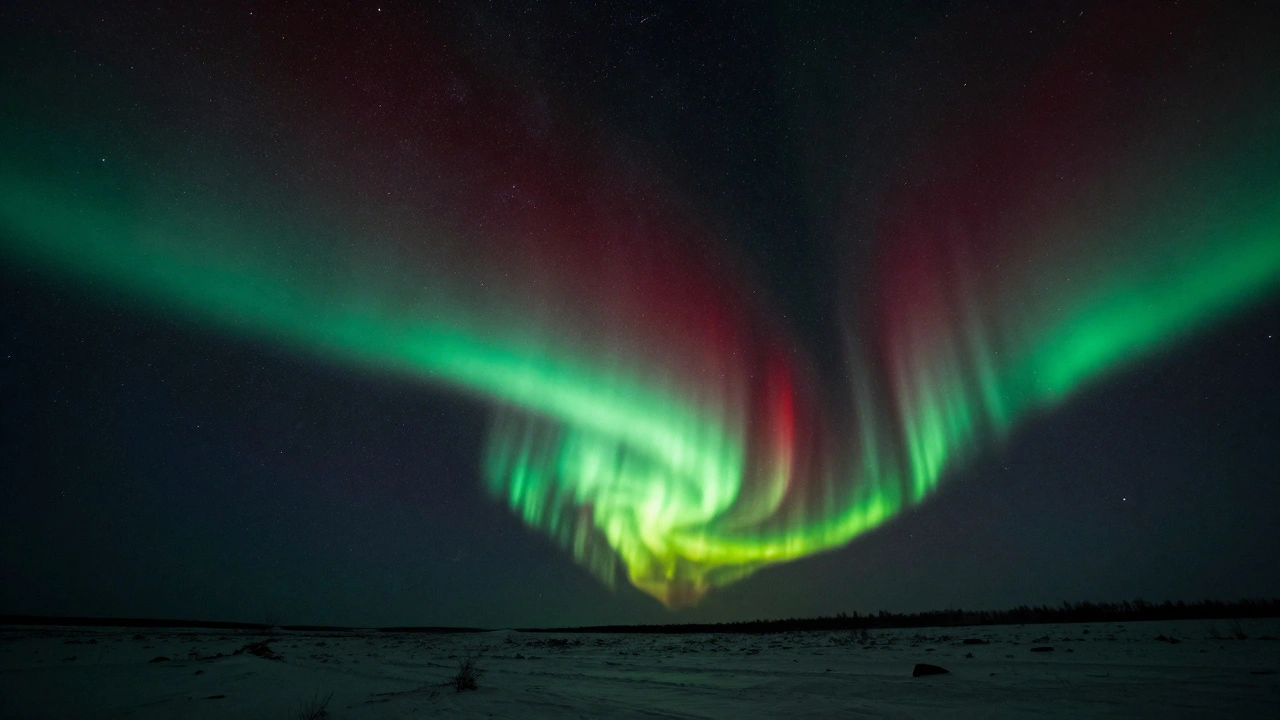
The aurora-also called the northern or southern lights-is a violent, solar-powered light show. It happens when charged particles from the Sun slam into Earth’s magnetic field, funnel down toward the poles, and crash into oxygen and nitrogen atoms in the upper atmosphere. That collision excites the atoms, and when they calm down, they release energy as light.
That’s why auroras are mostly seen near the Arctic and Antarctic circles. In places like Fairbanks, Alaska, or Tromsø, Norway, they’re common. But during strong solar storms, they can stretch as far south as Oregon, where I live. I saw one in January 2025-bright green bands twisting across the sky like neon ribbons. It moved fast. Within minutes, the shape changed. It pulsed. It flickered. That’s because the solar wind is constantly shifting, and the particles hit the atmosphere in bursts.
Auroras usually appear between 100 and 400 kilometers up. They’re tied to solar activity, so they’re unpredictable. You can’t plan for them like a meteor shower. But if you see a sudden, sharp, moving glow with clear structure-curtains, rays, or arcs-it’s almost certainly the aurora.
What Is Airglow?
Airglow is the atmosphere’s quiet, constant glow. It’s not caused by solar particles. It’s caused by chemical reactions happening every single night, all over the planet. Even when the Sun is down, its energy from hours earlier is still being slowly released.
During the day, sunlight breaks apart oxygen and nitrogen molecules. At night, those atoms recombine. When they do, they release photons-tiny bits of light. Oxygen gives off green and red. Sodium gives off yellow. Hydroxyl radicals (OH) give off infrared, which sometimes shows up as a faint red band near the horizon.
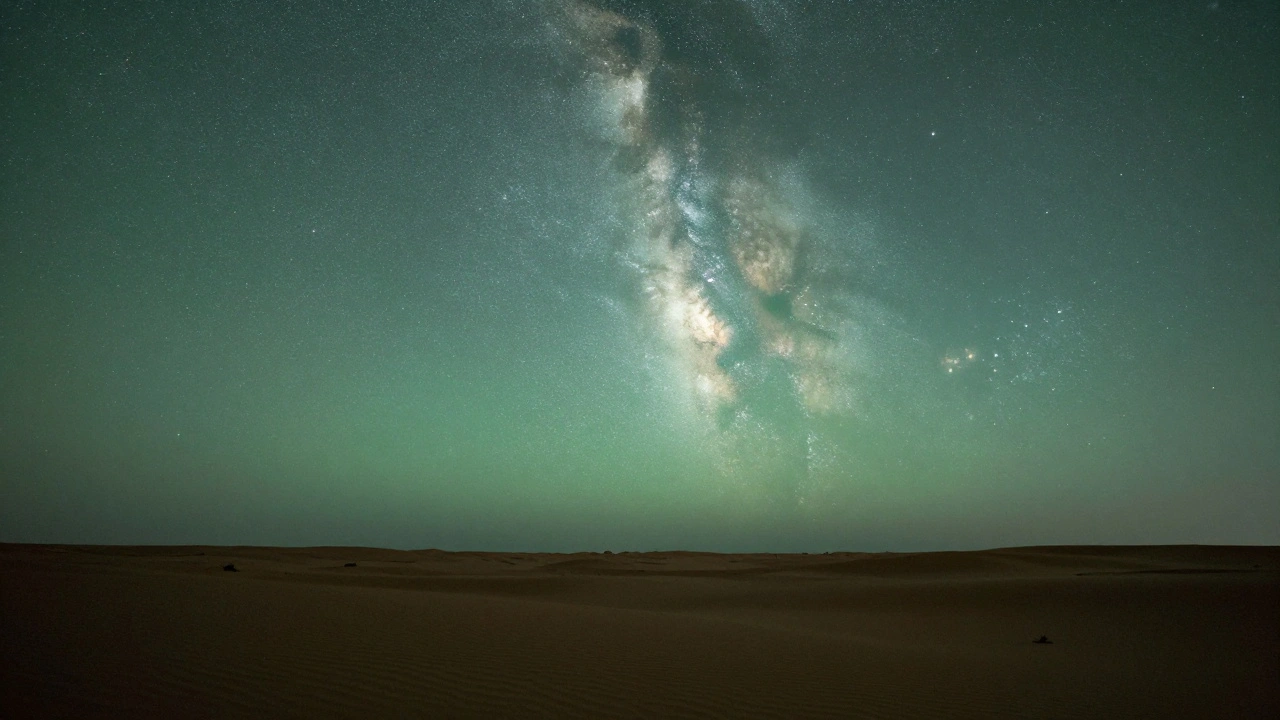
Airglow is everywhere. It’s not tied to the poles. It’s not tied to solar storms. It’s always there, but it’s so faint that your eyes can’t see it. You need long-exposure photography to catch it clearly. In a dark sky, away from city lights, airglow looks like a soft, even haze. No movement. No structure. Just a uniform, dim glow that seems to rise from the horizon.
I’ve taken dozens of night sky photos from my backyard in Portland. Most of them show airglow-not aurora. It’s the reason the Milky Way looks like it’s floating on a faint green veil. It’s the reason the horizon never looks truly black.
Side-by-Side Comparison
Here’s how to tell them apart in real time:
| Feature | Aurora | Airglow |
|---|---|---|
| Source | Solar wind particles hitting the magnetosphere | Chemical reactions in the upper atmosphere |
| Altitude | 100-400 km | 85-300 km |
| Movement | Fast, rippling, shifting shapes | Still, uniform, no motion |
| Shape | Curtains, rays, arcs, coronas | Smooth, diffuse haze |
| Location | Polar regions; expands during storms | Global, always present |
| Visibility | Often visible to naked eye during strong events | Usually needs long-exposure camera |
| Color | Green (most common), red, purple, pink | Green (dominant), faint red near horizon |
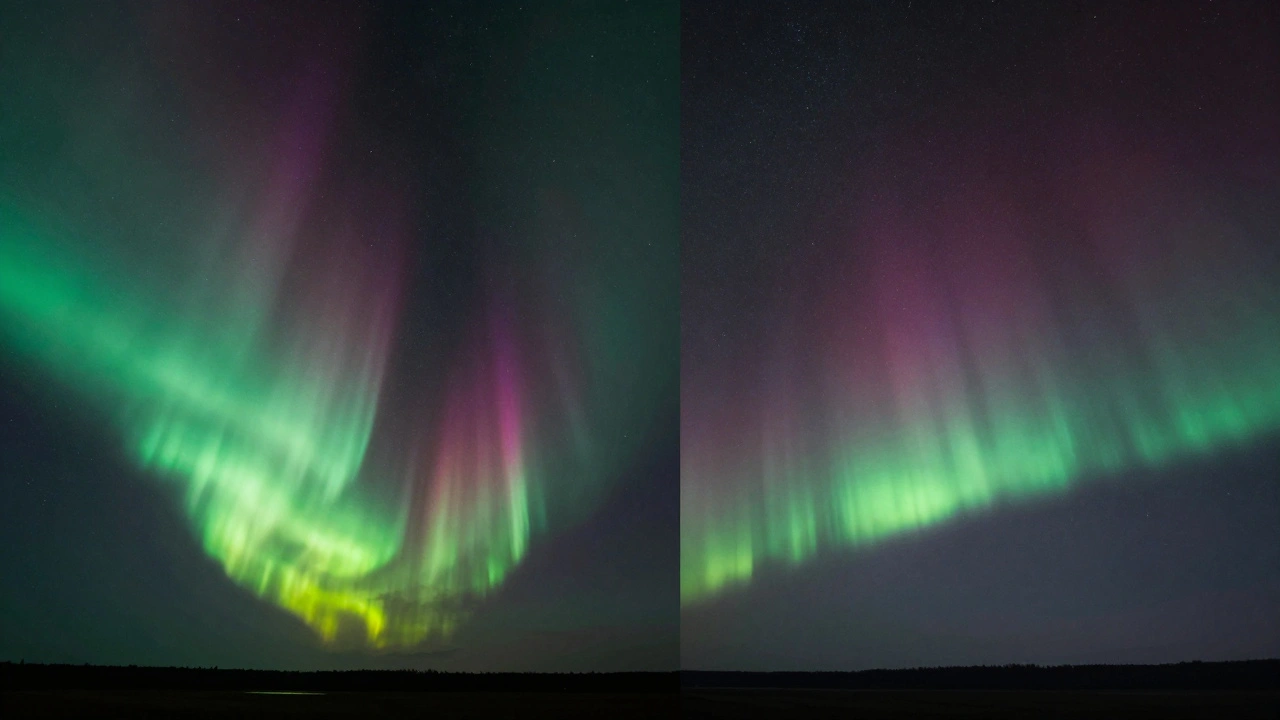
One thing to watch out for: airglow can sometimes look like a weak aurora if you’re not careful. If you see a faint green band near the horizon that doesn’t move, it’s airglow. If it’s high in the sky, dancing, and brighter than the Milky Way, it’s aurora.
How to Spot Them Yourself
You don’t need fancy gear to start noticing the difference. Here’s what to do:
- Find a truly dark sky. Drive out of the city. Portland’s light dome makes it hard to see airglow from home. Try the Columbia River Gorge or Mount Hood’s east side.
- Let your eyes adjust for 20 minutes. No phones. No red lights. Just sit in the dark.
- Look up. If you see a faint, steady glow along the horizon-especially greenish-that’s airglow. It’s subtle, but it’s there.
- Now look for motion. If something shifts, pulses, or forms vertical streaks, you’re seeing aurora. It won’t last long unless there’s a solar storm.
- Take a photo. Use a DSLR or smartphone with manual mode. Set exposure to 10-15 seconds, ISO 1600-3200, wide aperture (f/2.8 or lower). You’ll be surprised how much airglow shows up.
On clear winter nights, I’ve seen airglow every time I’ve gone out. It’s not flashy. But once you know it’s there, you’ll never look at a dark sky the same way again.
Why This Matters
Most people think the night sky is just stars, planets, and the occasional meteor. But the sky itself glows. Airglow is proof that Earth’s atmosphere is alive-even when we can’t feel it. It’s the afterglow of sunlight, the quiet chemistry of oxygen recombining, the invisible energy that keeps our upper air glowing.
Auroras remind us how connected we are to the Sun. Airglow reminds us how much of the universe happens right above our heads, without fanfare. One is a storm. The other is a breath.
If you’re into astrophotography, learning to recognize airglow helps you edit your images better. Many photographers remove it thinking it’s noise. But it’s natural. It’s part of the sky’s true color.
If you’re just looking up, wondering why the sky isn’t black-now you know.
Can you see airglow with the naked eye?
Yes, but only under very dark skies and with dark-adapted eyes. Airglow is faint, so city lights or moonlight will wash it out. In places like the Oregon high desert or remote parts of eastern Washington, you can see it as a soft greenish haze along the horizon. It won’t look like a bright curtain-it’ll look like the sky itself is glowing.
Is airglow the same as the Milky Way?
No. The Milky Way is made of billions of distant stars. Airglow is a glow from atoms in Earth’s atmosphere. They often appear together, which can be confusing. The Milky Way looks like a dusty band of white light. Airglow looks like a smooth, colored veil beneath it-usually greenish, sometimes reddish near the horizon.
Do auroras happen all year, or just in winter?
Auroras happen year-round. But they’re easier to see in winter because nights are longer and skies are darker. In summer, especially at northern latitudes, twilight never fully ends. That’s why most people associate them with winter. But solar storms can trigger auroras in April or August too-I saw one in late June 2024 from my driveway.
Can airglow be photographed with a smartphone?
Yes, if your phone has manual or Pro mode. Set exposure to 10-15 seconds, ISO to 1600 or higher, and focus to infinity. Use a tripod or rest the phone on a steady surface. You’ll likely capture airglow as a faint green band. It won’t look as vivid as in professional photos, but it’ll be visible. Many amateur astrophotographers start with smartphones.
Why does airglow look green?
The green color comes from oxygen atoms about 90-100 kilometers up. When these atoms recombine after being split by sunlight, they release photons at a wavelength of 557.7 nanometers-right in the green part of the spectrum. It’s the same reason auroras are often green. But airglow’s green is much fainter and spread out.