21 Mar 2026
- 0 Comments
When you’re peering through your telescope at Jupiter’s cloud bands or Saturn’s rings, the eyepiece you choose makes all the difference. It’s not just about magnification - it’s about clarity, contrast, and how much detail your eyes can actually pick up. For planetary observing, not all eyepieces are created equal. Three types dominate the conversation: orthoscopic (Orthos), Plossls, and widefield designs. Each has strengths, trade-offs, and ideal use cases. Knowing which one fits your telescope, your eyes, and your goals can turn a good view into a breathtaking one.
Why Eyepiece Choice Matters for Planets
Planets are small, bright, and require high contrast to show surface features. Jupiter’s Great Red Spot, Mars’ polar caps, or the subtle shading on Saturn’s C-ring don’t glow like nebulae. They’re faint contrasts against a bright disk. That means you need an eyepiece that delivers sharpness, high contrast, and minimal internal reflections. A blurry, hazy, or poorly coated eyepiece will wash out details you paid thousands for in your telescope.
Most planetary observers use magnifications between 150x and 300x. That’s not extreme - but it’s enough to expose flaws in optics. A 5mm eyepiece on a 1200mm focal length telescope gives you 240x. That’s a sweet spot for Mars during opposition or Jupiter at its closest. But if the eyepiece can’t handle that magnification cleanly, you’ll see ghosting, chromatic aberration, or a soft edge. The right eyepiece doesn’t just show you the planet - it shows you the texture of the planet.
Orthoscopic Eyepieces: The Classic Detail Machine
The orthoscopic, or Ortho, was invented in the 1920s and hasn’t changed much since. It’s a four-element design: a single lens in front, a triplet behind. Simple. Rugged. Reliable. It’s the eyepiece that many veteran observers still swear by.
Orthos deliver exceptional contrast. Their optical design minimizes scatter, which is huge when you’re trying to see the faintest cloud belts on Jupiter or the subtle limb darkening on Mars. They also have a very narrow field of view - around 40 to 45 degrees - which keeps your eye focused on the planet without distraction. That’s not a bug; it’s a feature. When you’re staring at a tiny disk, you don’t need a panoramic view. You need precision.
They’re also sharp across the entire field. No soft edges. No distortion. Even at high magnifications, the image stays crisp. That’s why so many planetary observers use a 5mm or 6mm Ortho as their go-to. In a fast telescope (f/5 or faster), they still hold up better than most modern designs. And they’re cheap. A decent 5mm Ortho costs under $50. You can buy three and never worry about upgrading.
But there’s a catch: eye relief. Orthos have very little - often under 5mm. If you wear glasses, you’ll struggle. Your eye has to be glued to the lens. For many, this makes them uncomfortable for extended sessions. That’s why you’ll see seasoned observers with their glasses off, squinting, adjusting their head position like they’re trying to kiss the eyepiece.
Plossl Eyepieces: The Balanced Workhorse
The Plossl is the most common eyepiece you’ll find in entry-level telescope kits. It’s a double-Plössl design - two pairs of doublets. It’s not fancy, but it’s solid. And for planetary work, it’s surprisingly capable.
Plossls offer a wider field than Orthos - around 50 degrees. That extra space makes it easier to center your target and track it as the Earth rotates. They also have better eye relief than Orthos, often 12-15mm. If you wear glasses, you can still see the full field. That’s a big deal if you’re observing for an hour or more.
Image quality? Very good. Sharp in the center. Slight softness near the edges, but barely noticeable on planets since you’re looking at the center anyway. They’re well-coated, too. Modern Plossls from brands like Celestron, Explore Scientific, or Vixen have multi-coated lenses that reduce glare and improve contrast.
Here’s the trade-off: Plossls can struggle in fast telescopes. If your scope is f/4 or faster, you might notice some off-axis aberrations - especially with 32mm or 25mm Plossls. But for planetary use, you’re probably using 10mm to 6mm. At those focal lengths, Plossls perform beautifully. They’re also more forgiving than Orthos if your telescope isn’t perfectly collimated.
They’re not cheap, though. A good 6mm Plossl costs $80-$120. But you get more comfort, better eye relief, and wider viewing than you would with an Ortho. For many, they’re the best all-around planetary eyepiece.
Widefield Eyepieces: The Modern Alternative
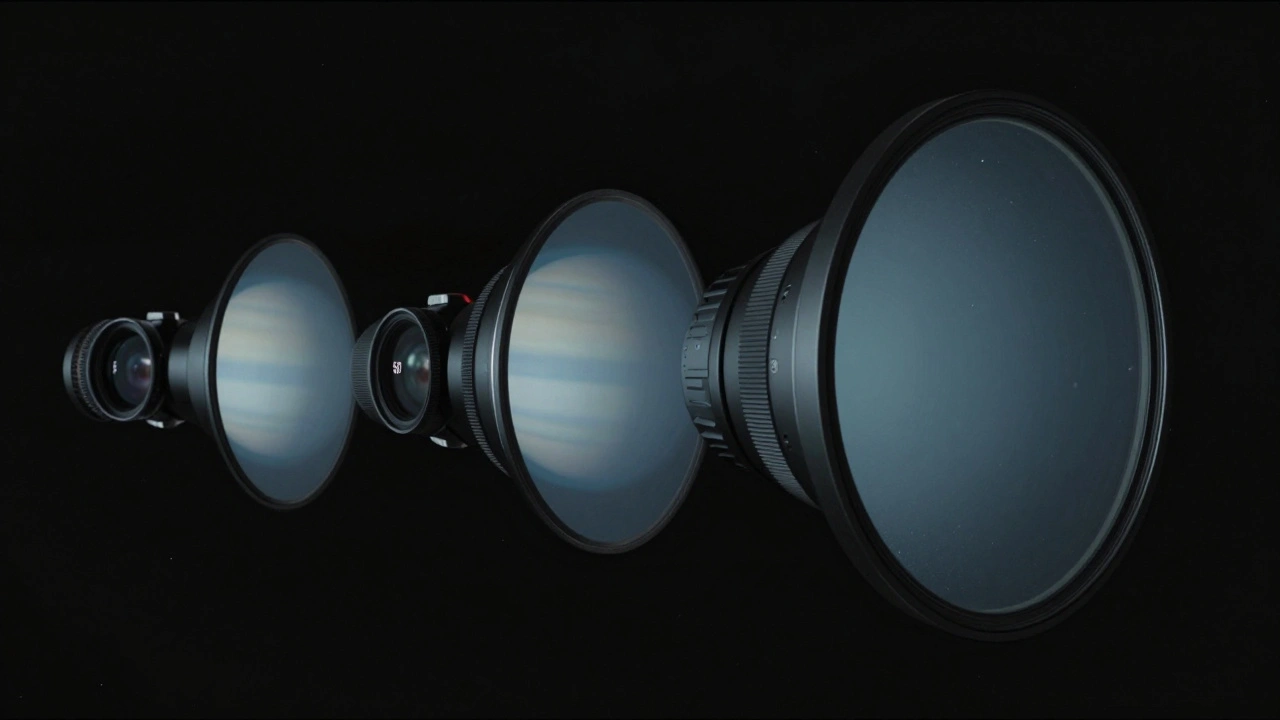
Widefield eyepieces - like the Tele Vue Nagler, Explore Scientific 82°, or Meade UWA - are designed for deep-sky objects. Huge fields. Immersive views. But can they work for planets?
Yes - but with conditions.
Modern widefields have come a long way. Designs like the 14mm ES 82° or the 12.5mm Tele Vue Delos offer sharpness, excellent contrast, and 80+ degrees of field. They’re expensive - $300 to $600 - but they’re built to perform even at high magnifications. If you’re using a telescope with f/7 or slower, they’ll show planets with stunning clarity. You’ll see more detail in Jupiter’s belts because the image is so clean and well-corrected.
But here’s the problem: they’re overkill. Planets are tiny. A 200x view of Mars fills less than 1% of a 82° field. You’re paying for a panoramic view you’ll never use. And if your scope is fast (f/5 or less), even premium widefields can show some color fringing or edge distortion.
Widefields shine when you want to see the planet in context - like watching Jupiter’s moons dance around it. You can see Ganymede and Io at the same time without moving the scope. That’s cool. But if your goal is to study the fine structure of the Great Red Spot, the extra field doesn’t help. You’re better off with a tighter view.
Still, if you want one eyepiece that does both planets and deep-sky, a high-end widefield like the 12.5mm Delos is a fantastic compromise. It’s not the cheapest option, but it’s one of the most versatile.
Real-World Comparison: Which One Should You Use?
Let’s say you have an 8-inch f/6 Dobsonian. You want to observe Mars at opposition. What’s your best bet?
- Ortho (5mm): You’ll get the sharpest, highest-contrast image. Details on the surface pop. But if you wear glasses, you’ll be frustrated. You’ll need to remove them and adjust your head constantly. Best for short, intense sessions.
- Plossl (6mm): Almost as sharp as the Ortho. Better eye relief. You can observe for 20 minutes without discomfort. Slightly wider view lets you track easier. Best overall choice for most people.
- Widefield (12.5mm): You’ll get a stunning view, but you’re using 120x instead of 200x. You’ll see Mars clearly - but not the fine dust storms or polar cap edges. You’ll enjoy the view, but you’ll miss the details.
Here’s the bottom line:
- If you’re on a budget and don’t wear glasses - go with an Ortho.
- If you wear glasses, want comfort, and want a balance of sharpness and field - go with a Plossl.
- If you’re already spending big on your telescope and want one eyepiece that does planets and deep-sky - consider a high-end widefield.
Pro Tips for Planetary Eyepieces
- Use a Barlow lens. A 2x Barlow turns your 10mm Plossl into a 5mm. You get the same magnification as an Ortho, but with better eye relief. It’s a cheap upgrade.
- Check your telescope’s focal ratio. If it’s f/6 or slower, most eyepieces will work fine. If it’s f/4 or faster, avoid cheap widefields - they’ll show aberrations.
- Don’t buy the cheapest eyepiece. A $20 planetary eyepiece from an unknown brand will ruin your view. Stick with known brands: Tele Vue, Explore Scientific, Vixen, Celestron, or Orion.
- Try before you buy. Many astronomy clubs have eyepiece swap nights. Test three types side by side. Your eyes will tell you which one feels right.
- Use a planetary filter. A #56 light green or #80A blue filter can dramatically improve contrast on Jupiter and Mars. Pair it with your best eyepiece - it’s like upgrading your telescope for $20.
Final Thoughts
There’s no single "best" eyepiece for planets. The right one depends on your telescope, your eyes, your budget, and what you’re trying to see. Orthos give you the sharpest, most detailed view - if you can handle the discomfort. Plossls give you the best balance of performance and comfort. Widefields give you immersion - but you’re paying for a field you won’t use.
For most people, a 6mm or 8mm Plossl is the sweet spot. It’s affordable, performs well, and won’t punish you after 15 minutes of observing. If you’re a detail junkie with perfect vision and no glasses, the Ortho is still the gold standard. And if you’re a deep-sky lover who also wants to peek at Saturn - then yes, spend the money on a Delos or Nagler. You won’t regret it.
At the end of the night, it’s not about the brand. It’s about what your eyes see. And if you’re seeing more detail - more texture, more contrast, more life - then you’ve chosen the right one.
Are Orthoscopic eyepieces still worth buying today?
Yes, if you prioritize maximum contrast and sharpness over comfort. Orthos are still the benchmark for planetary detail. They’re inexpensive, durable, and perform exceptionally well in slower telescopes (f/6 and above). But if you wear glasses or observe for long sessions, the short eye relief can be a dealbreaker. For many, they’re best used as a dedicated planetary eyepiece - not your only one.
Can I use a widefield eyepiece for planets?
Absolutely - but only if it’s a high-quality design. Cheap widefields will blur or distort planetary images. Premium models like the Tele Vue Delos or Explore Scientific 82° work very well, even at 200x. They offer stunning clarity and comfort, though you’re paying for a wide field you won’t fully use. Best for observers who want one eyepiece for both planets and deep-sky objects.
What magnification is best for planetary viewing?
Most planets look best between 150x and 300x. That’s roughly 30x to 50x per inch of aperture. For an 8-inch scope, aim for 240x. You can go higher on nights of excellent seeing, but atmospheric turbulence usually limits you. Always start low and increase magnification gradually. If the image gets fuzzy, you’ve gone too far.
Do I need a Barlow lens for planetary observing?
Not required, but highly recommended. A good 2x Barlow doubles your eyepiece options. A 10mm Plossl becomes a 5mm - perfect for planets - without buying a new eyepiece. It also lets you use longer focal length eyepieces, which often have better eye relief. Just make sure the Barlow is well-made. Cheap ones degrade image quality.
Which eyepiece gives the best contrast for Jupiter?
The orthoscopic typically delivers the highest contrast because of its simple, low-reflectance design. It minimizes internal scatter, which is critical when observing subtle cloud features on Jupiter. In side-by-side tests, Orthos often show more distinct belt boundaries and polar haze than Plossls or widefields at the same magnification. Pair it with a blue filter for even better results.