6 Feb 2026
- 0 Comments
When you're staring through your telescope at a variable star, you're not just watching one point of light. You're part of a silent, centuries-old conversation between stars - and the key to understanding it lies in two often-overlooked companions: the comparison star and the check star. Get these wrong, and your measurements could be off by half a magnitude or more. Get them right, and you’re contributing real data to professional astronomers. This isn’t guesswork. It’s science - and it’s within reach if you know what to look for.
Why You Need Comparison and Check Stars
Variable stars change brightness over time. Some fade slowly over weeks. Others flicker every few hours. To measure that change accurately, you can’t just guess how bright it looks. You need a reference. That’s where comparison stars come in.
A comparison star is a star near your target that has a known, stable brightness. You compare the variable’s brightness to it using your eyes or a digital sensor. If your variable looks about as bright as the comparison star, you record that. If it’s dimmer, you note how much. Simple, right? But here’s the catch: not all stars are stable. Some are variables themselves - you just didn’t know it.
That’s why you need a check star. It’s a second reference point, placed nearby, that should behave the same way as your comparison star. If the check star changes brightness while your target does, you know something’s wrong - maybe the comparison star isn’t as steady as you thought. It’s like having two clocks to check if one is running slow.
What Makes a Good Comparison Star
Not all stars near your target are equal. Here’s what to look for:
- Similar brightness: Your comparison star should be within 0.5 magnitudes of your variable. If your variable is magnitude 8.2, pick a comparison star between 7.7 and 8.7. Too bright, and your eye can’t judge subtle changes. Too dim, and noise overwhelms the signal.
- Same color: Stars come in different hues - blue, yellow, red. Your comparison star should match the color of your variable. A red variable next to a blue star? Your eye will misjudge brightness because of how human vision works. Use charts from the AAVSO to find stars with similar spectral types.
- Stable and non-variable: This is non-negotiable. Check the AAVSO Variable Star Index (VSX) or SIMBAD database. If the star is listed as a variable, even a slow one, skip it. Look for stars labeled as "non-variable" or "constant".
- Close proximity: The comparison star should be within 5 to 15 arcminutes of your target. Farther away, atmospheric conditions affect each star differently. You want them to experience the same sky turbulence, dust, and humidity.
- No nearby faint companions: If the comparison star has a dim neighbor you can’t resolve, your measurement gets skewed. Use high-res charts or digital overlays to make sure it’s truly alone.
For example, if you’re observing the variable star R Cygni, a common choice is 114 Cygni. It’s magnitude 8.3, yellow in color, and listed as non-variable in VSX. It’s only 7 arcminutes away. Perfect.
How to Choose a Reliable Check Star
The check star isn’t just a backup - it’s your error detector. Pick one that:
- Matches the comparison star: Same magnitude range, same color, same distance from the variable. If your comparison star is magnitude 8.3 and yellow, your check star should be 8.1-8.5 and yellow.
- Is farther away than the comparison star: Place it on the opposite side of the variable. This helps you spot if atmospheric distortion is affecting one side more than the other.
- Is independently verified: Don’t pick a star just because it’s convenient. Look it up in VSX. If it’s been observed by multiple amateur astronomers over years and shows no variation, it’s safe.
- Is bright enough to see clearly: You need to be able to see it easily, even under less-than-perfect skies. A magnitude 9.5 star might be stable, but if you can’t see it reliably, it’s useless as a check.
For R Cygni, many observers use HD 195847 as a check star. It’s magnitude 8.0, slightly bluer than R Cygni, but stable and 12 arcminutes away. It’s been monitored for decades - no drift detected.
Common Mistakes Everyone Makes
Even experienced observers mess this up. Here’s what goes wrong - and how to avoid it:
- Using a star just because it’s bright: Bright doesn’t mean stable. Many bright stars are variables you didn’t know about. Always check VSX.
- Ignoring color differences: Your eye sees red stars as brighter than blue ones at the same magnitude. If you’re comparing a red Mira variable to a white star, you’ll overestimate its brightness. Use color-matched stars.
- Assuming "close enough" is good enough: Two stars 20 arcminutes apart might seem close, but atmospheric conditions vary across that distance. Stick to 15 arcminutes or less.
- Not checking your check star: If you never look at the check star, you won’t know if your comparison star is drifting. Make it part of every observation. Record its brightness too.
- Using outdated charts: The AAVSO updates its charts every few years. If you’re using a chart from 2018, you might be comparing to a star that’s now known to be variable. Always download the latest chart from their website.
I once spent three months tracking a suspected nova in a small constellation. My data showed wild swings - 1.2 magnitude changes. I was thrilled. Then I checked my comparison star. Turns out, it was a previously unnoticed semiregular variable. My "nova" was just a bad reference. Lesson learned: always verify your references.
Tools You Need
You don’t need expensive gear. But you do need reliable resources:
- AAVSO Variable Star Plotter (VSP): This free tool generates custom charts with labeled comparison and check stars. Just enter your target’s name, and it pulls data from VSX. It even colors-code stars by stability.
- VSX Database: Search for any star and see its classification, variability type, and observational history. If a star has more than 100 observations with no variation, it’s safe.
- Digitized Sky Survey (DSS) images: Use these to spot faint companions or double stars you can’t resolve visually.
- Binoculars or wide-field scope: Before you start observing, use low power to scan the area. You might find a better comparison star you didn’t know existed.
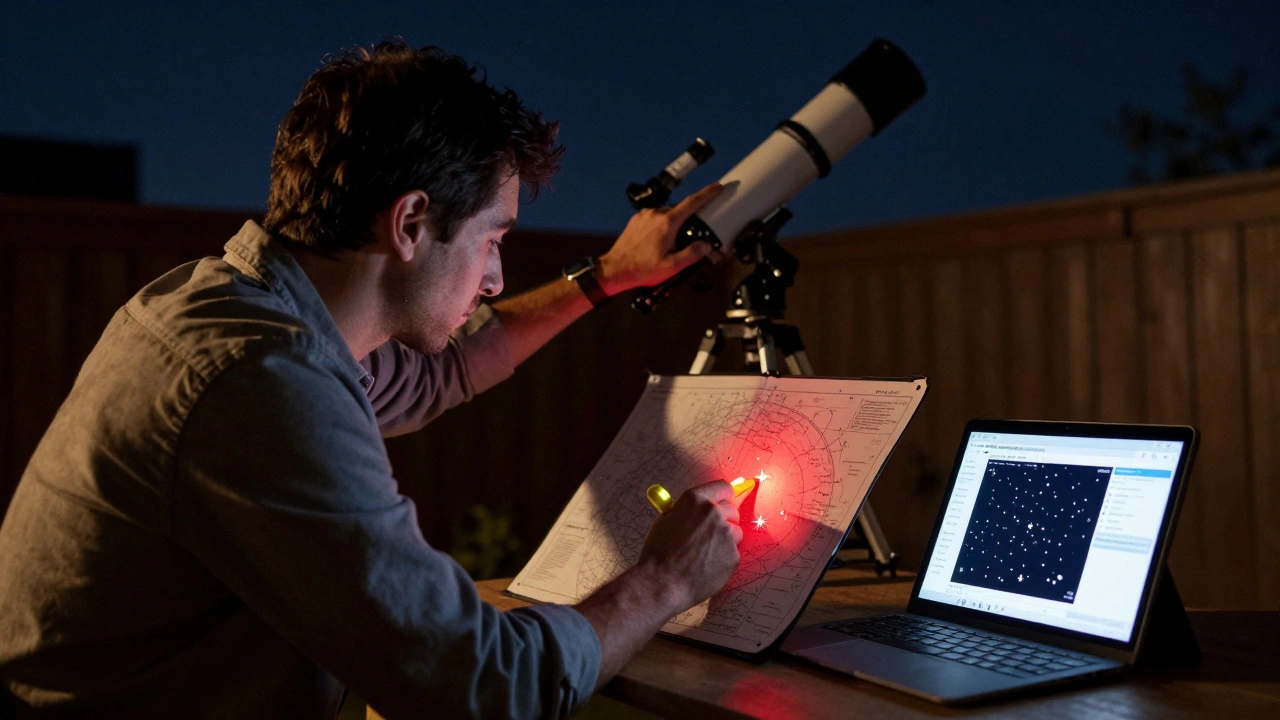
Pro tip: Save your chart as a PDF and print it. Use it under red light. Mark your comparison and check stars with a highlighter. You’ll thank yourself when it’s 2 a.m. and your eyes are tired.
What If You Can’t Find a Good Pair?
Sometimes, your target star is in a sparse region. No bright, stable stars nearby. What then?
- Use multiple faint stars. If you have three stars within 0.3 magnitudes of each other, average their brightness. This reduces individual error.
- Use the AAVSO’s sequence charts. They often include stars that are not obvious but have been verified as constant.
- Switch to digital photometry. With a CCD or CMOS camera and software like MuniWin or AAVSO’s Photometry Tool, you can measure dozens of stars at once. The software automatically selects the best comparison stars based on stability and brightness.
There’s no shame in using digital tools. In fact, most professional observers do. The goal isn’t to do it the "old way" - it’s to get accurate data.
Final Rule: Always Double-Check
Here’s the golden rule: every time you observe, record the brightness of both your comparison star and your check star. Not just your target. If your comparison star changes by more than 0.1 magnitude between nights, stop using it. Find a new one.
The most reliable observers aren’t the ones with the biggest telescopes. They’re the ones who double-check their references. They know that the difference between good data and garbage isn’t the equipment - it’s the attention to detail.
Variable star observing is one of the few areas in astronomy where amateurs still make real discoveries. But only if you get the basics right. Pick your stars wisely. Verify them constantly. And never assume. Your data matters - even if it’s just one observation.
What’s the difference between a comparison star and a check star?
A comparison star is your primary reference for measuring the brightness of your target variable star. A check star is a secondary reference - used to verify that your comparison star hasn’t changed. If the check star’s brightness shifts while your target stays the same, you know your comparison star might be unreliable.
Can I use the same star as both comparison and check?
No. Using the same star for both roles defeats the purpose. The whole point of a check star is to catch errors in your comparison star. If you only have one reference, you have no way to detect if it’s faulty. Always use two distinct stars.
How do I know if a star is truly non-variable?
Check the AAVSO Variable Star Index (VSX). Look for stars with at least 50 observations over 5+ years showing no significant change in brightness. Stars labeled "constant" or "non-variable" with low variability index (V.I. < 0.05) are safe. Avoid stars with "semiregular," "irregular," or "possible variable" tags.
Is it okay to use a star that’s slightly brighter than my target?
Yes, as long as it’s within 0.5 magnitudes. Human vision works best when comparing stars of similar brightness. A star 1 magnitude brighter might make your target look dimmer than it is. Stick to ±0.5 magnitudes for the most accurate estimates.
Do I need to use a telescope to pick comparison stars?
Not necessarily. Many observers use binoculars or wide-field scopes to find good comparison stars. The key is having a detailed star chart, not high magnification. Once you’ve identified your stars, you can switch to your main scope for observation.