20 Feb 2026
- 0 Comments
Looking up at the night sky and spotting a double star isn’t just about seeing two points of light close together-it’s about uncovering a hidden cosmic dance. Many amateur astronomers start with planets and bright nebulae, but once you get past the basics, double stars offer some of the most rewarding views. They’re colorful, dynamic, and often surprisingly close to home. The problem? Finding a reliable, complete list of targets to observe. That’s where catalogs and references come in. Not all double stars are created equal, and not all catalogs are created equal either.
Why Double Stars Matter
Double stars, or binary systems, aren’t just pretty. They’re one of the few places where you can directly see gravity at work. Unlike distant galaxies or faint nebulae, many double stars are bright enough to see with small telescopes, even from light-polluted suburbs. You don’t need a huge instrument. A 60mm refractor can split many of the most popular pairs. But knowing which ones to look for? That’s the real challenge.
There are over 100,000 known double stars in our galaxy. But only a fraction of them are easy to observe. Some are too close together. Others are too faint. A few are so far apart they’re not really bound at all-just optical illusions. That’s why catalogs exist. They filter the noise and give you the real targets.
The Washington Double Star Catalog: Your Starting Point
If you’re serious about double star observing, the Washington Double Star Catalog is the largest, most comprehensive database of double and multiple stars, maintained by the U.S. Naval Observatory. It’s not a printed book-it’s a living, constantly updated online database that includes over 150,000 entries.
Each entry has key data: coordinates, magnitudes, separation in arcseconds, position angle, discovery date, and sometimes even orbital periods. For example, the famous pair Albireo in Cygnus has a separation of 35 arcseconds and a color contrast that’s unforgettable-gold and blue. The WDS lists it as WDS 20241+2745, with its primary star at magnitude 3.1 and companion at 5.1.
What makes the WDS powerful isn’t just its size. It’s how it’s structured. You can search by constellation, magnitude difference, separation, or even by discoverer. Want to find all doubles discovered by William Herschel? Type his name in. Looking for pairs with a separation under 2 arcseconds? Filter it. This isn’t just a list-it’s a tool.
Other Key Catalogs You Should Know
The WDS is the backbone, but it’s not the only resource. Several other catalogs fill in the gaps:
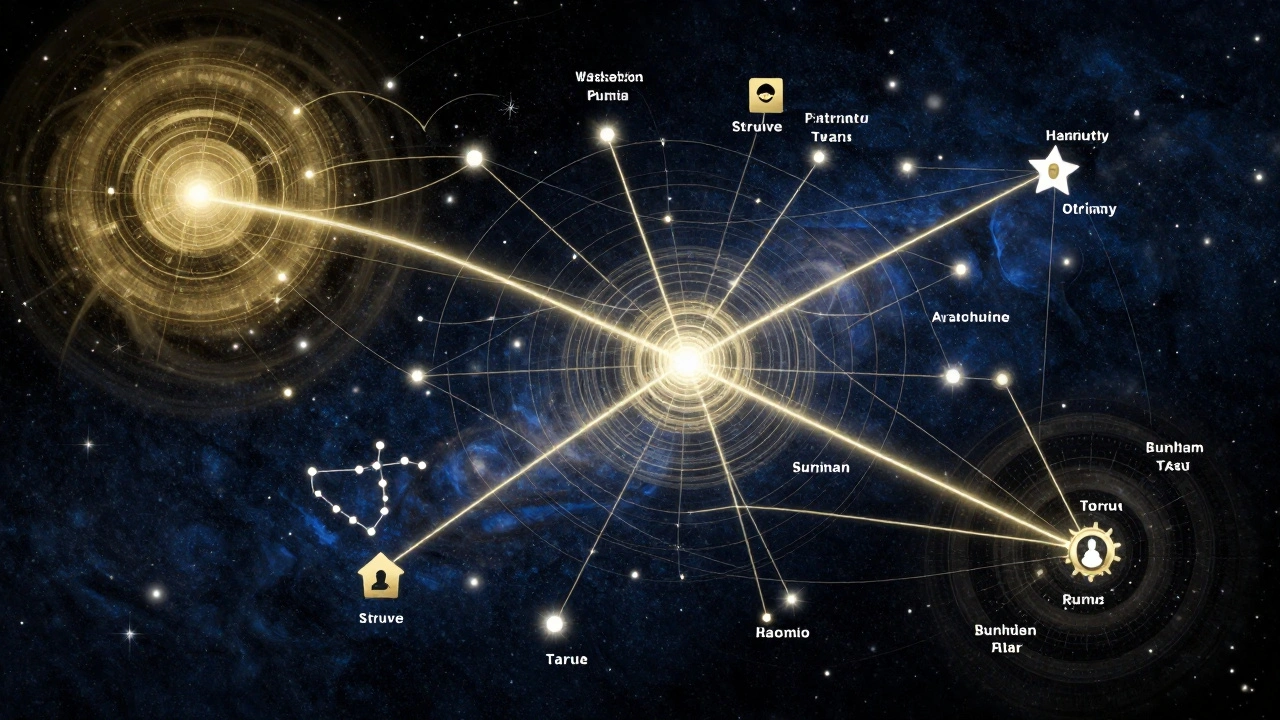
- Struve Catalog: Contains over 2,700 doubles discovered by Friedrich Georg Wilhelm Struve and his family. These are mostly bright, northern-hemisphere pairs. Many are still favorites among visual observers.
- Burnham’s Double Star Catalog: Compiled by Sherburne Wesley Burnham in the late 1800s, this catalog includes 13,665 doubles. It’s older, but still valuable because many of these stars were among the first to be measured with precision. Burnham’s work is now integrated into the WDS.
- ADS Catalog: The Aitken Double Star Catalog, published in 1932, is the predecessor to the WDS. It’s still referenced for historical context and for stars not yet updated in newer databases.
- CCDM: The Catalog of Components of Double and Multiple Stars, maintained by the Strasbourg Astronomical Data Center. It’s more technical and used often by researchers, but it includes precise measurements of components that can help you pick the right telescope.
These catalogs aren’t rivals-they’re teammates. The WDS pulls data from all of them. If you’re using a modern planetarium app like Stellarium or SkySafari, it’s likely pulling from the WDS behind the scenes. But if you’re planning a session with a paper chart or just want to know what’s out there, you need to understand where the data comes from.
What Makes a Good Double Star for Observation
Not every entry in the WDS is worth your time. Here’s what to look for:
- Separation: At least 2 arcseconds for small scopes. Below that, you’ll need a large aperture and perfect seeing. Above 10 arcseconds, even binoculars can split them.
- Magnitude difference: If the brighter star is more than 3 magnitudes brighter than its companion, you’ll need good contrast. A 1.5-magnitude difference? That’s ideal for color contrast.
- Color: Red and blue pairs are the most visually striking. Albireo, Mizar and Alcor, and Rasalhague are classics for this reason.
- Location: Avoid targets near the horizon. Aim for stars above 30 degrees elevation. That means winter and spring are prime seasons for northern observers.
For example, Gamma Virginis (Porrima) has a separation of 2.5 arcseconds and a magnitude difference of 0.4. It’s a great test for 4-inch scopes under decent skies. When it’s at its closest approach (every 169 years), it’s a challenge. At its widest, it’s easy. Knowing when to observe it? That’s where orbital data in the WDS helps.
Tools to Use with Catalogs
Having a catalog is useless if you can’t find the stars. Here’s how to bridge the gap:
- Stellarium: Type in a WDS designation like WDS 12345+6789, and it will center on the star. You can even filter to show only double stars.
- SkySafari 7 Pro: Has a dedicated double star filter and shows separation and position angle on-screen. It’s perfect for field use.
- Online WDS Search: Visit the official WDS site (note: no links in final output). Use the search tool to export a list for your next session.
- Printed Charts: The Double Star Observer’s Handbook by James Mullaney is still a great companion. It lists 100+ targets with observing notes, magnitudes, and charts.
Pro tip: Download a CSV of your favorite doubles from the WDS and import it into SkySafari. You’ll have a custom observing list ready to go.
How to Build Your Own Observing List
Here’s a simple method to build a list that works for your gear and sky:
- Start with your telescope’s aperture. A 70mm scope can handle separations down to 1.5 arcseconds under ideal conditions.
- Set a magnitude limit. Don’t go fainter than magnitude 9 for the primary star. Fainter targets take longer to find and are harder to split.
- Filter by color. Pick pairs with at least a 1.0 magnitude difference in color (e.g., one yellow, one blue).
- Check the season. Use a star chart to see which constellations are high in your sky right now.
- Use the WDS to search for doubles in those constellations, then sort by separation and magnitude difference.
- Export the top 15-20. You don’t need to observe them all in one night. Spread them out over weeks.
For example, if you’re in Portland in February 2026, Orion and Taurus are high in the sky. Search WDS for doubles in those constellations with separation > 3 arcseconds and magnitude difference < 2. You’ll get a list that includes Theta Orionis, 70 Orionis, and Epsilon Tauri-all doable with a 4-inch scope.
Common Mistakes to Avoid
Even experienced observers trip up. Here’s what to watch out for:
- Using outdated catalogs: Some old books list doubles that have since been proven to be unrelated. The WDS corrects these.
- Ignoring position angle: If the pair is edge-on, you might think it’s not split when it is. Always check the angle.
- Observing at low altitude: A star at 15 degrees above the horizon looks blurry. Wait until it’s higher.
- Expecting color in every pair: Not all doubles are colorful. Some are both white. That’s fine-it’s still a binary system.
Also, don’t rely on apps to do all the work. Learn to find stars by star-hopping. It builds skill. And remember: sometimes the best double star you’ll ever see is the one you found yourself, not the one your app told you to look at.
Where to Go Next
Once you’ve observed 20-30 doubles, you’ll start noticing patterns. You’ll know which pairs are easy, which are tricky, and which ones are just plain beautiful. That’s when you can dive deeper.
Join the Astronomical League’s Double Star Observing Program. It has 10 levels, from beginner to expert. Each level gives you a checklist of stars to observe and log. You don’t need to be a member to participate-just submit your logs. It’s a great way to track progress.
Or try the Visual Double Star Challenge-a community-driven project where observers worldwide share their observations of the same targets. You’ll see how different scopes, locations, and eyesight affect what you see. It’s not about perfection. It’s about participation.
Final Thought
Double stars are the hidden gems of the night sky. They’re not flashy like the Orion Nebula, but they’re more personal. Each pair tells a story-of gravity, motion, and time. Catalogs like the Washington Double Star Catalog give you the map. But the journey? That’s yours.
What is the best double star catalog for beginners?
The Washington Double Star Catalog (WDS) is the best starting point. It’s free, online, and updated daily. Use it with a planetarium app like Stellarium or SkySafari to find targets. You don’t need to memorize it-just search by constellation or star name. Start with pairs brighter than magnitude 6 and separated by more than 5 arcseconds.
Can I see double stars with binoculars?
Yes, but only the wide ones. Alcor and Mizar in Ursa Major are visible as a double with the naked eye, and binoculars make it obvious. Other pairs like Gamma Virginis (Porrima) or Epsilon Lyrae (the Double Double) are also binocular-friendly. Anything under 10 arcseconds separation usually needs a telescope.
Do double stars have orbits?
Many do. The WDS includes orbital periods for over 1,500 known binaries. Some, like Epsilon Lyrae, have orbits that take hundreds of years. Others, like the pair in 70 Orionis, change position noticeably over just a few years. That’s why observing them over time is so rewarding-you’re watching gravity in motion.
Are all double stars actually binary systems?
No. Some are optical doubles-just two stars that appear close from our viewpoint but are light-years apart. The WDS includes both true binaries and optical pairs. The catalog notes whether the system is likely physically bound. Look for entries with measured orbital motion or radial velocity data to confirm a true binary.
How often should I revisit double stars?
For wide pairs (over 10 arcseconds), you can revisit them every few years. For close pairs (under 3 arcseconds), observe them annually. The WDS tracks changes in separation and position angle, so you’ll see them shift over time. Some observers keep logs for decades to track motion. It’s one of the few astronomy activities where you can see measurable change in your lifetime.