2 Feb 2026
- 0 Comments
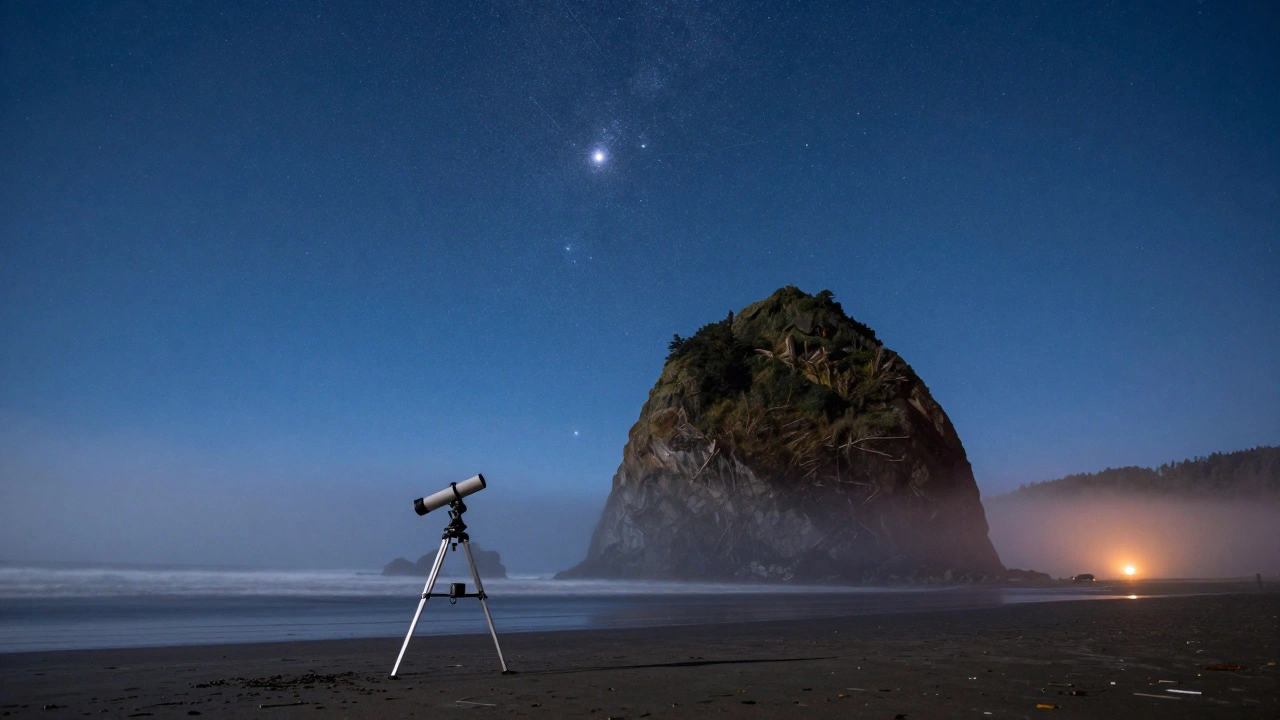
Planning a night of stargazing near the coast? You’ve got the telescope, the charts, maybe even a thermos of coffee. But if you’re within 20 miles of the ocean, you’re fighting something invisible-and it’s probably ruining your view. Marine layer and haze aren’t just weather nuisances. They’re the silent killers of clear skies for coastal observers. And if you don’t plan around them, you’ll waste hours waiting for stars that never show up.
What Exactly Is the Marine Layer?
The marine layer is a cool, moist air mass that forms over cold ocean water and gets pushed inland by wind patterns. It’s common along the Pacific Coast-from Northern California to Southern Oregon-and especially stubborn in places like Monterey, Santa Barbara, and Portland’s coast. This layer usually sits between 500 and 2,000 feet above sea level. When it settles, it traps moisture and pollutants, turning into a thick, grayish fog that swallows stars like a sponge swallows water.
It’s not just fog. Underneath that fog, there’s often a temperature inversion: warm air sitting on top of cold air. That inversion acts like a lid. It stops vertical mixing, so dust, salt particles, and pollution can’t rise and disperse. The result? A permanent, low-hanging haze that scatters light and reduces contrast. Stars turn into fuzzy smudges. Planets lose their sharp edges. Even bright objects like Jupiter or Saturn look dull and washed out.
Why Haze Is Worse Than Clouds
Clouds block the sky. You can see them. You know to wait. But haze? It doesn’t look like clouds. It looks like a normal night. The sky might even be dark. The stars seem to be there-until you look through the eyepiece. Then you realize: everything’s blurry. Your 10mm eyepiece isn’t broken. Your collimation is fine. The problem is the atmosphere itself.
Studies from the American Astronomical Society show that coastal observing sites with persistent marine layer can lose 60-80% of usable observing time during peak season (May-September). That’s not just inconvenient. It’s costly. Many amateur astronomers in coastal towns have given up on deep-sky observing altogether because of this.
When Does the Marine Layer Lift?
The key to success isn’t waiting for clear skies. It’s waiting for the right time within a cloudy night. The marine layer doesn’t just vanish-it lifts. And it lifts predictably.
Most coastal areas experience a daily cycle:
- Evening (6-10 PM): Layer forms or thickens. Sky is hazy or foggy. No observing.
- Midnight to 2 AM: Temperature drops. Layer stabilizes. Conditions rarely improve.
- 3-5 AM: Surface cools further. Wind often picks up slightly. Layer begins to thin at the edges.
- 5-7 AM: Sun warms the land. Thermal lift breaks the inversion. Layer lifts-sometimes completely.
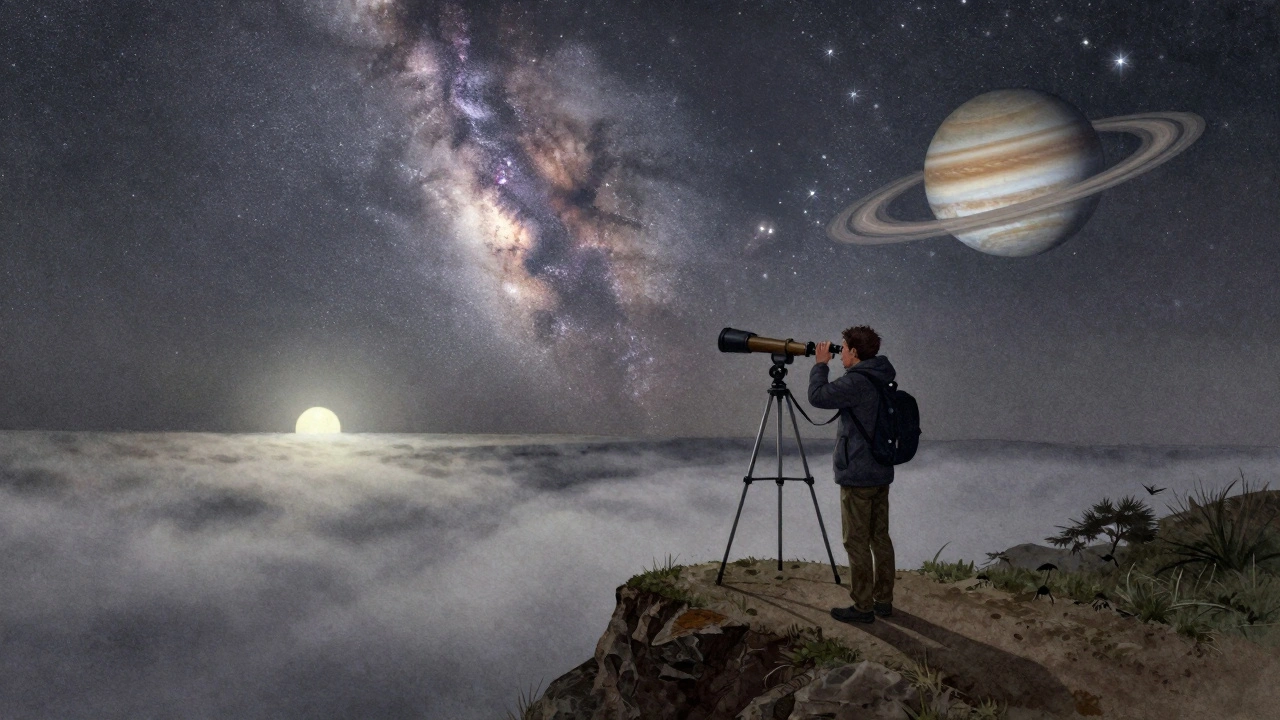
That window between 4 and 6 AM is your golden hour. Not for sunrise. For sky. That’s when the marine layer lifts enough to reveal the upper atmosphere. Stars you couldn’t see at 11 PM suddenly snap into focus. Jupiter’s cloud bands? Visible. The Orion Nebula? Glows with structure. You’re not getting lucky. You’re timing it right.
How to Predict the Lift
You can’t just guess. You need data. Here’s what works:
- Check coastal weather radar: Look for low-lying, grayish clouds over the ocean. If it’s solid over the water and barely touching land, the layer is shallow and will likely lift by dawn.
- Use temperature inversion maps: Sites like Windy.com a weather visualization platform that shows wind, temperature, and inversion layers in real time show temperature gradients. If the inversion is strong (more than 5°C difference between surface and 1,000 ft), expect persistent haze.
- Monitor dew point spread: If the air temperature and dew point are within 2°F of each other, moisture is saturated. That’s haze territory. If they’re 5°F+ apart, the air is drier-and clearer.
- Watch the coastline: If you can see the ocean from your observing spot, look for waves breaking on shore. If they’re visible and the horizon is sharp, the marine layer is thinning. If it’s a solid white wall, wait.
One observer in Astoria, Oregon, started keeping a log. After 18 months, he found that 73% of his best nights occurred between 4:30 and 5:30 AM. He didn’t need fancy gear. He just showed up at the right time.
Where to Go: Elevation Is Your Friend
Marine layer is a low-altitude problem. The higher you go, the more likely you are to rise above it.
Even 300-500 feet of elevation can make a huge difference. In coastal Oregon, many observers head to the foothills of the Coast Range. Places like:
- Yaquina Head (near Newport)
- Mount Hebo (north of Tillamook)
- Haystack Rock overlook (near Cannon Beach)
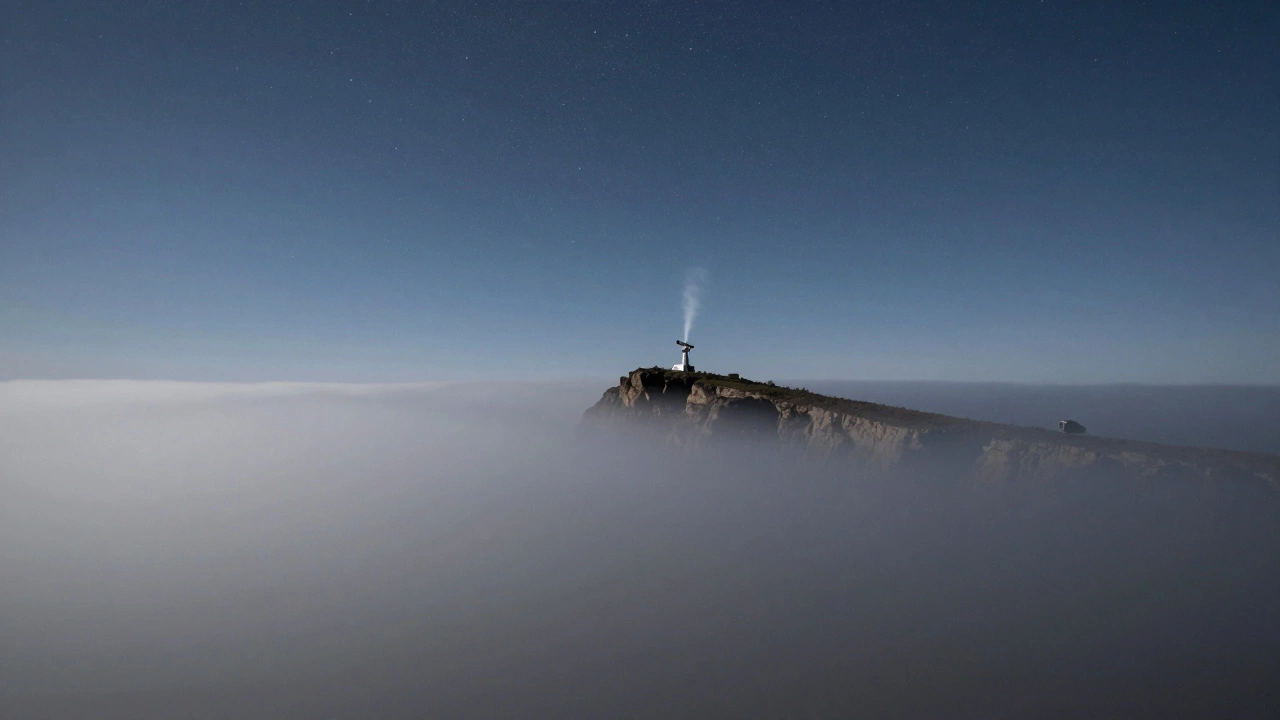
These spots aren’t mountain peaks. But they’re high enough to peek over the fog. You’ll still see some haze below you-but the sky above? Crystal clear. A 200x telescope on a faint galaxy becomes usable again.
Pro tip: Use Google Earth to check elevation profiles. If your observing spot is below 200 feet and within 10 miles of the coast, you’re probably in the layer. Move up.
Equipment Adjustments for Hazy Conditions
Even with perfect timing, haze reduces contrast. Your gear needs to compensate.
- Use narrowband filters: For nebulae, an OIII or H-beta filter cuts through scattered light. It doesn’t make the haze disappear-but it makes the object pop.
- Switch to higher magnification: Haze blurs fine details. Increasing magnification (within reason) can help isolate the target from background glow. Try 200x+ on planets.
- Reduce light pollution filters: If you’re using a broadband light pollution filter, swap it out. It’s designed for urban skies, not marine haze. It can make things worse.
- Let your scope acclimate: Haze often comes with damp air. Let your telescope sit outside for 45 minutes before observing. Dew won’t ruin your optics, but thermal shock will.
One astrophotographer in Mendocino started using a ZWO ASI294MC Pro with a 10nm H-alpha filter. She went from capturing nothing to getting detailed images of the Horsehead Nebula-all because she tuned her gear to the haze, not against it.
When to Skip It Altogether
Not every night is worth it. If the marine layer is thick at 9 PM and shows no sign of lifting by midnight, don’t drag your gear out. You’ll get cold, frustrated, and nothing to show for it.
Use this simple decision tree:
- Is the marine layer visible from your location at 8 PM? → Yes? Proceed.
- Is the dew point spread less than 3°F? → Yes? Skip.
- Is the wind speed below 5 mph? → Yes? Layer will linger.
- Is the sky forecast to be overcast above 5,000 ft? → Yes? Skip.
- Can you reach an elevation above 400 ft within 15 minutes? → Yes? Go. If not? Stay home.
Discipline beats desire. The best observers aren’t the ones who go out every night. They’re the ones who go out only when conditions align.
Real-World Example: A Night in Cannon Beach
Last June, a group of five observers gathered at Haystack Rock at 3:30 AM. They checked Windy.com. The inversion layer was 1,200 ft. Dew point spread: 6°F. Wind: 8 mph from the northwest. They knew the layer would lift.
By 4:45 AM, the fog dropped below the cliff. The sky opened. They saw:
- NGC 1491 (the California Nebula) with clear structure
- M42’s Trapezium stars cleanly resolved
- Orion’s Sword with visible nebulosity
- Andromeda Galaxy’s dust lanes
They didn’t have perfect weather. They had smart planning.
Final Thought: It’s Not About the Sky. It’s About Timing.
Coastal astronomy isn’t about finding a place with no clouds. It’s about understanding the rhythm of the air. Marine layer and haze aren’t obstacles you overcome. They’re patterns you learn. The more you observe the sky, the better you’ll predict when the air will clear.
Next time you plan a session, don’t just check the cloud forecast. Check the inversion. Check the elevation. Check the time. Your telescope will thank you.
Can marine layer affect telescope collimation?
No, marine layer doesn’t physically move telescope optics. But the damp air can cause condensation on mirrors and lenses, which distorts the view. That’s not collimation-it’s dew. Always use a dew heater or cover your scope until observing time.
Is marine layer worse in summer or winter?
It’s worst in late spring and summer (May-September), when ocean temperatures are coldest and inland heating is strongest. That creates the strongest temperature inversion. Winter marine layers are thinner and less persistent.
Can I use a camera to see through haze better than my eyes?
Yes, but only with the right setup. Long-exposure astrophotography can capture detail invisible to the eye, especially with narrowband filters. However, haze still reduces contrast and increases noise. A DSLR with a 10nm H-alpha filter works better than visual observing, but it’s not magic. Timing still matters.
Why don’t professional observatories build on the coast?
They do-but only on high peaks. Mauna Kea in Hawaii and Cerro Tololo in Chile are thousands of feet above sea level. Coastal observatories like Lick Observatory sit on mountains for the same reason: to rise above the marine layer and pollution. If you’re at sea level, you’re below the action.
Does wind help or hurt coastal observing?
A light wind (5-10 mph) helps by breaking up the marine layer and mixing air. Strong winds (15+ mph) create turbulence, which blurs images. The sweet spot is steady, moderate breeze-not calm, not stormy.
For those who live near the coast, astronomy isn’t about waiting for perfect skies. It’s about reading the air. Learn the rhythm. Time your nights. And when the haze lifts-you’ll see what most never do.