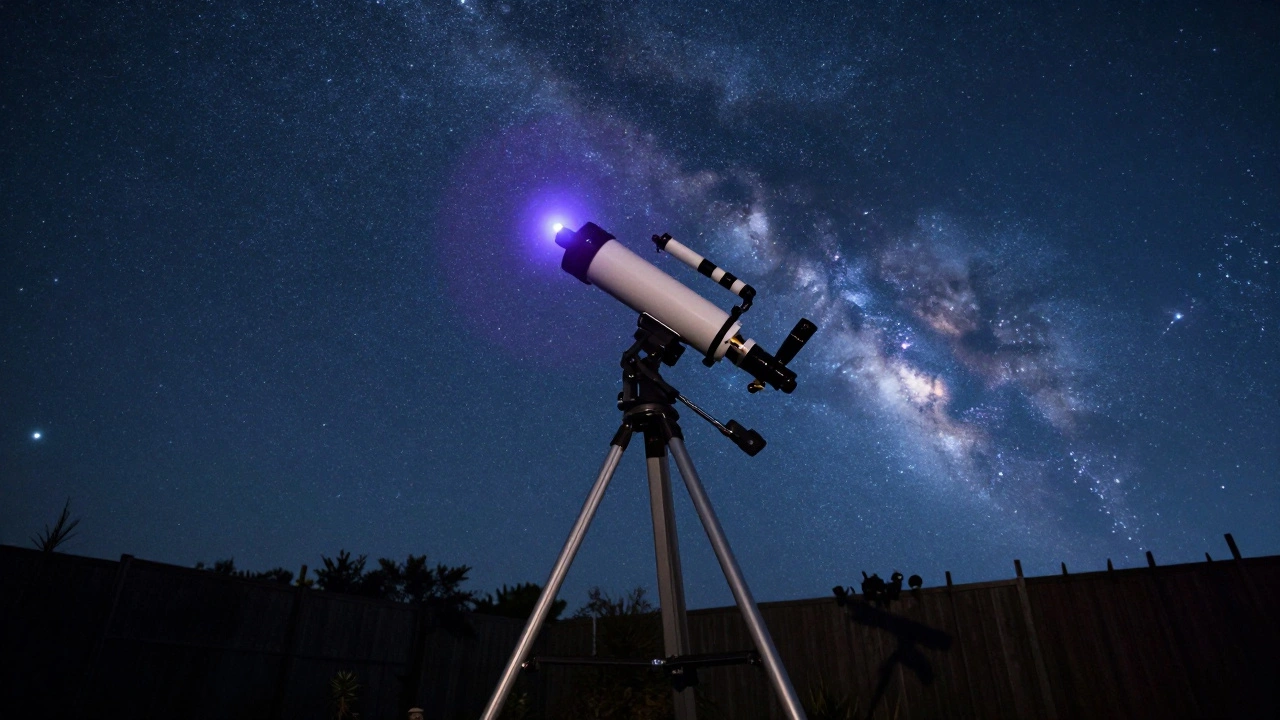
27 Feb 2026
- 0 Comments
When you're shopping for a refractor telescope, you’ve probably seen terms like ED and APO thrown around like they’re magic words. But what do they actually mean? And more importantly - does paying extra for ED glass or an APO design make a real difference in what you see through the eyepiece?
Let’s cut through the marketing noise. This isn’t about brand names or fancy packaging. It’s about light. Specifically, how different types of glass bend light, and what happens when they don’t do it right.
What’s the problem with regular glass?
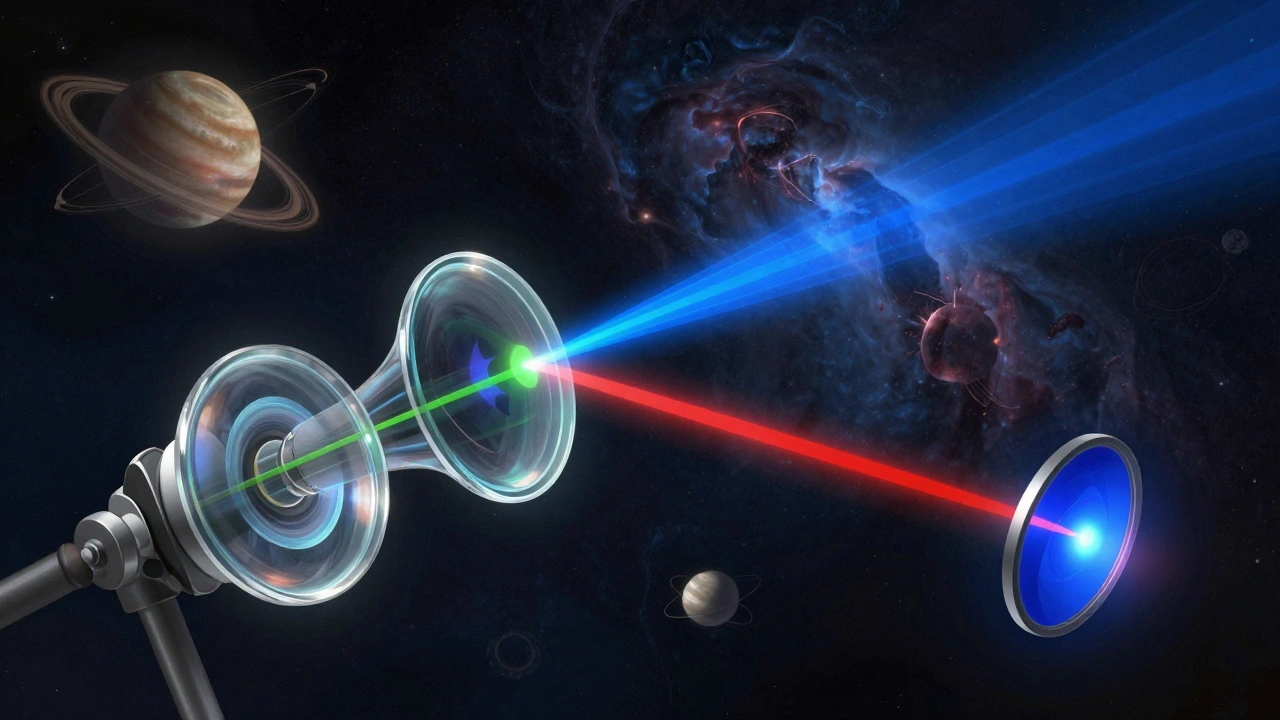
Every refractor telescope uses lenses to gather and focus light. Simple, right? Not quite. White light - like the light from a star - is made up of all the colors of the rainbow. When that light passes through a single lens, each color bends at a slightly different angle. Blue light bends more than red. Green bends somewhere in between.
This is called chromatic aberration. And it’s why you might see a purple or greenish halo around bright stars or planets like Jupiter. It’s not your eyes. It’s the lens. In cheap refractors, this effect is obvious. In mid-range ones, it’s subtle but still there. And it ruins contrast.
Imagine trying to see the fine details of Saturn’s rings, but every edge is smeared with a faint rainbow. That’s chromatic aberration. It doesn’t just look bad - it makes the image feel soft, lifeless. You lose detail. You lose contrast. You lose the thrill.
ED glass: the first step toward cleaner light
ED stands for Extra-Low Dispersion. It’s a type of glass engineered to bend different colors of light much more similarly than standard optical glass. Think of it as a smarter material. Instead of letting blue and red light go their separate ways, ED glass keeps them closer together.
Most ED glass is made from fluorite or special fluoride-containing materials. These aren’t cheap. A single ED element can cost more than an entire low-end telescope lens. But the payoff? A noticeable drop in color fringing. You’ll still see a tiny bit of purple around the brightest stars, but it’s far less distracting.
ED refractors are often labeled as “ED doublets.” That means two lenses - one made of ED glass, the other of standard crown or flint glass. The ED element corrects most of the chromatic aberration. The second lens fine-tunes focus. It’s not perfect, but it’s a huge improvement over non-ED designs.
For visual observers, an ED doublet is often enough. You get crisp views of the Moon, Jupiter’s cloud bands, and the Orion Nebula without the rainbow haze. For astrophotographers? It’s a start - but not the finish line.
APO: the gold standard
APO stands for apochromatic. That sounds fancy, but it just means the lens system brings three colors - red, green, and blue - into focus at the same point. This is what real color correction looks like. No purple halos. No green tinges. Just pure, sharp, high-contrast images.
APO refractors use three or more lens elements. Common configurations include triplets: two ED elements with a standard element, or one ED element with a fluorite element. Fluorite is even better than ED glass at controlling dispersion. It’s rare, expensive, and harder to manufacture. That’s why APO refractors cost more.
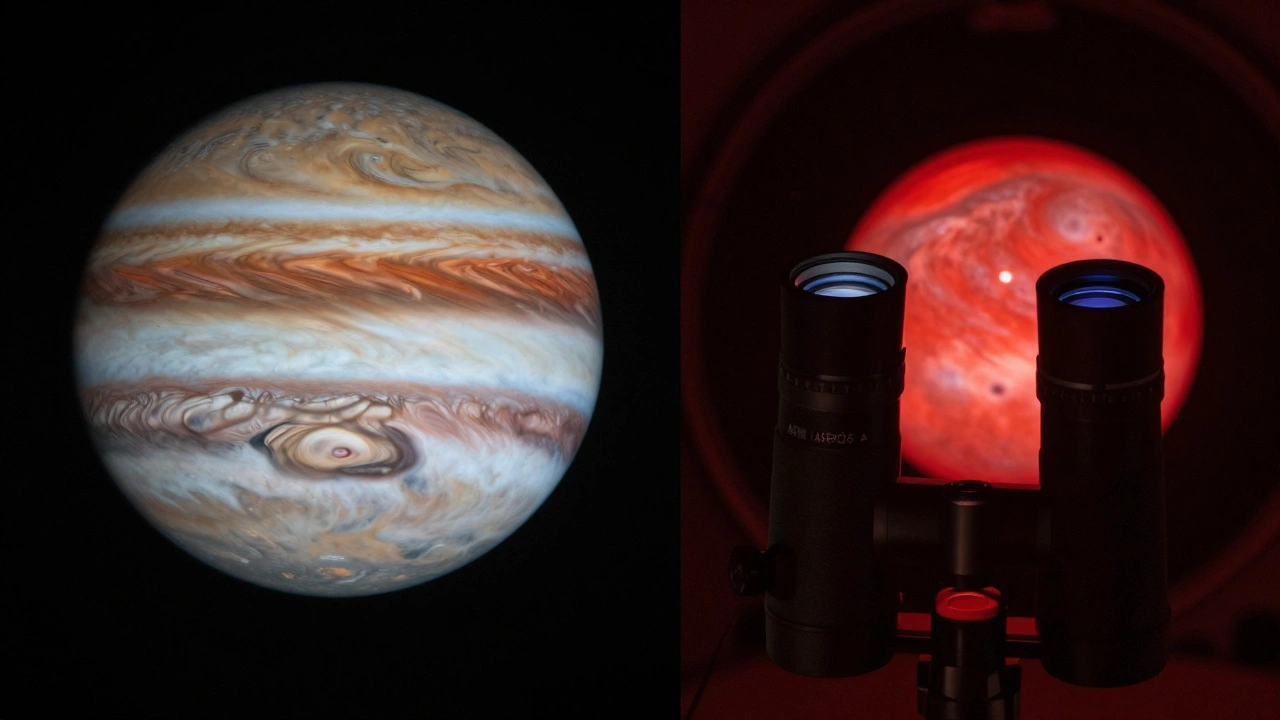
The difference between a good ED doublet and a true APO triplet isn’t subtle. It’s dramatic. Look at Jupiter through an ED scope, and you’ll see the Great Red Spot clearly. Look through a true APO, and you’ll see the subtle texture within the storm - the swirls, the edges, the shadows. The contrast is deeper. The colors are truer. The image feels three-dimensional.
Take the Orion Nebula. In an ED scope, the central star cluster pops. In an APO, you’ll see the faint wisps of gas between the stars - the ones that look like smoke curling through space. That’s because APO lenses preserve contrast across the full spectrum. They don’t just fix color fringing. They recover what chromatic aberration steals: fine detail.
Real-world comparison: ED doublet vs APO triplet
Here’s what you actually get when you upgrade:
| Feature | ED Doublet | APO Triplet |
|---|---|---|
| Lens elements | 2 | 3 or more |
| Primary glass type | One ED element | Two or more ED or fluorite elements |
| Chromatic aberration | Reduced, but still visible on bright objects | Nearly eliminated |
| Contrast | Good | Exceptional |
| Color fidelity | Mostly accurate | Perfect |
| Typical price range (80mm-100mm) | $400-$800 | $1,000-$2,500 |
| Best for | Visual observers, casual astrophotographers | Deep-sky imaging, planetary detail, serious observers |
The numbers don’t lie. If you’re imaging galaxies or capturing long-exposure shots of nebulae, even a tiny bit of residual color error can ruin your data. APOs handle this with ease. ED scopes? They can work - but you’ll spend hours in post-processing trying to fix what the lens didn’t.
Who really needs an APO?
If you’re mostly looking at the Moon, Jupiter, or Saturn through an eyepiece - and you’re happy with sharp, clean views - an ED doublet is more than enough. You’ll spend less money and still get stunning results.
But if you’re chasing:
- Color-accurate astrophotography of nebulae
- Detail on Mars’ polar caps
- Sharp planetary images with no post-processing fixes
- Long-exposure deep-sky shots without rainbow halos
Then the extra cost of an APO isn’t a luxury - it’s a necessity. The difference isn’t just in sharpness. It’s in how the image feels. APO views have a presence. They feel alive. You’re not just seeing a picture. You’re seeing space.
Myth: More glass = better
Some brands slap on extra lenses and call it an APO. But that’s not how it works. Adding lenses doesn’t fix chromatic aberration. It’s about the type of glass and how they’re arranged.
A triplet made of cheap glass with no ED or fluorite will still show color fringing. It might even be worse - because more glass means more light loss and more internal reflections.
Don’t be fooled by buzzwords. Look for the glass type. If a manufacturer doesn’t say whether they use ED, fluorite, or both - walk away. Real APOs are transparent about their materials.
What about size and weight?
APO refractors are heavier. A 100mm APO triplet can weigh 10-15 pounds. An ED doublet of the same size? Maybe 6-8 pounds. That matters if you’re hand-holding or using a lightweight mount.
If your mount can’t handle the load, you’ll get blurry images from vibration - no matter how perfect the lens. So don’t buy an APO just because it’s “better.” Buy it because your setup can support it.
Bottom line: It’s not about labels. It’s about results.
ED glass is a major upgrade over standard refractors. It brings color correction into the realm of practicality for visual use.
APO refractors are the next level - where color correction becomes invisible. Where the telescope stops being a tool and starts feeling like a window.
You don’t need an APO to enjoy the night sky. But if you’ve ever looked at Jupiter and thought, “I wish I could see more,” then you’re already on the path to needing one.
Choose ED if you want great views without breaking the bank. Choose APO if you want the best possible view - and you’re ready to pay for it.
Is ED glass the same as fluorite?
No. Fluorite is a natural mineral that has even lower dispersion than ED glass. Many high-end APOs use fluorite as one of their elements. ED glass is a manufactured material designed to mimic fluorite’s properties at a lower cost. Fluorite is rarer, more expensive, and often used in premium lenses.
Can I fix chromatic aberration in post-processing?
Yes, to a point. If you’re doing astrophotography, software can reduce color fringing. But it can’t recover lost contrast or fine detail. A lens with poor color correction throws away information before the camera even captures it. No amount of editing can bring that back.
Are all APO refractors triplets?
Most are, but not all. Some APOs use four or five elements, especially in longer focal lengths. The key isn’t the number of lenses - it’s the combination of glass types. If a lens brings red, green, and blue light to the same focus point, it’s apochromatic - regardless of how many elements it has.
Why do some ED scopes cost more than some APOs?
Brand, build quality, and accessories matter. A premium ED scope with a carbon fiber tube, precision focuser, and high-end coatings can cost more than a basic APO from a lesser-known brand. But the glass itself - the optical design - is still not as well corrected. Always check the lens configuration, not just the price tag.
Do I need an APO for planetary viewing?
You don’t need one - but you’ll wish you had it. Planets are bright and small. Even a tiny bit of color blur softens their edges. An APO gives you sharper limb definition on Jupiter, cleaner polar caps on Mars, and more detail in Saturn’s rings. If you’re serious about planetary observation, the APO’s contrast advantage is unmistakable.