2 Sep 2026
- 0 Comments
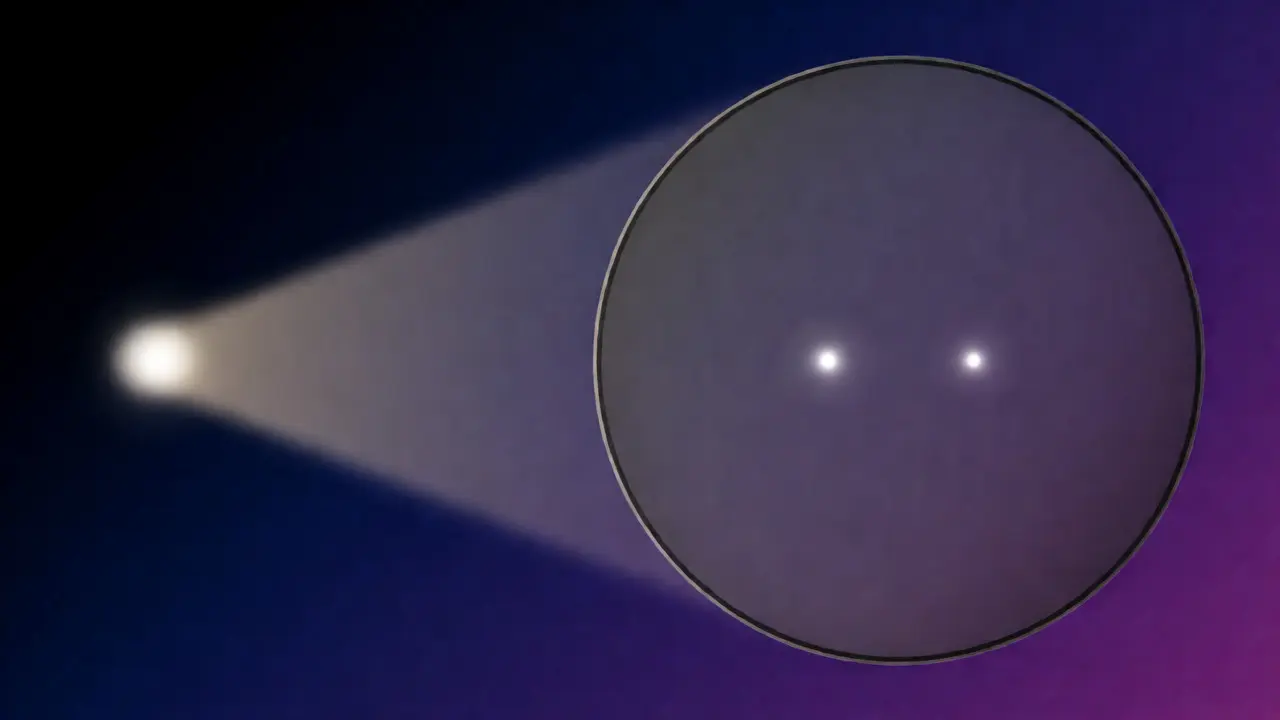
You have a telescope. You point it at the night sky. You see two points of light that look like one blurry blob to your naked eye. But are they actually separate? This is the game of splitting double stars. It’s not just about seeing dots; it’s about proving you can resolve them into distinct entities. Many beginners think buying a bigger scope solves everything. It doesn’t. If you don’t understand how aperture and magnification work together, you’ll end up with a fuzzy mess no matter how much money you spent.
Let’s cut through the noise. To split a double star, you need two things: enough light-gathering power (aperture) to separate the images, and enough magnification to make those separated images visible to your eye. These aren’t interchangeable. You can’t just crank up the zoom on a tiny telescope and expect miracles. And you can’t use a massive telescope with low power and hope for the best. There’s a sweet spot. Let’s find it.
The Physics of Resolution: Why Aperture Matters Most
At its core, splitting a binary system is an optical physics problem. Light waves bend around the edges of your telescope’s mirror or lens. This bending creates a diffraction pattern known as the Airy disk. When two stars are close together, their Airy disks overlap. If they overlap too much, your eye sees one bright smear. If they are far enough apart, you see two distinct peaks with a dip in between. That dip is the key.
Aperture is the diameter of your objective lens or primary mirror. It is the single most critical factor in determining the minimum angular separation you can theoretically resolve. The larger the aperture, the smaller the Airy disk, and the closer two stars can be before they blur into each other. This relationship is governed by the Rayleigh criterion, but amateur astronomers often prefer the simpler Dawes limit because it matches human visual performance better in practice.
The Dawes limit formula is straightforward: $R = 116 / D$, where $R$ is the resolution in arcseconds and $D$ is the aperture in millimeters. For example, if you have a 100mm refractor, your theoretical resolution is $116 / 100 = 1.16$ arcseconds. If a double star has a separation of 1.0 arcsecond, this scope will struggle. If it has 1.5 arcseconds, you should see it clearly. But here is the catch: this is a theoretical maximum under perfect conditions. Atmospheric turbulence, optical quality, and observer skill all degrade this number.
Magnification: The Enabler, Not the Creator
If aperture sets the limit, what does Magnification do? It takes the resolved image created by the aperture and scales it up so your retina can detect the gap. Think of it like a photograph. If you take a picture of two distant cars merging into one pixelated blob, zooming in digitally won’t reveal two cars. But if the camera sensor had enough resolution to capture two distinct pixels, zooming in lets you see them. In astronomy, aperture captures the detail; magnification reveals it to your eye.
There is a concept called "empty magnification." This happens when you increase magnification beyond what the optics can support. The image gets dimmer, softer, and shakier, but no new detail appears. You’re just making the blur bigger. Conversely, if you use too little magnification, the resolved stars might still be too small for your eye to distinguish, even if the telescope physically separated them.
So, what is the right amount? A good rule of thumb is that you need enough magnification to spread the Airy disk across several retinal cells. For most observers, this means using magnifications between 30x and 50x per inch of aperture (or roughly 12x to 20x per centimeter). However, for tight doubles, you often need to push higher. If the separation is near the Dawes limit, try increasing magnification until the background sky brightness drops slightly and the stars appear sharp and steady. Stop when the image degrades.
Atmospheric Seeing: The Real Bottleneck
You could own a 20-inch Dobsonian with perfect optics, but if the atmosphere is turbulent, you won’t split anything well. Seeing refers to atmospheric stability. On a bad night, high-magnification views turn stars into boiling blobs. On an excellent night, you can push magnification to the limit and see crisp details.
This variable changes nightly and even hourly. It depends on wind speed, temperature gradients, and jet stream activity. You cannot control seeing, but you can adapt to it. Here is a practical strategy:
- Low Seeing: Use lower magnification. Accept that you might only split wider pairs. Focus on contrast rather than extreme resolution.
- Average Seeing: Use moderate magnification. Aim for pairs with separations above 1.5 times your Dawes limit.
- Excellent Seeing: Push your magnification limits. Try to split pairs at or below your theoretical resolution. This is when you test your equipment’s true capability.
Don’t blame your telescope when the view is soft. Check the seeing first. Look at Jupiter’s moons or the Moon’s craters. If they shimmer violently, back off the power. If they sit rock-steady, go for the tight splits.
Optical Quality and Collimation
Even with perfect aperture and ideal seeing, bad optics will ruin your chances. Collimation is the alignment of optical elements. In reflectors, misalignment causes coma and astigmatism, which smear star images. In refractors, poor lens design introduces chromatic aberration, creating colored halos that mask faint companions.
Before attempting any serious double-star observing, ensure your telescope is perfectly collimated. For Newtonians, this means adjusting the secondary mirror and primary mirror until the reflection of the focuser is centered. For refractors, check for color fringing. If a bright star shows a strong purple halo, your achromatic lens may not handle high magnification well on tight doubles. APO (apochromatic) refractors perform significantly better here because they minimize color errors.
Another hidden factor is thermal equilibrium. If your mirror is warmer than the ambient air, rising heat currents inside the tube distort the view. Wait 30-60 minutes after setting up your telescope before trying to split difficult targets. This simple step improves resolution more than upgrading eyepieces.
Observer Technique: Training Your Eye
Your eye is part of the optical system. Human vision has limitations. We are sensitive to contrast, not just resolution. Sometimes, a pair is technically resolvable, but your brain fails to register the second star because it’s too faint relative to the primary. This is common in unequal binaries, where the companion is many magnitudes fainter.
Use averted vision. Instead of looking directly at the stars, look slightly to the side. This shifts the image onto the rod-rich peripheral retina, which is more sensitive to low light. Also, blink frequently. Dry eyes cause micro-tremors that blur the image. Keep your head steady against the eyepiece guard. Even slight movement smears the view.
Practice makes perfect. Start with easy targets like Albireo (separation ~34") or Mizar (separation ~14"). Move to harder ones like Epsilon Lyrae (the "Double Double," separations ~2.3" and ~2.4"). Then try the challenge cases: pairs with sub-arcsecond separations or large magnitude differences. Record your observations. Did you see it? Was it a clean split or a hint of elongation? Tracking your progress helps you calibrate your expectations.
Practical Tools and Targets
To get started, you don’t need expensive gear. A 60mm refractor or a 4.5-inch reflector can split thousands of pairs. What you need is a good chart. Software like SkySafari or Stellarium helps locate targets. Print out lists from the Washington Double Star Catalog (WDS), which contains over 100,000 entries. Filter by separation and magnitude difference to match your scope’s capabilities.
Here is a quick reference guide for common apertures:
| Aperture (mm) | Dawes Limit (arcsec) | Typical Practical Limit (arcsec) | Recommended Max Mag (approx) |
|---|---|---|---|
| 60 | 1.9 | 2.5 - 3.0 | 120x |
| 80 | 1.5 | 2.0 - 2.5 | 160x |
| 100 | 1.2 | 1.5 - 1.8 | 200x |
| 150 | 0.8 | 1.0 - 1.2 | 300x |
| 200 | 0.6 | 0.8 - 1.0 | 400x |
Note that the "Practical Limit" is higher than the Dawes limit. Real-world factors like seeing and optical imperfections mean you rarely achieve the theoretical maximum. Don’t beat yourself up if you can’t split a 0.8" pair with a 100mm scope. It’s hard!
Common Pitfalls to Avoid
One major mistake is assuming all doubles are equal. Some are optical illusions-stars at different distances that happen to align. Others are gravitationally bound binaries. While this doesn’t affect the act of splitting, it affects the interest level. Bound binaries offer orbital motion data, while optical pairs are static. Check the WDS catalog to know which is which.
Another pitfall is ignoring the color. Color contrast helps split pairs. Blue-white primaries with orange companions are easier to distinguish than two identical white stars. The human eye detects color differences more easily than minute positional shifts. Choose colorful targets for easier wins.
Finally, don’t overlook exit pupil size. Exit pupil is aperture divided by magnification. If your exit pupil is smaller than 0.5mm, the image becomes dim and uncomfortable for older eyes or those with floaters. If it’s larger than 7mm, you waste light. Aim for an exit pupil between 0.5mm and 1.0mm for high-power double-star work.
Can I split double stars with binoculars?
Yes, absolutely. Binoculars with 50mm objectives (like 10x50s) have a Dawes limit of roughly 2.3 arcseconds. They can easily split wide pairs like Albireo or Mizar. In fact, wide-field binocular views are great for finding doubles before switching to a telescope. Just ensure your binoculars are well-collimated and free of significant chromatic aberration.
Why can't I see the second star even though my telescope meets the Dawes limit?
Several reasons exist. First, atmospheric seeing might be poor, blurring the image beyond the theoretical limit. Second, the magnitude difference might be too high; the fainter star is washed out by the glare of the brighter one. Third, your magnification might be too low to make the separation perceptible to your eye. Finally, optical defects like uncorrected coma or astigmatism can smear the image. Try increasing magnification, waiting for better seeing, or checking your collimation.
Is a refractor better than a reflector for double stars?
Generally, yes, especially for tight splits. Refractors provide high contrast and no central obstruction, which preserves fine detail. Reflectors have a secondary mirror that reduces contrast and spreads light from the Airy disk into rings, making faint companions harder to see. However, a well-collimated reflector with good optics can still perform excellently. The trade-off is cost: a high-quality apochromatic refractor is much more expensive than a reflector of the same aperture.
How do I measure the separation once I've split the star?
For precise measurements, use a micrometer eyepiece or digital imaging software. For casual observation, you can estimate visually by comparing the gap to the width of the Airy disk. Another method is to use a reticle eyepiece with a grid. Digital methods involve taking a video stack, processing it in software like AutoStakkert! or Registax, and measuring the pixel distance between centroids, then converting to arcseconds based on your focal length and pixel size.
Does moonlight affect double-star observing?
Moonlight raises the sky background brightness, which reduces contrast. This makes faint companions harder to see against the glare of the primary star. It also washes out the dark sky needed for optimal visual acuity. While you can still observe bright pairs under moonlight, faint or close pairs are best observed during new moon phases or when the moon is below the horizon. Using a narrowband filter can sometimes help reduce moonlight interference.