26 Mar 2026
- 0 Comments
You want to measure the distance between two stars, but you don't have a fancy CCD camera or a high-end guiding system. Most guides tell you to grab a micrometer eyepiece and wait hours for perfect transparency. But there is a simpler way that relies on the most reliable clock in the universe: the rotation of the Earth itself. It's called the drift method, and it turns your basic telescope into a precision angular ruler.
This technique works by timing how long it takes for the star pair to pass across your field of view. Because Earth rotates at a predictable speed, that time directly translates into a distance on the sky. If you've ever looked through an eyepiece and wondered exactly how far apart those binary companions are in arcseconds, this is the tool you need in your kit.
Understanding the Drift Concept
The sky appears to move because we stand on a spinning planet. To us, objects rise in the east and set in the west along curved paths. Near the celestial equator, this motion is fastest. As objects get closer to the poles, their path slows down relative to the horizon, but their drift through the right ascension coordinate remains consistent in terms of sidereal rate.
The Drift Method is a technique used in visual astronomy to determine angular separation between two celestial objects by timing their transit across the observer's field of view. The fundamental idea is simple: Astronomical Drift Rate provides a constant baseline. At the celestial equator, the sky moves at roughly 15.04 arcseconds per second of time. Knowing this number, you simply need to watch how many seconds the stars take to cross a specific point. If you have a clear path between them, the time difference gives you their separation.You don't need to calculate complex equations during the session. You can rely on pre-determined conversion factors or simple formulas after you record your timings. The beauty here is that you aren't fighting atmospheric turbulence trying to hold two shaky images steady against each other. Instead, you let the atmosphere settle naturally while the stars do the work of moving past your reticle.
Essential Gear for Accurate Timing
You might assume you need a computerized mount to pull this off accurately. Surprisingly, a simple alt-azimuth setup works perfectly well as long as the drive isn't active. However, for the cleanest measurements, your equipment needs to meet three criteria:
- The Telescope: Any aperture works, but stability matters more than magnification. A refractor often offers a sharper view for precise splitting.
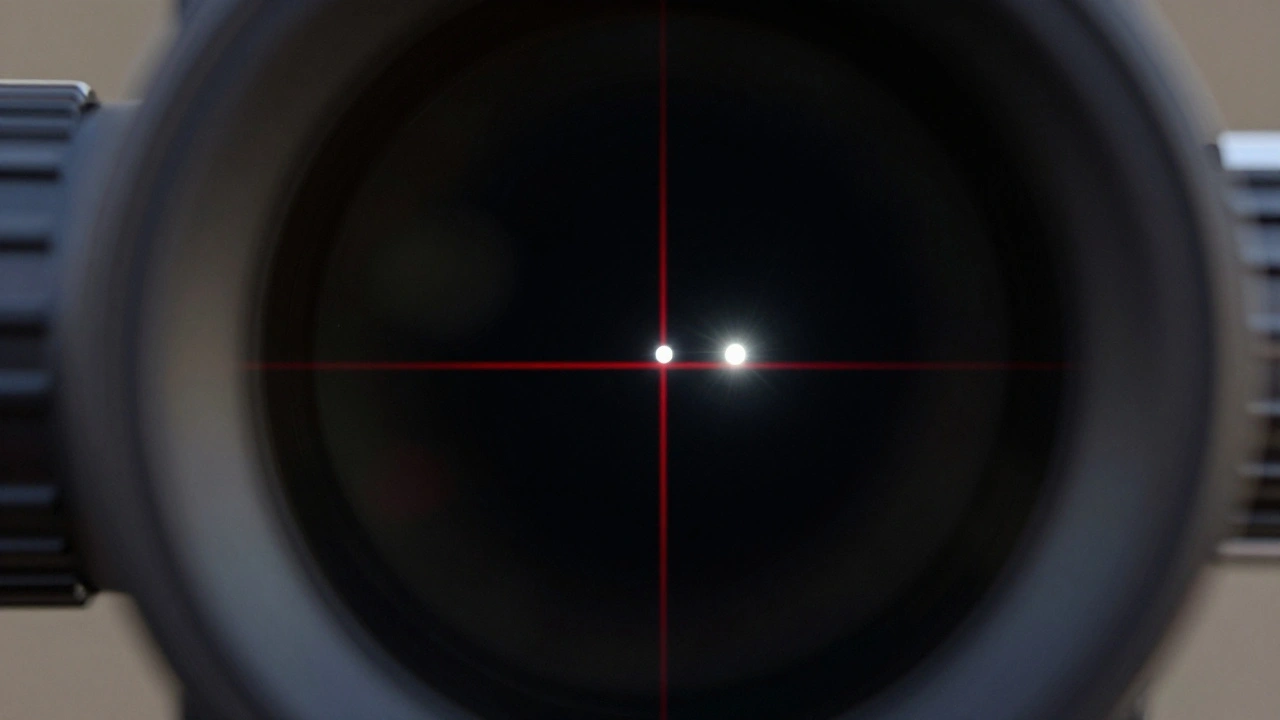
- The Eyepiece: You need a reticle-a fine line or crosshair etched onto the glass. If you lack a dedicated micrometer eyepiece, a simple straight-line reticle lets you align the stars perpendicular to the drift path.
- The Stopwatch: Human reflexes vary. While a smartphone timer works, you should practice starting and stopping the same way to minimize human error.
If you plan on doing serious work, calibrate your reticle first. Check that the line you're aiming for is truly parallel to the Right Ascension axis. If your line is tilted, the math gets messy, and you introduce errors based on Declination offsets. Most modern reticles come aligned, but checking it visually by slewing north-south helps ensure precision.
Executing the Observation Step-by-Step
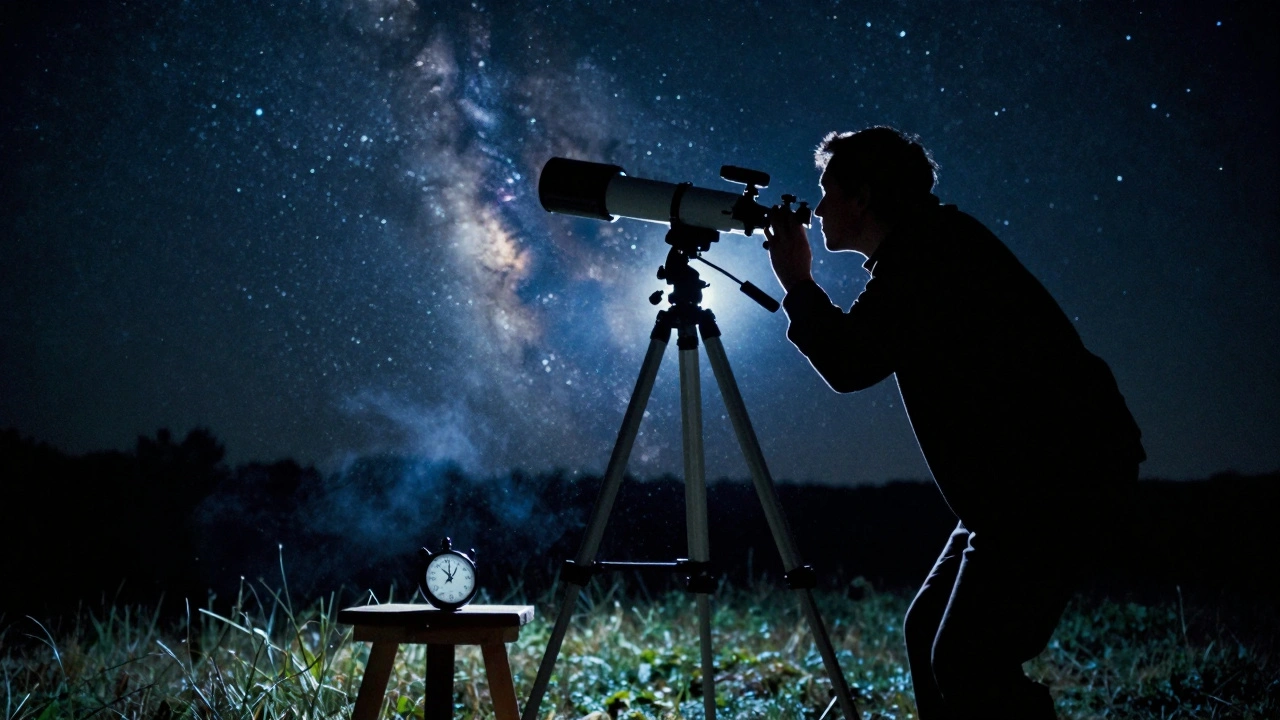
The procedure sounds mechanical, but it requires patience. You cannot rush the timing. Here is how you set it up effectively without needing complex software.
- Select Your Target: Choose a double star where the separation is measurable. Systems with separations under 1 arcsecond drift too fast to time manually. Pairs separated by 20 to 60 arcseconds are ideal for handheld timing.
- Align the Line: Center the primary star. Rotate your eyepiece until the stars drift along your reticle line. If they move diagonally across the crosshair, you have an angle error. Adjust the orientation until the motion is perfectly linear along the line.
- Start the Timer: Wait for the first star (usually the brighter one) to cross the exact center of your reticle. Press start the moment its center hits the intersection.
- Stop the Timer: Keep watching. When the second star crosses that same intersection point, press stop immediately.
- Record the Data: Note the elapsed time in seconds. Repeat the process three times to average out reaction lag.
This method shines when dealing with wide binaries that standard fixed eyepieces struggle to gauge. For very tight doubles, the drift might happen in less than a blink, requiring you to switch to high power or accept a lower resolution estimate.
| Sky Region | Approximate Drift Rate | Best Used For |
|---|---|---|
| Celestial Equator | 15.04 arcseconds/sec | Fast-moving targets, high accuracy |
| Polar Regions (Pole Star) | Nearly Stationary | Not suitable for this method |
| Mid-Declination | Variable (Requires calculation) | Common constellations |
The Math Behind the Numbers
Once you have your time, you convert it to arcseconds. The raw formula involves the cosine of the Declination (Dec). If the stars are near the celestial equator (Dec = 0), the math is trivial: 1 second of time equals roughly 15 arcseconds of space. But move up toward Polaris, and that rate slows significantly.
To get the true separation, multiply your time (in seconds) by 15.04, then multiply that result by the cosine of the star's Declination. For example, if you measured 4.0 seconds between two stars located at 60 degrees North, the calculation changes.
- Raw Time: 4 seconds
- Equatorial Factor: 15.04 x 4 = 60.16 arcseconds
- Declination Correction: Cosine(60°) is 0.5
- Final Result: 60.16 x 0.5 ≈ 30 arcseconds
Don't worry about carrying a pocket calculator everywhere. There are mobile apps designed to give you the correction factor instantly. Input the target name, and the app outputs the multiplier. This makes the process feel less like homework and more like casual discovery.
Managing Common Sources of Error
No observation is perfect. Even seasoned observers face hurdles when trying to get that decimal point right. The biggest enemy here is "Seeing." Turbulence in the air causes the star image to dance. If the star is dancing wildly, your trigger finger reacts to the jitter, not the crossing event.
To mitigate this, wait for moments of calm air. Don't force a measurement during bad transparency. Also, be aware of your own reaction time. Studies suggest average human reaction latency is about 200 milliseconds. By averaging multiple trials-taking three or four runs-you cancel out individual delays. If the numbers scatter widely, discard the whole set and try later.
Another subtle issue involves the optical axis. If your telescope is not perfectly aligned with the pole (for equatorial mounts), the drift path won't look straight. A diagonal tube can also cause a slight tilt in the field view. Checking the reticle alignment before you start observing ensures the geometric calculations hold up against reality.
Why Manual Drift Still Matters
In an age where digital imaging solves almost everything, manual drift offers something cameras can't: direct understanding of the mechanics. It connects you to the rotation of the Earth in a visceral way. Furthermore, catalogs like the Washington Double Star Catalog get updated slowly. Finding discrepancies in known separations using your own eyes contributes to citizen science databases.
Some observers prefer drift because it doesn't require expensive add-on hardware. You don't need a specialized filar micrometer costing hundreds of dollars. You just need a stable platform, a clear night, and the willingness to sit still for five minutes.
Does the drift method work for all constellations?
It works best for targets away from the celestial poles. Near the North or South Celestial Pole, stars circle around rather than drift linearly across the eyepiece, making linear timing inaccurate for separation. Focus on mid-declination objects for the cleanest results.
What is the minimum separation I can measure?
You generally need at least 1 to 2 arcseconds. Anything tighter happens too fast to time reliably without video recording and frame analysis. Human reflexes usually limit resolution above 1 arcsecond.
Do I need an equatorial mount?
No, an alt-azimuth mount works perfectly. In fact, letting the drive run idle allows natural drift which is what you need. An EQ mount must be powered off so the stars drift at the sidereal rate.
Can I measure position angles with this?
Yes, roughly. By noting the direction of the drift vector relative to the eyepiece markings, you can estimate position angle, though measuring pure separation is significantly more accurate than deriving angles.
How do I account for the eye's reaction delay?
Consistency is key. Practice pressing the button on the same mental cue. Averaging multiple readings smooths out the biological variability. Recording the exact time stamps helps verify outliers.