17 Aug 2026
- 0 Comments
There is a specific frustration that hits every amateur astronomer who owns a Newtonian reflector is a type of telescope that uses a concave primary mirror and a flat secondary mirror to direct light to an eyepiece. You align the mirrors perfectly using a laser or Cheshire tool, but the view still looks slightly soft off-center. The culprit is rarely the primary mirror; it is almost always the secondary mirror sitting off-axis in its holder.
Misplaced holders are a common issue because the factory default position often assumes a standard focal length that doesn't match your specific tube length. If the secondary mirror isn't centered on the optical axis, you lose field of view, introduce coma, and make true collimation impossible. This guide walks you through how to diagnose the problem and physically re-center the secondary without needing expensive specialized tools.
Why Centering Matters More Than Collimation
Many people confuse collimation with centering. Collimation aligns the optical surfaces to be parallel to the optical axis. Centering places the physical mirror onto that axis. Think of it like aiming a rifle: if the scope is mounted crooked on the rail (off-center), adjusting the turrets (collimation) won't fix the fundamental misalignment. The bullet will still fly where the scope points, not where the barrel points.
In a Newtonian telescope is an optical system consisting of a primary mirror at the back and a secondary mirror near the front., the optical axis is the imaginary line running down the exact center of the telescope tube from the primary mirror to the open end. If the secondary mirror is shifted even by a millimeter, the light path bends slightly. This causes asymmetrical aberrations that no amount of fine-tuning the primary mirror knobs can fully correct.
Diagnosing a Misplaced Secondary
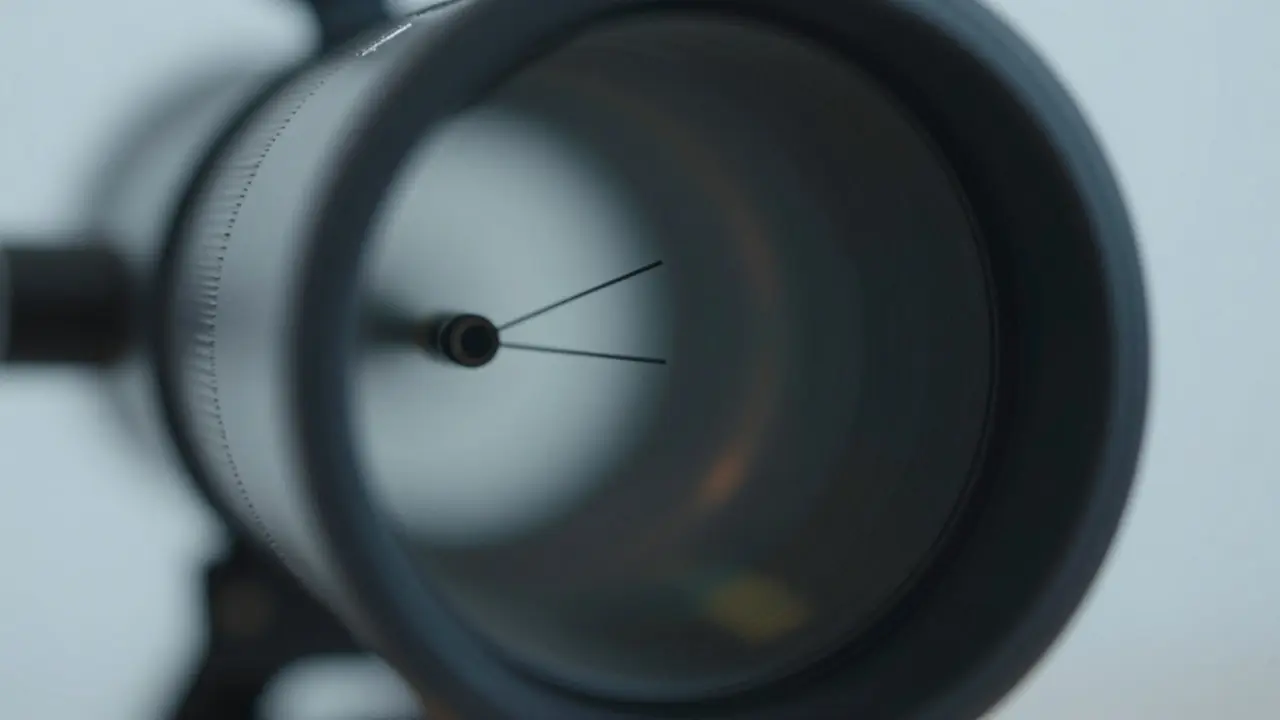
Before touching any screws, you need to confirm the secondary is actually off-center. A quick visual check involves looking down the tube from the focuser end. Remove the eyepiece and look straight in. The secondary mirror should appear as a perfect circle centered within the circular opening of the tube. If it looks like an oval or sits clearly toward one edge, it needs re-centering.
A more precise method uses a Cheshire eyepiece or a laser collimator. When properly centered, the reflection of the secondary's edge should touch the inside of the spider vane uniformly on all sides. If there is a gap on one side and overlap on the other, the mirror is displaced. Note that some telescopes use elliptical secondaries for faster f-ratios; these must still be centered, though the shape itself is not round.
The Tools You Need for Adjustment
You do not need a $100 specialized centering tool to start. Most adjustments can be made with basic hand tools. However, having the right equipment makes the process significantly less frustrating.
- Phillips screwdriver: For adjusting the three set screws on most secondary holders.
- Flathead screwdriver: Some older or budget models use slotted screws.
- Cheshire eyepiece: Provides a crosshair reference for checking centering accuracy.
- Laser collimator: Offers a bright, visible beam to check alignment quickly.
- Masking tape: Useful for marking the current position before making changes.
If you have a telescope tube is the cylindrical housing that holds the optical components in a fixed relationship., ensure it is clean. Dust on the glass can obscure your view of the mirror edges, leading to inaccurate judgments.
Step-by-Step: Adjusting the Holder Screws
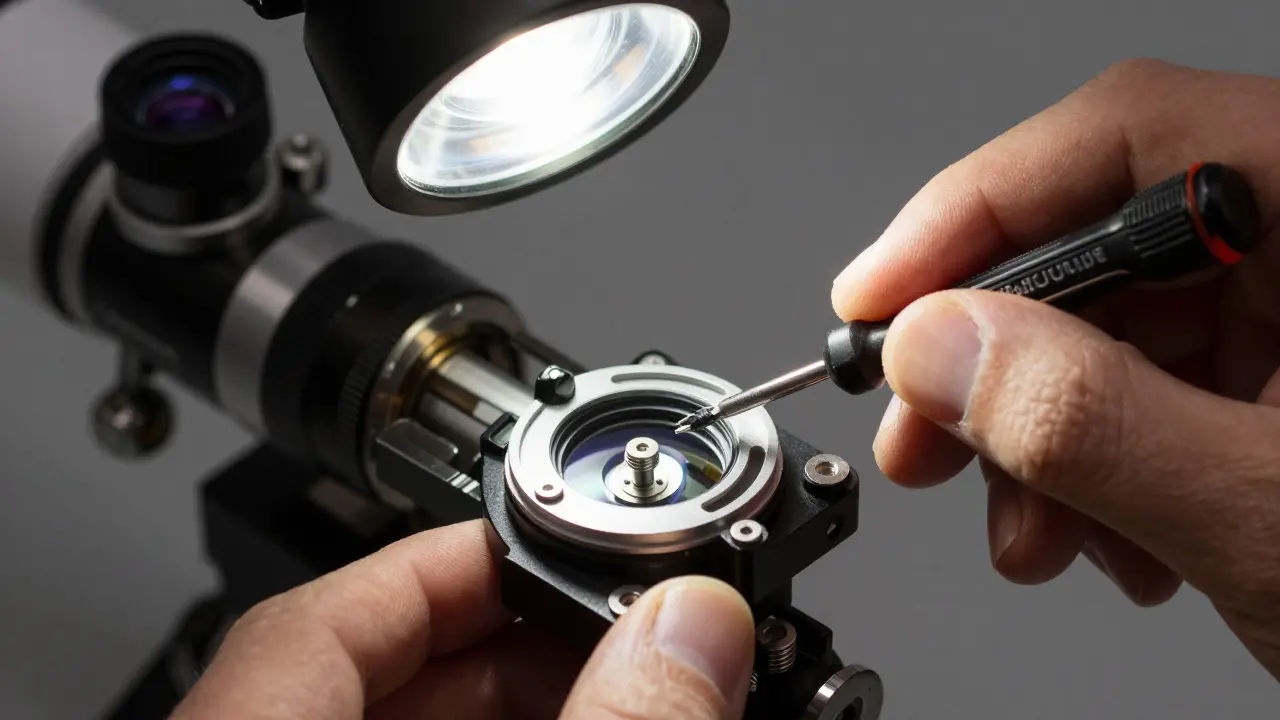
Most modern secondary mirror holders are mechanisms designed to hold the secondary mirror at a 45-degree angle while allowing for positional adjustments. typically feature three small set screws arranged in a triangle. These screws push against the back of the mirror cell. By loosening one and tightening another, you shift the mirror's position relative to the tube wall.
- Loosen the lock ring: Many holders have a central locking mechanism or a ring that secures the assembly to the spider vanes. Loosen this just enough so the holder can move freely but does not fall out.
- Identify the direction of error: Look through the Cheshire or laser. Determine which way the mirror is shifted. If the mirror appears too high, you need to lower it.
- Adjust the opposing screws: To move the mirror down, loosen the top screw slightly and tighten the bottom two screws evenly. Do this in small increments-quarter turns at a time.
- Check frequently: After each small adjustment, look through the tool again. Over-adjusting is the most common mistake. It takes twice as long to undo an over-correction.
- Tighten securely: Once the mirror is centered, tighten the lock ring or main securing screw firmly. Then, re-check the centering, as tightening can sometimes shift the mirror slightly.
Remember, you are moving the entire mirror assembly, not just tilting it. Tilting is part of collimation; moving is centering. If you find yourself constantly fighting between tilt and position, your holder may be worn or damaged.
Common Pitfalls and How to Avoid Them
One major trap is assuming the tube is perfectly straight. In reality, gravity and manufacturing tolerances mean tubes bow slightly. This is why we talk about the "effective" optical axis. When centering, aim for the geometric center of the tube opening, not necessarily the theoretical center of the primary mirror if the tube is warped.
Another issue is overtightening the set screws. These are usually small and delicate. If you strip a thread, you may need to replace the entire holder. Use gentle pressure and consider applying a tiny drop of blue threadlocker if the screws tend to vibrate loose during transport.
Finally, don't forget the spider vanes. If the vanes holding the secondary are bent or unevenly spaced, they will pull the mirror off-center regardless of how well you adjust the screws. Inspect the vanes for damage before blaming the holder.

When to Replace the Holder
Sometimes, adjustment isn't enough. If the holder has been used for many years, the plastic or metal parts may wear down, creating play. If you find that the mirror shifts after a night of observing, or if the screws no longer grip firmly, it is time to consider a replacement. Aftermarket holders are widely available and often offer better materials and precision than the original equipment manufacturer's parts. A quality replacement can restore the performance of an aging telescope significantly.
Frequently Asked Questions
Does every Newtonian telescope need secondary centering?
Yes, technically every Newtonian requires the secondary to be centered on the optical axis for optimal performance. However, minor offsets in fast f-ratio scopes are less noticeable than in slow, long-tube instruments. Still, proper centering ensures maximum field of view and symmetry.
What is the difference between centering and collimating?
Centering moves the physical location of the secondary mirror along the tube's axis. Collimation adjusts the angle of the mirrors so their reflective surfaces are perpendicular to the optical path. You must center first, then collimate.
Can I use a laser collimator to center the secondary?
Yes, but with caution. A laser shows you where the beam hits, which helps identify offset. However, lasers can be misleading if the focuser is not perfectly aligned with the tube. A Cheshire eyepiece is generally considered more accurate for initial centering checks.
How much does a few millimeters of offset matter?
In a fast f/4 or f/5 scope, even 1-2mm of offset can cause noticeable vignetting and asymmetric star shapes. In slower f/8 or f/10 scopes, small offsets are less critical but still reduce overall image quality and usable field size.
Should I re-center after changing the eyepiece?
No, changing eyepieces does not affect the position of the secondary mirror. However, if you change the focuser or drawtube, you may need to re-collimate, but the secondary centering remains unchanged unless you physically moved the holder.