4 Sep 2026
- 0 Comments
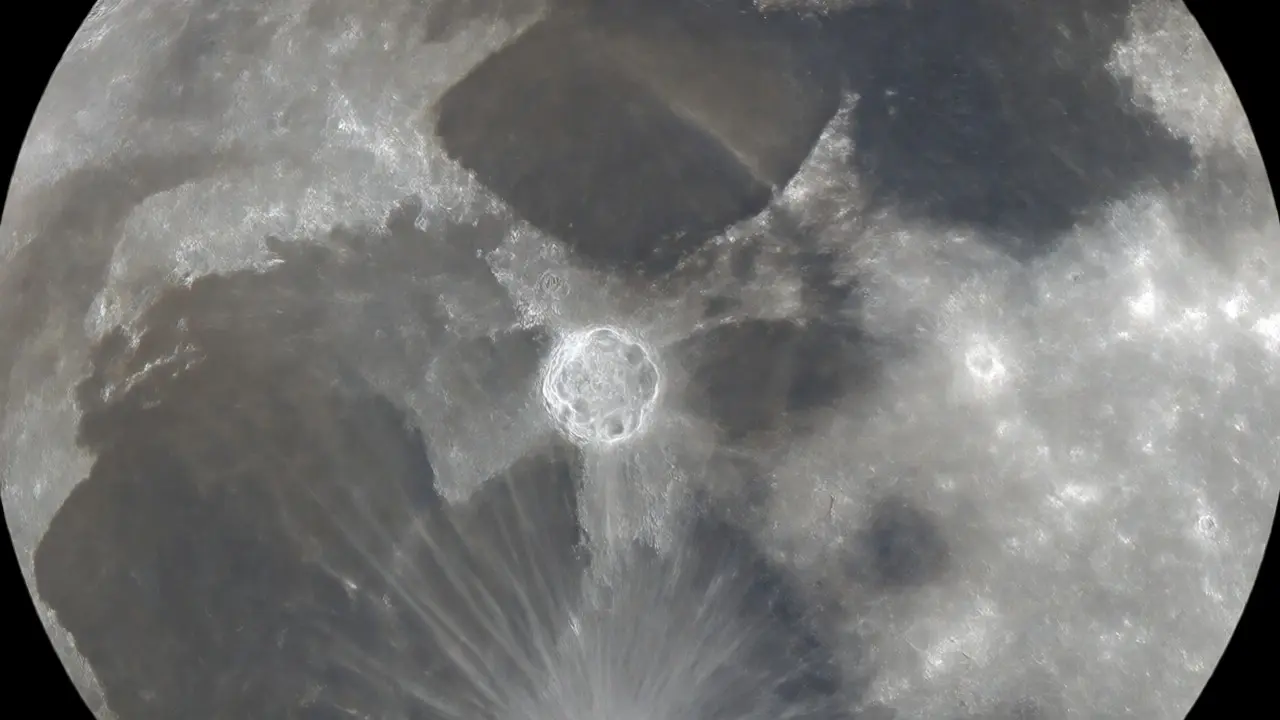
You know that feeling when you look through your telescope at the Moon and see something that looks like a starburst? It’s not a glitch in your optics or a smudge on your lens. You’re looking at lunar rays, which are bright streaks of material ejected during high-energy meteorite impacts. These aren’t just pretty patterns; they are geological timestamps that tell us exactly how young a crater is. If you’ve ever wondered why some craters glow white against the gray regolith while others fade into obscurity, you’re asking the right question.
Most amateur astronomers start by hunting for big, obvious features like the Sea of Tranquility. But once you master those, the real game changes. You start chasing freshness. Lunar rays are the ultimate indicator of recent cosmic violence. They don’t last forever-space weather erases them over hundreds of millions of years. So, if you see them, you’re witnessing geology in its infancy. Let’s break down what they are, where to find them, and how to spot them without losing your mind trying to focus your eyepiece.
What Exactly Are Lunar Rays?
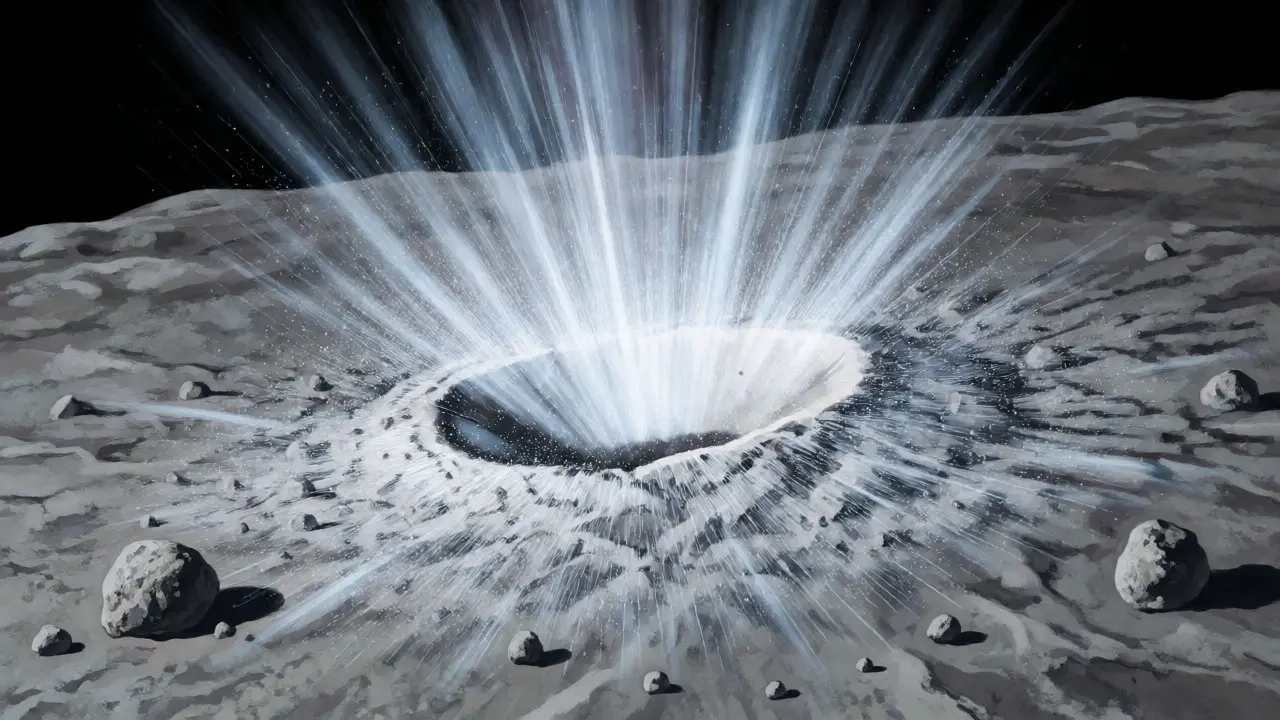
Think of a lunar ray as the debris field from a massive explosion. When a rock hits the Moon at tens of thousands of miles per hour, it doesn’t just make a hole. It blasts material outward in every direction. This ejecta lands in long, linear streaks radiating away from the impact site. Unlike the dark, iron-rich basalt that makes up the lunar maria (the "seas"), this fresh ejecta is rich in anorthosite-a light-colored plagioclase feldspar mineral. That’s why it reflects so much sunlight. The contrast between the bright rays and the darker, older surface creates that striking visual effect.
Here’s the kicker: these rays are fragile. Micrometeorites constantly pummel the lunar surface, grinding everything down into fine dust. Solar wind also bombards the surface, causing space weathering that darkens exposed minerals over time. This process, called agglutination, turns bright glassy beads into dark, fused grains. Because of this, lunar rays have a short shelf life. In astronomical terms, they’re ephemeral. A crater with well-defined rays is likely less than a few hundred million years old. Compare that to the Moon’s 4.5-billion-year history, and you realize you’re seeing a blink-of-an-eye event preserved in stone.
The Big Three: Where to Look First
If you want to practice spotting rays, don’t start with obscure craters. Start with the heavy hitters. There are three primary sources of prominent lunar rays visible from Earth, and they dominate the southern hemisphere of the Moon. Master these, and you’ll understand the physics of impact ejecta better than most textbooks can teach you.
| Crater Name | Diameter | Age Estimate | Best Viewing Time |
|---|---|---|---|
| Tycho | 85 km | 108 million years | Full Moon |
| Copernicus | 93 km | 800 million years | Waxing Gibbous |
| Kepler | 32 km | ~1 billion years | First Quarter |
Tycho is the king of rays. Located near the center of the Moon’s southern face, it shoots out streaks that span nearly half the lunar disk. During a full moon, Tycho is impossible to miss because the sun is directly overhead, washing out shadows but highlighting albedo differences. The rays appear as brilliant white lines cutting across darker terrain. If you can only remember one target, make it Tycho.
Copernicus offers a different experience. While its rays are fainter than Tycho’s, they extend significantly northward. Copernicus is often easier to observe during partial phases because the low-angle sunlight reveals its complex terraced walls and central peaks. However, if you wait until the Moon is nearly full, you can trace its ray system stretching toward the Mare Imbrium. It’s a great exercise in contrast management-adjusting your eyes to see subtle brightness variations rather than stark shadows.
Kepler is smaller but surprisingly bright. Situated between Copernicus and Aristarchus, Kepler has a compact but intense ray system. Because it’s younger than Copernicus but older than Tycho, it serves as a perfect middle ground for study. Its rays are shorter, typically extending only a few crater diameters, but they are crisp and well-defined. Use Kepler to train your eye to distinguish between true rays and secondary crater chains.
Why Full Moons Are Actually Better for Ray Hunting
This might sound counterintuitive. Every astronomy guide tells you to avoid the full moon because the lack of shadows flattens the landscape. And they’re right-if you’re looking for mountain ranges or crater rims, the full moon is terrible. But for lunar rays? It’s prime time.
Rays are defined by their reflectivity, not their topography. They are flat deposits of bright material sitting on top of darker soil. To see them, you need maximum illumination. At first quarter, the terminator (the line dividing day and night) casts long shadows that reveal height, but it also creates harsh contrasts that can wash out subtle albedo differences. When the sun is high overhead, those shadows disappear, leaving you with a map of brightness. This is when the white rays pop against the gray background.
So, here’s your strategy: use the waxing gibbous phase to study structure and depth. Then, switch to the full moon specifically to hunt for ray systems. Bring a neutral density filter if the glare hurts your eyes, but don’t let the brightness scare you off. It’s the best time to see the aftermath of ancient collisions.
How to Distinguish Rays from Other Features
New observers often confuse lunar rays with other linear features. You might mistake a rille (a channel formed by lava flow) or a fault scarp for a ray. Here’s how to tell them apart:
- Origin Point: Rays always radiate from a specific impact crater. If you trace the lines backward, they should converge on a bowl-shaped depression. Rilles meander independently of craters.
- Texture: Rays are diffuse and fuzzy at the edges. They blend gradually into the surrounding terrain. Fault scarps have sharp, defined edges because they are physical cliffs.
- Color/Brightness: Rays are brighter than the surrounding area. Lava flows (maria) are darker. If the feature is darker than the surroundings, it’s probably not a ray.
- Continuity: Rays can be broken by newer craters or mountains. They don’t follow geological boundaries like faults do. They ignore terrain, draping over hills and filling valleys.
Another common trap is mistaking secondary craters for rays. Secondary craters form when large chunks of ejecta land and create their own small pits. These often align in chains that point back to the primary crater. While related, they aren’t rays themselves. Rays are the fine-grained spray; secondary craters are the boulders. Look for the continuous bright streaks between the dots to confirm you’re seeing a true ray system.
Observation Tips for Clear Views
Seeing lunar rays requires more than just pointing your scope at the Moon. Atmospheric conditions play a huge role. Since rays are low-contrast features, turbulence can blur them out completely. Here’s how to optimize your setup:
- Wait for High Altitude: Observe when the Moon is highest in the sky. Less atmosphere means less distortion. In Portland, Oregon, this usually happens around midnight during winter months.
- Use Moderate Magnification: Don’t crank up the power. High magnification amplifies atmospheric shimmer and narrows your field of view, making it hard to see the full ray pattern. Stick to 50x-100x to see the context.
- Try a Blue Filter: Surprisingly, a blue filter can enhance the visibility of certain lunar features by reducing red-light scattering. Some observers report that blue filters make the bright ejecta stand out more crisply against the yellowish-gray regolith.
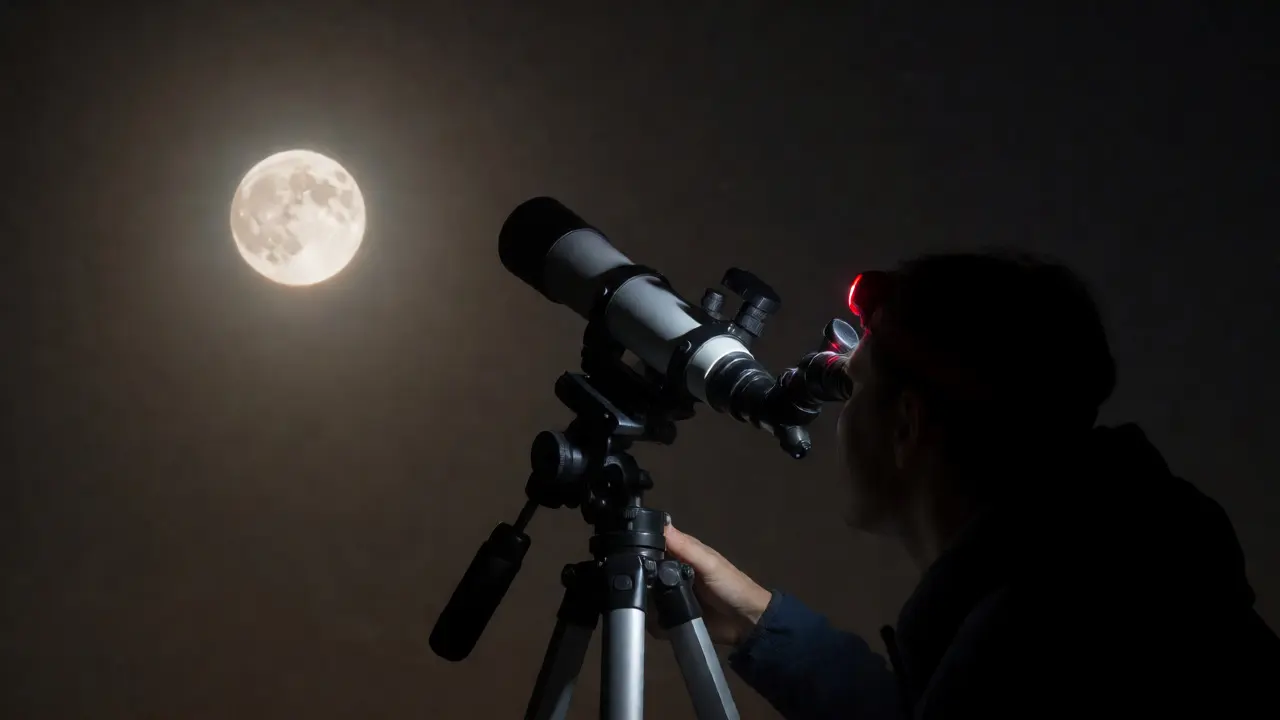
- Dark Adaptation: Give your eyes 20 minutes to adjust. Even though the Moon is bright, your pupils need to dilate to pick up subtle brightness gradients. Avoid using white lights nearby; use red LEDs instead.
If you’re using binoculars, you can still catch Tycho’s main rays. They’re broad enough to be seen without optical aid under good skies. But for the finer details of Copernicus or Kepler, a small telescope (60mm-80mm aperture) is sufficient. You don’t need a giant Dobsonian to appreciate these structures.
The Science Behind the Shine
Why does this matter beyond pretty pictures? Lunar rays help scientists date surfaces. By counting the number of superimposed craters on a rayed surface, researchers estimate its age. Fewer craters mean a younger surface. This method helped establish the Lunar Stratigraphy, allowing us to build a timeline of bombardment events.
Furthermore, analyzing the composition of ray material tells us about the subsurface geology. The ejecta comes from deep beneath the surface, sometimes kilometers down. By studying the mineral content of rays via spectroscopy, we learn what lies below the regolith without digging. For example, Tycho’s rays contain materials from the upper crust, providing clues about the Moon’s differentiation history. When you look at those bright streaks, you’re essentially reading a core sample taken from the Moon’s interior.
It’s worth noting that not all bright features are rays. Some are frost-like deposits of water ice in permanently shadowed craters, but those are found near the poles and don’t radiate. Others are volcanic ash deposits, which tend to be darker and more localized. True impact rays are unique in their radial symmetry and extreme brightness relative to their surroundings.
Frequently Asked Questions
Can I see lunar rays with naked eyes?
Yes, but barely. Under excellent viewing conditions, the brightest rays from Tycho can sometimes be detected as a vague brightening around the crater. However, you really need binoculars or a telescope to resolve the distinct streaks clearly. Naked-eye observation is mostly limited to seeing the bright spot of the crater itself, not the extended ray system.
Why do lunar rays disappear over time?
Space weathering is the main culprit. Constant micrometeorite impacts grind the bright, glassy ejecta into fine, dark dust. Additionally, solar wind implantation alters the chemical structure of the minerals, darkening them. Over hundreds of millions of years, the contrast between the rays and the surrounding terrain fades until the rays become indistinguishable from the background regolith.
Are there any new craters with rays forming right now?
No, not visibly. Impacts happen frequently, but most are too small to create significant ray systems visible from Earth. The Lunar Reconnaissance Orbiter (LRO) detects fresh impacts regularly, creating temporary bright spots called "fresh craters," but these are microscopic compared to Tycho. We haven't had a major, ray-producing impact since the formation of Giordano Bruno, which was observed by amateurs in 2013, but its rays are very faint.
Do lunar rays exist on other planets?
Yes, but they look different due to atmospheres. On Mars, winds quickly erase ray systems, so they are rare and short-lived. On Mercury, which has no atmosphere, rays persist longer but are harder to see due to the planet's proximity to the Sun and observational challenges. The Moon is ideal for ray preservation because it lacks both an atmosphere (which would blow away ejecta) and active tectonics (which would bury them).
Which filter helps most with lunar ray observation?
While no filter is mandatory, a neutral density (ND) filter reduces glare without altering color balance, making it easier to see subtle brightness differences. Some observers prefer a blue filter to enhance contrast in the blue spectrum, where the difference between bright anorthosite and dark basalt can be more pronounced. Experiment with both to see which works best for your eyes and equipment.