12 Apr 2026
- 0 Comments
You see a sudden streak of light rip across the night sky. It happens in a heartbeat-gone before you can even reach for a camera. For many, the instinct is to try and snap a photo, but by the time the app opens, the moment is dead. The real secret to capturing a meteor's story isn't in a digital sensor; it's in a notebook. Hand-sketching is the fastest way to log the trajectory, the intensity, and the origin of a shooting star, turning a fleeting glimpse into a piece of scientific data.
Key Takeaways for Meteor Logging
- The Radiant: The specific point in the sky where meteors appear to originate.
- Trajectory: The path and angle the meteor takes across the celestial sphere.
- Brightness: Estimating magnitude by comparing the streak to known stars.
- Timing: Using a stopwatch or clock to mark exact arrival times.
The Art of the Quick Sketch
When a meteor flashes, you don't have time for a masterpiece. You need a system that allows you to dump visual information onto paper in seconds. Meteor sketching is the process of manually documenting the visual characteristics of a meteor, including its path, duration, and brightness. It’s less about art and more about spatial memory.
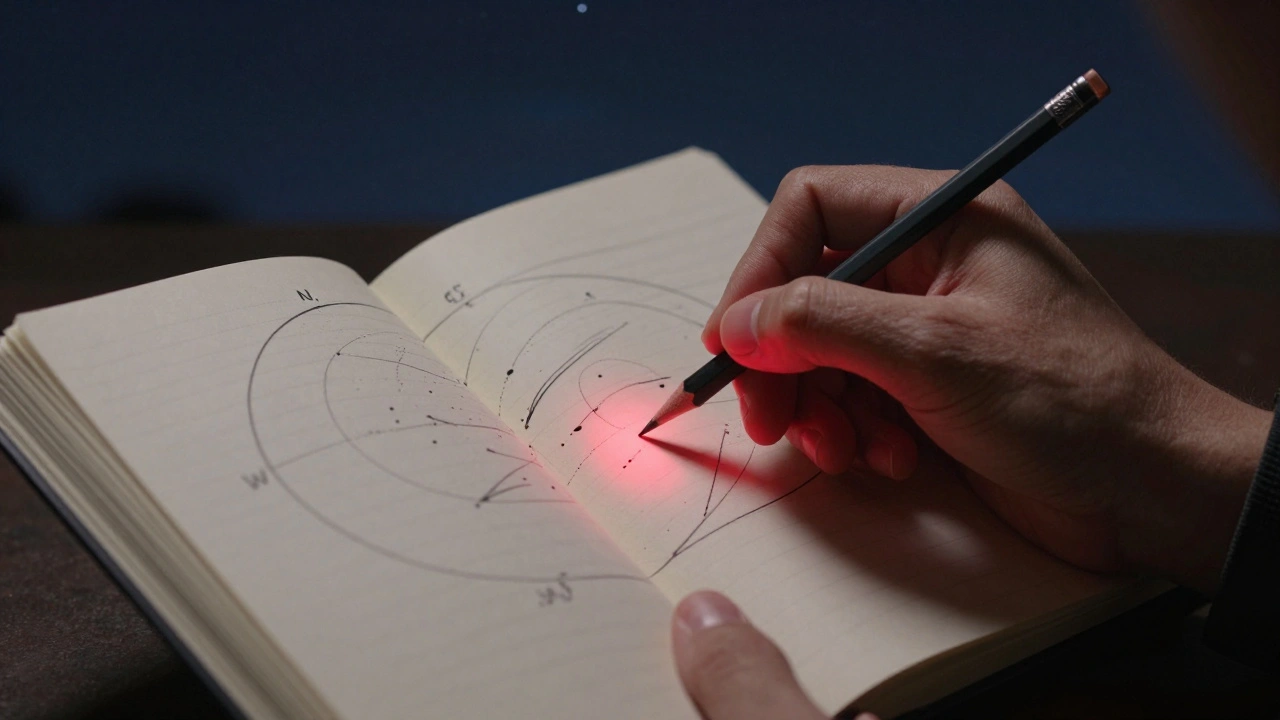
Start with a "sky map"-a simple circular sketch of your horizon. Mark your north, south, east, and west. Note where the moon is, as it often obscures the view. When a meteor appears, don't try to draw a perfect line immediately. Instead, place two dots: one where the meteor started and one where it vanished. Connecting these dots later allows you to maintain a steady rhythm of observation without missing the next streak.
Why do this by hand? Because a sketch forces your brain to analyze the meteor shower event. You're not just watching; you're measuring. You'll start to notice patterns, like how some meteors are slow and graceful while others are sudden, violent bursts of light.
Finding and Mapping the Radiant Point
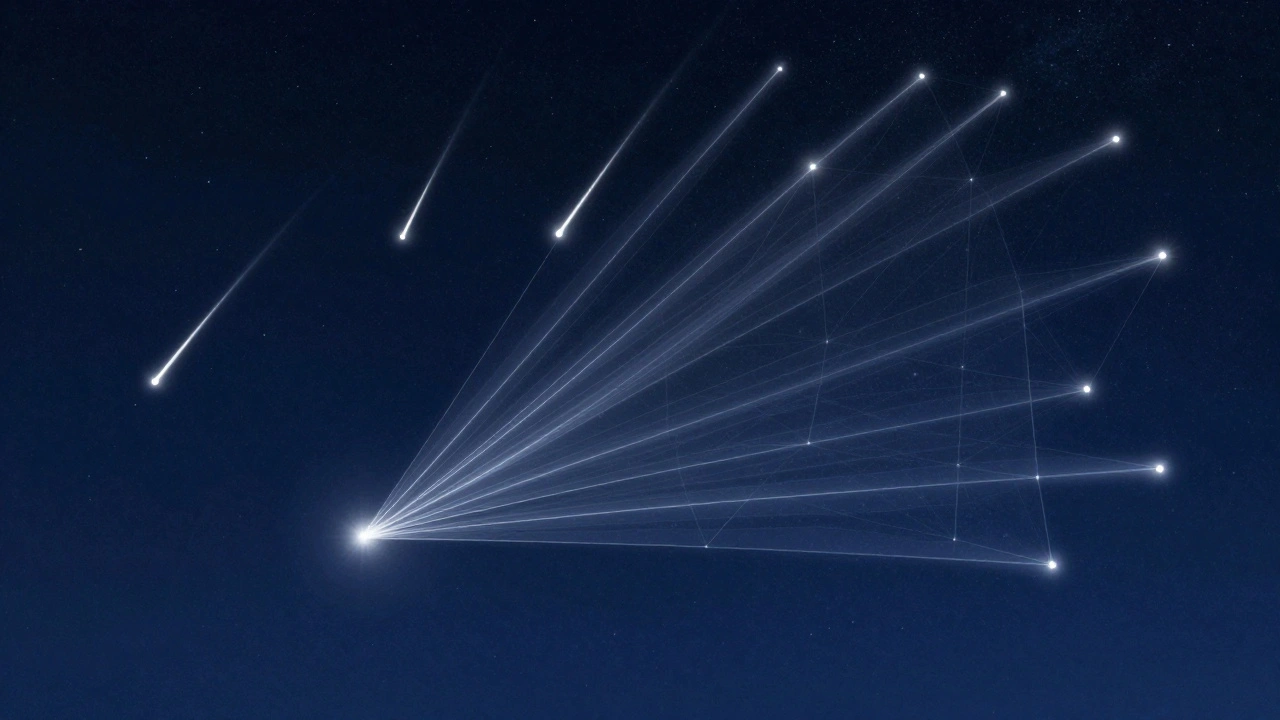
If you're watching a known event, like the Perseids or the Geminids, you're dealing with a stream of debris from a comet or asteroid. These particles all enter the atmosphere at the same angle, making it look like they are all flying away from one single spot in the sky. This is the Radiant, which is the point of origin from which meteors in a shower appear to emanate.
To find the radiant by hand, sketch three or four different meteor paths. Use a ruler to extend those lines backward. The point where these lines intersect is your radiant. If you're sketching during the August peaks, you'll find the Perseid radiant in the constellation Perseus. Mapping this point is crucial because it tells you if you're seeing a "shower meteor" or a "sporadic"-a lone wanderer that isn't part of any organized group.
| Feature | Shower Meteors | Sporadic Meteors |
|---|---|---|
| Origin | Trace back to a single radiant | Random directions |
| Predictability | High (peak dates known) | Low (anytime) |
| Common Paths | Parallel trajectories | Diverse angles |
| Velocity | Consistent for the shower | Highly variable |
Estimating Brightness and Magnitude
Brightness is the trickiest part of a manual log. In astronomy, we use the magnitude scale, where a lower number means a brighter object. But you can't just guess a number. You need a reference. This is where your knowledge of Apparent Magnitude comes in-the brightness of a star as seen from Earth.
Before you start, identify the brightest stars in your field of view. For example, if Vega is visible, you know it's roughly magnitude 0. If the meteor is brighter than Vega, it's a "fireball." If it's dimmer than the faintest star you can see, it's a low-magnitude streak. In your notes, use a simple code: "B+" for brighter than the brightest star, "B-" for dimmer than the average visible star.
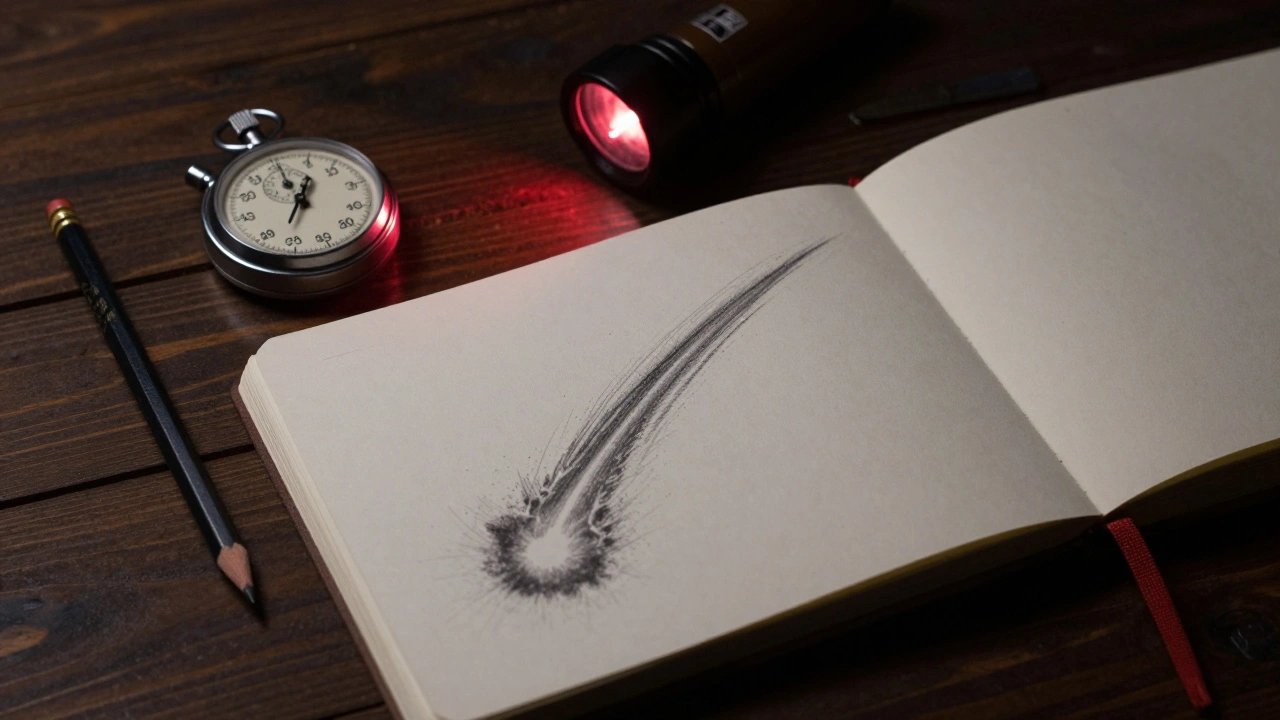
Watch for the "train." Some bright meteors leave a glowing trail of ionized gas that lingers for seconds. Sketch this as a fading smudge. The length and persistence of the train often correlate with the speed and mass of the particle hitting the Atmosphere, providing a clue about whether the object was a grain of sand or a small pebble.
Essential Gear for the Field
You don't need a telescope for this-in fact, a telescope is your enemy because it narrows your field of view. You need a wide-angle perspective. A red-light flashlight is mandatory. White light will destroy your night vision, which takes about 20 minutes to fully develop. If you use a white phone screen to check the time, you'll be blind to the fainter meteors for the next ten minutes.
For your sketchbook, use a hard-bound journal with a dark background or heavy cardstock. A graphite pencil is better than a pen because it reflects less light and allows for quick shading of the radiant area. Keep a stopwatch in your hand. The moment a meteor disappears, hit the lap button. The duration of the streak-whether it lasted 0.5 seconds or 3 seconds-is a vital piece of data for calculating the entry angle.
Common Pitfalls and How to Avoid Them
The biggest mistake beginners make is trying to be too precise in the moment. If you spend two minutes carefully drawing a line, you'll miss the next three meteors. Remember: dots first, lines later. Another common error is confusing satellites with meteors. Satellites move steadily and slowly; they don't have a "head" and a "tail," and they certainly don't vanish in a flash of light. If the object takes more than ten seconds to cross the sky, it's likely a satellite or a high-altitude aircraft.
Also, watch out for "parallax error." If you are sketching with a partner, you might see the meteor in slightly different positions relative to the stars. This is normal. It's actually a tool used by professional observatories to triangulate the exact altitude of the meteor. If you're working alone, just pick a fixed point on the horizon-like a specific tree or a building-to anchor your sketch.
Turning Sketches into Data
Once you're back inside, your rough sketches can be converted into a more formal log. You can use a star map app to identify the exact coordinates of your radiant. By recording the time, the duration, and the estimated magnitude, you can contribute to citizen science projects. Many astronomical societies value hand-logged data because it captures the "human feel" of the event-details like the color of the streak (green for nickel, yellow for sodium) that cameras sometimes distort.
Think of your sketchbook as a map of the solar system's debris. Every line you draw is a collision between Earth and a piece of ancient cosmic history. By mastering the art of the quick sketch, you move from being a passive observer to an active chronicler of the night sky.
Do I need a telescope to see the radiant point?
No, in fact, telescopes are not recommended for meteor watching. Meteors move rapidly across large portions of the sky, and a telescope's narrow field of view would make it nearly impossible to track them. The radiant point is found by observing the general direction from which multiple meteors appear to originate across the open sky.
What is the difference between a meteor and a fireball?
A meteor is the general streak of light caused by a space rock burning up. A fireball is a meteor that is exceptionally bright-specifically, one that reaches a magnitude of -4 or brighter, making it brighter than Venus. In your sketches, fireballs are usually marked by intense brightness and often leave long-lasting ionized trails.
How can I tell if a streak is a satellite?
Satellites move at a constant, slow speed and do not flicker or flare up. They also do not have a tapering tail. If the object takes a long time to cross the sky and doesn't suddenly disappear or explode, it's a satellite. Meteors are much faster and usually vanish quickly.
Which pencil is best for night sketching?
A soft graphite pencil (like a 2B or 4B) is ideal. It allows you to make bold marks quickly without needing to press hard, and it's easy to smudge or adjust if you're marking a general area of the sky. Avoid pens with reflective ink or bright white paper that might bounce light back into your eyes.
Can I sketch meteors during the day?
While extremely rare, "daylight fireballs" do happen. These are usually very large fragments that create a massive flash of light. If you see one, sketch the position relative to the sun and the horizon immediately, as these events are scientifically valuable for tracking larger asteroids.