23 Mar 2026
- 0 Comments
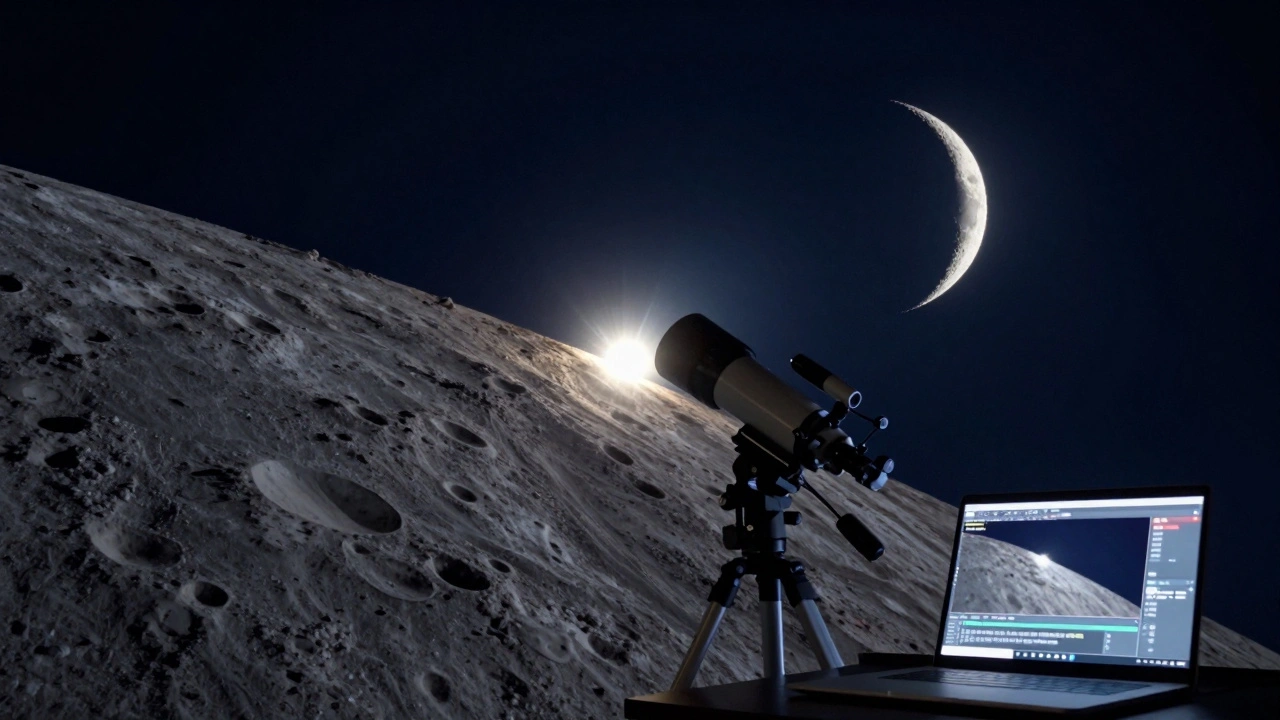
Every night, hundreds of tiny rocks from space slam into the Moon. You won’t see them with your eyes. But you can see the flashes they make - brief, bright bursts of light that last less than a second. These are lunar impact flashes, and they’re being tracked by regular people with backyard telescopes, not just NASA scientists. You don’t need a fancy observatory to help map where meteors hit the Moon. All you need is a camera, a telescope, and a clear night.
What Are Lunar Impact Flashes?
When a meteoroid - a small piece of space rock - hits the Moon’s surface at speeds over 50,000 miles per hour, it doesn’t explode like it would on Earth. There’s no air to cause a fireball. Instead, the impact turns rock and dust into superheated plasma. That plasma glows for a fraction of a second, creating a flash of light visible from Earth. These flashes are usually only a few thousandths of a magnitude brighter than the dimmest stars we can see.
Most of these impacts come from meteoroids smaller than a grain of sand. But even those tiny particles release energy equal to a small firecracker. Bigger ones, like a baseball-sized rock, can flash as brightly as a 10th-magnitude star. That’s faint, but within reach of amateur equipment.
Since the Moon has no atmosphere, no weather, and no erosion, these flashes leave behind fresh craters that stay visible for decades. Scientists use them to understand how often the Moon gets hit, which helps predict risks for future lunar bases.
How Do You See Something That Lasts Less Than a Second?
Seeing a lunar impact flash isn’t about looking harder. It’s about recording everything - and then watching the video later.
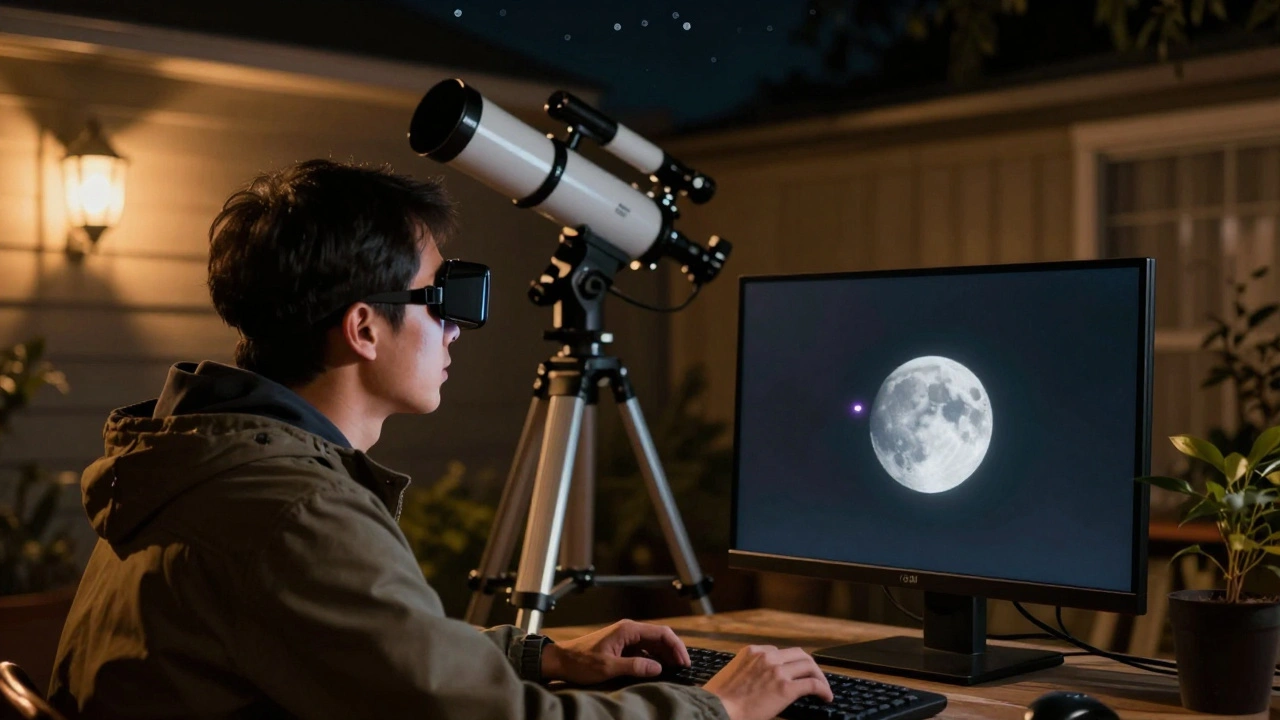
Amateur astronomers use video cameras attached to telescopes. These aren’t expensive DSLRs. Many use off-the-shelf planetary cameras like the ZWO ASI120MM or the Celestron Skyris 274. These can capture 30 to 100 frames per second. That’s fast enough to catch a flash that lasts 50 to 200 milliseconds.
You point your telescope at the Moon’s dark edge - the terminator - where sunlight is just starting to hit. That’s where impacts are easiest to spot. The contrast between the dark lunar surface and the sudden flash stands out clearly. You record for hours, usually during a lunar eclipse or when the Moon is in its crescent phase. That’s when the background sky is darkest.
After recording, you play back the video frame by frame. One frame might show nothing. The next frame? A tiny dot of light that wasn’t there before. That’s your impact.
How Citizen Scientists Are Changing Lunar Science
For decades, NASA’s Lunar Impact Monitoring Program used professional telescopes to track flashes. But the Moon is huge, and impacts happen everywhere. In 2013, NASA released its data to the public. That’s when citizen scientists jumped in.
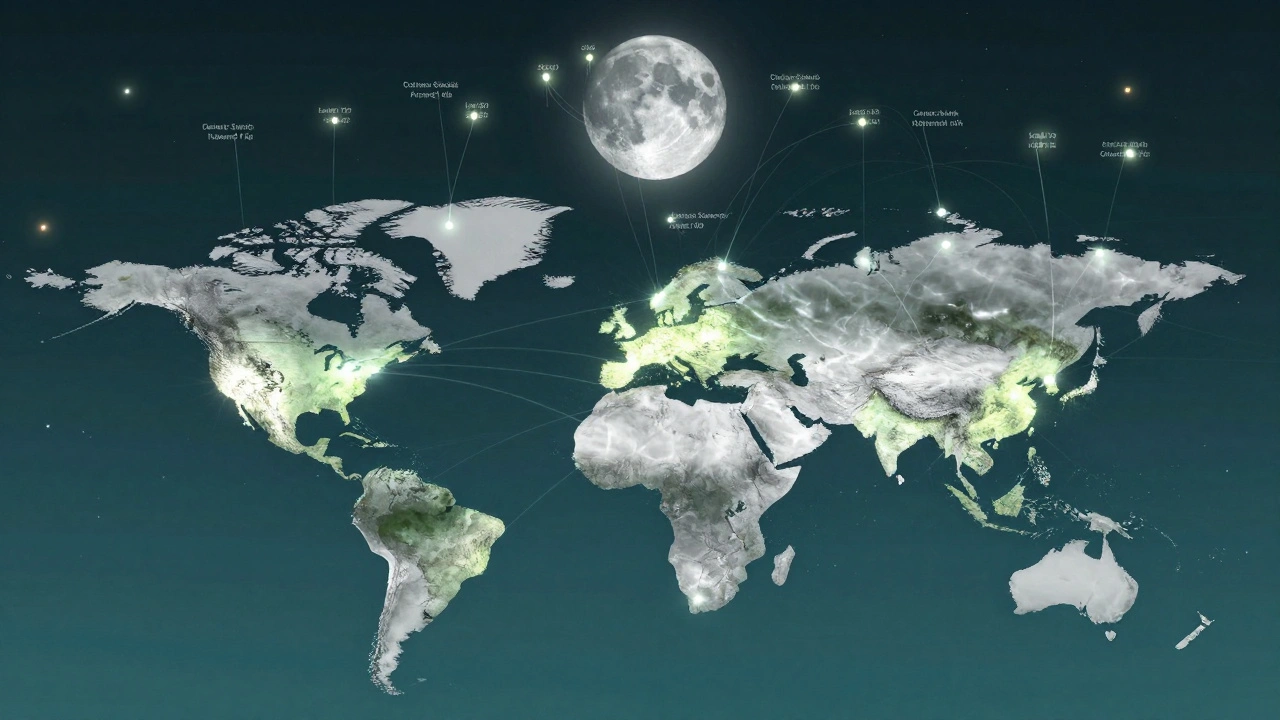
Today, networks like the International Meteor Organization and the Moonwatch Network coordinate hundreds of observers across six continents. One team in Spain recorded over 400 flashes in a single year. A high school student in Texas found a flash that matched a known meteoroid stream. A retired engineer in Australia confirmed the timing of a flash NASA’s Lunar Reconnaissance Orbiter later imaged as a brand-new 3-meter crater.
These aren’t lucky accidents. They’re systematic efforts. Volunteers follow strict protocols: calibrating their equipment, logging exact times, and submitting data to centralized databases. Some use software like LunarScan or Moonwatcher to automate frame analysis. Others manually review every video.
The result? A growing map of impact hotspots. Scientists now know that meteor showers like the Perseids and Leonids produce predictable spikes in lunar flashes. They’ve even found impacts from comets - something ground-based telescopes on Earth can’t detect.
What Gear Do You Actually Need?
You don’t need a $10,000 setup. Here’s what works for most beginners:
- Telescope: At least 6-inch aperture. Refractors or reflectors both work. A Dobsonian is fine if you can track the Moon manually.
- Camera: A monochrome planetary camera with high frame rate (50+ fps). Color cameras work but lose sensitivity.
- Software: FireCapture, SharpCap, or LunarRegio for recording. Use AutoStakkert! or RegiStax to stack frames later.
- Mount: A motorized equatorial mount helps, but a sturdy alt-azimuth with manual tracking works too.
- Computer: A laptop or Raspberry Pi to run the software and store videos.
Most setups cost under $1,500. Many people start with used gear. You can even borrow a telescope from a local astronomy club. The key isn’t the gear - it’s consistency. Record one night a week for a year, and you’ll likely catch your first flash.
Why This Matters Beyond Amateur Astronomy
Every flash you record adds data to a global database. That data helps scientists answer real questions:
- How often do meteoroids larger than 10 cm hit the Moon? (Answer: About once a week.)
- Where are the most dangerous zones for future lunar bases? (Answer: Near the poles, where more impacts cluster.)
- Are there hidden meteoroid streams we haven’t detected yet? (Answer: Yes - some flashes come from unknown sources.)
One study published in 2025 analyzed 1,800 citizen-reported flashes and found that 12% couldn’t be matched to any known meteor shower. That means we’re still discovering space debris we didn’t know existed.
For future astronauts, this isn’t academic. A meteoroid impact on the Moon can send debris flying at 1,000 mph. If you’re building a habitat or a rover, you need to know where and how often those hits happen. Citizen data helps design better shielding.
Where to Start
If you’re ready to try this:
- Join the Moonwatch Network or the International Meteor Organization.
- Watch the lunar calendar. Target crescent phases - especially just after new moon.
- Record at least 30 minutes per session. Longer is better.
- Submit your videos with timestamps and equipment details. Don’t worry if you’re wrong - experts will verify.
- Check back in a few weeks. You might be the first person to spot a new impact site.
You won’t become famous. But you’ll be part of something bigger: a global network of people watching the Moon, not just for beauty, but for science. And if you’re lucky, one night, you’ll see a flash - a tiny spark on the dark side - and know you helped map a piece of space history.
Can I see lunar impact flashes with my naked eye?
No. Lunar impact flashes are too brief and too faint to be seen without a camera. Even the brightest flashes are about 100 times dimmer than the dimmest star visible to the naked eye. You need video recording to capture the moment.
Do I need a telescope to participate?
Yes, a telescope is required. A minimum of 6-inch aperture is recommended to resolve the tiny flashes against the lunar surface. Smaller telescopes might catch the brightest events, but you’ll miss most of the data scientists need.
How often do lunar impact flashes occur?
On average, about 10 to 20 flashes are visible each night from Earth, but only under ideal conditions. During meteor showers like the Perseids or Geminids, that number can jump to over 100 in a single night. Most are too faint to record without good equipment.
What time of year is best for observing lunar impacts?
The best time is during the Moon’s crescent phases, especially 2-5 days after new moon. That’s when the terminator (the line between day and night on the Moon) is visible, and the background sky is darkest. Major meteor showers also boost activity - Perseids in August, Leonids in November.
Can I use a smartphone to record lunar impacts?
Not reliably. Smartphones lack the frame rate, sensitivity, and manual control needed. You might catch a very bright flash by accident, but you won’t get the consistent, calibrated data that scientists use. Dedicated planetary cameras are designed for this exact purpose.
Is this project still active in 2026?
Yes. As of 2026, over 300 active citizen observers contribute data monthly. NASA still uses this data to validate its own lunar impact models. The Moonwatch Network added 47 new impact sites in early 2026 alone, all found by amateur observers.