17 Aug 2026
- 0 Comments
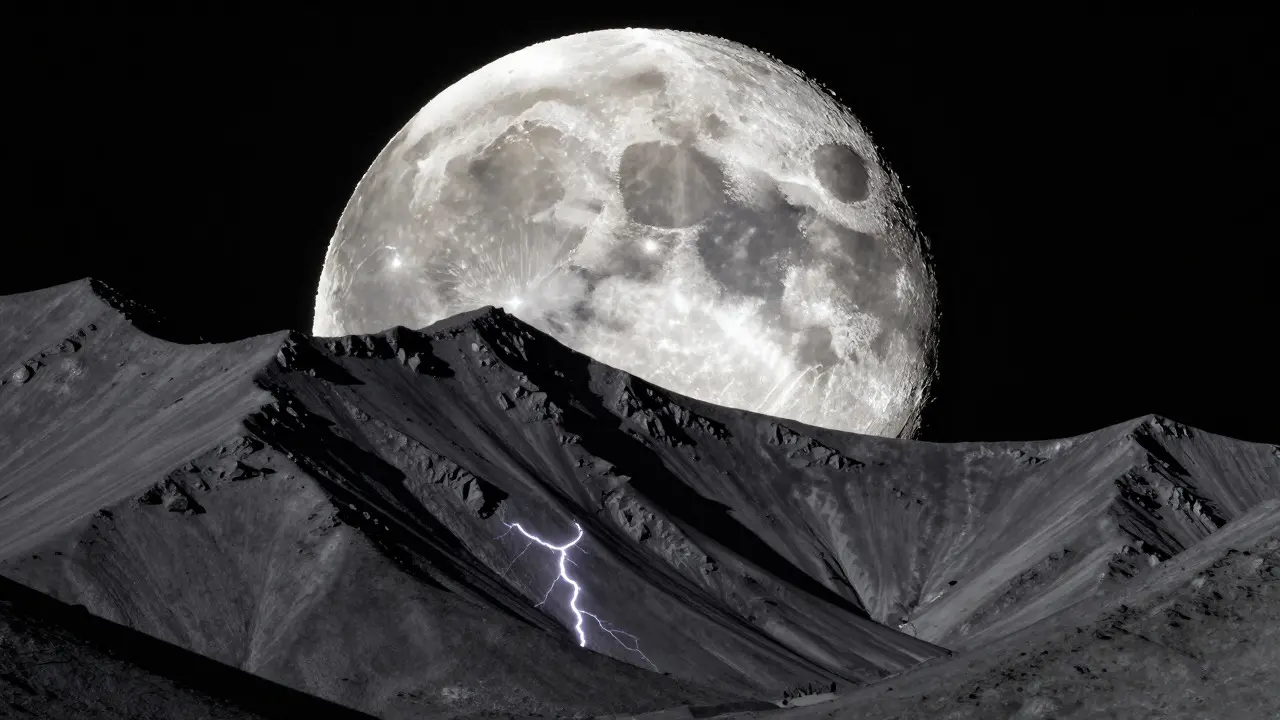
There is a specific moment in the lunar cycle that every serious observer chases. It is not the full moon, which is often washed out and flat. It is not the new moon, which is invisible. It is the phase where the Moon is roughly one-quarter illuminated, creating a sharp boundary between light and dark known as the terminator. This is when you see the Lunar Thunderbolt effect: the dramatic, jagged shadows cast by mountains and craters that stretch across the surface like lightning bolts frozen in time. Pair this with the Straight Wall, or Rectum Radium, a massive linear ridge that appears to cut through the terrain, and you have the highest contrast view possible on the lunar surface.
Understanding how to time these features correctly is the difference between seeing a gray disk and witnessing a three-dimensional landscape. The geometry of sunlight hitting the Moon changes daily, but only for a few days each month do the shadows align to create maximum depth. If you miss this window, you are just looking at a lit-up ball. If you hit it, you are looking into the heart of the Moon's topography.
The Geometry of Shadows: Why Timing Matters
To capture the best high-contrast views, you need to understand how the Sun illuminates the lunar surface. As the Moon orbits Earth, the angle of sunlight relative to your line of sight changes. When the Moon is near first quarter (around day 7 of the lunar cycle), the Sun is nearly perpendicular to the surface along the terminator. This means shadows are at their shortest and sharpest, but they are also most distinct against the bright side.
However, the "Thunderbolt" effect is most pronounced when the terminator is crossing specific mountain ranges. For example, the Apennine Mountains on the eastern edge of the Sea of Tranquility cast long, dark shadows that look like electrical discharges when the Sun is low. This happens best during the waxing gibbous phase, just before full moon, or the waning gibbous phase, just after. But wait-actually, the sharpest contrast occurs closer to the quarter phase because the shadows are longer and more defined. Let’s clarify: at first quarter, the terminator runs vertically down the center of the visible disk. The mountains along this line cast shadows eastward (to the right) if it is the waxing phase, or westward (to the left) if it is the waning phase.
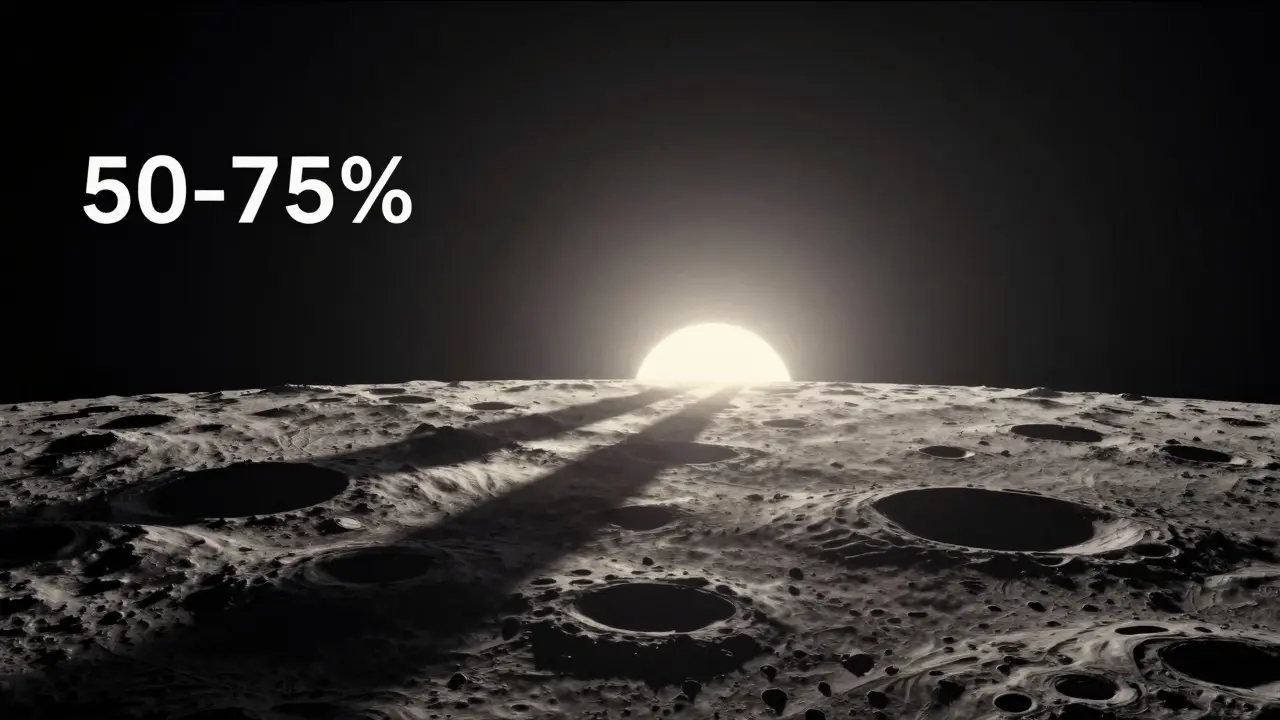
The key is the solar elevation. You want the Sun to be low enough to cast long shadows, but high enough that the peaks are still brightly lit. This sweet spot typically falls between 50% and 75% illumination. Observers in the Northern Hemisphere, such as those in Portland, Oregon, will find that the best viewing times for the northern lunar highlands occur during the waxing phase, while the southern highlands are better viewed during the waning phase due to the tilt of the Moon’s axis relative to our latitude.
Identifying the Lunar Thunderbolt
The term "Lunar Thunderbolt" is not an official IAU designation but a descriptive term used by visual astronomers to describe the intense, jagged shadow patterns created by major mountain chains. These patterns are most visible in the following regions:
- The Apennines: Located on the northwestern edge of the Sea of Tranquility. During the waxing phase, the peaks here cast dramatic shadows that resemble branching lightning. The mountain peak Nobile stands out prominently here.
- Mons Huygens: A solitary mountain on the western edge of the Oceanus Procellarum. Its shadow can stretch hundreds of kilometers, creating a stark black line against the gray regolith.
- The Alps: Running parallel to the Apennines, these mountains provide a continuous band of high-contrast detail when the terminator passes through them.
When the Sun hits these features at a low angle, the shadows are not just dark; they are pitch black, creating a contrast ratio that makes the terrain pop. This is the essence of the Thunderbolt effect. It is a visual phenomenon that relies entirely on the interplay of light and shadow, making timing critical. If you observe too early in the cycle, the shadows are too short. If you observe too late, the Sun is too high, and the shadows fade into the general darkness of the night side.
The Straight Wall: A Geological Anomaly
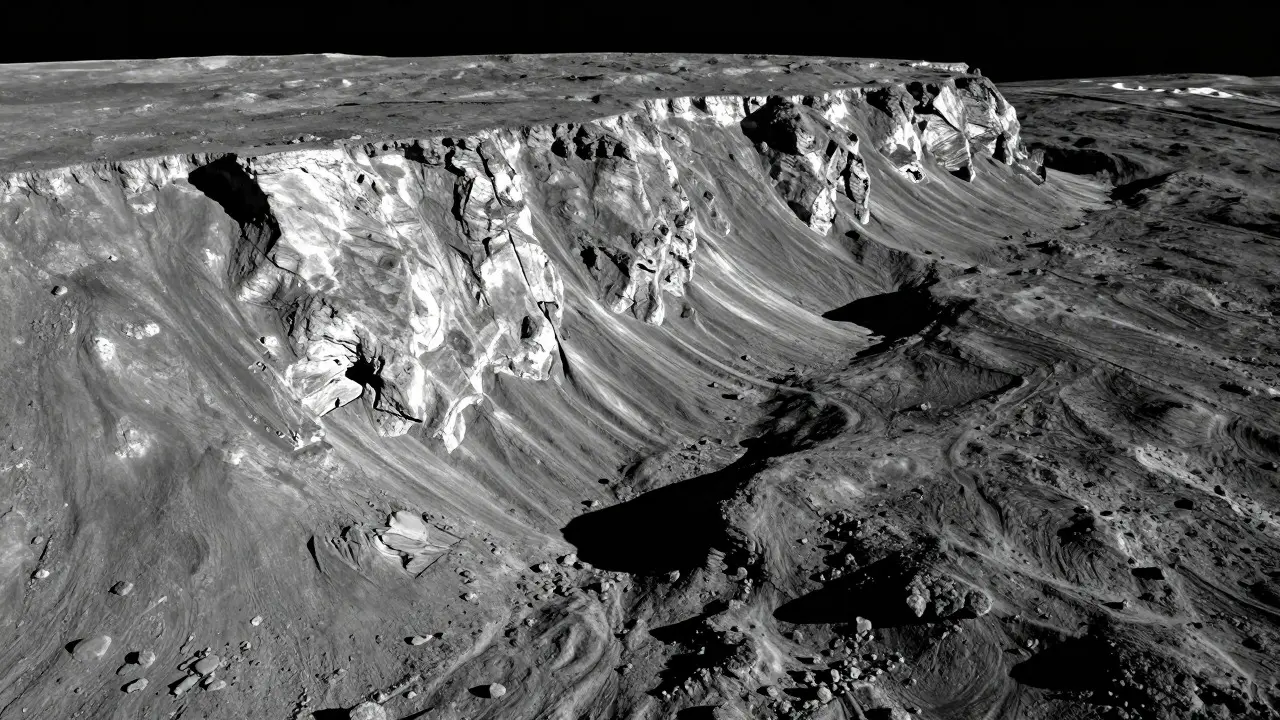
The Straight Wall is a prominent linear scarp located in the southwestern part of the Mare Imbrium, extending approximately 115 kilometers from northwest to southeast. Also known as Rectum Radium, this feature is a cliff face that rises about 1.5 kilometers above the surrounding mare basalt. Unlike natural mountain ranges formed by tectonic activity, the Straight Wall is believed to be a fault scarp, created by the gravitational stresses that occurred when the heavy basalt lava cooled and contracted, pulling the crust apart.
This feature is best observed when the terminator is positioned just to the west of it, allowing the sun to illuminate the top of the wall while casting a deep shadow below. Because it is a straight, artificial-looking line in a chaotic landscape, it stands out even in moderate seeing conditions. However, to see its true scale and the sheer drop-off, you need high magnification and steady air. In Portland, where summer evenings can be humid and unstable, using a smaller aperture telescope or waiting for the air to settle can make all the difference in resolving this fine detail.
Optimizing Your Telescope Settings
Seeing high-contrast lunar details requires more than just good timing; it requires the right optical setup. Many beginners make the mistake of using too much magnification, which reduces brightness and increases the impact of atmospheric turbulence. For the Lunar Thunderbolt and Straight Wall, you want clarity over power.
- Start Low: Begin with a low-power eyepiece (e.g., 32mm) to locate the region. This provides a wide field of view and higher contrast.
- Increase Gradually: Switch to a medium-power eyepiece (e.g., 10mm or 12.5mm) to bring the mountains and walls into focus. This is usually the sweet spot for seeing the shadow details without losing contrast.
- Avoid Over-Magnification: Do not go above 200x unless the seeing is exceptional. High magnification washes out the subtle gradations in the shadows, turning the "Thunderbolt" into a blurry smear.
- Use a Filter: A neutral density filter or a dedicated lunar filter can help reduce glare from the bright parts of the Moon, enhancing the visibility of the darker shadowed areas. This is particularly useful in the Pacific Northwest, where light pollution from cities like Seattle or Vancouver can sometimes interfere with contrast perception.
Additionally, consider the time of night. The Moon moves across the sky, and its altitude affects image stability. At low altitudes, you are looking through more atmosphere, which distorts the fine details of the Straight Wall. Aim to observe when the Moon is at its highest point in the sky, typically around local midnight for a first-quarter Moon. In August, the first quarter Moon rises around noon and sets around midnight, placing it at a favorable altitude for evening observations in the latter half of the night.
Planning Your Observation Session
Let’s apply this to a real-world scenario. Suppose you are planning to observe in mid-August 2026. You check a lunar calendar and find that the First Quarter Moon occurs on August 19. This is your prime target date. On this day, the Moon is 50% illuminated, and the terminator is running vertically down the center of the disk.
At 8:00 PM local time in Portland, the Moon will be rising in the east-southeast. By 10:00 PM, it will be higher in the south, providing better seeing conditions. The Apennines will be near the center of the visible disk, and the Straight Wall will be on the western limb, partially obscured by the curvature of the Moon but still visible if you use a telecentric projection or simply accept the foreshortening. Wait, actually, at First Quarter, the Straight Wall is on the western edge of the Mare Imbrium, which is near the center of the disk, not the limb. The limb is the outer edge. So, the Straight Wall is well-positioned for observation. The Apennines are also central. This is the ideal configuration.
If you miss August 19, the next best opportunity is August 18 or 20. On August 18, the Moon is slightly less than 50% illuminated, so the shadows are a bit shorter. On August 20, it is slightly more than 50%, so the shadows are a bit longer. Both are acceptable, but August 19 offers the most balanced contrast. Always check the weather forecast, as cloud cover in the Pacific Northwest can change rapidly. Having a backup plan, such as observing the previous or following night, is wise.
| Phase | Illumination % | Terminator Position | Best Features Visible | Shadow Length |
|---|---|---|---|---|
| First Quarter | 50% | Center of Disk | Apennines, Straight Wall, Tycho Crater | Longest & Sharpest |
| Waxing Gibbous | 75% | Western Third | Copernicus, Kepler, Southern Highlands | Medium |
| Full Moon | 100% | None (Fully Lit) | Albedo Features, Ray Systems | Shortest (Minimal) |
| Waning Gibbous | 75% | Eastern Third | Byrgham, Aristarchus, Eastern Highlands | Medium |
Common Pitfalls and How to Avoid Them
Even with perfect timing, several factors can ruin your view of the Lunar Thunderbolt and Straight Wall. The most common issue is poor collimation. If your telescope optics are not aligned, the image will be soft, and the sharp edges of the shadows will blur. Check your collimation before every session, especially if you have transported your equipment. A simple star test can reveal misalignment.
Another pitfall is eye adaptation. When you first look at the Moon, your eyes adjust to the bright light, reducing your ability to see subtle contrast differences. Take five minutes to let your eyes adapt to the telescope view. Blink slowly and avoid looking at bright lights nearby. This helps preserve your dark-adapted vision, which is crucial for discerning the faint details in the shadowed areas.
Finally, don’t rely solely on star charts. While they show the positions of craters and mountains, they don’t show the dynamic nature of shadows. Use a lunar atlas or an app that simulates the Moon’s appearance based on the exact date and time of observation. This allows you to predict exactly where the terminator will be and which features will be highlighted. Apps like Stellarium or SkySafari are excellent tools for this purpose, providing real-time simulations of the lunar surface.
Frequently Asked Questions
What is the best time of year to observe the Lunar Thunderbolt?
The best time is any month where the First Quarter Moon occurs on a clear night. Since the lunar cycle repeats every 29.5 days, there is always a First Quarter Moon somewhere in the sky each month. However, summer months like August offer longer nights and higher Moon altitudes in the evening, making them ideal for observers in the Northern Hemisphere.
Can I see the Straight Wall with binoculars?
Yes, but it will appear as a faint, straight line rather than a detailed cliff face. Binoculars are excellent for viewing the overall shape of the Mare Imbrium and the general position of the Straight Wall. For detailed study of the scarp’s height and texture, a telescope with at least 60mm aperture is recommended.
Why do the shadows disappear during the Full Moon?
During the Full Moon, the Sun is directly behind the observer, shining straight down onto the lunar surface. This eliminates long shadows because the light source is at a high angle relative to the surface. Without shadows, the terrain appears flat, and features like the Lunar Thunderbolt lose their definition.
How does humidity affect lunar observing in Portland?
Humidity itself does not significantly affect the clarity of the Moon, but it often correlates with atmospheric instability and cloud formation. High humidity can lead to haze, which reduces contrast and makes it harder to see the dark shadows against the bright surface. Waiting for drier, clearer nights is essential for optimal viewing.
What is the difference between the Lunar Thunderbolt and regular shadows?
The Lunar Thunderbolt refers specifically to the complex, branching shadow patterns created by major mountain ranges like the Apennines. Regular shadows are simpler and cast by individual craters or small hills. The Thunderbolt effect is characterized by its scale and intricate detail, resembling lightning strikes rather than simple dark patches.