29 Aug 2026
- 0 Comments
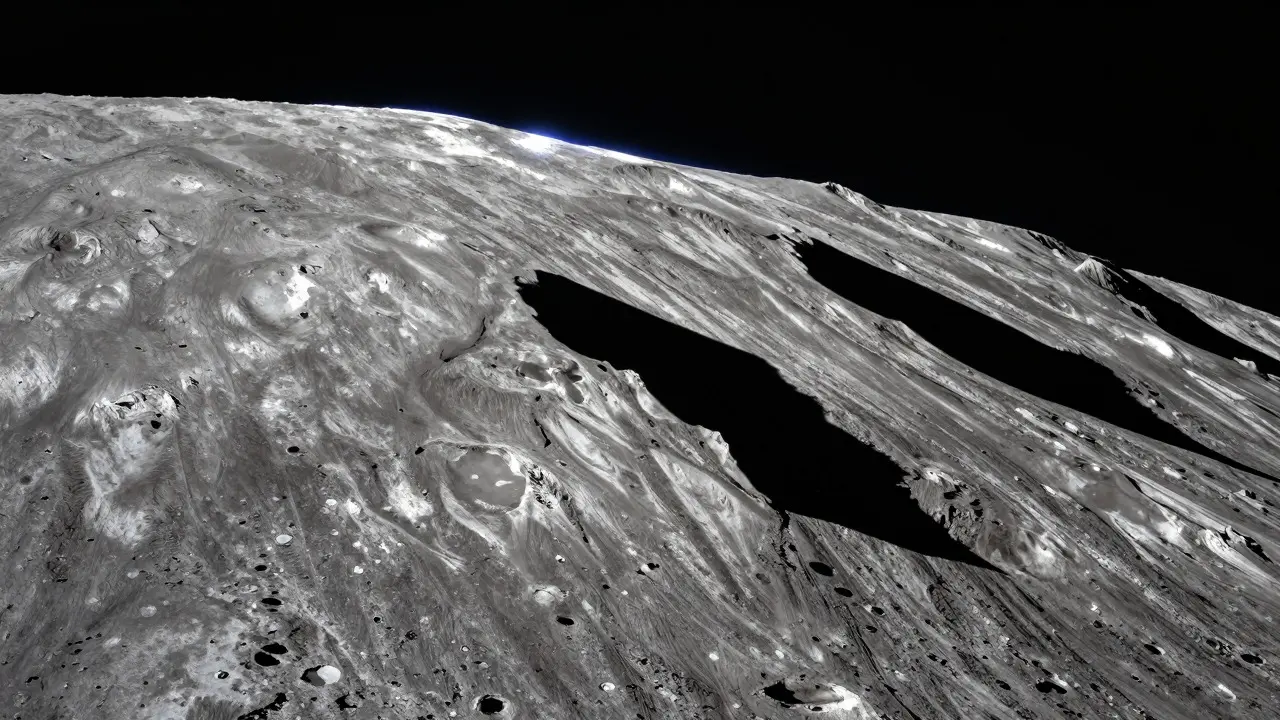
You’ve seen the Moon a thousand times. Maybe you’ve even looked through a telescope before. But have you ever stopped to trace the jagged line where light meets shadow on the crater rims? That’s not just pretty contrast; it’s a map of violent history written in rock and gravity. Lunar topography is the study of the Moon's surface features, ranging from massive impact basins to delicate volcanic channels. Unlike Earth, the Moon has no weather to erase its scars. Every valley carved by ancient lava flows and every mountain peak thrust upward by collision remains exactly where it was left millions-or billions-of years ago.
If you’re looking to upgrade your night sky viewing from "spotting craters" to "reading geology," you need to understand the two biggest players on the stage: lunar valleys (often called rilles) and mountain ranges. These aren't just random bumps. They tell us how the Moon cooled, cracked, and erupted. Let’s break down what you’re actually seeing when you point that scope at the terminator-the dividing line between day and night.
The Architecture of Impact: Lunar Mountain Ranges
Most people think mountains are built by tectonic plates crashing together, like the Himalayas. On the Moon, it’s mostly about things hitting really, really hard. When a large asteroid or comet strikes the lunar surface, it doesn’t just make a hole. The energy is so immense that the crust rebounds, pushing material upward to form central peaks and ringed mountain ranges around the impact site. This process creates lunar mountain ranges, which are often concentric rings surrounding large basins.
The most famous example? The Apennine Mountains. Look for them along the eastern edge of Mare Imbrium (the Sea of Clouds). They aren't a single continuous wall but a series of rugged peaks formed by the splash-back of debris from the giant impact that created the basin itself. Peaks like Mount Bradley and Mount Huygens rise over 5 kilometers high. Because there’s no atmosphere to scatter light, these shadows stretch incredibly long near the terminator, making the mountains look dramatic and three-dimensional.
| Feature Name | Location | Formation Type | Notable Characteristic |
|---|---|---|---|
| Apennines | East of Mare Imbrium | Impact Basin Rim | Home to Apollo 15 landing site; distinct peaks visible with small scopes. |
| Caucasus Mountains | Northwest of Mare Serenitatis | Impact Basin Rim | Rugged terrain; excellent for studying ejecta patterns. |
| Carpathian Mountains | Between Mare Imbrium and Mare Frigoris | Impact Basin Rim | Broken chain of hills; shows degradation over time. |
| Montes Caucasus | Northern Limb | Impact Basin Rim | High albedo (brightness) due to fresh rocky material. |
When observing these ranges, timing is everything. If you look at the full Moon, the sunlight hits straight down. Shadows disappear. The mountains flatten out into grey blobs. To see the texture, you must observe during the first or last quarter phases. This is when the sun is low on the horizon, casting long shadows that reveal the height and steepness of the slopes. It’s the same reason photographers wait for sunrise or sunset-it’s all about the angle of light.
Rilles and Valleys: Scars of Volcanism
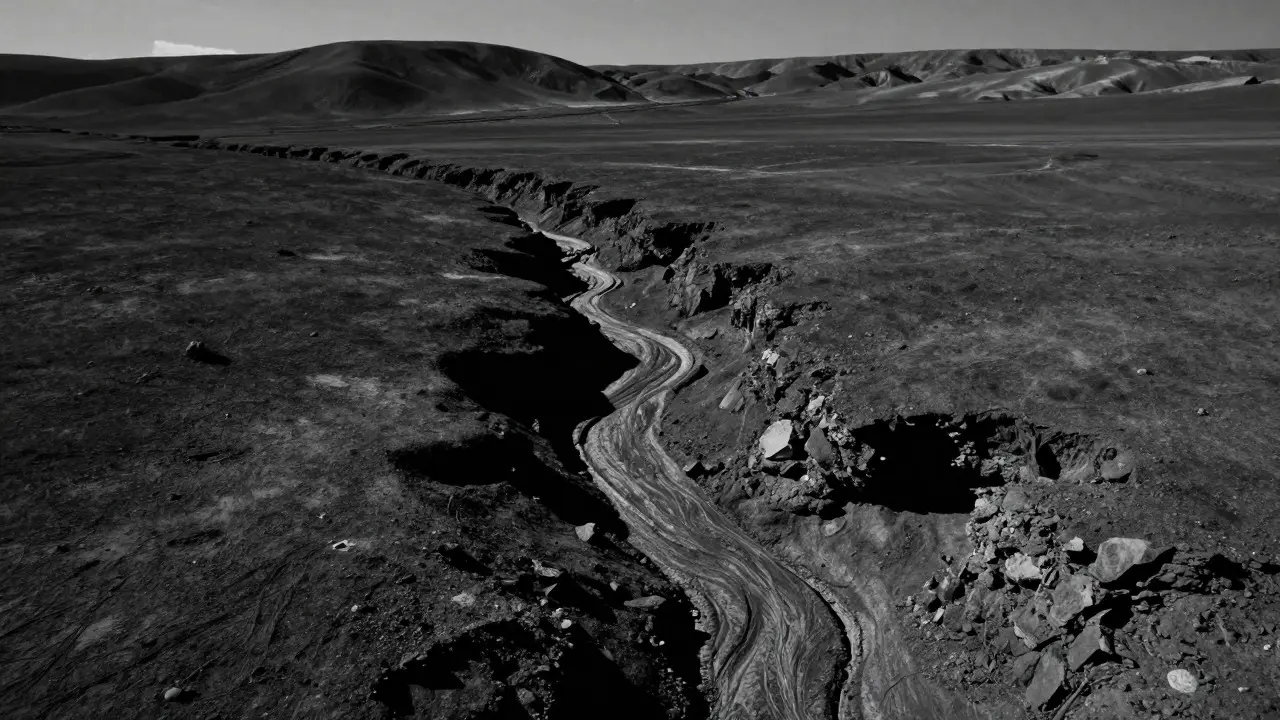
If mountains are scars of impact, valleys are often traces of fire. Lunar rilles are narrow, channel-like depressions found across the lunar surface. They come in three main types: sinuous, arcuate, and linear. Sinuous rilles look exactly like dry riverbeds on Earth, winding back and forth. For decades, scientists debated whether water once flowed here. Today, we know they were likely formed by flowing lava. As the molten rock moved, it carved channels or collapsed tubes left behind after the lava drained away.
A prime example is Hadley Rille, located right next to the Apennine Mountains. This isn’t just a crack in the ground; it’s a complex system. Some sections appear to be open channels where lava flowed on the surface, while other parts look like collapsed lava tubes-huge underground tunnels that carried hot magma miles across the Moon. During the Apollo 15 mission, astronauts drove their rover along this feature, collecting samples that confirmed its volcanic origin. Seeing Hadley Rille through an amateur telescope is a thrill because you’re looking at the exact path ancient lava took to fill the Mare Imbrium basin.
- Sinuous Rilles: Winding, meandering channels. Likely formed by lava flow or collapse of lava tubes. Example: Hadley Rille.
- Arcuate Rilles: Curved, bow-shaped grooves. Often associated with the edges of maria (seas), caused by cooling and contraction of the lava plains. Example: Rima Hyginus.
- Linear Rilles: Straight cracks. Usually tectonic faults where the crust stretched and broke apart. Example: Rimae Romer.
Why do these matter? They show us that the Moon wasn't always dead rock. It had active volcanism relatively recently in geological terms. The presence of young-looking rilles suggests that lava flows continued until perhaps 100 million years ago-a blink of an eye compared to Earth’s history. When you spot a rille, you’re spotting evidence of a fiery past.
How to Spot Them: Observing Techniques
You don’t need a $2,000 telescope to see these features. A good pair of binoculars (7x50 or 10x50) will reveal major mountain shadows and wide rilles. However, to truly appreciate the detail, a small refractor or reflector with 60mm-80mm aperture works wonders. Here’s how to optimize your view:
- Check the Terminator: Use a lunar calendar app or website to find the current phase. Aim for observations when the Moon is between 4 and 9 days old (waxing) or 21 to 26 days old (waning). The terminator moves slowly, giving you hours of stable lighting conditions.
- Use Filters: A neutral density filter reduces glare. The Moon is surprisingly bright, especially through a telescope. Reducing brightness helps your eyes adjust to darker details within the shadows.
- Look for Contrast: Don’t stare directly at the center of a feature. Look slightly to the side (averted vision). Your peripheral vision is more sensitive to faint details and subtle shading differences.
- Sketch It: Drawing what you see forces you to look longer. You’ll notice nuances in the mountain ridges or the branching of a rille that you might miss if you just glance.
One common mistake beginners make is trying to see too much at once. Pick one region. Say, the area around the Aristarchus Plateau. It’s rich in both mountains and rilles. Spend twenty minutes just watching how the shadows change as the Earth rotates. You’ll see details emerge that weren’t there ten minutes prior.
Geological Context: Why the Moon Looks Like This
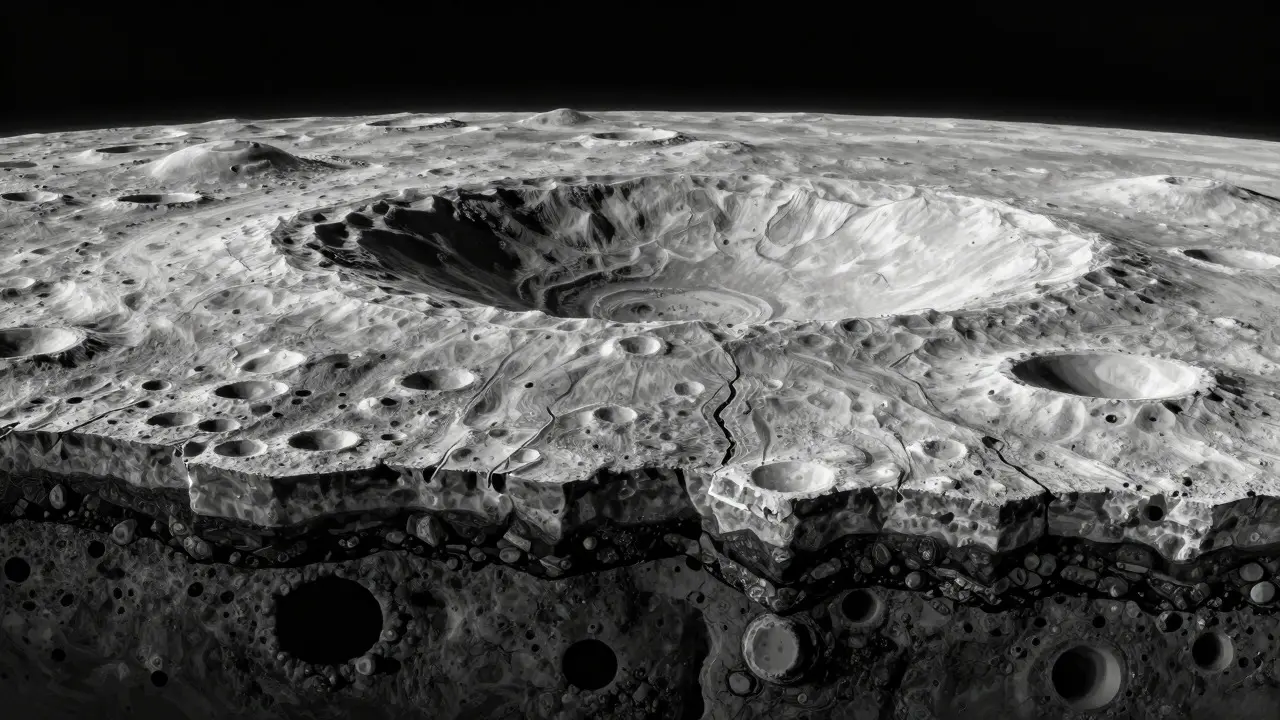
To really get why these features exist, you have to understand the Moon’s cooling story. About 4 billion years ago, the Moon was covered in a global ocean of magma. As it cooled, lighter minerals floated to the top, forming the bright highlands (terrae). Heavier minerals sank, creating dense areas beneath the surface. Later, massive impacts punched holes in this crust, allowing dark, iron-rich lava from the mantle to flood up and cover vast areas. These floods created the dark, flat plains we call maria.
This dual nature explains the topography. The highlands are heavily cratered and mountainous because they are older and have taken more hits. The maria are smoother but fractured by rilles because they are younger and experienced stress as the underlying lava cooled and contracted. The interaction between these two zones creates the most interesting viewing spots. Where the rugged highlands meet the smooth maria, you often find the sharpest contrasts and deepest valleys.
Consider the Schiaparelli Basin. It sits on the western limb. Its rim is broken by huge gaps, revealing the layers of the Moon’s crust. Nearby, you can see wrinkle ridges-low, sinuous elevations formed by compression of the lava flows. These aren't mountains, but they add texture to the otherwise flat seas. Learning to distinguish between impact-generated mountains and volcano-generated valleys gives you a deeper appreciation of the landscape.
Common Pitfalls for Beginners
Even experienced observers sometimes misidentify features. Here are a few traps to avoid:
- Confusing Crater Shadows with Mountains: A tall crater wall casts a shadow similar to a mountain range. Check the context. Is it isolated? Probably a crater. Is it part of a long chain? Likely a mountain range.
- Ignoring Atmospheric Distortion: Even though the Moon has no air, Earth’s atmosphere does. Turbulence (seeing conditions) can blur fine details like thin rilles. Wait for moments of stability. Using a higher magnification eyepiece during bad seeing makes things worse, not better.
- Overlooking Small Features: Sometimes the most interesting rilles are tiny. Don’t assume you need to see the big picture. Zoom in on specific sectors. A 3-kilometer-wide rille is still significant if you can resolve it.
Also, remember that the Moon is tidally locked. We only see one side. The far side has different topography-more craters, fewer maria. While you can’t see it directly from Earth without spacecraft images, knowing this adds context. The features you see are just half the story.
Frequently Asked Questions
What is the best telescope for viewing lunar mountains?
You don't need a large aperture. A 60mm to 80mm refractor or a 4-inch reflector provides excellent views. The key is optical quality and proper collimation (alignment). Larger telescopes offer more detail but are harder to transport and set up quickly. For lunar observing, portability often beats sheer power.
Why do lunar rilles look like rivers?
They mimic river shapes because fluid dynamics work similarly for lava and water. Both flow downhill, follow existing contours, and branch around obstacles. However, lunar rilles were formed by molten rock, not water. Evidence includes their association with volcanic vents and lack of sediment deposits typical of water erosion.
Can I see lunar mountains with binoculars?
Yes. Binoculars with 7x or 10x magnification clearly show major mountain ranges like the Apennines and Caucasus, especially near the terminator. You won't see fine details like small craters inside the ranges, but the overall structure and long shadows are quite visible.
Are there any active volcanoes on the Moon today?
No. The Moon is geologically inactive. There are no eruptions happening now. However, some studies suggest minor seismic activity (moonquakes) and possible outgassing from residual radioactive decay, but nothing comparable to Earth's volcanism. The features we see are relics of past activity.
How does the Moon's lack of atmosphere affect observing?
It means there is no scattering of light. Shadows are pitch black, and highlights are blindingly bright. This high contrast makes features stand out sharply but requires careful eye adjustment. Also, stars don't twinkle behind the Moon, so background star visibility is unaffected by lunar glare except very close to the limb.
Next Steps for Your Observation Log
Start simple. Tonight, grab your binoculars or scope. Find the Apennines. Watch the shadows lengthen as the evening progresses. Note which peaks cast the longest shadows. Then, move to Hadley Rille. Try to trace its path. Does it look like a tube or a channel? Write down what you see. Over a month, track how the lighting changes. You’ll start to recognize features by their shape alone, regardless of the phase. That’s when you stop just looking at the Moon and start reading it.