23 Feb 2026
- 0 Comments
After you’ve spent hours carefully collimating your telescope, everything looks perfect on-axis. Stars in the center of the field are sharp, round points of light. But then you move the target to the edge of the field-and suddenly, stars stretch into comets or triangles. That’s not poor seeing. That’s off-axis aberration. Two of the most common culprits? Coma and astigmatism. And neither one is fixed by tweaking your secondary mirror again.
What Off-Axis Aberrations Really Mean
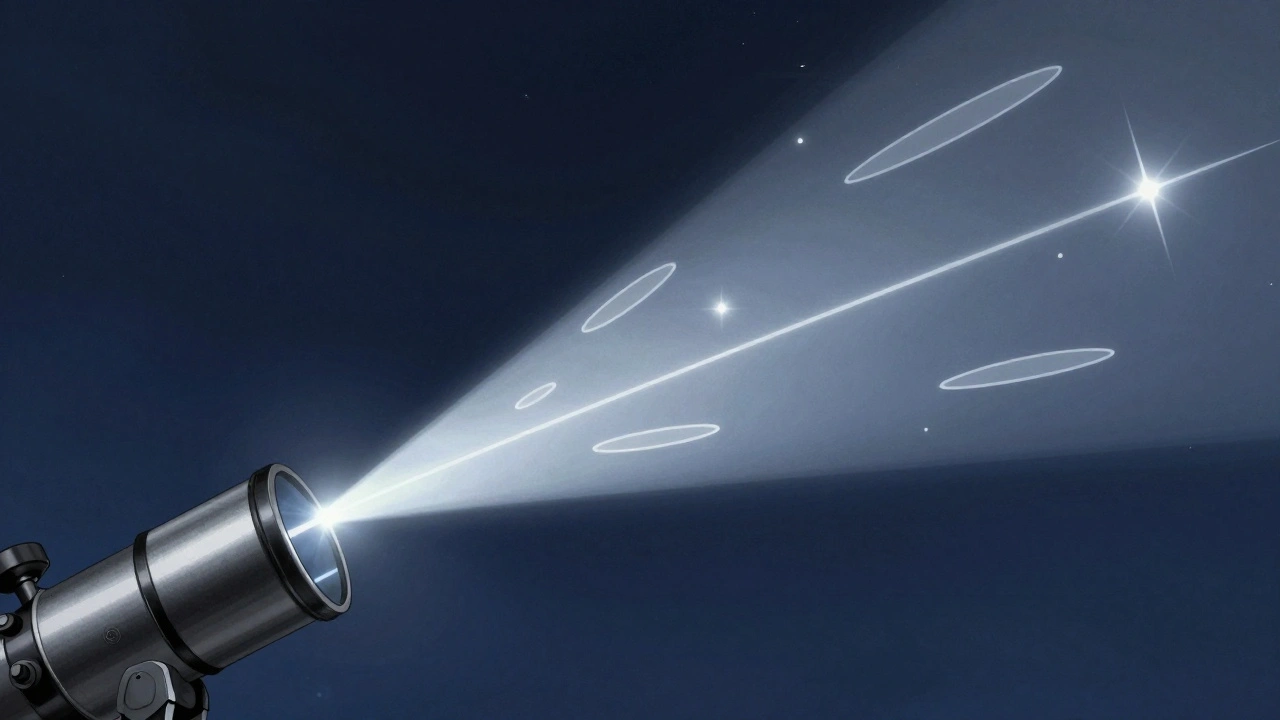
Collimation fixes alignment along the optical axis-the line running from your eyepiece to the primary mirror. But light doesn’t only travel along that center line. When you look at stars away from the center, light rays hit the mirrors at angles. If your optical system isn’t designed to handle those angled rays properly, distortions appear. These are called off-axis aberrations.
Coma makes stars look like tiny comets with tails pointing away from the center of the field. It’s worst in fast Newtonians-f/4 to f/5-and gets worse the farther you go from the center. Astigmatism, on the other hand, turns stars into lines or ellipses that rotate depending on where you look. One direction might stretch horizontally, another vertically. Both can look like misalignment, but they’re not.
Coma: The Comet Effect
Coma isn’t caused by bad collimation. It’s an inherent flaw in Newtonian reflectors, especially those with short focal ratios. The more light you gather (faster scope), the worse it gets. A fast f/4 scope will show obvious coma at just 20% off-axis. At 50% off-axis, stars are barely recognizable.
You can test for coma easily. Point your scope at a bright star, center it, and bring it into perfect focus. Then, without touching the focuser, nudge the star to the edge of the field. If it stretches into a teardrop shape with the point facing outward from the center, that’s coma. No amount of collimation will fix it. That’s because coma comes from the shape of the parabolic mirror itself. It’s designed to focus parallel rays from the center-but angled rays from the edge don’t converge at the same point.
There are two real solutions: use a coma corrector or slow down your scope. A coma corrector is a small lens group placed just before the eyepiece. Brands like Baader, Tele Vue, and Explore Scientific make them for common focal ratios. They cost $100-$250, but they restore sharpness across the whole field. If you’re into wide-field astrophotography, it’s non-negotiable.
Slowing down your scope means using a longer focal length. Switch from an f/4 to an f/6 or f/7. You’ll lose some light-gathering power, but coma becomes negligible. You’ll also need longer exposures for imaging, but your stars will stay round even at the edge.
Astigmatism: When Stars Become Lines
Astigmatism is trickier because it can be caused by multiple things-and one of them might be bad collimation. But not always.
True optical astigmatism happens when the primary or secondary mirror is slightly warped. It’s rare in new scopes but common in older ones that were mishandled. The mirror isn’t perfectly spherical or parabolic-it’s stretched in one direction. When light hits it, one axis focuses before the other. The result? A star looks like a short line. Rotate the star to the edge of the field, and the line rotates too. It’s not a coma tail. It’s a line, and it changes direction.
But here’s the catch: astigmatism can also come from your eyepiece, focuser, or even the adapter. A cheap 2” to 1.25” adapter with a loose fit can tilt the eyepiece slightly. That tilt introduces astigmatism. So can a focuser that’s worn out or not perfectly square to the optical tube.
How do you tell which is which? First, swap eyepieces. If the astigmatism stays the same shape and direction with different eyepieces, it’s likely the scope. If it changes-or disappears-then it’s the eyepiece or adapter. Try removing the adapter entirely. Use a 2” eyepiece directly. If the lines vanish, your adapter was the problem.
Also, test under different temperatures. Astigmatism from mirror deformation often gets worse as the mirror cools. If your scope was outside in freezing air and the astigmatism appeared after 20 minutes, that’s a sign the mirror is still adjusting. Let it cool fully-sometimes 45 minutes to an hour-and test again.
Collimation Isn’t the Cure
Here’s where most people go wrong. They see distorted stars at the edge and think, "I didn’t collimate well enough." So they tweak the secondary, nudge the primary, use a laser collimator, even a Cheshire. They get perfect center alignment-and the coma and astigmatism are still there.
Collimation fixes axial alignment. It ensures the optical axis is straight. But off-axis aberrations are about how the optics handle non-axial rays. You can be perfectly collimated and still have severe coma or astigmatism. That’s why a perfectly collimated f/4 Newtonian still shows coma. It’s not a mistake. It’s physics.
That said, bad collimation can *mimic* astigmatism. If your secondary is tilted too much, it can create asymmetric blur that looks like astigmatism. But it won’t rotate with the field. If you rotate the eyepiece and the direction of the stretch rotates too, it’s likely real astigmatism. If the stretch stays fixed in space as you rotate the eyepiece, it’s a collimation issue.
So check collimation-but don’t assume it’s the problem. Use a star test. Center a star. Defocus slightly. You should see a symmetrical donut. If the donut is lopsided, your collimation is off. If it’s symmetrical but stars at the edge are still distorted, you’re dealing with off-axis aberrations.
Diagnosing the Problem: A Step-by-Step Flow
Here’s how to diagnose coma and astigmatism without guessing:
- Choose a bright star (Sirius, Vega, or Polaris) and center it in the field.
- Focus perfectly. Defocus slightly. Look for a symmetrical donut. If not, fix collimation first.
- Move the star to the edge of the field (use a high-power eyepiece).
- Observe the shape:
- If it’s a teardrop pointing outward → coma.
- If it’s a line that rotates when you rotate the eyepiece → astigmatism.
- If it’s a line that doesn’t rotate → collimation error or focuser tilt.
- Swap eyepieces. If the issue changes, blame the eyepiece or adapter.
- Test in different temperatures. If it improves after 45 minutes → thermal stress.
- If coma is bad and you’re using f/5 or faster → add a coma corrector.
- If astigmatism persists and isn’t from gear → suspect mirror deformation or focuser misalignment.
When to Accept It
Not every optical flaw needs fixing. If you’re mostly visual and use medium to low power, coma and astigmatism might not bother you. At 100x, a 20% off-axis star distortion is barely noticeable. But if you’re into wide-field astrophotography, even 5% off-axis matters. A single pixel shift across a 10-minute exposure ruins your image.
For visual observers, a coma corrector isn’t always worth the cost or added weight. Many just learn to center their targets. For imaging? No choice. You need correction.
Also, don’t forget the field flattener. If you’re using a refractor or a Ritchey-Chrétien, astigmatism can be corrected with a field flattener. But Newtonians? They need coma correctors. Different tools, different problems.
Real-World Fixes That Work
Here’s what actually works in practice:
- For coma: Baader MPCC for f/4-f/5. Tele Vue Paracorr for f/3-f/5. Costs $150-$250. Worth every penny if you image.
- For astigmatism from adapters: Use a 2” eyepiece directly. If you must use an adapter, get a metal one with a set screw (like the Televue 2” to 1.25” with locking ring).
- For focuser tilt: Check if your focuser is square to the tube. Use a sight tube or autocollimator. If it’s off, you might need to shim the focuser base.
- For mirror deformation: If your mirror is old, cracked, or was dropped, it may need refiguring. That’s expensive. Consider replacing the mirror or upgrading the scope.
One last tip: don’t chase perfection. Even professional observatories have off-axis aberrations. They use software to correct them in post-processing. You can too. Star alignment tools in SharpCap or PixInsight can reduce the visual impact. But nothing beats good optics from the start.