18 Aug 2026
- 0 Comments
When you look at the Moon, it usually looks like a static rock. But if you zoom in on the poles, the picture changes completely. You see craters that have never seen sunlight in billions of years and tiny mountain peaks that are bathed in constant daylight. These extreme environments hold the keys to understanding our solar system's history and our future space exploration.
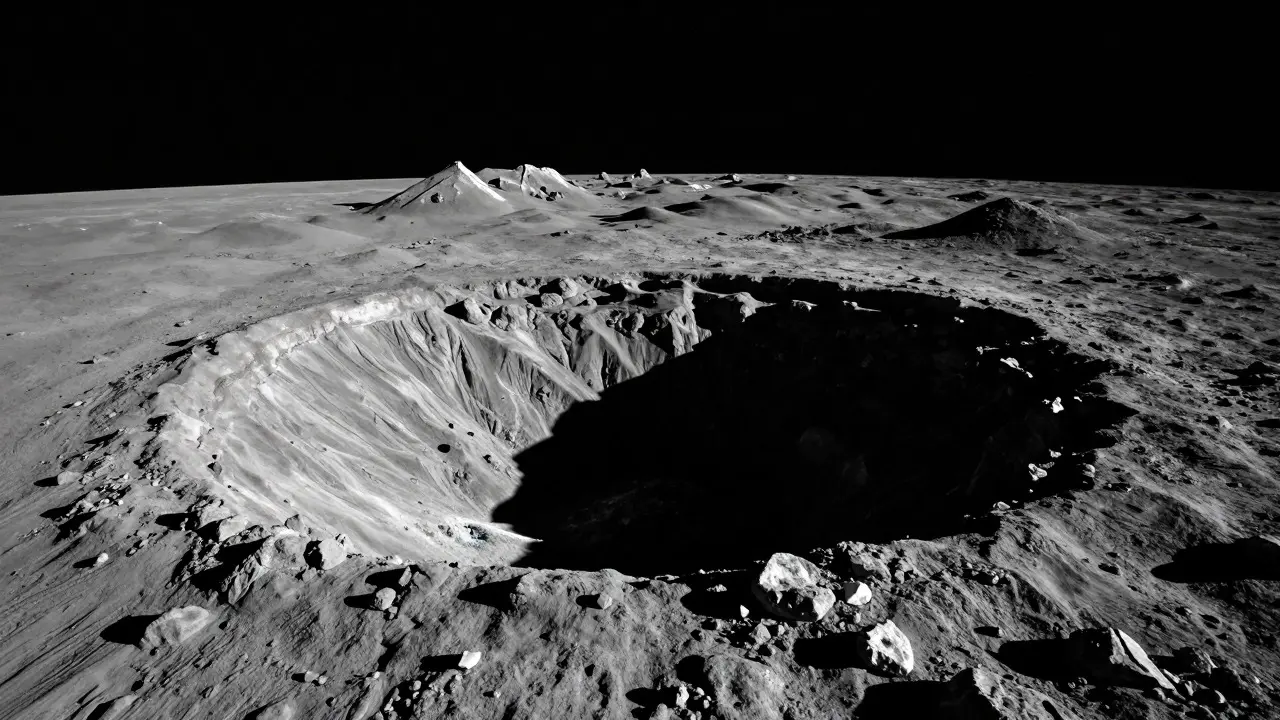
The Lunar Polar Regions are the northernmost and southernmost areas of the Moon characterized by high terrain and deep impact basins. Because the Moon has almost no axial tilt-only about 1.5 degrees compared to Earth's 23.4 degrees-the sun stays very low on the horizon there. This geometry creates two distinct phenomena: Permanently Shadowed Regions (PSRs) are crater interiors where sunlight never reaches due to the low solar angle, and Peaks of Eternal Light (PELs) are elevated landforms that remain illuminated for most or all of the lunar day.
Why the Moon’s Poles Are Different
On Earth, seasons happen because our axis is tilted. The Moon doesn’t really have seasons. Its surface temperature swings wildly between day and night, but the poles behave differently because of their topography. Imagine standing in a deep bowl. If the sun is just above the rim, the bottom of the bowl stays dark. That is exactly what happens in PSRs.
These shadows aren't just temporary; they are permanent. For over four billion years, these pockets have been frozen time capsules. Scientists believe they contain Water Ice from cometary impacts and solar wind hydrogen implantation. This ice has survived because the temperatures inside these craters drop to around -250°F (-160°C). It’s cold enough to keep volatile molecules trapped in place.
In contrast, PELs sit on the rims of these basins or on isolated mountains. They receive consistent solar energy, making them potential locations for future bases. A base here would need less power generation since solar panels could operate continuously, unlike on the equator where every site faces a two-week night.
Exploring the Permanently Shadowed Regions
Getting data from PSRs is tough. Most lunar orbiters fly too high to resolve the details, and rovers can't easily drive into steep crater walls. However, several missions have changed our understanding of these dark spots.
- Cassini: In 2009, NASA’s Cassini spacecraft sent a radar pulse toward the Moon while passing close. It detected strong reflections in the south pole, confirming the presence of subsurface ice.
- Kaguya: Japan’s Kaguya orbiter mapped the lunar surface with high precision, helping identify specific craters suitable for landing.
- LRO: The Lunar Reconnaissance Orbiter has been circling the Moon since 2009. Its instruments, including the Lyman Alpha Mapper, have provided detailed maps of hydrogen abundance, which correlates with water ice deposits.
- Chandrayaan-1: India’s first lunar mission used its Moon Mineralogy Mapper to detect hydroxyl and water molecules on the lunar surface, proving that water isn't just in the poles but scattered across the Moon.
The most famous PSR is Shackleton Crater in the south pole. It is 21 miles wide and 4,000 feet deep. Its inner wall is so steep that the floor has been in darkness since the crater formed. Another key site is Haworth Crater, which was the target of India’s Chandrayaan-3 mission in 2023. The Vikram lander successfully touched down near this site, marking a historic achievement for Indian space exploration.
The Promise of Peaks of Eternal Light
If PSRs are the vaults of the past, PELs are the launchpads of the future. Why do we care about peaks that are always lit? Two main reasons: power and communication.
Solar power is the lifeline for any off-world settlement. On the lunar equator, a solar panel works for 14 days and then sits idle for 14 days. You’d need massive battery storage or nuclear reactors to bridge the gap. At a PEL, the sun never sets. You can run your life support systems, labs, and communications without worrying about the long night.
Communication is another critical factor. The Earth-Moon line of sight is blocked when you are on the far side or in a deep crater. High-elevation sites often have better visibility to Earth and to relay satellites. The South Pole-Aitken Basin is a prime example. It is the largest, deepest, and oldest impact basin on the Moon. Its rim features some of the highest points on the lunar surface, offering excellent vantage points for both science and operations.
| Feature | Lunar Equator | Lunar Poles (PSR/PEL) |
|---|---|---|
| Solar Exposure | 14 days day / 14 days night | Variable; PELs have continuous light, PSRs have none |
| Temperature Range | -280°F to 260°F | PSRs: ~-250°F; PELs: Moderate warmth |
| Resource Potential | Regolith only | Water ice (PSRs), Solar power (PELs) |
| Communication Visibility | Poor during night/far side | High from elevated PELs |
| Scientific Value | Geological evolution | Volatiles, early solar system history |
Historical Context: What We Knew Before
We didn’t always know about these resources. During the Apollo Program in the late 1960s and early 1970s, astronauts focused on the equatorial highlands and maria. They brought back rocks that told us about volcanic activity and meteorite bombardment, but they didn’t sample the poles because getting there was technically difficult and scientifically uncertain at the time.
Apollo 17 came closest to the poles, landing in the Taurus-Littrow valley. While not at the pole itself, the crew observed unique geological features that hinted at complex tectonic processes. Today, we use those samples to calibrate our remote sensing instruments. When an orbital sensor sees a certain spectral signature, we compare it to the actual rock composition measured in labs from Apollo samples. This ground-truthing ensures our maps of the poles are accurate.
Future Missions and Exploration Goals
The race to the lunar poles is heating up. Several agencies and private companies have concrete plans.
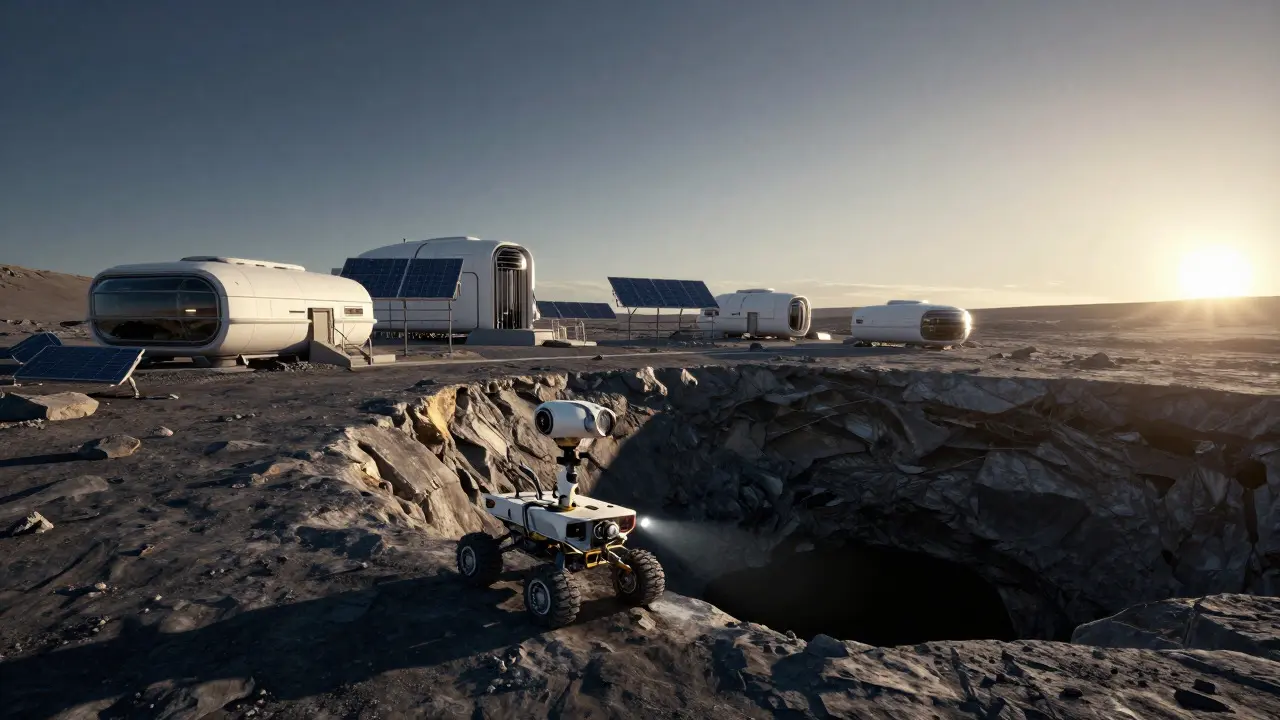
- Artemis Program (NASA): The goal is to return humans to the Moon and stay. The Artemis Base Camp will likely be established near the south pole. Astronauts will explore PSRs using rovers equipped with drills to extract ice. This ice can be split into oxygen for breathing and hydrogen for rocket fuel.
- China National Space Administration (CNSA): China plans to send its own crewed missions to the Moon by the mid-2030s. Their Chang’e series of orbiters has already mapped the poles extensively. They aim to establish a research station that complements the US effort.
- Commercial Partnerships: Companies like Intuitive Machines and Astrobotic are developing cargo landers. These vehicles will deliver scientific payloads and infrastructure components to the poles before humans arrive. This reduces risk and cost for the crewed missions.
The economic logic is compelling. Water is heavy. Carrying water from Earth to the Moon costs millions of dollars per kilogram. If you can mine it locally, you drastically reduce the cost of launching rockets to Mars. The Moon becomes a refueling depot, not just a destination.
Observing the Poles from Earth
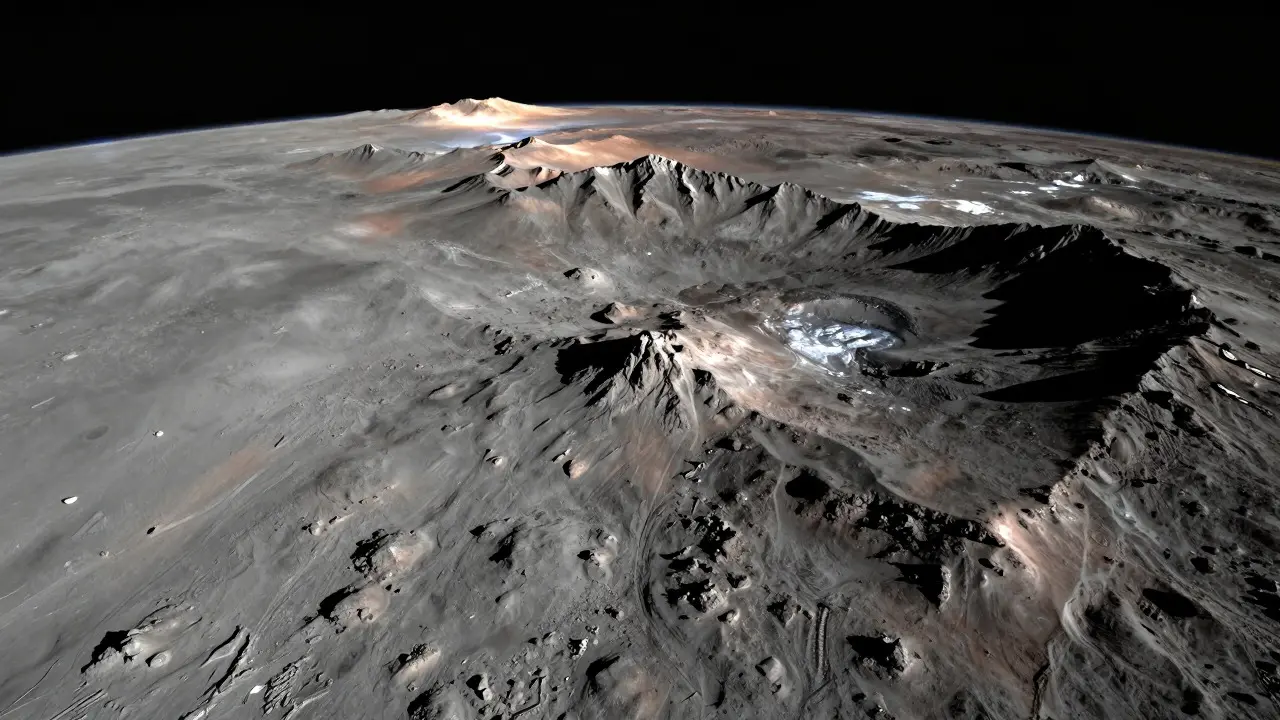
Can you see these features with a telescope? Partially. With a decent amateur telescope (8-inch aperture or larger) and good seeing conditions, you can spot the bright rims of large polar craters. Shackleton Crater is visible as a bright circle near the south limb. However, the interior remains dark, just as it is in reality. The lack of internal detail is actually a clue-it confirms the shadowing effect.
For visual observers, the best time to view the lunar poles is when the terminator (the line between day and night) crosses the region. As the sun rises over the highlands, the long shadows cast by the peaks become dramatic. This is also when you might notice subtle albedo differences caused by the distribution of regolith and ice. While you won't see the ice directly, the context helps you appreciate why scientists are so interested in these specific coordinates.
Frequently Asked Questions
Is there really water on the Moon?
Yes. Water exists in two forms: as ice trapped in permanently shadowed craters and as hydroxyl molecules bound in the surface regolith. The ice in the poles is the most abundant and accessible form for future mining.
Why are the lunar poles important for space travel?
The poles offer stable solar power sources via Peaks of Eternal Light and access to water ice in Permanently Shadowed Regions. Water can be processed into fuel and oxygen, reducing the need to carry these heavy resources from Earth.
Which country landed near a lunar polar crater recently?
India. In August 2023, the Chandrayaan-3 mission landed the Vikram lander near the south pole, specifically in the vicinity of Haworth Crater. This made India the fourth nation to achieve a soft landing on the Moon.
Can you see the lunar poles with a small telescope?
You can see the general brightness of the polar highlands, but resolving specific craters like Shackleton requires a larger aperture, typically 8 inches or more, and excellent atmospheric conditions. The dark interiors are hard to distinguish from the surrounding shadowed terrain.
What is the South Pole-Aitken Basin?
It is the largest impact basin on the Moon, located in the southern hemisphere. It is believed to expose material from the Moon's mantle, making it a key site for understanding the Moon's formation and internal structure.