21 Jan 2026
- 0 Comments
When you look up at the night sky, most stars seem fixed - steady, silent, unchanging. But some aren’t. A small group of stars, called RR Lyrae variables, pulse like slow, cosmic heartbeats. They brighten and dim with clockwork regularity, every few hours, over and over again. These aren’t just oddities. They’re one of the most important tools astronomers have for measuring distances across the galaxy.
What Exactly Is an RR Lyrae Star?
An RR Lyrae star is a type of pulsating star that’s old, low-mass, and in a late stage of its life. It’s usually a horizontal branch star, meaning it’s fusing helium in its core after having burned through its hydrogen. These stars are typically about half the mass of our Sun, but they’re much hotter and brighter than they should be for their size.
What makes them special is their rhythm. They don’t just flicker randomly. They go through a full brightness cycle every 5 to 14 hours - incredibly fast for a star. The pattern is so consistent that astronomers can predict exactly when the star will peak in brightness, even from thousands of light-years away.
They’re named after the first one discovered in the constellation Lyra, back in 1902. Since then, we’ve found over 80,000 of them, mostly in the galactic halo and globular clusters. That’s not a coincidence. RR Lyrae stars love old stellar neighborhoods. They’re practically the fossil record of the Milky Way’s early days.
Why Do They Pulse?
Their heartbeat comes from a delicate balance inside their outer layers. At a certain temperature - around 10,000 Kelvin - helium in the star’s atmosphere becomes partially ionized. This makes it less transparent to radiation. Photons from the core get trapped, building up pressure like steam in a kettle. Eventually, the pressure blows the outer layers outward.
But once the star expands, it cools. The helium recombines, becomes more transparent again, and the trapped radiation escapes. Without that pressure, gravity pulls the star back in. The cycle repeats: swell, cool, collapse, heat, swell again.
This is called the kappa mechanism, and it’s what drives all pulsating stars. But RR Lyrae stars are unique because their pulsation period is tightly linked to their intrinsic brightness. That’s the key to their cosmic usefulness.
The Cosmic Yardstick
Here’s the magic: the brighter an RR Lyrae star is, the longer its pulsation period. Not just a little - it’s a precise, measurable relationship. Once you observe how long it takes to pulse, you can calculate its true brightness. Then, by comparing that to how bright it looks from Earth, you can figure out how far away it is.
This is called the period-luminosity relation. It’s not as strong as the one used for Cepheid variables (which are younger, heavier stars), but RR Lyrae stars have a huge advantage: they’re everywhere in old star clusters. That makes them perfect for mapping the shape of our galaxy’s halo and measuring distances to globular clusters.
In fact, before modern satellites like Gaia, RR Lyrae stars were the go-to standard for calibrating the cosmic distance ladder. They helped us confirm that the Milky Way is about 100,000 light-years across. They helped us find the center of the galaxy. And they gave us the first solid evidence that other galaxies exist beyond our own.
Where to Find Them
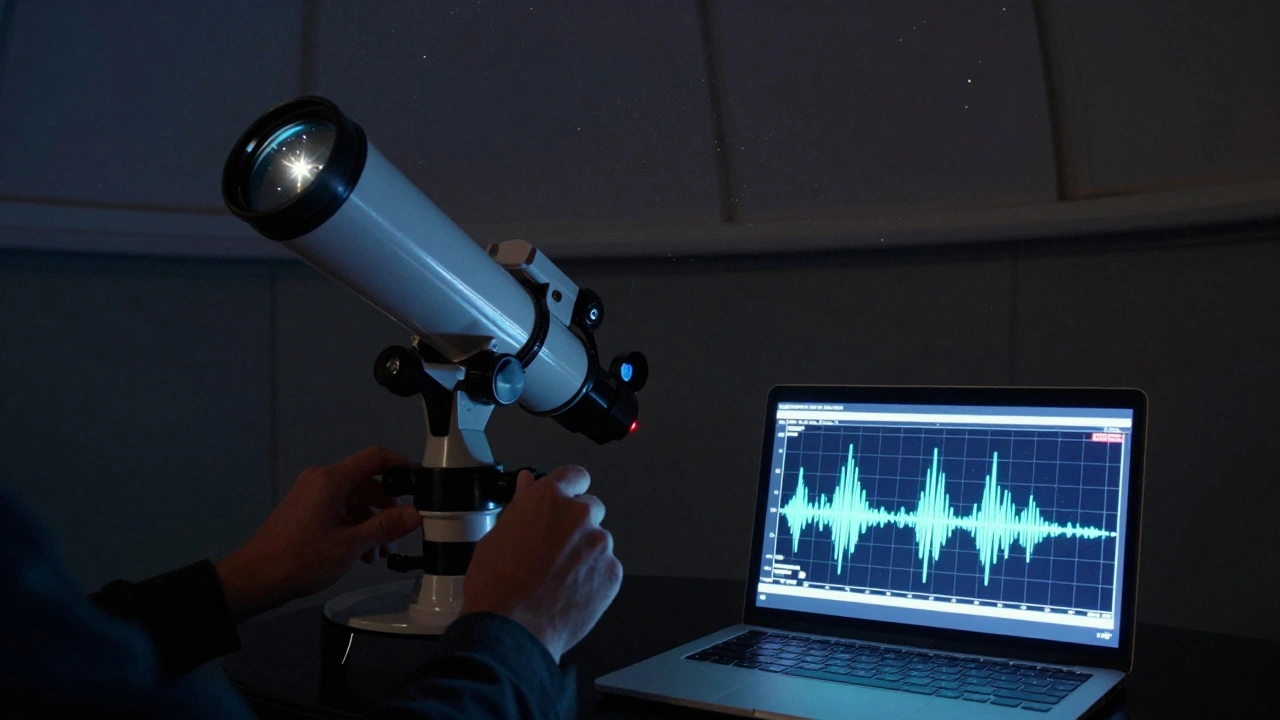
You won’t see an RR Lyrae star with the naked eye. They’re too faint, usually around magnitude 12 to 15. But if you’re using a backyard telescope and a sensitive camera, you can catch them in action.
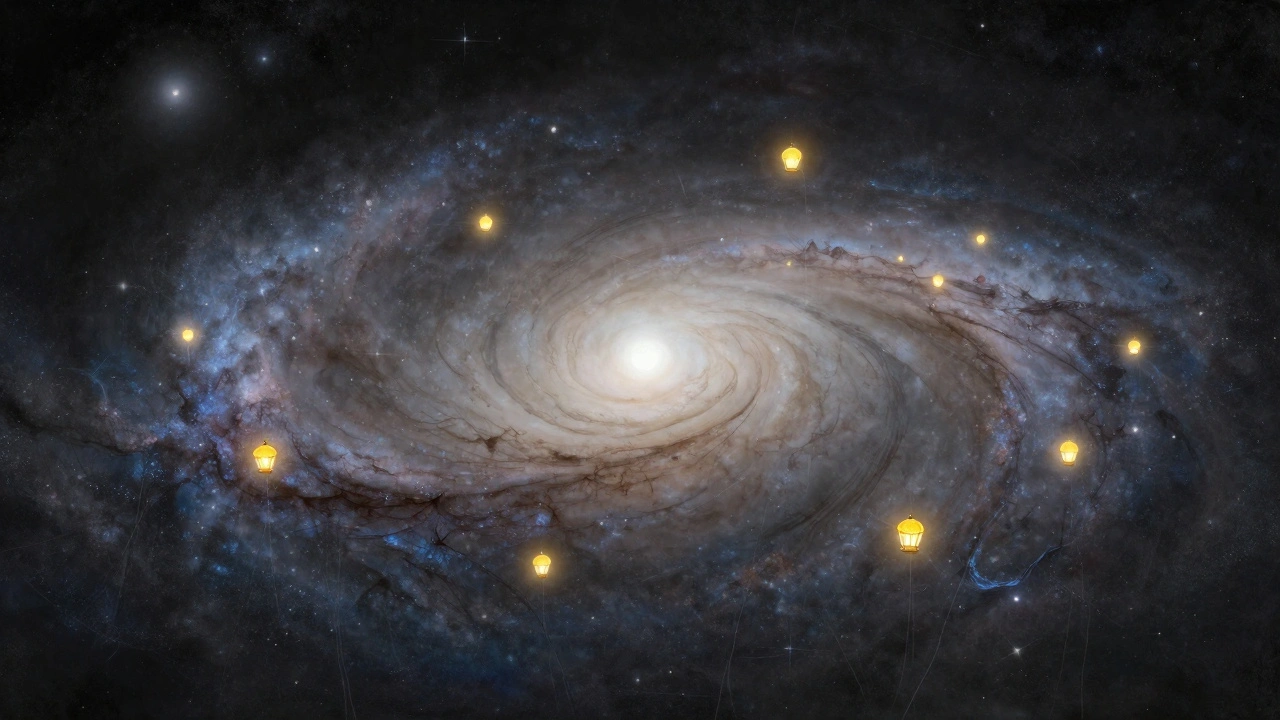
The best places to look are globular clusters. M3, M5, M13, and NGC 5466 are all rich with RR Lyrae stars. In M3 alone, over 130 have been identified. They’re also common in the galactic bulge and halo - the ancient, spherical regions surrounding the disk of the Milky Way.
Amateur astronomers have contributed a lot to studying them. Projects like the American Association of Variable Star Observers (AAVSO) rely on volunteers to track their brightness changes over time. One observer in Oregon, for example, recorded a 300-day light curve of an RR Lyrae in the cluster M92 - data later used by professional researchers to refine distance models.
Why They Matter Today
Even with space telescopes and laser-guided measurements, RR Lyrae stars haven’t been replaced. They’re still the gold standard for measuring distances to objects older than 10 billion years. When scientists want to know how old a globular cluster is, they look for RR Lyrae stars inside it. Their pulsation period tells you their mass, and their mass tells you their age.
They’re also used to test theories about dark matter. The way RR Lyrae stars move through the galactic halo helps map invisible mass. If they’re moving faster than expected, it suggests more gravitational pull from unseen material.
And in the search for exoplanets, they’ve become useful as background markers. Because they’re so predictable, astronomers use them to check the accuracy of instruments measuring tiny dips in starlight - the telltale sign of a planet crossing in front of a distant sun.
How to Observe One Yourself
You don’t need a professional observatory to contribute. Here’s what you need:
- A telescope with at least 6-inch aperture
- A CCD or DSLR camera capable of long exposures
- Software like AAVSO’s VPhot or AstroImageJ
- A clear night and patience
Start with M13 in Hercules - it’s bright, easy to find, and packed with RR Lyrae stars. Take images over several nights. Compare your measurements to the known brightness values in the AAVSO database. Even a few data points can help refine the pulsation curve of a star no one’s looked at in years.
Some amateurs have discovered new RR Lyrae stars this way. One in 2024 was spotted by a high school student in Montana while analyzing data from his backyard setup. He submitted it to the AAVSO, and it was confirmed by the Sloan Digital Sky Survey. That’s how science still happens - not just in labs, but under open skies.
Final Thought: Stars That Speak in Rhythms
RR Lyrae stars don’t shout. They don’t explode or glow like supernovae. They whisper - in pulses, in brightness, in time. But those whispers carry the weight of cosmic history. They’ve helped us map the Milky Way, measure its age, and understand how galaxies form. They’re not just stars. They’re clocks. And in a universe full of chaos, that kind of regularity is priceless.
How are RR Lyrae stars different from Cepheid variables?
RR Lyrae stars are older, smaller, and fainter than Cepheids. They typically have masses around 0.5 to 0.8 solar masses and pulsate in under 14 hours. Cepheids are more massive (4-20 solar masses), brighter, and pulse over days or weeks. RR Lyrae stars are found mostly in old star clusters, while Cepheids live in younger regions like spiral arms. Both are used as distance indicators, but RR Lyrae stars are better for older systems, while Cepheids help measure farther distances - like to other galaxies.
Can RR Lyrae stars be seen with the naked eye?
No. Most RR Lyrae stars have apparent magnitudes between 12 and 15, which is far too dim for the human eye. Even under perfect dark skies, the faintest stars visible to the naked eye are around magnitude 6. You’ll need at least a small telescope and a camera to detect them. But once you do, their regular brightness changes are easy to track over time.
Why are RR Lyrae stars so common in globular clusters?
Globular clusters are ancient - over 10 billion years old. That’s old enough for stars to have evolved off the main sequence and reached the horizontal branch stage, where RR Lyrae stars live. Since these clusters formed early in the galaxy’s history, they’re filled with old, low-mass stars. RR Lyrae stars are the pulsating subset of those stars. They’re not rare in these clusters - they’re expected.
Do RR Lyrae stars have planets?
There’s no confirmed evidence of planets around RR Lyrae stars. Their pulsations create chaotic environments - constant changes in brightness and gravity make it unlikely for planets to form or survive. Plus, they’re old stars that lost their planet-forming disks billions of years ago. Any planets that once orbited them were probably swallowed during the star’s red giant phase.
How do astronomers measure the brightness of RR Lyrae stars?
They use photometry - capturing images through colored filters (like B and V bands) and comparing the star’s light to known reference stars. Software then calculates the exact magnitude at each point in time. By plotting these measurements over weeks or months, they build a light curve that shows the star’s pulsation pattern. This curve reveals the period, amplitude, and shape - all critical for distance calculations.