17 Aug 2026
- 0 Comments
Staring into the night sky with a 60mm refractor or an 80mm Dobsonian can feel limiting when you see charts packed with thousands of galaxies. But here is the secret that veteran observers know: small scopes don't need big objects to have a great night. They just need the right ones at the right time.
The problem isn't your aperture; it's your target selection. Many beginners try to observe M31 (Andromeda) in August when it’s low and washed out by light pollution, then give up on deep-sky observing entirely. Instead, we are going to build a seasonal roadmap. This guide breaks down the best deep-sky targets for each month, specifically curated for instruments under 150mm aperture. You will learn how to match celestial objects to your equipment’s capabilities and the season’s sky conditions.
Why Seasonal Planning Matters for Visual Astronomy
Astronomy is a game of geometry. The Earth orbits the Sun, which means different parts of the galaxy become visible at different times of the year. In January, the galactic center is high in the sky, offering dense star fields. In July, the summer triangle dominates, providing bright nebulae but fewer rich star clusters. If you pick a target that is only above the horizon for two hours, or one that sits below 20 degrees altitude, atmospheric turbulence will ruin the view regardless of your scope size.
For small scopes, altitude is critical. Light from faint objects like globular clusters has to pass through more atmosphere when it is near the horizon. This scatters the light, reducing contrast. A 4-inch telescope might easily resolve M13 in Hercules when it is overhead in August, but the same cluster becomes a smudge when viewed from a northern latitude in December if it dips too low. Therefore, our monthly lists prioritize objects that reach their highest point (culmination) during prime observing hours (10 PM to 2 AM local time).
Winter Targets: The Core of the Galaxy
From late November through February, the Milky Way’s core rises in Sagittarius and Scorpius. This is peak season for visual astronomers. Even a modest 70mm reflector can reveal wonders here because the density of stars compensates for lower magnification.
- M8 (Lagoon Nebula): Visible in Sagittarius. With binoculars or a small telescope, this appears as a fuzzy patch with a dark lane cutting through it. It is one of the brightest emission nebulae in the sky.
- M20 (Trifid Nebula): Just next to M8. At higher magnifications (60x-80x), you can see the red reflection nebulosity and the dark dust lanes that divide it into three sections. This is a classic 'wow' object for small scopes.
- Omega Centauri: Located in the southern sky (visible from mid-latitudes). It is the largest and brightest globular cluster in the entire sky. It looks like a soft, glowing ball of stars rather than a resolved sphere, even in large telescopes, but its sheer brightness makes it a staple for winter nights.
- Double Cluster (NGC 869/884): In Perseus. These are not faint. They are spectacular open clusters that look like spilled jewels. Any small scope can show hundreds of individual stars in these two neighboring groups.
Pro Tip: Use a UHC (Ultraviolet/Visual Cut) filter for M8 and M20. It boosts the contrast of the hydrogen-alpha emission against the blue background sky, making the nebulae pop significantly in smaller apertures.
Spring Targets: Resolving Faint Galaxies
Spring (March to May) is often considered the best season for deep-sky observing. The sky is dark early, and the air is stable. More importantly, the Virgo Cluster comes into view. This region contains dozens of galaxies, many of which are challenging but rewarding for small scopes if you use averted vision.
- M104 (Sombrero Galaxy): One of the most recognizable shapes in the sky. It appears as a distinct oval with a dark band across the middle. In a 6-inch scope, you can clearly see the nucleus and the dust lane. It is a must-observe for spring.
- M81 (Bode’s Galaxy) and M82 (Cigar Galaxy): Located in Ursa Major. M81 is bright and easy to see as a roundish blob. M82 is harder; it looks like a cigar-shaped smudge. Using averted vision (looking slightly to the side) helps reveal M82’s extended structure even in small telescopes.
- M51 (Whirlpool Galaxy): This spiral galaxy is famous for its companion. While the spiral arms are hard to see visually without very dark skies, the interaction between the main galaxy and the smaller companion is visible as a distorted shape. It is a favorite for spring evenings.
- M101 (Pinwheel Galaxy): A face-on spiral galaxy. It is larger and fainter than M51. In a small scope, it looks like a diffuse, circular patch. It requires excellent seeing conditions to appreciate its extent.
Strategy: Spring is about patience. Don’t rush. Let your eyes adapt for 30 minutes. Use low power (10x-20x) to find the field, then switch to medium power (40x-60x) to examine details. Averted vision is your best friend for the fainter galaxies in the Virgo Cluster.
Summer Targets: Bright Nebulae and Clusters
Summer (June to August) offers some of the brightest deep-sky objects in the northern hemisphere. The Great Square of Pegasus is rising, and Cygnus and Lyra dominate the zenith. The downside? The Milky Way is thick, which can wash out fainter objects, but the bright ones shine brilliantly.
- M13 (Hercules Cluster): The king of globular clusters in the Northern Hemisphere. It is so bright that it is visible in binoculars as a star-like point. In a small telescope, it resolves into thousands of stars. It is the ultimate test of a scope’s resolving power and a guaranteed highlight of the summer season.
- M57 (Ring Nebula): In Lyra. This is a planetary nebula that looks like a tiny, bright ring. It is compact and bright, making it ideal for small scopes. You can easily see the central star and the distinct ring shape, even in suburban skies.
- M31 (Andromeda Galaxy): Wait, Andromeda in summer? Yes, but it is low in the west. However, it is still visible after sunset. Because it is so large and bright, it remains a spectacular sight even when low. Look for the dust lanes and the satellite galaxies M32 and M110, which appear as bright knots within the main body.
- M45 (Pleiades): While visible in winter, they remain high in the evening sky into early summer. The 'Seven Sisters' are a stunning open cluster. Add a nebula filter to see the faint blue reflection nebulosity surrounding the stars. It is a beautiful target for any aperture.
Pro Tip: For M57, try using a high-power eyepiece (25mm or less) to get a detailed view of the ring. The contrast is high enough that you don’t need a filter, but a moon filter can help reduce glare if the sky is bright.
Fall Targets: Transitioning to Winter Constellations
Autumn (September to November) is a transitional period. The summer constellations set earlier, and the winter ones rise later. The sky is clearer and drier, which is perfect for observing. The Perseus Double Cluster returns, and Orion begins to peek over the eastern horizon.
- M42 (Orion Nebula): As Orion rises in the east in late autumn, the Great Orion Nebula becomes visible. It is the brightest nebula in the sky. Even a 4-inch scope shows the Trapezium stars and the surrounding glow. It is a fantastic target for late September and October nights.
- M44 (Beehive Cluster): In Cancer. This is a large, loose open cluster that is visible to the naked eye as a fuzzy patch. In a small telescope, it resolves into a swarm of stars. It is a good target for practicing low-power observation and star hopping.
- M67: In Cancer. Unlike the Beehive, M67 is a tight, spherical cluster. It is older and redder. It is a nice contrast to M44 and tests your scope’s ability to resolve close-packed stars.
- M1 (Crab Nebula): In Taurus. This is a supernova remnant. It is faint and extended, requiring averted vision. In a small scope, it appears as a small, elliptical smudge. It is a historical landmark in astronomy and a challenging but rewarding target for dark skies.
Strategy: Fall is about preparation. Use this time to practice star hopping to the winter constellations. Learn the stick figures of Orion, Taurus, and Gemini. By the time winter arrives, you will be ready to tackle the dense core of the Milky Way.
Optimizing Your Setup for Faint Objects
Having the right target list is only half the battle. How you observe matters just as much. Here are practical tips to maximize what you see with a small scope.
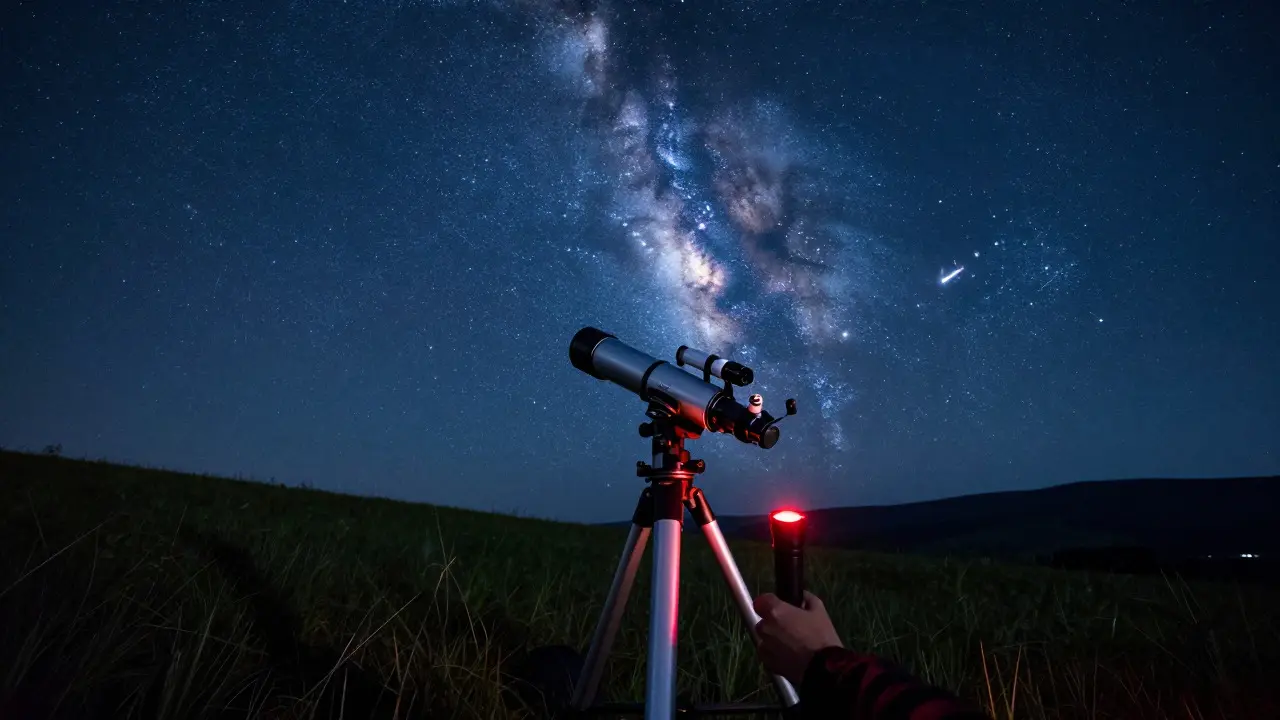
- Dark Adaptation is Non-Negotiable: Give your eyes 30-45 minutes to fully adapt. Use a red-light flashlight exclusively. White light resets your night vision instantly. This single habit doubles your effective aperture.
- Master Averted Vision: For faint galaxies and nebulae, do not look directly at the object. Look slightly to the side. Your peripheral vision is more sensitive to dim light. Sweep your gaze slowly across the area until the object fades in.
- Use Filters Wisely:
- Nebula Filters (UHC/OIII): Boost emission nebulae like M8, M20, and M57. Do not use them on galaxies or star clusters.
- Light Pollution Filters: Can help in urban areas by cutting sodium and mercury lights. They work on all objects but may reduce color fidelity.
- Start Low, Zoom Slowly: Begin with your lowest power eyepiece to find the object. Once centered, switch to higher power. Jumping straight to high power makes finding faint objects nearly impossible.
- Keep Notes: Write down what you see. Did you see the dust lane in M104? Could you resolve the Trapezium in M42? Tracking your progress motivates you and helps you calibrate your expectations for future sessions.
Comparison Table: Best Targets by Scope Size and Season
Common Pitfalls to Avoid
Even with a good list, you can ruin your night if you make these common mistakes.
- Chasing Too Many Targets: Pick 3-5 quality objects per session. Rushing prevents proper dark adaptation and detailed observation. Depth beats breadth.
- Ignoring Seeing Conditions: On windy or turbulent nights, high-magnification views will shake. Stick to low-power views of large objects like M42 or M13. Save detailed galaxy work for calm nights.
- Overestimating Your Sky Quality: If you are in a Bortle 8 (bright suburban) sky, forget about faint spiral arms. Focus on bright, compact objects like planetary nebulae and bright clusters. Check the Bortle scale for your location to set realistic expectations.
- Not Collimating: A misaligned Newtonian reflector will blur everything. Check your collimation before every session. It takes five minutes and makes a huge difference in image sharpness.
Building Your Own Monthly Challenge
You don’t have to follow this list blindly. Use it as a template. Each month, pick one 'challenge' object. For example, in March, challenge yourself to see the dust lane in M104. In July, challenge yourself to count the number of stars you can resolve in M13. Keep a logbook. Over time, you will notice improvements in your technique and your sky perception.
Deep-sky observing with a small scope is not about competing with professional telescopes. It is about connecting with the universe on a human scale. When you see the first hint of a galaxy’s spiral arm or the delicate structure of a nebula, it feels personal. It’s your eyes, your scope, your night. That connection is worth far more than any photograph.
What is the best small telescope for deep-sky observing?
A 6-inch (150mm) Dobsonian reflector is widely considered the best value for deep-sky observing. It offers a large aperture for collecting light, a simple design, and a lightweight tube that is easy to transport. Refractors under 80mm are also excellent for planetary nebulae and star clusters due to their sharp images.
Can I see galaxies with a 4-inch telescope?
Yes, but only the brightest ones. M31 (Andromeda), M32, and M110 are easily visible. M104 (Sombrero) and M51 (Whirlpool) are possible under dark skies using averted vision. Fainter spirals in the Virgo Cluster will require a larger aperture or exceptional sky conditions.
Do I need a motorized mount for deep-sky observing?
No. A manual alt-azimuth mount is sufficient for visual observing. You can track objects manually for several minutes at low magnification. GoTo mounts are convenient for finding objects quickly, but they add cost and complexity. For learning star hopping, a manual mount is actually beneficial.
How long should I spend on each target?
Spend at least 10-15 minutes on each target. The first few minutes are for finding and centering the object. The next 5-10 minutes allow your eyes to adapt to the specific brightness of the object, revealing fainter details. Rushing leads to missed details.
What is averted vision and how do I use it?
Averted vision involves looking slightly to the side of the object rather than directly at it. Your peripheral retina has more rod cells, which are sensitive to dim light. To use it, center the object in your eyepiece, then move your head slightly away from the eyepiece while keeping your eyes fixed on the area. The faint object will fade in and out as you adjust your gaze.