24 Mar 2026
- 0 Comments
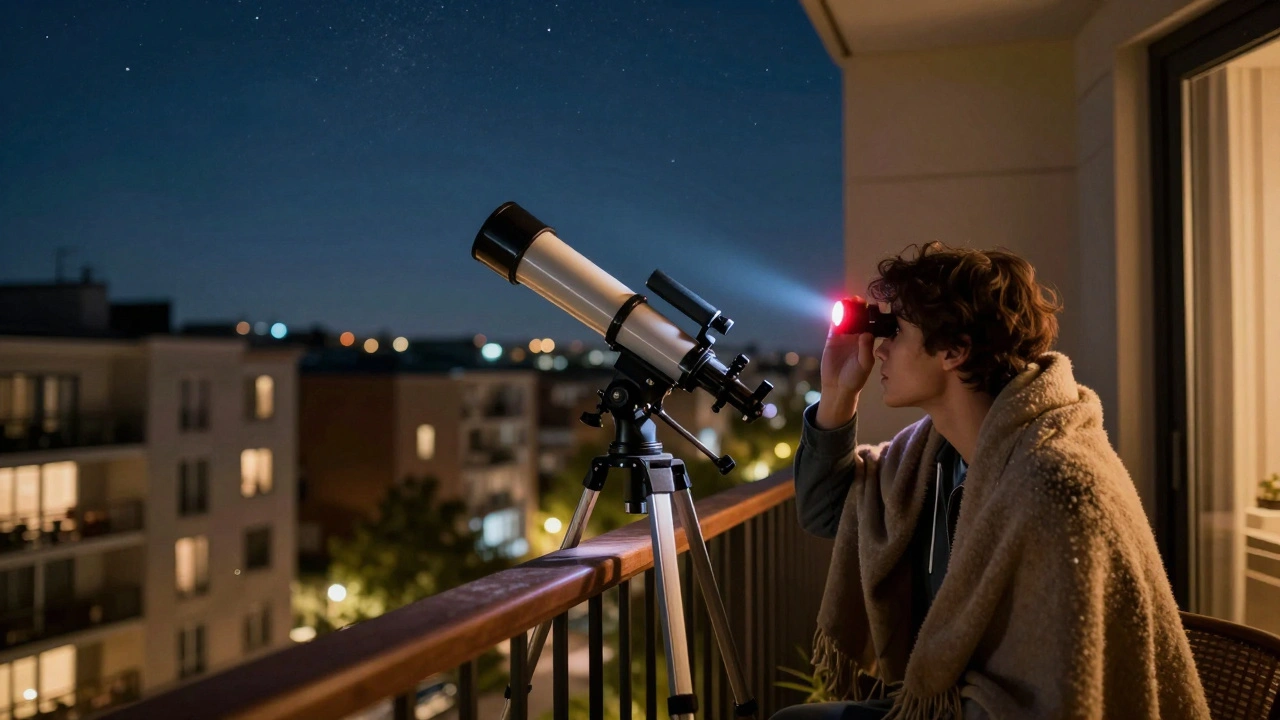
Living in an apartment doesn’t mean you have to give up stargazing. If you’ve ever looked up at the night sky from your fire escape or balcony and thought, I wish I could see more, you’re not alone. Thousands of city dwellers are doing the same thing-and many are finding their best tool isn’t a giant telescope, but a tabletop Dobsonian. These compact, no-frills telescopes are turning small balconies, living room windows, and even kitchen counters into personal observatories.
Why Tabletop Dobsonians Work for Apartments
Most beginner telescopes are built for backyards. They come on tall tripods, weigh 20 pounds or more, and need 10 feet of clearance to swing around. In an apartment? That’s a recipe for tripping over cables, knocking over plants, or getting yelled at by neighbors for setting up gear in the hallway.
Tabletop Dobsonians solve this. They’re designed to sit on a flat surface-like a windowsill, a sturdy table, or even a folding camp stool on your balcony. The entire telescope is under 15 pounds, often under 10. You can carry one in a backpack. No assembly. No tools. Just unpack, point, and look.
The secret is in the design. Dobsonians use a simple alt-azimuth mount: the tube moves up and down (altitude) and side to side (azimuth) with smooth, friction-based motion. No gears, no motors, no electronics. That means no batteries to charge, no software to update, and no complicated alignment. It’s pure, mechanical simplicity.
And here’s the kicker: for its size, a tabletop Dobsonian gives you more light-gathering power than most beginner refractors or catadioptrics. A 6-inch mirror collects over 60% more light than a standard 80mm refractor. That means you’ll see Saturn’s rings clearly, pick out the Orion Nebula’s glow, and track Jupiter’s moons without needing a dark sky.
What You Can Actually See from an Apartment
People assume city lights ruin stargazing. They don’t. Not if you know what to look for.
From a typical urban apartment in Portland, Seattle, or Chicago, a tabletop Dobsonian with a 6-inch mirror can show you:
- Saturn with its rings clearly visible-no filter needed
- Jupiter and its four largest moons, plus cloud bands on clear nights
- The Moon in stunning detail: craters, mountains, and valleys
- The Orion Nebula as a glowing, misty patch with hints of structure
- The Pleiades star cluster-over a dozen stars, not just the six most obvious ones
- Double stars like Albireo (a golden and blue pair) and Mizar and Alcor
- Venus in its phases, like a tiny crescent
- Mars during opposition: a small orange disk, sometimes with polar ice caps
You won’t see distant galaxies like Andromeda in full glory, but you’ll still catch its fuzzy glow. And if you wait for a clear night after a cold front passes, the air clears up and you’ll get better views than most suburban observers.
Top 3 Tabletop Dobsonians for Apartments (2026)
Not all tabletop Dobsonians are made equal. Here are the three that actually work for apartment living in 2026:
| Model | Aperture | Weight | Portability | Best For |
|---|---|---|---|---|
| Orion SkyQuest XT4.5 | 4.5 inches | 8.5 lbs | Very high | First-time users, tight spaces |
| Stellarvue T2 | 6 inches | 11 lbs | High | Best balance of power and portability |
| Explore Scientific Twilight I | 6 inches | 12 lbs | High | Smoothest motion, best optics |
The Orion XT4.5 is the cheapest and lightest. It’s perfect if you’re testing the waters. The Stellarvue T2 is the sweet spot: 6 inches of aperture, solid build, and a base that doesn’t wobble on a glass table. The Explore Scientific Twilight I is the premium pick-it has a smoother motion and better optics, but costs more. All three come with 1.25-inch eyepieces, so you can upgrade later if you want.
How to Set Up Your Tabletop Dobsonian in an Apartment
Setting up isn’t rocket science, but a few tricks make it work better:
- Find a stable surface. A wobbly table = blurry views. Use a solid wooden table, a heavy metal shelf, or even a concrete balcony ledge. Avoid glass tables or folding metal chairs.
- Let it adjust. Bring the telescope inside from a cold balcony at least 20 minutes before use. Temperature differences cause the mirror to fog or warp.
- Use a red light. Keep your phone flashlight off. Use a cheap red LED headlamp or a piece of red cellophane over your phone screen. Your night vision lasts longer.
- Start with the Moon. It’s bright, easy to find, and teaches you how the telescope moves. Learn to track it slowly across the sky.
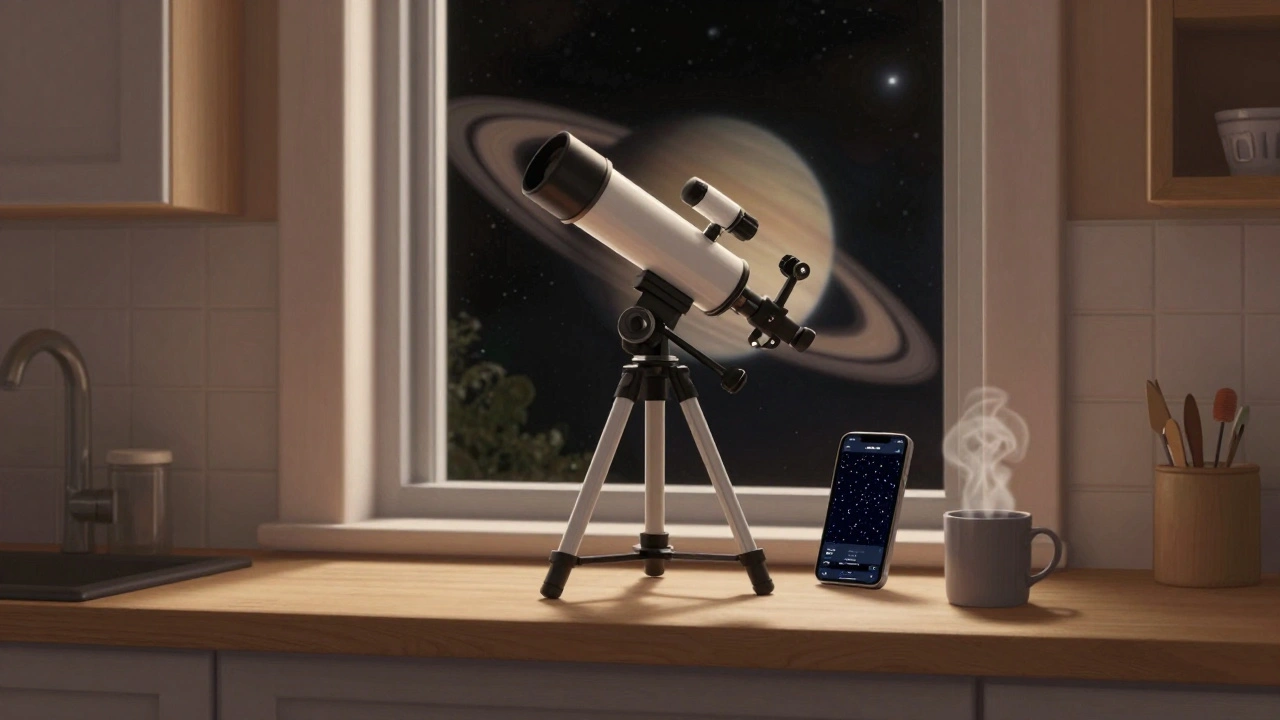
- Use a phone app. Try SkySafari or Stellarium Mobile. Point your phone at the sky-it’ll show you what’s up. Then use the telescope to find it.
Pro tip: If your balcony is too windy, bring the telescope inside and look out a window. Just open the window and rest the base on the sill. Many urban observers do this. It’s quieter, warmer, and surprisingly effective.
What You Don’t Need
Don’t waste money on these common beginner mistakes:
- High-power eyepieces. 6mm or 4mm eyepieces sound cool but just make images fuzzy. Stick with 10mm-20mm. You’ll see more.
- Motorized mounts. If you’re in an apartment, you don’t need tracking. You’re not photographing galaxies. You’re looking. Manual is better.
- Barlow lenses. They double magnification but cut light and clarity. Skip them until you’re advanced.
- Expensive filters. Lunar filters help with brightness, but they’re optional. Start without them.
Focus on learning the sky. The best telescope is the one you use. And if you’re using a tabletop Dobsonian every clear night, you’re already ahead of 90% of people who bought a telescope and left it in the box.
When to Skip a Tabletop Dobsonian
These telescopes aren’t magic. They’re not right for everyone.
If you:
- Want to photograph deep-sky objects (galaxies, nebulae)
- Live in a high-rise with no outdoor access
- Need to store your telescope in a closet or under a bed
- Want to use it during the day for birdwatching or landscape viewing
Then a tabletop Dobsonian isn’t your best fit. For astrophotography, you need a tracking mount. For indoor-only use, consider a pair of 10x50 binoculars-they’re cheaper, more portable, and show you the same bright objects with less setup.
Final Thought: You Don’t Need a Dark Sky
Many people think you need to drive 30 miles out of town to see anything. That’s not true anymore. With a tabletop Dobsonian, you can see the wonders of the solar system from your apartment window. You don’t need perfect skies-you just need a clear night and 10 minutes to set up.
One of the most common stories I hear from apartment stargazers is this: they looked up one night, saw Saturn, and called their kid. Or their partner. Or a friend. Suddenly, stargazing became a ritual. A quiet moment of wonder in a busy city.
You don’t need a backyard. You don’t need a telescope that costs $1,000. You just need a small, simple tool-and the curiosity to look up.
Can a tabletop Dobsonian fit in a small apartment?
Yes. Most tabletop Dobsonians are under 20 inches long and 8 inches wide. They fit easily in a closet, under a bed, or on a shelf. The base is usually a flat circle, so it doesn’t take up much space. You can even store the eyepieces inside the tube.
Is a 6-inch Dobsonian too big for an apartment?
No. A 6-inch model weighs about 11-12 pounds and sits on a table. It’s not bulky-it’s just a tube with a base. If you can carry a backpack, you can carry this. The real issue is storage space, not size. Most users keep theirs on a bookshelf or in a corner.
Can I use a tabletop Dobsonian on a balcony?
Absolutely. Balconies are ideal. Just make sure the surface is stable and not too windy. If it’s cold, bring a blanket and a thermos. Many urban astronomers prefer balcony observing because it’s quiet and gives a clearer view than looking through a window.
Do I need a finder scope?
Most tabletop Dobsonians come with a simple red dot finder or a basic optical finder. You don’t need anything fancy. If you’re struggling to find objects, use a free app like SkySafari on your phone. Point it at the sky, then move the telescope to match.
How long does it take to learn to use one?
You can start seeing the Moon and Jupiter on night one. Learning to find planets and star clusters takes a few weeks. Most users get comfortable in about a month. No classes needed. Just go out, look up, and try again.
Are tabletop Dobsonians good for kids?
Yes. They’re simple, durable, and don’t need batteries. Kids as young as 8 can use them with supervision. The direct view (no mirrors or screens) helps them understand what they’re seeing. Many parents report their kids asking to go outside every night after getting one.
If you’re ready to start, pick up a 6-inch tabletop Dobsonian. Wait for a clear night. Step outside. Look up. And remember-you’re not just looking at stars. You’re connecting with something ancient, quiet, and beautiful, right where you live.