17 Aug 2026
- 0 Comments
There is a specific thrill in pointing a telescope at Venus is the second planet from the Sun and the brightest natural object in Earth's night sky after the Moon. You are not just looking at a star-like point of light. You are witnessing a dynamic celestial dance where the planet shifts from a thin sliver to a full disk over roughly 584 days. This cycle, known as the synodic period, creates distinct shapes that mirror our own lunar phases but on a much faster timeline.
For many amateur astronomers, this remains one of the most rewarding observations possible. Unlike Mars or Jupiter, which look relatively static in shape, Venus changes dramatically every few weeks. If you know when to look and what to expect, you can track these changes with naked-eye precision through your eyepiece. Here is how to make the most of this phenomenon without needing professional-grade gear.
Understanding the Geometry of Venus
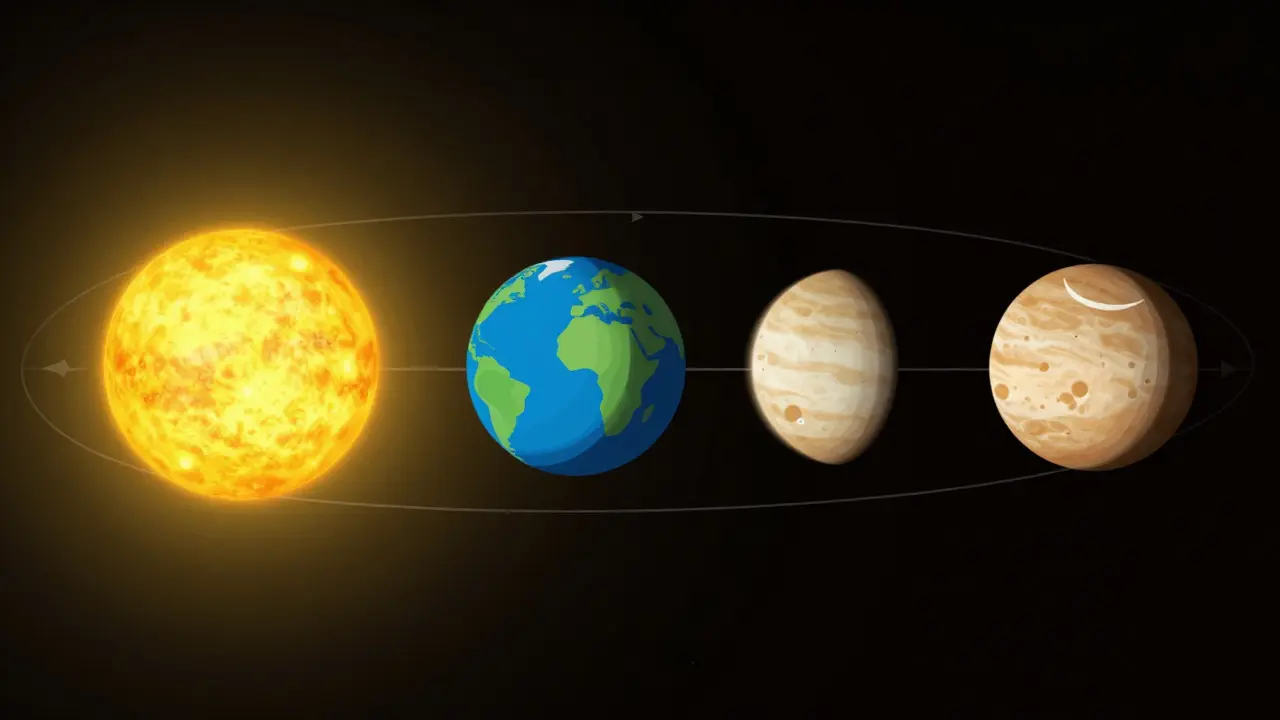
To appreciate why Venus looks like it does, you have to understand its position relative to Earth and the Sun. Venus is an inferior planet, meaning it orbits closer to the Sun than we do. Because of this, it never strays far from the Sun in our sky. It appears either in the western sky just after sunset (as an "Evening Star") or in the eastern sky just before sunrise (as a "Morning Star").
The phase of Venus depends entirely on where it sits in its orbit compared to us. When Venus is between Earth and the Sun, we see only a tiny sliver of sunlight hitting its day side, creating a crescent shape. When Venus is on the opposite side of the Sun from Earth, we see the fully illuminated disk, though it appears smaller because it is farther away. This inverse relationship-size versus illumination-is the core puzzle of observing Venus.
The Four Key Stages of Observation
You don't need to observe every single night to catch the drama. Instead, focus on four critical windows during the ~19-month cycle. Each stage offers a unique visual experience that tests your equipment and your eyes differently.
- Crescent Phase: This occurs shortly after greatest elongation (when Venus is farthest from the Sun in angular distance). The disk is large, spanning about 60-70 arcseconds, but only a small portion is lit. This is the hardest phase to see clearly due to atmospheric turbulence near the horizon. Wait until Venus is high enough above the tree line or buildings.
- Gibbous Phase: As Venus moves toward superior conjunction (behind the Sun), the illuminated portion grows. The disk shrinks slightly, but the contrast improves. This is often the sweet spot for beginners because the shape is clear, the planet is bright, and it stays visible for longer periods of the evening.
- Full Phase: At superior conjunction, Venus is directly behind the Sun. Technically, it is invisible to us because it is lost in the solar glare. However, in the weeks leading up to and following this point, you will see a nearly full disk. It is small (around 10-15 arcseconds) but sharp if conditions are good.
- Waxing Crescent: After passing the Sun, Venus re-emerges as a morning star. It starts as a thin crescent again, growing larger as it moves away from the Sun. This mirrors the evening sequence but happens in the pre-dawn hours.
Choosing Your Telescope and Eyepiece
You do not need a massive reflector to see Venus phases. In fact, very large apertures can sometimes work against you by increasing sensitivity to atmospheric seeing. A small refractor (60mm to 80mm aperture) or a compact Dobsonian telescope is ideal. The key requirement is stability. Any vibration makes judging the exact curvature of the crescent difficult.
Magnification matters more here than raw light-gathering power. To resolve the fine details of the crescent tip, you want high magnification. Aim for 150x to 250x. For example, if you have a 1000mm focal length telescope, use a 4mm or 5mm eyepiece. Do not go higher than 300x unless your atmosphere is exceptionally steady; otherwise, the image will shimmer and blur the edges.
| Phase | Illumination % | Angular Size (Arcsec) | Visibility Window |
|---|---|---|---|
| Thin Crescent | ~10% | ~65" | Low altitude, short duration |
| Half (Dichotomy) | 50% | ~45" | Medium altitude, moderate duration |
| Gibbous | ~80% | ~25" | Higher altitude, longer duration |
| Full | 100% | ~12" | Near Sun, difficult to locate |
Techniques for Sharper Views
Seeing Venus clearly is less about the glass and more about technique. Atmospheric turbulence distorts the image, making the crescent tips waver. Here are three practical tips to stabilize your view:
First, wait for the planet to rise higher. Observing Venus within 30 degrees of the horizon is risky. The air path is long, and heat shimmer is intense. Aim for observations when Venus is at least 40-50 degrees up.
Second, let your telescope settle. Cold optics create internal convection currents that ruin sharpness. Set up your scope at least 20 minutes before observing to let the tube temperature match the ambient air.
Third, relax your eye. Staring hard at a high-magnification image causes eye strain and blurs perception. Look slightly off-axis and then back at the center. This peripheral vision trick often reveals sharper edges than direct staring.
Tracking the Cycle: What to Log
The best way to learn is to document. Keep a simple journal or use a spreadsheet. Record the date, time, magnification used, and a sketch of the shape. You don't need to be an artist; stick figures of the crescent width are enough. Over six months, you will start to see the pattern yourself. You will notice that the crescent gets thinner just before it disappears into the Sun’s glare, and thicker just after it emerges. This personal data becomes invaluable for predicting future visibility windows.
Common Pitfalls to Avoid
Many observers give up too early. If the sky is hazy, try again the next night. Consistency beats perfection. Also, avoid using filters that cut too much light. A neutral density filter can help reduce glare, but a strong color filter might distort the subtle shading of the terminator (the line between light and dark). Stick to standard white light or a very mild yellow filter if the sun is low and causing discomfort.
Frequently Asked Questions
Can I see Venus phases with binoculars?
Yes, but it is challenging. Binoculars typically offer 10x to 30x magnification. You will see Venus as a distinct dot, and on very clear nights, you might discern a gibbous or half shape. However, the thin crescent phases usually require the higher magnification of a telescope to be clearly resolved.
Why does Venus appear brighter when it is a crescent?
This is counterintuitive but true. When Venus is a crescent, it is closer to Earth, making its apparent size much larger. Even though only a small fraction is illuminated, the total surface area reflecting light toward us is greater than when it is full but distant. This proximity effect boosts its overall brightness significantly.
How often does the Venus cycle repeat?
The synodic period of Venus is approximately 584 days, or about 19 months. This means the pattern of phases repeats itself every 19 months. However, because 19 months is not a whole number of years, the seasons in which you see certain phases shift slightly each year.
Do I need special software to find Venus?
Not necessarily. Venus is the third brightest object in the sky. Once you know the direction of the Sun, you can estimate its position. However, apps like Stellarium or SkySafari are helpful for beginners to pinpoint exactly where to look, especially when Venus is close to the horizon and obscured by terrain.
Is it safe to look at Venus with a telescope?
Yes, absolutely. Unlike the Sun, Venus reflects sunlight rather than emitting it. There is no risk of retinal damage from looking at Venus through a telescope. You can observe it safely whenever it is visible in the twilight sky.