17 Aug 2026
- 0 Comments
Imagine standing in a field at night, watching a star vanish behind the moon’s edge, only to reappear moments later. For most people, that’s just a pretty sight. But for citizen scientists tracking precise astronomical events where one celestial body passes in front of another, those seconds are gold. Accurate occultation predictions aren’t just about knowing when something happens; they’re about knowing exactly where you need to be, down to the kilometer, to catch the fleeting moment of a graze or a cross-country transit.
The difference between a successful observation and a wasted trip often comes down to two things: the quality of your prediction data and your understanding of local geometry. Whether you’re chasing a lunar chord across North America or a planetary occultation visible from Europe, the principles remain the same. You need to translate global ephemeris data into local ground truth.
Why Precision Matters in Occultation Observations
Unlike total solar eclipses, which have wide paths of totality, many stellar occultations by the Moon (lunar occultations) are narrow. A "graze" occurs when the star skims along the limb of the Moon, sometimes disappearing and reappearing multiple times due to the rugged terrain of the lunar mountains. If your predicted time is off by even 30 seconds, you might miss the entire event or stand in the wrong place entirely.
Citizen science projects rely on these precise timings to refine our models of the Moon’s topography and orbital mechanics. When you record an exact disappearance (D) and reappearance (R) time, you contribute to a dataset that helps astronomers map craters and ridges with meter-level precision. This isn't just hobbyist fun; it's active scientific contribution.
- Timing Accuracy: Requires GPS-synced clocks or NTP network time synchronization.
- Location Specificity: Your latitude and longitude must be accurate to within 10 meters for high-precision chords.
- Atmospheric Conditions: Seeing conditions affect the perceived sharpness of the event, though less so for timing than for imaging.
Understanding Chords and Grazes
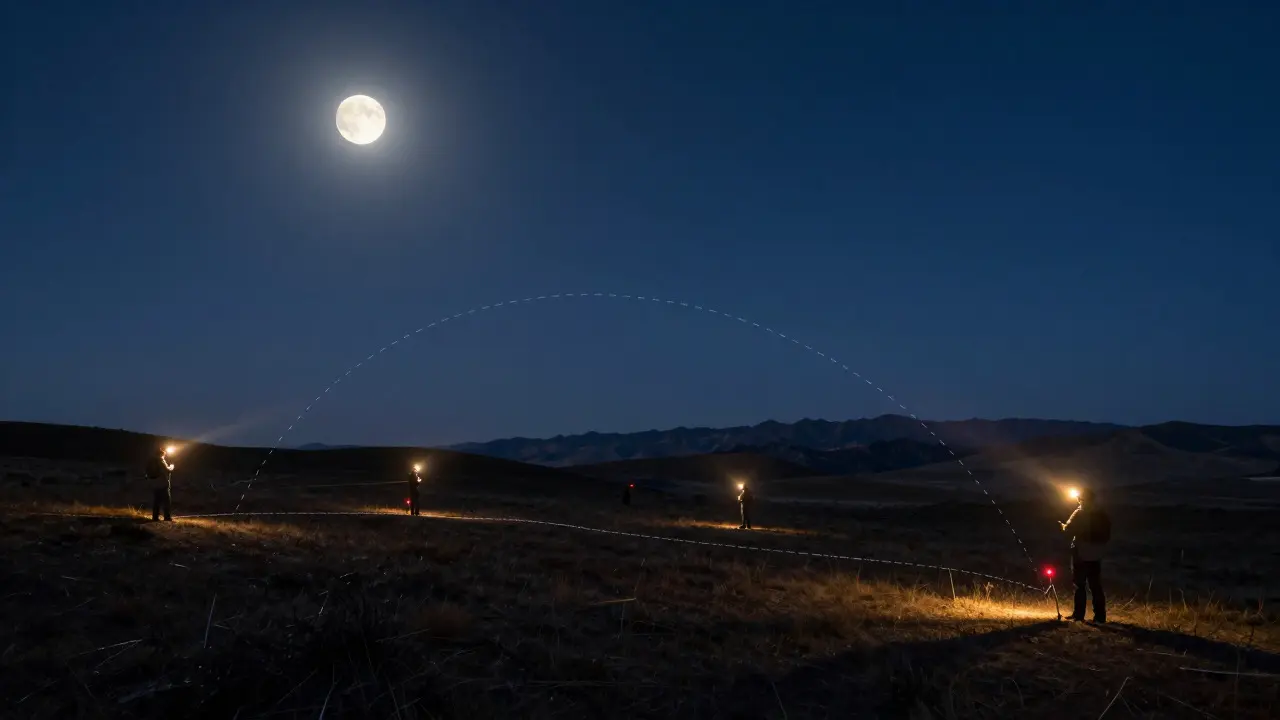
A chord is the path on Earth where the star disappears and reappears behind the Moon's limb. The center line of this chord is where the event lasts the longest. As you move away from the center line, either north or south, the duration shortens until you reach the limit lines, where the star just touches the limb.
Grazes are the most exciting but also the trickiest. Because the Moon’s surface is not smooth, a star can blink in and out as it passes behind peaks and valleys. Predicting exactly how many blinks will occur and their precise timing requires detailed digital elevation models of the lunar limb. Services like the IOTA (International Organization of Timing Associations) provide these refined predictions, accounting for specific crater profiles.
For a cross-country timing campaign, observers spread out along the chord record their individual D and R times. By comparing these times across different locations, researchers can triangulate the exact position of the lunar feature causing the occultation. This collaborative effort turns individual backyard observations into a high-resolution map of the Moon’s edge.
Tools and Data Sources for Reliable Predictions
You don’t need to calculate orbital mechanics yourself. Several authoritative sources provide pre-computed ephemerides. The key is choosing the right tool for your level of precision.
| Tool Name | Primary Use Case | Precision Level | Best Feature |
|---|---|---|---|
| IOTA Ephemerides | Lunar grazing and chord planning | High (meter-level) | Detailed limb profile integration |
| X-Ephem (Stellarium) | General visibility checks | Moderate | Easy-to-use graphical interface |
| OccultPlan | Advanced custom calculations | Very High | Customizable coordinate inputs |
When using these tools, always input your exact coordinates. Using city-center coordinates instead of your actual observing site can introduce errors of several seconds in timing, which is fatal for tight grazes. Additionally, check the "limit lines" provided by the software. These show the northernmost and southernmost points where the event is still visible. If you’re outside these lines, the star won’t disappear at all.
Planning Your Observation Strategy
Once you have your prediction, the next step is logistics. For cross-country campaigns, coordination is key. Here is a practical workflow for planning a session:
- Select the Event: Choose a target with a favorable sky position (high altitude, away from twilight). Avoid targets near the horizon where atmospheric refraction distorts timing.
- Check the Weather: Clear skies are non-negotiable. Use hyper-local weather forecasts rather than regional ones. Cloud cover over a specific valley can ruin an otherwise perfect forecast.
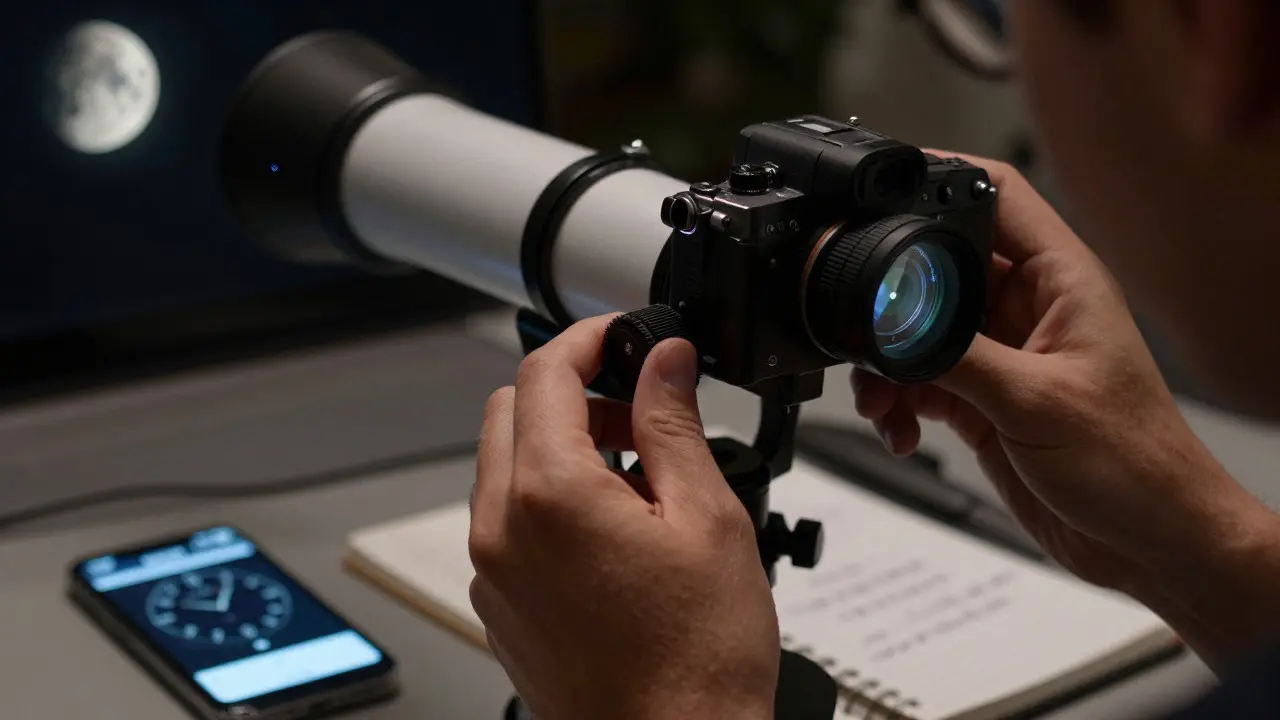
- Prepare Your Equipment: A telescope with a focal length of 800mm to 1200mm is ideal for video recording. You need enough magnification to see the star clearly against the lunar limb, but not so much that the field of view becomes too small to track easily.
- Set Up Timekeeping: Use a dedicated device for timing. A smartphone connected to the internet via NTP is sufficient, but a GPS clock provides independent verification. Record the start and end times of your video file to correlate with the observed event.
- Test Your Setup: Before the event, test your video recording frame rate. You want at least 30 frames per second to capture rapid blinks during a graze. Lower frame rates may miss quick appearances and disappearances.
If you are traveling to a remote location for a major event, drive there early. Setting up a tripod and aligning a telescope takes longer than you think, especially in the dark. Arriving at least an hour before the predicted mid-time gives you buffer for technical issues.
Common Pitfalls and How to Avoid Them
Even experienced observers make mistakes. The most common error is underestimating the impact of atmospheric seeing. On nights with poor seeing, the star’s image will wobble, making the exact moment of disappearance harder to pinpoint visually. This is why video recording is preferred over visual estimation. Video allows you to scrub through frames later to find the exact moment of contact.
Another pitfall is ignoring the Moon’s libration. The Moon wobbles slightly as it orbits Earth, changing which side of its surface we see. While this doesn’t drastically change the timing of a standard occultation, it affects the apparent position of the limb features. Always use up-to-date ephemerides that account for current libration values.
Finally, don’t forget to log your metadata. After the event, immediately note your exact location (GPS coordinates), telescope specs, camera settings, and any environmental factors like wind or temperature. This data is crucial for validating your results against other observers’ reports. Incomplete logs render good data useless for scientific analysis.
Contributing to Global Datasets
Your individual observation is a piece of a larger puzzle. Organizations like the IOTA and various university-led projects aggregate data from hundreds of observers worldwide. By submitting your timed observations, you help verify theoretical predictions and discover new anomalies in the Moon’s orbit or surface structure.
For beginners, start with simpler events, such as bright stars passing behind the Moon’s smooth equatorial regions. These are more forgiving and easier to time accurately. As your skills grow, tackle complex grazes involving mountain ranges. Each successful observation builds your confidence and contributes valuable data to the global scientific community.
Remember, the goal isn’t just to watch; it’s to measure. Every second you record brings us closer to understanding the celestial mechanics that govern our night sky. So grab your gear, check your predictions, and get ready to capture the universe in real-time.
What is the best equipment for recording lunar occultations?
A telescope with a focal length between 800mm and 1200mm paired with a CMOS camera capable of at least 30 frames per second is ideal. This setup provides enough magnification to see the star clearly while allowing fast enough recording to capture rapid blinks during grazes. Avoid using very long focal lengths as they make tracking difficult and reduce the field of view.
How accurate do my GPS coordinates need to be?
For high-precision chord observations, your coordinates should be accurate to within 10 meters. Small errors in location can lead to significant timing discrepancies, especially for narrow chords or tight grazes. Use a dedicated GPS unit or a smartphone with high-accuracy mode enabled to ensure precise positioning.
Can I observe an occultation without a telescope?
Yes, but with limitations. Binoculars or the naked eye can be used for basic timing of bright stars, but you will lack the resolution to see fine details of the lunar limb or capture rapid blinks during grazes. For serious citizen science contributions, a telescope and video camera are strongly recommended to achieve the necessary precision.
What is the difference between a graze and a chord?
A chord is the general path on Earth where the star disappears and reappears behind the Moon. A graze is a specific type of chord where the star passes close to the Moon's rugged limb, causing it to blink in and out due to lunar mountains. Grazes are more complex to predict and observe because of the irregular terrain involved.
How do I submit my observation data?
Most major organizations like IOTA have online portals for submitting timed observations. You will typically need to provide your name, location, equipment used, and the precise UTC times of disappearance and reappearance. Include any notes on atmospheric conditions or video links if available. Ensure your data is formatted according to the organization's guidelines for easy processing.