17 Aug 2026
- 0 Comments
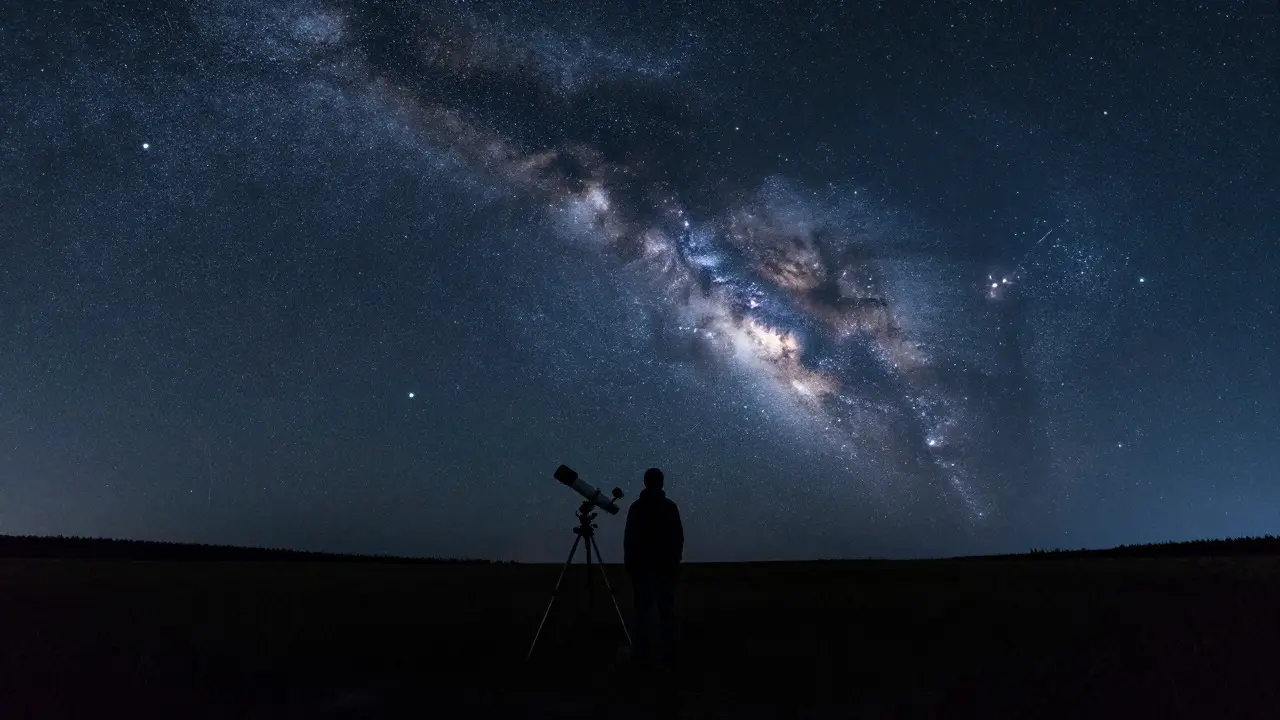
Imagine you are standing in the middle of a vast, dark field at night. You want to point your telescope at a specific star, but there are no street signs, no mile markers, and no grid lines on the sky. How do you find it? This is where celestial coordinates come in. They are the GPS system for the night sky, allowing astronomers and hobbyists alike to pinpoint any object with precision. If you have ever tried star hopping-the technique of moving from one bright star to another to reach a target-you already know that understanding this coordinate system is not just helpful; it is essential.
The two main components of this system are Right Ascension (RA) and Declination (Dec). Together, they form a spherical coordinate system that wraps around the Earth, much like latitude and longitude wrap around our planet. But unlike geographic coordinates, which are fixed relative to the ground, celestial coordinates are fixed relative to the stars. This distinction matters because the Earth rotates, but the stars appear to move across the sky due to that rotation. By using RA and Dec, we create a stable reference frame that allows us to track objects regardless of where or when we observe them.
What Are Right Ascension and Declination?
To understand how these coordinates work, we first need to look at the celestial sphere. This is an imaginary sphere centered on the Earth onto which all distant stars and galaxies are projected. It has a north pole and a south pole, aligned with Earth's rotational axis. The equator of this sphere is the projection of Earth's equator into space, known as the celestial equator.
Declination is the angular distance of an object north or south of the celestial equator. It works exactly like latitude on Earth. The celestial equator is 0° Declination. The North Celestial Pole is +90°, and the South Celestial Pole is -90°. If you live in Portland, Oregon, your latitude is approximately 45° N. This means you can see stars with Declinations ranging roughly from +45° up to +90° and down to about -45° above the horizon. Objects with Declinations lower than -45° will never rise above your northern horizon. Understanding this limit helps you choose targets that are actually visible from your location.
Right Ascension is the east-west position of an object measured along the celestial equator. Unlike Declination, which uses degrees, Right Ascension is measured in time units: hours, minutes, and seconds. There are 24 hours of RA in a full circle. Why time? Because the Earth rotates 360 degrees in 24 hours. One hour of RA corresponds to 15 degrees of arc (360 / 24 = 15). The zero point, or origin, is defined by the vernal equinox, the point where the Sun crosses the celestial equator moving northward in March. As the Earth rotates, objects with higher RA values rise later in the evening. For example, a star with RA 00h 00m rises near sunset in late March, while a star with RA 12h 00m rises near midnight in late March.
How Star Hopping Uses These Coordinates
Star hopping is the art of navigating the sky without relying entirely on electronic go-to systems. Instead, you use bright, easily identifiable stars as waypoints. Your goal is to move from a known star to your target object by following a path of other stars. This method requires you to understand the relative positions of objects, which is where RA and Dec become your primary tools.
When planning a star hop, you look at the difference in RA and Dec between your starting star and your target. Let’s say you are trying to find M42, the Orion Nebula. Its coordinates are approximately RA 05h 35m and Dec -05° 23'. A good starting point might be Rigel, one of the brightest stars in Orion. Rigel has coordinates of RA 05h 14m and Dec -08° 12'. Notice that the RA is very close (only about 21 minutes apart), but the Dec differs by about 3 degrees. This tells you that M42 is almost directly above Rigel in the sky, slightly to the west. In practice, you would locate Rigel, then look slightly upward and to the left (west) to find the nebula. The small difference in RA means you don’t have to scan far horizontally, saving you time and reducing the chance of losing your place in the sky.
Another example involves finding M13, the Great Cluster in Hercules. M13 has coordinates of RA 16h 41m and Dec +36° 27'. A common approach is to start from the star Zeta Herculis, which is part of the Keystone asterism in Hercules. Zeta Her has coordinates of RA 16h 55m and Dec +35° 02'. Here, the RA difference is about 14 minutes, and the Dec difference is about 1.5 degrees. This suggests M13 is slightly to the east and north of Zeta Her. By knowing these directional cues, you can confidently sweep your eyepiece in the correct direction rather than randomly searching the entire field of view.

Converting Between Time and Degrees
One of the most common stumbling blocks for beginners is mixing up time-based RA with degree-based Dec. While Dec is straightforward (degrees, arcminutes, arcseconds), RA requires conversion if you want to visualize angular distances. Remember the core rule: 1 hour of RA equals 15 degrees. Therefore, 1 minute of RA equals 15 arcminutes, and 1 second of RA equals 15 arcseconds.
Let’s break this down with a practical example. Suppose you are comparing two stars. Star A has an RA of 10h 00m, and Star B has an RA of 10h 10m. The difference in RA is 10 minutes. To convert this to degrees, you multiply 10 by 15, giving you 150 arcminutes, or 2.5 degrees. Now, if the Dec difference between the two stars is also 2.5 degrees, you can estimate the total angular separation using basic trigonometry. However, for simple star hopping, you usually only need to know the direction and approximate magnitude of the shift. Knowing that 10 minutes of RA is equivalent to 2.5 degrees helps you gauge how far to move your telescope. Most binoculars have fields of view between 5 and 10 degrees, so a 2.5-degree shift is manageable within a single view.
| Unit Type | Measurement Unit | Equivalent in Degrees/Arcminutes | Typical Use Case |
|---|---|---|---|
| Declination | 1 Degree | 1° (60 arcminutes) | North-South positioning |
| Right Ascension | 1 Hour | 15° (900 arcminutes) | East-West positioning over large scales |
| Right Ascension | 1 Minute | 15' (15 arcminutes) | Precise star hopping adjustments |
| Right Ascension | 1 Second | 15" (15 arcseconds) | High-precision astrophotography alignment |
Visibility and Seasonal Constraints
Knowing the coordinates of an object is only half the battle. You also need to know if it is currently visible from your location. This depends on two factors: the object's Declination and its Right Ascension relative to the current date and time.
Declination determines whether an object is circumpolar, seasonal, or never visible. From Portland, Oregon (latitude ~45° N), objects with Declinations greater than +45° are circumpolar; they never set below the horizon. Objects with Declinations less than -45° are never visible. Objects in between rise and set depending on the season. For instance, Sirius, the brightest star in the night sky, has a Declination of -16° 43'. It is well within the visible range for Portland, rising in the southeast in winter evenings and setting in the southwest before dawn. However, during summer, Sirius rises after sunrise, making it difficult to observe under dark skies.
Right Ascension determines the best time of year to observe an object. An object is highest in the sky at midnight when its RA matches the local sidereal time. Local sidereal time advances by about 2 hours each month. Therefore, constellations with RA around 00h are best viewed in early spring, those with RA around 06h in early summer, those with RA around 12h in early autumn, and those with RA around 18h in early winter. If you are planning to observe M31, the Andromeda Galaxy (RA 00h 42m, Dec +41° 16'), you should aim for late winter or early spring nights. During this period, Andromeda is high in the southern sky around midnight, providing optimal viewing conditions. Trying to find it in August would be frustrating because it sets too early in the evening to be useful for deep-sky observing.
Common Pitfalls and Pro Tips
Even experienced observers make mistakes with celestial coordinates. One frequent error is confusing the East-West orientation. On a standard sky map, East is on the left and West is on the right. This is the opposite of a terrestrial map. Why? Because you are looking up at the sky, not down at the ground. When you face South, East is to your left. Since most Northern Hemisphere observers face South to view the majority of the sky, East appears on the left side of their mental map. Always remember: RA increases toward the East. So, if your target has a higher RA than your guide star, you need to move your telescope to the East (left if facing South).
Another pitfall is ignoring atmospheric refraction. Near the horizon, the atmosphere bends light, making objects appear higher than they actually are. This effect is negligible at zenith (overhead) but can shift an object’s apparent position by several degrees near the horizon. For precise star hopping, especially for faint deep-sky objects, account for this by aiming slightly lower than the calculated coordinates if the object is near the horizon.
Here are some pro tips to enhance your star hopping success:
- Use a red-light flashlight: Preserve your dark adaptation by using a dim red light when reading charts or checking coordinates.
- Learn the major asterisms: Familiarize yourself with patterns like the Big Dipper, the Summer Triangle, and the Keystone in Hercules. These serve as reliable landmarks for navigation.
- Practice with bright stars first: Before attempting faint galaxies, practice moving between bright stars. Get comfortable with the feel of your mount and the speed of your movements.
- Keep a logbook: Record the coordinates of objects you successfully find. Over time, you will build an intuitive sense of the sky’s layout.
Frequently Asked Questions
Why is Right Ascension measured in time instead of degrees?
Right Ascension is measured in time because the Earth rotates 360 degrees in 24 hours. Using time units makes it easier to relate the position of celestial objects to the clock. One hour of RA corresponds to 15 degrees of arc, which simplifies calculations for astronomers who track objects as they move across the sky due to Earth's rotation.
Can I use Right Ascension and Declination for planets?
Yes, but with a caveat. Planets move against the background of fixed stars, so their RA and Dec change daily. While the coordinate system applies to planets, you must check ephemerides for their current positions. Fixed stars and deep-sky objects have nearly constant coordinates, making them more stable references for long-term planning.
How accurate do my coordinates need to be for star hopping?
For visual star hopping, accuracy within 1 to 2 degrees is usually sufficient. This corresponds to about 4 to 8 minutes of RA or 1 to 2 degrees of Dec. Your field of view in a typical eyepiece is often 1 to 5 degrees, so being within this range ensures the target is likely in your view. For astrophotography, however, you need sub-arcsecond precision to align accurately.
What is the difference between altitude/azimuth and RA/Dec?
Altitude and Azimuth are horizontal coordinates based on your local horizon. Altitude is the angle above the horizon, and Azimuth is the compass direction. These coordinates change constantly as the Earth rotates. RA and Dec are equatorial coordinates fixed relative to the stars. They remain constant for a given object, making them ideal for cataloging and long-term tracking, whereas Alt/Az is better for immediate pointing relative to the ground.
Do I need to know the exact date to use celestial coordinates?
You need the date to determine the visibility of an object, specifically its Right Ascension relative to the current sidereal time. The coordinates themselves (RA and Dec) do not change significantly over human timescales for stars and galaxies. However, knowing the date helps you predict when an object will be highest in the sky, ensuring you plan your observation for the best possible conditions.