17 Aug 2026
- 0 Comments
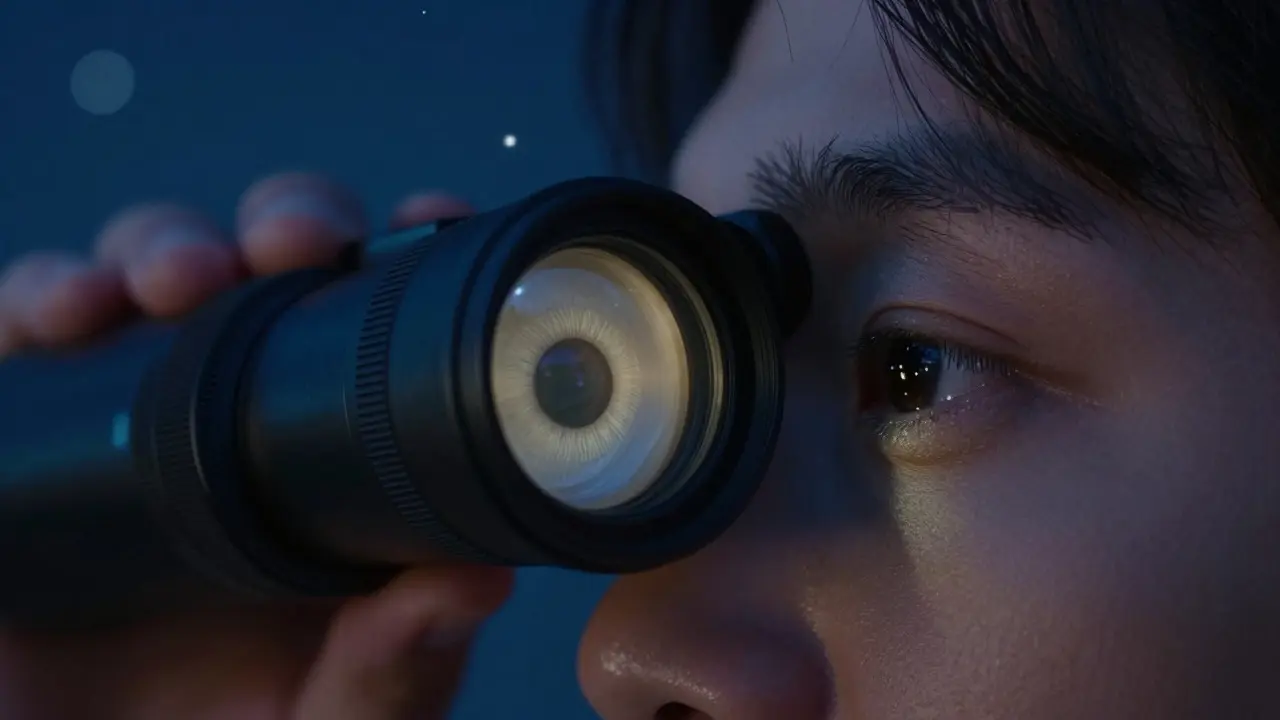
Looking through a high-quality telescope should feel like seeing the universe in sharp focus. But if you notice stars turning into soft ovals or lines instead of pinpoint dots, your eyes might be playing tricks on you. This is often Astigmatism is a common refractive error where the cornea has an irregular shape, causing light to focus at multiple points rather than one. Unlike simple nearsightedness, astigmatism distorts shapes, making circular objects appear stretched. For astronomers, this can ruin image quality even with perfect optics. Understanding how to calculate and correct for this using Diopters is the unit of measurement for the optical power of a lens, defined as the reciprocal of the focal length in meters is essential for getting the best view from your eyepiece.
Why Your Eyes Matter More Than Your Telescope
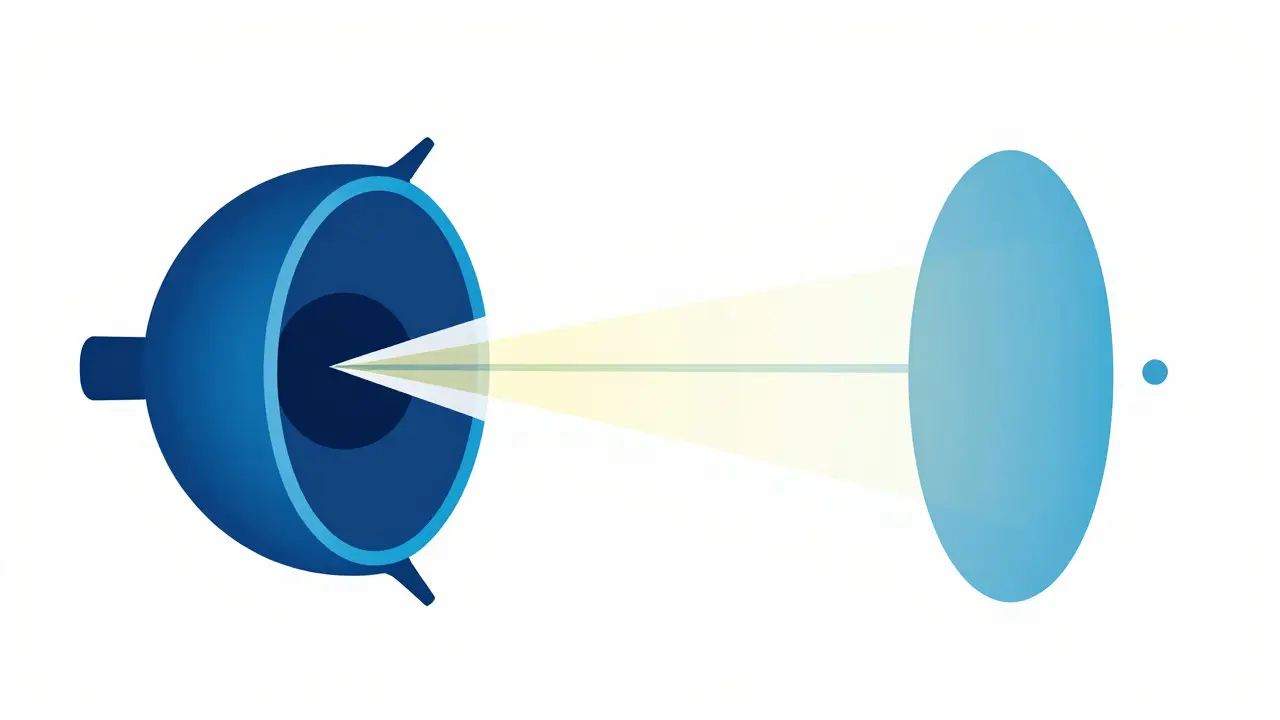
Many observers assume that if their telescope is aligned and focused correctly, the image will be perfect. However, the human eye is the final lens in the chain. If your eye has uncorrected astigmatism, it introduces distortion that no amount of telescope adjustment can fix. The Cornea is the transparent front part of the eye that covers the iris and pupil, acting as the primary refractive surface usually curves more steeply in one direction than another. This asymmetry means light rays entering the eye don't converge at a single point on the retina. Instead, they form two focal lines. The result? A star that should be a bright dot becomes a fuzzy streak or a small ellipse.
This effect is particularly noticeable at high magnifications. When you zoom in on a planet or a double star, the diffraction spikes and Airy disks become elongated. If you have mild astigmatism, you might not notice it during casual viewing of the Moon. But when trying to resolve fine details on Mars or separate close binary stars, the distortion becomes obvious. Recognizing this early saves you hours of frustrated focusing.
The Math Behind Visual Correction
To correct astigmatism at the eyepiece, we need to understand how lenses interact with distorted light. The goal is to introduce an equal but opposite curvature to neutralize the eye's irregularity. This is done using cylindrical lenses, measured in Cylindrical Power is the additional optical power needed to correct astigmatism, expressed in diopters and oriented at a specific axis angle.
The basic formula for calculating the required correction involves the difference between the steepest and flattest meridians of your eye. Let's say your optometrist reports your prescription as -0.50 sphere and -1.00 cylinder at 90 degrees. The spherical part handles general nearsightedness, while the cylindrical part handles the astigmatism. To create a custom eyepiece adapter or select a corrective lens, you need to match this cylindrical power.
Here is a simplified way to think about the calculation:
- Identify the Cylinder Value: This is the magnitude of the astigmatism (e.g., -1.00 D).
- Determine the Axis: This is the orientation of the correction (e.g., 90 degrees). In telescopes, you must rotate the corrective lens to match this axis exactly.
- Calculate Effective Power: If you are adding a lens to an existing eyepiece, the effective power changes based on the distance from the eye. The formula $P_{effective} = P_{lens} / (1 - d \cdot P_{lens})$ helps estimate how much power reaches your eye, where $d$ is the distance in meters.
For most amateur astronomers, you don't need to build a custom lens. Instead, you use a dedicated astigmatic eyepiece or a clip-on filter designed for this purpose. These tools pre-calculate the necessary curvature based on standard prescriptions.
Practical Methods for Correction at the Eyepiece
You have three main options to tackle astigmatism during observation. Each has its own trade-offs in cost, convenience, and image quality.
| Method | Cost Range | Image Quality Impact | Convenience | Best For |
|---|---|---|---|---|
| Contact Lenses | $100 - $300/year | Minimal (if well-fitted) | High (set and forget) | Regular observers with stable prescriptions |
| Glasses (with adaptation) | $150 - $500 | Moderate (eye relief issues) | Medium (must wear during viewing) | Low-power wide-field viewing |
| Custom Cylindrical Eyepiece Adapter | $200 - $800 | Excellent (optical purity) | Low (requires specific setup) | High-magnification planetary/moon observing |
Contact Lenses are often the easiest solution. They sit directly on the eye, correcting the refraction before light enters the pupil. This eliminates the issue of eye relief, which is critical when wearing glasses with a telescope. However, dry eyes during long sessions can make them uncomfortable. If you choose this route, ensure your lenses are specifically designed for low-light conditions to maximize pupil dilation without excessive glare.
Glasses present a different challenge. Most eyepieces have limited "eye relief"-the distance between the lens and your eye where you can still see the full field of view. Wearing glasses pushes your eye back, potentially cutting off the edges of the image. If you must use glasses, look for eyepieces with long eye relief, such as wide-angle designs. Alternatively, some adapters allow you to remove the frame and mount just the lenses, though this is rare and expensive.
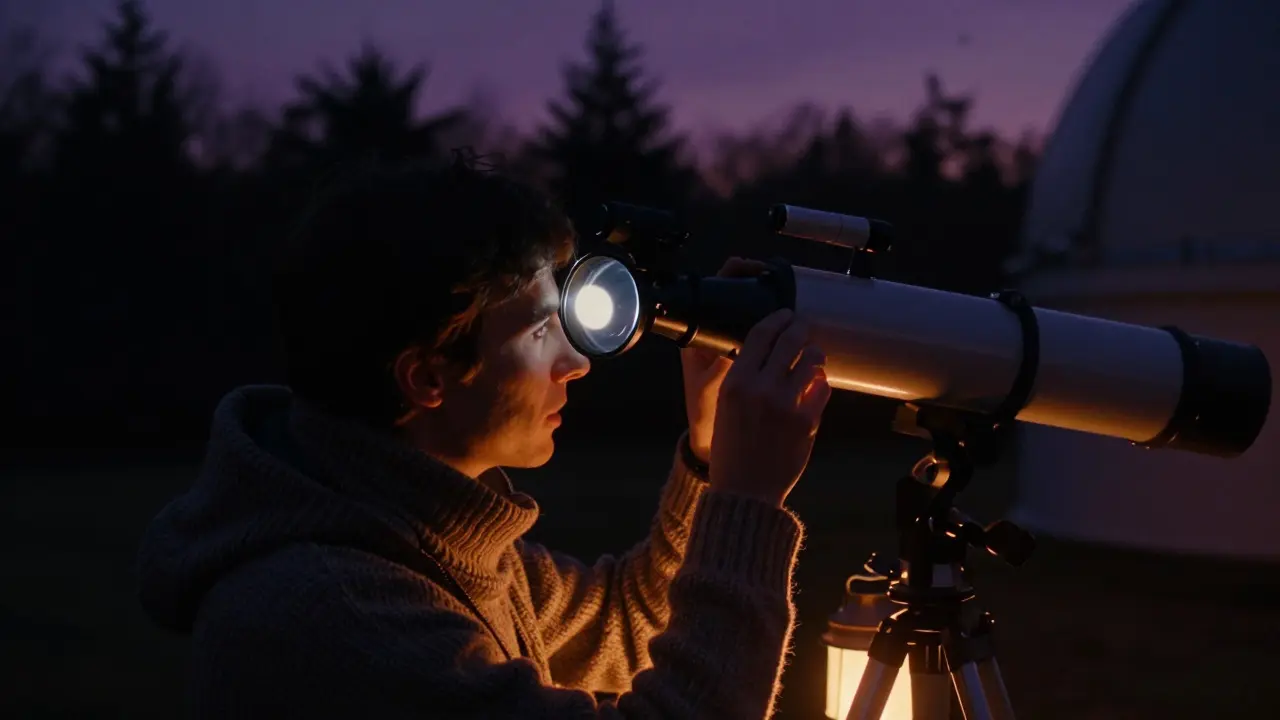
Custom Adapters are the pro-level solution. Companies like TeleVue and Baader offer cylindrical filters or dedicated eyepieces that incorporate astigmatic correction. These devices screw onto your existing eyepiece or replace it entirely. They allow you to keep your naked-eye vision intact while providing a perfectly corrected view through the scope. The downside is that you must align the axis marker on the adapter to match your prescription's axis. Getting this wrong by even 10 degrees can reduce the effectiveness of the correction significantly.
Common Pitfalls and How to Avoid Them
Even with the right equipment, mistakes happen. Here are the most frequent errors I see in home observatories:
- Ignoring the Axis: Astigmatism isn't just about strength; it's about direction. A -1.00 D correction at 180 degrees is completely different from one at 90 degrees. Always check your latest prescription sheet. If it's older than two years, get a new exam, as astigmatism can shift slightly over time.
- Over-Correcting: Some people try to "focus out" the blur by adjusting the telescope's focuser too far. This doesn't fix the shape distortion; it just makes the whole image softer. Trust the optical correction, not the mechanical focus.
- Using Cheap Filters: Not all cylindrical filters are created equal. Low-quality glass can introduce chromatic aberration or internal reflections. Stick to reputable brands that specify anti-reflective coatings.
- Neglecting Eye Health: Dry eyes can mimic astigmatism symptoms. Blinking frequently and using lubricating drops can sometimes improve clarity without any optical intervention.
When to Consider Professional Help
If your astigmatism is severe (above -2.00 D) or irregular, simple corrections might not suffice. Irregular astigmatism, often caused by keratoconus, cannot be fully corrected with standard cylindrical lenses. In these cases, rigid gas permeable contact lenses or specialized scleral lenses are recommended. These lenses create a new, smooth refractive surface in front of the eye, effectively bypassing the irregular cornea. While more complex to fit, they offer the highest level of visual acuity for demanding astronomical targets.
Also, consider consulting an optometrist who specializes in low-vision care or astronomy. They can test your visual acuity under dim lighting conditions, which is crucial because your pupils dilate significantly at night. A prescription optimized for daytime driving may not be ideal for nighttime stargazing.
Frequently Asked Questions
Can I use my regular reading glasses with a telescope?
Yes, but with caution. You need an eyepiece with sufficient eye relief to accommodate the distance between your glasses and your eye. Wide-angle eyepieces typically offer better eye relief. If the edge of the field of view is cut off, try moving the eyepiece slightly away from the telescope tube to increase the gap.
How do I know if my blurry view is due to astigmatism or poor telescope focus?
Focus issues affect all objects equally, making them uniformly soft. Astigmatism causes directional distortion. Look at a bright star at high magnification. If it appears as a perfect circle when focused, your optics are good. If it turns into an oval or line regardless of focus, you likely have astigmatism. Also, rotating the telescope 180 degrees won't change the orientation of the oval if it's caused by your eye, but it might if it's caused by collimation errors.
What is the maximum astigmatism that can be corrected with a standard eyepiece adapter?
Most commercial cylindrical filters cover ranges from -0.50 D to -3.00 D. Beyond this range, the thickness of the lens increases, which can introduce other optical distortions. For very high astigmatism, custom-made lenses or specialized contact lenses are more effective solutions.
Does astigmatism affect astrophotography?
Only if you are doing visual guiding or taking photos through your eyepiece (afocal photography). For direct imaging with a camera attached to the telescope, your eye is not in the light path, so your astigmatism does not affect the final image. The camera sensor captures the light exactly as the telescope delivers it.
How often should I update my prescription for astronomy?
Every two to three years is standard for adults. However, if you notice a sudden change in image quality or increased eye strain, get checked sooner. Astigmatism can progress slowly, especially in younger individuals. Keeping an up-to-date record ensures your corrective tools remain accurate.