28 Aug 2026
- 0 Comments
Imagine looking up at a star that looks completely steady one night, only to watch it dim by half its brightness just twenty-four hours later. This isn't a glitch in your telescope or a cloud passing overhead. You are witnessing an Eclipsing Binary System is a pair of stars orbiting each other in such a way that, from Earth's perspective, they periodically pass in front of one another, causing measurable drops in total brightness. These celestial dance partners offer some of the most precise data points we have for measuring stellar mass, radius, and distance. For amateur astronomers and serious observers, monitoring these systems provides a tangible connection to fundamental astrophysics without needing a space telescope.
The core appeal lies in the predictability. Unlike irregular variable stars that flare unpredictably, eclipsing binaries follow strict orbital mechanics. If you know the period-the time between primary eclipses-you can plan your observations down to the minute. This regularity turns what might seem like a chaotic sky into a structured experiment where every measurement counts toward a larger scientific picture.
Understanding the Mechanics of Eclipses
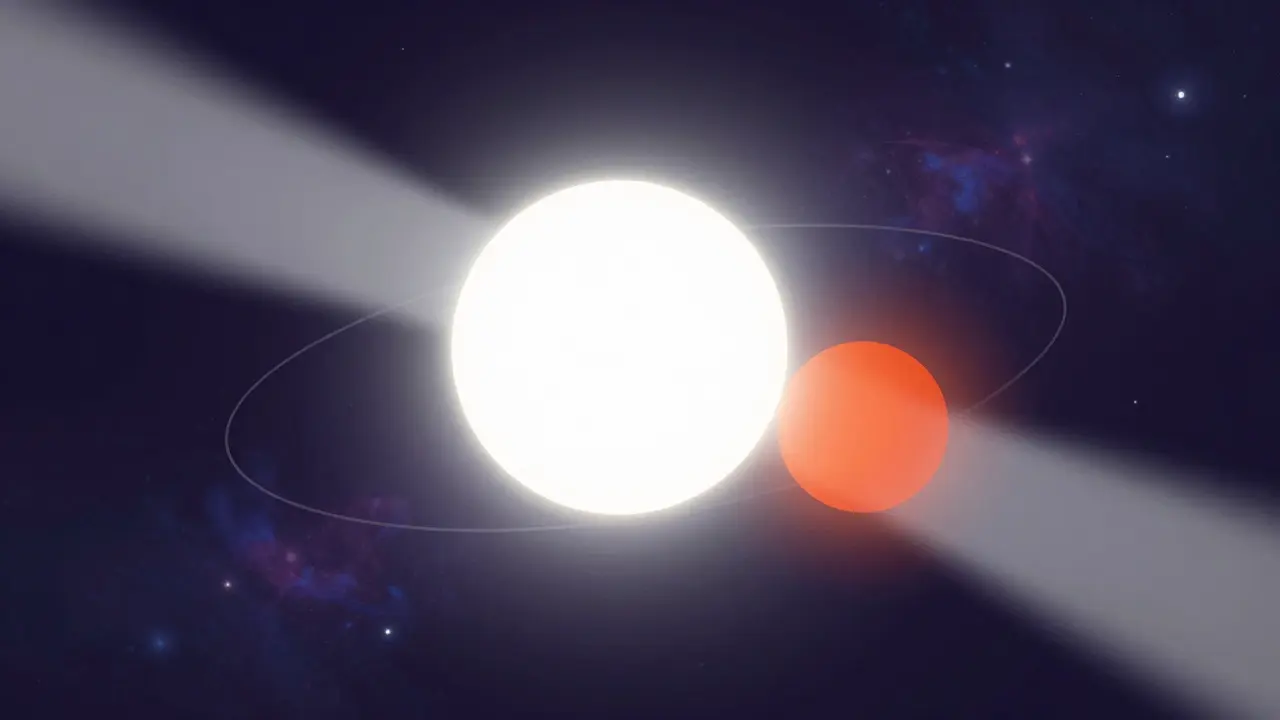
To monitor these systems effectively, you first need to understand what you are actually seeing. In a typical eclipsing binary, two stars orbit a common center of mass. When the smaller, often cooler star passes in front of the brighter, hotter primary, we call this the secondary eclipse. It causes a slight dip in brightness. However, when the cooler star passes behind the hotter primary, blocking a significant portion of its light, we observe the primary eclipse. This results in a much deeper drop in magnitude.
The shape of this light curve tells a story. A flat-bottomed primary eclipse suggests the stars are similar in size and temperature, or that the system is viewed edge-on with complete coverage. A V-shaped curve indicates partial eclipses, where one star only partially covers the other. By analyzing the depth and duration of these dips, astronomers can calculate the ratio of the stellar radii and the inclination angle of the orbit relative to our line of sight.
- Primary Eclipse: The deeper minimum occurring when the hotter star is obscured.
- Secondary Eclipse: The shallower minimum occurring when the cooler star is obscured.
- Ingress and Egress: The periods where the stars begin to overlap and separate, respectively.
- Out-of-Eclipse Light: The baseline brightness level when no occultation is happening.
Essential Tools for Photometric Monitoring
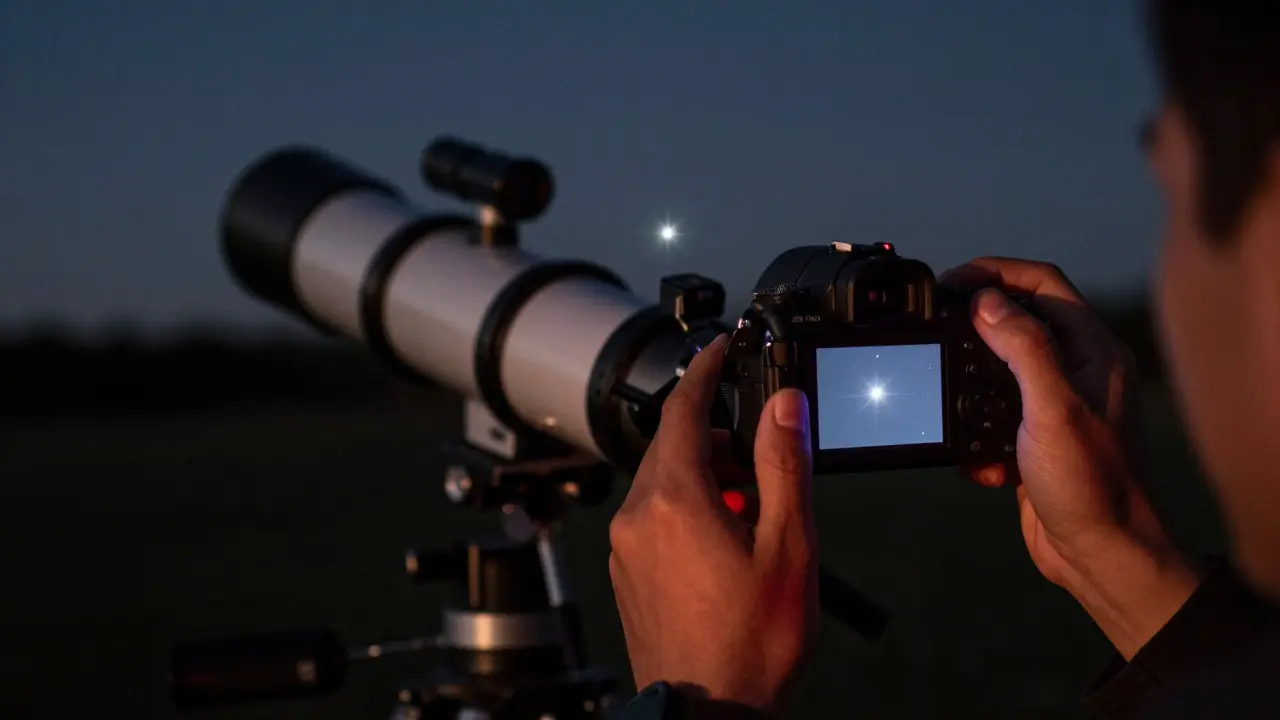
You don’t need a professional observatory to contribute meaningful data. A small refractor or reflector telescope with a digital camera is sufficient for many bright eclipsing binaries. The key component is not the telescope itself, but the ability to measure flux accurately. This is where photometry comes in.
For visual observers, using a set of calibrated filters (V-band is standard) and a hand-held photometer can yield usable results, though electronic methods are far superior for precision. Most modern observers use a CMOS or CCD camera attached to their telescope. The software used for processing is just as critical as the hardware. Programs like MaxIm DL is a popular astronomy imaging and photometry software suite known for its robust calibration tools and ease of use for variable star monitoring. or free alternatives like Astrometrica is an open-source photometry tool specifically designed for variable star observation, offering automated reduction pipelines. allow you to subtract background noise and atmospheric effects automatically.
| Method | Precision Limit | Equipment Cost | Best For |
|---|---|---|---|
| Visual Estimation | 0.1-0.2 magnitudes | Low ($50-$100) | Bright targets, casual tracking |
| Hand-held Photometer | 0.01-0.03 magnitudes | Medium ($500-$1,000) | Field observing, quick checks |
| CCD/CMOS Imaging | 0.001-0.005 magnitudes | High ($1,000+) | Precise light curves, research-grade data |
Choosing Your Targets: Periods and Magnitudes
Not all eclipsing binaries are created equal. Some have periods measured in hours, while others take days or even months to complete an orbit. For a beginner, short-period systems are ideal because you can observe multiple cycles in a single night. Stars like Algol (Beta Persei is the prototype eclipsing binary, located in the constellation Perseus, with a well-known 2.87-day period and a prominent 2.3-magnitude drop during primary eclipse.) are famous for this reason. Its deep, sharp eclipses make it easy to detect even with modest equipment.
However, long-period systems present unique challenges. If the period is longer than a few nights, you must coordinate with other observers globally to fill in the gaps. The American Association of Variable Star Observers (AAVSO) maintains a global network where your local midnight observation might be the only data point for that specific phase of the orbit. This collaborative aspect is what makes variable star monitoring a true community science effort.
When selecting targets, consider the following criteria:
- Magnitude: Aim for stars between 6th and 10th magnitude for visual work, or 8th to 14th for imaging.
- Period: Shorter periods (under 3 days) allow for full cycle coverage in one session.
- Sky Position: Choose targets that are high in the sky during your best observing windows to minimize atmospheric extinction.
- History: Check if the system has a well-established ephemeris. New discoveries require more frequent monitoring to pin down the period accurately.
The Observation Workflow: From Setup to Submission
Consistency is king in variable star monitoring. Here is a streamlined workflow that ensures your data is reliable and easily comparable to others.
- Check the Ephemeris: Use a tool like the AAVSO website or the VSOP (Variable Star Online Program) to determine the exact times of ingress, mid-eclipse, and egress for your location. Note the Universal Time (UT) and convert to local time.
- Calibrate Your Instrument: Before starting, take a series of test exposures on a nearby comparison star. This helps you verify your gain settings and filter performance. Remember, the goal is stability, not absolute brightness.
- Monitor the Target: Begin taking images 30 minutes before predicted ingress. Continue through the entire eclipse and until 30 minutes after egress. Take a sequence of images every 2-5 minutes. During the out-of-eclipse phases, you can space them out further, but during the rapid changes of ingress and egress, tighter timing is crucial.
- Capture Comparison Data: Always include at least two stable comparison stars in your field of view. These should be of similar brightness to your target and not themselves variable. They serve as references to correct for atmospheric changes and guiding errors.
- Reduce and Plot: Use your photometry software to process the stacks. Generate a light curve plot. Look for outliers-these are usually caused by clouds, satellite trails, or guiding issues. Flag them for exclusion.
- Submit the Data: Upload your measurements to the AAVSO database. Include the date, time, instrument details, and the names of your comparison stars. The more metadata you provide, the easier it is for researchers to trust and use your data.
Common Pitfalls and How to Avoid Them
Even experienced observers run into issues that can ruin a dataset. Atmospheric turbulence, also known as "seeing," can blur stars and reduce contrast. While this doesn't stop photometry, it can affect the accuracy of aperture selection. If your seeing is poor, increase your exposure time slightly rather than trying to stack too many noisy frames.
Another major pitfall is systematic error. If your telescope drifts off-target due to bad polar alignment, your comparison stars will change position relative to the target. This introduces noise into your differential photometry. Always check your guide stars frequently. If you are using an autoguider, ensure it is locked onto a suitable star before starting the sequence.
Finally, don't ignore the weather. Even thin, high-altitude cirrus clouds can scatter enough light to alter your measurements. Use a cloud cover app or simply look up. If the sky transparency is questionable, take a reference image of a known constant star. If its magnitude varies by more than 0.05 magnitudes over the course of the night, consider pausing your observations until conditions improve.
Why Your Data Matters: The Scientific Impact
It’s easy to feel like your backyard observations are a drop in the ocean. But for eclipsing binaries, individual data points are vital. Professional telescopes are expensive and booked solid. They cannot monitor thousands of variables simultaneously. Amateur astronomers provide the continuous, long-term baseline that reveals subtle changes over decades.For example, some eclipsing binaries show signs of mass transfer, where material flows from one star to the other. This process can cause the orbital period to change over time. Detecting this requires consistent monitoring over years. Without amateur contributions, these slow evolutionary processes would go unnoticed until it was too late to track their progression. Your data helps refine models of stellar evolution, test theories of gravity, and even calibrate distances to other galaxies by serving as "standard candles."
Moreover, the rise of exoplanet hunting relies heavily on transit photometry, which is essentially the same technique used for eclipsing binaries. By mastering the art of detecting small dips in brightness from binary stars, you are honing the exact skills needed to identify exoplanets. Many citizen scientists have contributed to the discovery of new worlds by applying these techniques to distant sun-like stars.
Frequently Asked Questions
Do I need a large telescope to monitor eclipsing binaries?
No. A 4-inch or 6-inch refractor is often sufficient for bright targets. The limiting factor is usually the camera sensor quality and the stability of the mount, not the aperture. Larger apertures help with fainter targets but do not significantly improve the precision of photometry for bright stars.
What is the difference between an eclipsing binary and a spectroscopic binary?
An eclipsing binary shows periodic brightness changes because the stars physically block each other from our view. A spectroscopic binary is detected by shifts in spectral lines caused by the Doppler effect as the stars move toward and away from us. Spectroscopic binaries may or may not eclipse; they are identified by velocity measurements, not brightness dips.
How accurate does my timing need to be?
For most amateur purposes, timing accuracy within 10-15 seconds is excellent. Ensure your computer clock is synchronized with NIST time via internet sync before starting. Precise timestamps are crucial for determining the exact moment of mid-eclipse, which is used to update the system's ephemeris.
Can I use a smartphone to monitor these stars?
Yes, but with limitations. Smartphone cameras have automatic exposure and white balance settings that introduce noise. You must use a pro-mode app to lock exposure and ISO. While less precise than dedicated cameras, smartphone data is valuable for broad surveys and confirming events, especially for very bright targets.
Where can I find the next eclipse times for a specific star?
The AAVSO website and the Variable Star Online Program (VSOP) both provide ephemerides. You can input the star name and your longitude to get local event times. Additionally, apps like Stellarium can display basic variable star information, though dedicated variable star databases are more accurate for precise timing.