16 Aug 2026
- 0 Comments
Ever look at a photo you took of the Orion Nebula and think, "I wish I could see more of the sky around it"? Or maybe you snapped a picture of M42 and wanted the nebula to fill more of your frame? That’s exactly where focal reducers and Barlow lenses come in. These two small accessories sit between your telescope and camera, but they completely change what you capture. One widens your view; the other zooms in. Understanding how they work is the difference between guessing and knowing exactly what your final image will look like.
The Core Difference: Widening vs. Zooming
At their heart, these tools do opposite things to your light path. A focal reducer takes the light from your telescope and bends it so it hits your camera sensor faster. This effectively shortens your telescope's focal length. A Barlow lens does the reverse. It magnifies the image before it reaches the sensor, effectively lengthening the focal length.
Let’s use a concrete example. Imagine you have an 8-inch Dobsonian telescope with a focal length of 1200mm. If you attach a 0.6x focal reducer, your new effective focal length becomes 720mm (1200 * 0.6). If you attach a 2x Barlow, your new effective focal length becomes 2400mm (1200 * 2). The math is simple, but the visual impact on your star trails and nebula sizes is massive.
How Focal Length Dictates Image Scale
Your image scale-how many pixels per arcsecond you get-is determined by your effective focal length and your camera's pixel size. The formula is straightforward: Image Scale = (57.3 * Pixel Size) / Focal Length. If you reduce your focal length with a reducer, your image scale gets larger. This means each pixel covers more of the sky. You capture a wider area, but individual objects appear smaller in the frame.
Conversely, using a Barlow increases your focal length, which shrinks your image scale. Each pixel covers less of the sky, making objects appear larger. But here’s the catch: if you zoom in too much without enough resolution, your stars start to look soft or bloated. This is called oversampling. If you zoom out too much, you might undersample, leading to blocky, pixelated stars. Finding the sweet spot is key.
Calculating Your New Field of View
Before you buy anything, you need to know what you’ll actually see. The field of view (FOV) depends on your sensor size and your effective focal length. A simple rule of thumb is that your FOV in degrees is approximately equal to the sensor width divided by the focal length, multiplied by 57.3.
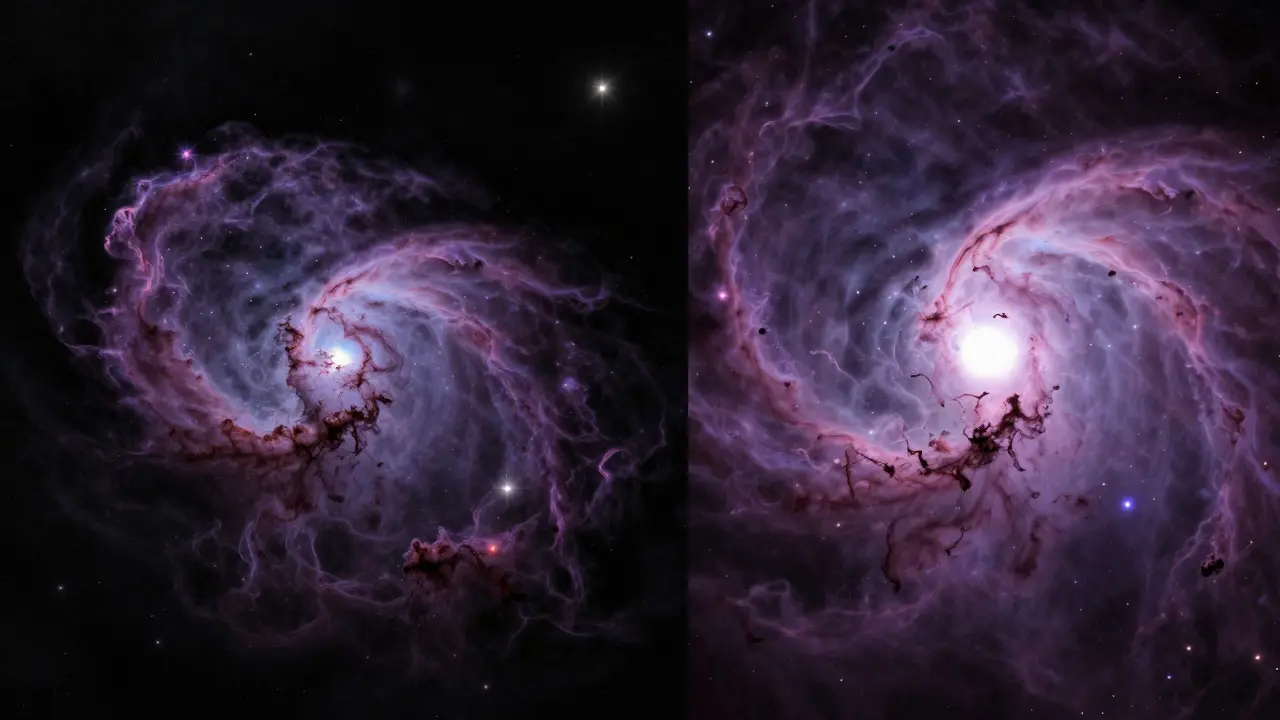
Suppose you have a full-frame DSLR with a 36mm wide sensor and a 1200mm telescope. Without any accessory, your horizontal FOV is about 1.7 degrees. Add a 0.6x reducer, and your focal length drops to 720mm. Your new FOV jumps to roughly 2.8 degrees. That’s a significant chunk of extra sky. Now, add a 2x Barlow instead. Your focal length goes to 2400mm, and your FOV shrinks to just 0.85 degrees. Suddenly, you’re looking at a tiny slice of the sky, perfect for isolating a specific part of a nebula.
Practical Considerations: Back Focus and Optics
It’s not just about the math. Physical setup matters. Focal reducers often require specific back focus distances to work correctly. If your camera isn’t far enough from the reducer, you won’t get sharp images across the entire frame. Many reducers are designed for specific telescope models, so check compatibility carefully.
Barlows are generally more universal. You can plug them into almost any eyepiece holder or camera adapter. However, cheap Barlows can introduce chromatic aberration or distortions, especially at higher magnifications. A high-quality achromatic or apochromatic Barlow maintains edge-to-edge sharpness, which is crucial for wide-field shots even when zoomed in.
Choosing the Right Tool for Your Target
So, which one should you use? It depends entirely on your target. If you want to capture the entire Andromeda Galaxy (M31) with its surrounding halo, a focal reducer is your best friend. It gives you the wide angle needed to fit that massive object in your frame. If you want to resolve the spiral arms of M31 or capture the intricate details of the Ring Nebula (M57), a Barlow helps you zoom in on those fine structures.
Many astrophotographers own both. They use the reducer for their deep-sky survey shots and the Barlow for close-up studies. Some even use a combination, though this is rare and usually only done to fine-tune the sampling rate.
Common Pitfalls to Avoid
One big mistake is assuming that a reducer always improves image quality. While it widens the field, it also reduces the amount of light per pixel. This means you might need longer exposures to achieve the same signal-to-noise ratio. Similarly, using a high-power Barlow can make guiding more difficult because the stars move faster across your sensor during tracking errors. Always test your setup before a long exposure session.
Another pitfall is ignoring vignetting. Reducers can sometimes cause corner darkening if the optical train isn’t optimized. Check your test frames for uniformity. If the corners are darker than the center, you might need to adjust your back focus or use a different filter wheel position.
Frequently Asked Questions
Can I use a focal reducer with a refractor?
Yes, but be careful. Refractors often have shorter focal lengths already. Adding a reducer might make the focal length too short, resulting in very large image scales that are hard to sample properly. Check your specific model’s recommendations.
Does a Barlow affect my exposure time?
Yes. Since a Barlow increases focal length, it gathers less light per unit area on the sensor. You may need to increase your exposure time slightly to maintain the same brightness level as without the Barlow.
What is the ideal image scale for astrophotography?
There is no single ideal scale. It depends on your seeing conditions and target. Generally, 1-2 arcseconds per pixel is a good starting point for most deep-sky objects. Planets may require tighter sampling.
Are focal reducers worth the cost?
If you frequently shoot wide-field targets, yes. They allow you to capture more sky with the same equipment. However, if you mostly shoot planets or tight objects, a Barlow might be a better investment.
Can I stack a Barlow and a reducer together?
Technically yes, but it’s rarely practical. The combined effect might cancel out the benefits of either tool. It’s better to choose one based on your desired field of view.